Spending time with my dark side

As preparation for an upcoming project, I read 2 interesting books this Saturday – “Why CEO’s Fail” and “The Wisdom of the Enneagram.” Both books explore various personality types in great detail and explore both the best and worst of these types.

I found “Why CEO’s Fail” simpler to digest and thought I’d share what I took away. This book was written by an executive coach and a Professor from Columbia Business School and built on the 11 derailers that Robert Hogan’s famous psychometric assessment popularized. The 11 derailers are –

  • Arrogance – you are right and everyone else is wrong
  • Melodrama – you always grab the center of attention
  • Volatility – your mood shifts are sudden and unpredictable
  • Excessive Caution—you’re afraid to make decisions.
  • Habitual Distrust—you focus on the negatives.
  • Aloofness —you’re disengaged and disconnected.
  • Mischievousness—you believe that rules are made to be broken.
  • Eccentricity—you try to be different just for the sake of it.
  • Passive Resistance—what you say is not what you really believe.
  • Perfectionism—you get the little things right and the big things wrong.
  • Eagerness to Please—you try to win the popularity contest.

Each of these derailers has a chapter dedicated to it with many examples of the sort of behavior exhibit by folks who have derailed (and, in some cases, folks who managed to take corrective action in time). The examples were largely from executives the authors had coached. It was particularly relevant for senior executives because, as the book observes, “a CEO’s jokes are always funnier and his/her insights are always more insightful.” That is a fantastic observation. Of course, the book is very relevant to every one of us.

I found it helpful to walk through the 11 derailers too. I realized that my biggest issues when I was going through my teens were – melodrama, an eagerness to please and perfectionism. I worked on melodrama and eagerness to please by spending time thinking about what I stood for and what I wanted. I’ve worked hard on the “perfectionism” (or what I describe as pseudo perfectionism as the core issue really is fear of failure) by learning to let go of the outcome. This is hard and an ongoing process.

The two biggest derailers that remain are arrogance and mischievousness. A combination of arrogance and pseudo perfectionism were the reason I started blogging here every day. Writing about my failures and focusing on developing my learning mindset muscle have helped me a lot over the years. Mischievousness, on the other hand, is one I expect to struggle with for the longest time. As the book describes it, this means I’m prone to starting to breaking rules for the sake of it (rebel without a cause) and start many a project without really completing any. I’ve attempted to combat this by over indexing on the idea of making and keeping commitments. But, it is hard nevertheless.

So, why does all this matter? Every one of these derailers is the flip side of a great strength. In fact, in almost every case, they are just overused strengths (typically under stress). As a result, we can never really get rid of them. The path forward is to accept that they will always be with us, be aware and accepting of them when they show up, and then learn to develop systems that help us deal with them consistently.

The first step, of course, is understanding that they exist.

Leadership and a bigger heart

There’s so much said about leadership. And, rightly so. Leadership isn’t a cloak you can wear for a few hours and remove at the end of the day. Once you take up responsibility, you are expected to be accountable for the results of everyone you lead (and this could just be yourself). Everything you do sets an example – one way or the other.

That’s why leadership is so hard to define or teach. It is one of those all encompassing responsibilities that changes you – whether you like it or not.

I have worked hard to understand this beast myself over the years. But, the more time I spend attempting to practice it (key word is attempting – :-)), I go back to a simple idea that Jack Welch shared in his autobiography – “Leadership is simply caring more than the next person.”

Caring, like leadership, has many dimensions – it means caring for your organization’s success, for your team’s success, and for the success of all the folks on your team. Caring means giving without expectations, experimenting without assurances and putting yourself out there expecting to take a few blows. It also means apologizing when it is not your fault and generously sharing credit when things go well. Caring, in its purest form, isn’t easy.

Caring is also the reason that leadership, when done right, is a thing of beauty. It isn’t a race to dominate, to stamp authority, to command or to show bravado. It is simply a race to care more. As a result, it isn’t, as one might expect, just a victory of a bigger brain or of iron will or of steely determination.

At its core, great leadership is a triumph of a bigger heart.

Source

A requisite for good convergent thinking

Imagine you have dedicated some time to generate solutions to a problem. The typical structure of time dedicated to this is to spend time diverging before you spend time converging, i.e, generate 40-50 ideas first and then begin narrowing down to 3 you want to act upon.

Source

This makes sense simply because you don’t want to focus too quickly on the first good idea that pops in. Take the time to explore before you narrow in. As a result, good divergent thinking is a requisite for convergent thinking.

It follows that, to be able to focus consistently in our daily lives, it is vital that we give our minds the license to explore, be distracted and be occasionally un-focused. In fact, if we aren’t experiencing many of these distractions or random idea explorations, the chances are that we aren’t fulfilling our full convergent thinking potential either.

But, how do we do so in our daily lives – especially considering we spend most of our days attempting to focus at work (or at school)?

This speaks to the importance of hobbies and doing things outside of your main sphere of work. They offer us the environment and time to diverge. This is precisely why many of our best ideas come to us while taking a shower or taking a walk.

We cannot force focus. All we can do is to create an environment conducive to focus and hope it happens. And, if we seek to create such an environment in our workplaces, it is necessary we create areas that feel different from the usual collection of work desks – areas that allow us to diverge. Hence, the need for game rooms and idea labs.

These aren’t just healthy or cool – they are necessary if we expect consistent convergent thought.

David Allen on Re-entry

There’s a David Allen story about re-entry that I love. He had been stuck at a certain Karate level and had been working really hard to make a break through. Try as he might, he just couldn’t. Frustrated, he decided to take a break for a few weeks.

When he came back a few weeks later, he found himself break through the previous barriers with ease.

The lesson he took away from it is – when you most feel like you don’t need a break is exactly when you need one.

I think the concept of “re-entry” is incredibly powerful as it involves a complete re-charge of your batteries. Vacations and breaks exist for exactly this purpose. But, it isn’t possible to take a week’s vacation every time you need to recharge. So, I’ve learnt to mix things up to create mini breaks. Sometimes, it just means sleeping an inordinate amount of time (a close friend called it my hibernation). For this weekend, it is a 24 hour break from my phone and a general break from all things email or work.

Loving it. And, looking forward to re-entry.

Quadrant II – invest to prevent fire fighting

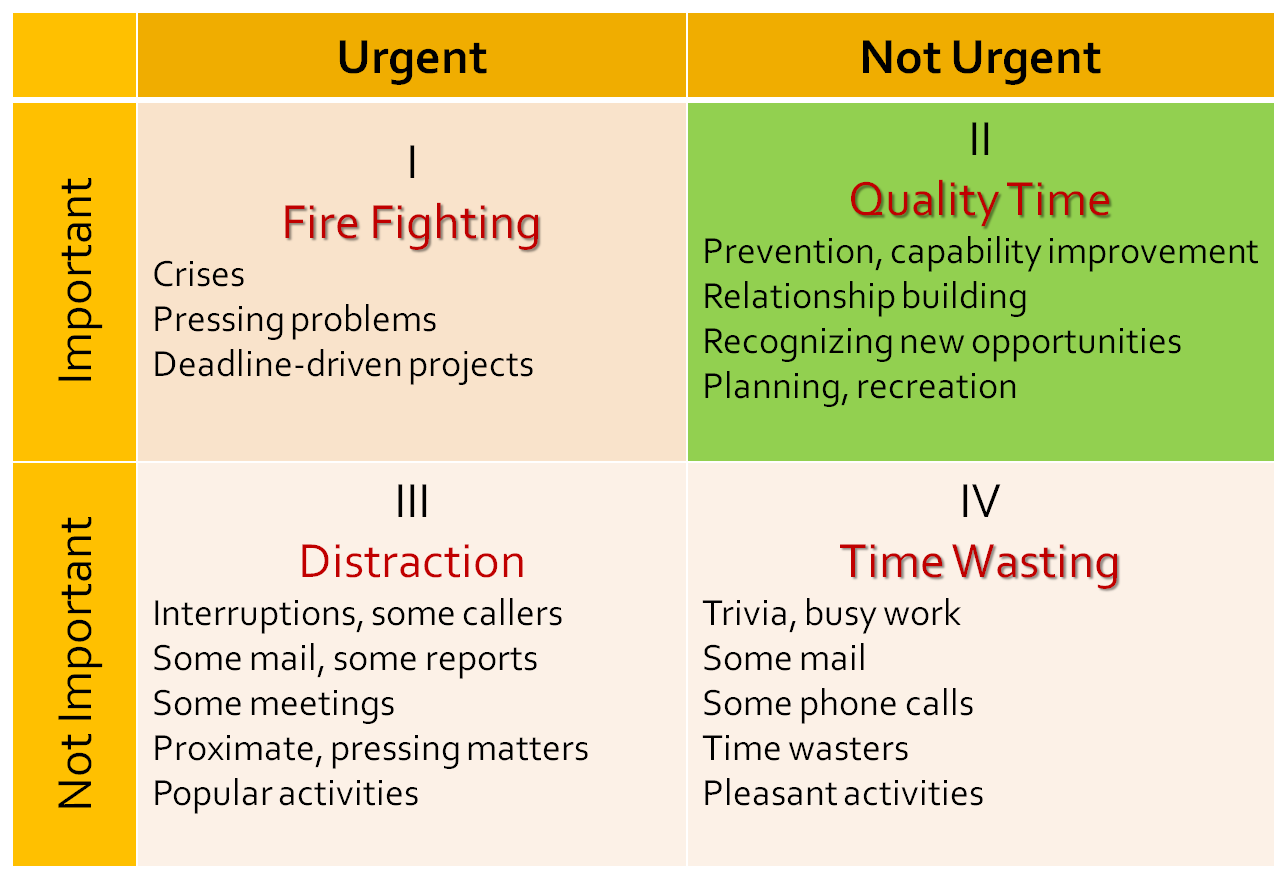
One of the best frameworks from Stephen Covey’s excellent book – The 7 Habits of Highly Effective People – is the urgency-importance matrix.

time-matrixSource: Tina O Brien’s blog

Covey’s thesis was that effective people spend a comparatively large chunk of their time in quadrant 2 – activities that aren’t urgent, but are important. Quadrant II activities are those that require us to invest in ourselves and the long term. For example, exercise and spending time with your loved ones are Quadrant II activities. If you don’t exercise and take care of yourself, it is very likely it’ll show up in Quadrant I as a health crisis. So, in many ways, a lot of Quadrant I activities are former Quadrant II activities that we didn’t work on.

This is an interesting idea – the more time we spend in “investment mode,” the less time we will likely have to spend in “fire fighting” mode. It also gets to the root of productivity. I define work done as a function of focus, intensity, and time. And, spending time on Quadrant II is focus done right.

This is the idea I was trying to get to when I discussed waking up in the morning and getting to the news/email versus meditation. As a dear friend wisely pointed out to me, the morning, for many of us, is the only real time of the day when we can take a step back and think about where we should direct our focus. As a result, it becomes the best time in the day to plan or perform Quadrant II activities.

It is important we use it well.

Meager resources and fluid plans

I played a fair bit of cricket and soccer growing up. As resources were not in abundance, we used the following as replacements for equipment.

Cricket bat replacement: Part of a coconut tree branch, scratch pad
Cricket ball replacement: Crushed paper ball (played with a scratch pad)
Soccer ball replacement: Tennis ball, Crushed coca cola can

The handle part of a coconut tree cricket bat (Source)

There were many other substitutes to other games too. Like these, none were close to perfect. But, as kids looking to play, it didn’t really matter. The most important thing was to just play. As kids, we readily accepted plan A was not likely to happen and moved very quickly to plans B, C, D and so on.

As I’ve grown up and gotten used to having more resources, I have found myself occasionally getting thrown off when plan A doesn’t work. This could be a reaction to small annoyances – a power cord that doesn’t work, a faulty presentation adapter, etc.

Remembering these childhood hacks from days with meager resources is a good reminder that I should respond better.

News frame-of-mind versus Meditation frame-of-mind

I’ve experimented with various arbitrary rules for my post-wake-up routine over the years. For a long time, I didn’t get to email or the news till I’d thought about my day and written my blog post. This made a lot of intuitive sense to me – use the early morning freshness to think and don’t just get into execution mode.

Over the past two weeks, due to a combination of the sheer volume of stuff going on and a lack of clarity in why I resisted opening up my email and news as soon as I woke up, I began doing exactly that. As this blog is just one giant experiment, I figured this would be an interesting one. So, after two straight weeks of checking email and the news as soon as I woke up, I went back to my preferred default habits this morning – wake up, meditate, organize my priorities for the day, blog and then get to email, news and all the good stuff.

The benefit of getting to email and the news first thing is the instant gratification associated with “getting things done” within minutes of waking up. However, I noticed it had a pretty large effect on ideas in the morning. For example, I struggled to write my blog post in the morning yesterday. But, this morning, there are at least three topics I feel really excited to write about. I can also just feel a huge difference in mental freshness.

I’ve found that there are two common states of the mind – ideas and execution. And, I’ve found that different stimuli and environments aide one or the other. For example, using a standing desk is a very effective way to get into the execution frame. Standing brings with it a certain amount of tension that gets us into execution mode. It is, however, bad for ideas. Most of us tend to be more creative when we’re in a relaxed frame of mind.

Similarly, reading the news and email first thing put me in the execution state of mind. This isn’t a bad thing. But, since most of us spend a large part of our day in execution mode (I certainly do), wasting early morning freshness and creativity is a pitiful waste of a limited and scarce resource. Additionally, I’m not all that certain that the net gain in productivity from getting things done first thing even exists. I have no reliable way of measuring this but my gut tells me that I execute better after giving myself the space to think. I’ve definitely observed that the principle of going slow to go fast generally holds true.

Lesson learnt… at least until the next time I feel compelled to experiment. :-)

Source

Walking meetings

Instead of catching up over coffee, I’ve been insisting on walking meetings these past months. I’ve noticed 3 interesting things about walking meetings.

First, there is no chance of distraction. People rarely dig out the phone or check messages when you are out on a brisk walk.

Second, LinkedIn’s CEO Jeff Weiner had shared that he found walking meetings to result in more forthright discussion as he felt facing each other put more pressure on people. I think that’s right. I think there’s also less pressure to fill every minute with chatter – that’s important too.

Finally, I’ve found myself feeling regularly thankful for beautiful outdoors and fresh air. And, nothing like a bit of gratitude to remind me that life is good.

In control or out of control

As I think about the day today, there are many factors that are outside my control. There are deadlines I’m working on that were set by others, there are projects that depend on others, I don’t control the weather or the behavior of those I meet (they could be real surly, for example) and can’t ensure this week will be one without any mishaps.

On the other hand, there are so many little things that are actually in my control. I have control over a good proportion of my time and definitely have a fair bit of control over my energy. I can choose to make many micro decisions that would greatly improve the quality of my day and week.

So, are things largely in my control or out of my control? There’s enough data to argue this both ways. It all just depends on what I choose to focus on and the narrative I choose to believe.

The quality of our life is directly related to the stories we tell ourselves.

And, if that is the case, we might as well learn to tell ourselves stories that make our life better.

Source

Paris reflections

I picked up an image from the mourning in Paris post the attacks on Charlie Hebdo last year.

In response to the horrible attacks yesterday, Joanne asked on her blog – How could people have so much anger at the world to kill innocent people? What happened that made people want to be a part of a terrorist group where their lives are so unhappy that becoming a human bomb and killing themselves doesn’t matter? Where do we go from here? How do we unite as a world to stop this? As parents how can we feel safe for our families?

There are definitely more questions than answers.

Barack Obama, in his own televised address, said the US stands ready to assist France, its oldest ally. “Those that think that they can terrorize the people of France or the values that they stand for are wrong,” Obama said.

But, as Quartz pointed out in their newsletter this morning, – “Except of course they are not wrong; their terror already has been committed. The question now is how the world responds.”

And, we need a response.