The next game

Reputations are useful till you enter the field to play the next game.

But, they don’t count for much once you begin playing that next game. The moment you choose to play, you choose to do the hard work of continuing to to do the hard work of building your own character and, thus, managing and building that reputation.

When you are in the game, there is no such thing as resting on past laurels. Yes, it helps if you’ve had a great run in the last few – but, only up to a point. You are only as good as your next game.

And, what got you here won’t get you there.

the next gameImage Source

Um, like and being heard – The 200 words project

2 years ago, I tried cutting out “um”/”you know”/other such filler words from my language. That initiative went nowhere. Recently, however, I’ve been able to make more progress thanks to a post on Seth Godin’s excellent blog.

As Seth explains – “For a million years, people have been judging each other based on voice. Not just on what we say, but on how we say it. I heard a Pulitzer-prize winning author interviewed on a local radio show. The tension of the interview caused an “um” eruption—your words and your approach sell your ideas, and at least on this interview, nothing much got sold.
Or consider the recent college grad who uses thirty or forty “likes” a minute. Hard to see through to the real you when it’s so hard to hear you.”

Acknowledging that you can’t remove this verbal tic by willing it away (as I had tried before), Seth suggests that we don’t try to rid ourselves of the “um” or “like.” Instead, aim to simply replace it with a pause. We don’t need to keep making sounds to keep our place as the speaker. So, we should talk as slowly as needed to until speeding up feels comfortable.

The best part: Our default assumption is that people who choose their words carefully are quite smart. Like you. – Seth Godin


Thanks to – image source

Anti-intellectualism and racism

Fearing and, thus, hating someone who is different from us is a natural emotional response from a brain wired for life in the forest fighting other warring hunter gatherers. Racism, as a result, is a natural part of our humanity. We are all racist and discriminatory. If it isn’t based on color, we discriminate based on religion, education, sexual orientation, nationality, caste, etc.

The relationship between education and discrimination is a fascinating one as it is one that is underlined with a lot of tension. The reason for this tension is that an educated mind is one that treats every belief as a hypothesis that needs to be tested. Galileo Galilei, one of the fathers of the scientific method, discovered this was an issue in 1610 when he faced the ire of nearly every institution that mattered. The church, arguably the most powerful of those institutions then, took nearly 500 years to declare him innocent.

The essence of discrimination is blind belief. Education, thus, is dangerous as it shakes its foundations of discrimination. As a result, a key part of the oppressors playbook is to control the education its citizens receive. If you can fake education, i.e. pretend to educate while not really teaching the scientific method, people will never find out.

Until they do, of course.

This is why the Brexit was a damning verdict for anyone concerned about the state of the world today. It wasn’t because the Brexit was the absolute wrong result. There is a case to be made that it was a good result for both sides in the long run – that Britain will benefit and that the EU will treat it as a wake-up call to right the many issues inherent in its structure. The issue was the way it happened. It happened without the voters really understanding why they were doing what they were doing. It happened without any debate of the real long term issues. It was a classic anti-intellectual process and it was as good as a bunch of fearful people voting yes for xenophobia.

That is also why the November election in the United States is critical. It is becoming increasingly clear that the beliefs that drive the Republican party in the United States is not that of smaller government, but one of cultural disillusionment. It is also becoming increasingly clear that “make America great again” seems to just be a different version of “make America white again.” There are a lot of direct effects of the Republican nominee becoming President but probably none as powerful as the brand of anti-intellectualism that he espouses.

The key part of the Donald Trump message is simplicity. It is a clear action plan that involves shutting down borders, breaking ally agreements and building walls. These simple steps will put an end to the death, gloom and destruction. Leaving aside facts about violence and the like, this sort of simplicity ignores that one thing that makes debate necessary – nuance. Or, to use a more fitting term, trade-offs. Good decision making requires an understanding of trade-offs. Good decision making requires spirited debate and an understanding of nuance. But, discussing nuance isn’t what won Trump the Republican primary. It isn’t what he is about. He makes decisions based on his gut and data is for losers. Well, life can be relatively simple when you are born into a brash household in the top 1%. It isn’t that simple for everyone else and it is certainly not going to be simple when you govern in an interdependent world.

This is one direct effect, however. The full list is long. The most important indirect effect, in my assessment, is that I think his coming to power will sadly reverse the trend on discrimination and racism. The facts on violence and discrimination tell us one thing for certain – as bad as things seem, they have only been getting better and are better today than ever before. However, the moment we give up our willingness to debate, we indicate that we are open to flexing our discrimination muscles. It is a recipe for bigotry – an intolerance toward those who hold different opinions from us. If we are intolerant toward different opinions, can you begin to imagine what the future holds for people who look different from us?

This indirect effect is beautifully summed up in a line from a comment I shared following the Brexit – “But, can anybody tell me the last time a prevailing culture of anti-intellectualism has led to anything other than bigotry?”

When indeed…

anti-intellectualism and racismThanks to Storify for the image

There is too much to read

There is too much to read. That is a fact.

But, if that is an excuse for incompetence or for post factual debates, then it is a poor excuse indeed.

When Google released data of Britons searching for what Brexit meant after the event, it was tempting to laugh at their ignorance. Yet, is that different from most parts of the world right now?

The easy, lazy solution is to assign blame. Blame the CEO who gives you false assurance, blame the politician who runs a campaign based on lies and blame whoever else you think is wrong.

Like all easy, lazy solutions, it is useless and accomplishes squat. Better to say “mea culpa” and move on – no one to blame but us. Everyone at your company is educated – there is no reason they shouldn’t be able to get to the truth of what the leadership is saying. Wherever you are, if there are more educated people than not, there is again no reason they shouldn’t be able to get to the truth of what their politicians are saying.

No, the issue is not one of education. It is one of the worst kind of incompetence – one that is embraced by people who could quite easily be competent.

We live in an age where you can get most questions answered by simply typing or saying a few words. If we wanted more, we could also just get a few books on that topic of interest written by people who’ve devoted a lifetime to research on that topic. Is doing this a guarantee that we’ll get to the truth? Probably not. But, is doing this a guarantee that we’ll begin to understand what is going on and be more competent? Absolutely.

The chances are high that you’ll be a better spouse if you took the time to read a marriage book or two. The chances are very high that you’d be a better decision maker if you picked up one of the best decision making books out there. And, reading some of the best distilled wisdom on how to run your start-up is likely only going to aide you in the quest. If reading a book is too hard, no worry – just get a summary of the book somewhere – they’re a dime-a-dozen. Or, ask someone who has read the book to take 15 minutes to give you a summary.

But, if you refuse to do the pre-work or choose to scorn at the wisdom of those who’ve done it before, then you lose the right to expect competence from your leaders and those around you. If you don’t spend time understanding what is going on and where we’re heading, you lose the right to expect your politicians to be better.

If you’re wondering what it takes to flip the switch, it is simple. Spend 30 minutes every week day reading a book that will teach you something.

That habit alone will change all our lives. Not just yours – because you will then spread the goodness of all that reading to us. Thank you for doing that.

The only skill expected from your education is an eagerness to learn for the rest of your life. The rest is gravy.

there is too much to readThanks to Fast Company for the image

Great customer service email

I love a great customer service email. I always find it surprising when companies mess this up. In today’s day and age, it is so easy to create a beautifully customized email.

We recently purchased ceramic knives from a small vendor on Amazon called Oliver & Kline. Their initial email and follow up notes have been outstanding. So, I thought I’d deconstruct that today.


Hi Rohan, (Use the customer’s name.. duh. “Dear Customer” just shows an incredible lack of thoughtfulness given most of us know mail merge exists.)

Thanks a lot for picking up the Oliver & Kline Ceramic Knife Set!

Your order is being processed by Amazon. Before your product arrives, I wanted to let you know:

Have you ever used a ceramic knife before? If not, you’re in for a treat. These things effortlessly slice through anything in a way that traditional knives do not.

In addition, they hold an edge longer than any other type of knife you may have used previously – we’re looking at you stainless steel! (Always lovely to have a bit of humor. I could rationalize it by saying it makes me feel this is more human. But, that’s just because everything else is great..) Plus ceramic knives never rust and are easier to clean. This knife set looks great, cuts great, comes in a fabulous gift box, and are just plain fun to use!

To help you get the best results using our creamic (I would pick on this typo but the positive energy from the rest of the email makes me ignore it.) knife set, I have attached a short Users Guide (Combining the onboarding with the training manual – nicely done.). You are strongly advised to give it a quick read to prolong the life of your knives!

I predict that the high quality (and easy of use) will blow you away! (Love the positivity, cheer and can sense the pride in the product.)

I’ll email you as soon as it’s been shipped. (They did do this – albeit a bit late as Amazon shipped it ahead of time.)

Thanks again Rohan, we really appreciate your order! (Ah – the use of my name twice. I know it is just a merge field but it feels personal. And, this just isn’t done right usually. Well played.)
Sincerely,
Oliver & Kline
(My only gripe with this email would be that I’d suggest signing off with a human name. Always nice to be interacting with a human being.)

P.S. IMPORTANT, PLEASE READ: We’re 100% committed to providing you with a top-notch customer experience. If there’s anything that didn’t go right with your order, please hit REPLY to this email and let us know immediately before leaving a review on Amazon. I’ll look into it for you personally! (I love the – “I’ll look into it for you personally.” I think it might even be more powerful to just leave a phone number. But, this works pretty well.)

Remember – we’re in this together, and success stories from awesome customers like you is what brings a glowing smile to our face, so thank you for being a part of this movement!


The beauty about this email was that I was rooting for these knives before they even showed up. Sure, there isn’t a thing as a universally great customer service email. But, there are certain small things – personalization, positivity, humor and thoughtfulness – that easily make an average email into a very good one.

And, just to show it wasn’t a flash in the pan, here is their response when I thanked them for it.
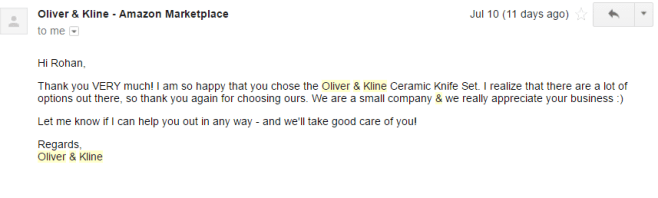
Oliver&Kline email

Small things. Big impact. Nice job, Oliver & Kline.

PS: The knives are great.

Malleable

It is tempting to sit back and take everything around us for granted. There’s so much we don’t control and, if we believe the news, all of it seems to be going downhill – the politics suck, the environment is doomed, corporations are evil, terrorists seem to be unrelenting. But, that sort of view is just one that has forgotten just how malleable the world is. It is also one that takes no responsibility for the future.

It is easy to forget that most things we see, hear, touch and use has been created by human beings just like us. And, what we take for granted wasn’t a given during 99+% of human history. In the last 100 years (a rounding error in the history of human beings), the world has outdone itself in demonstrating how malleable it is. Pokemon Go would have been consigned to the craziest corner of science fiction.

There’s a lot right in the world. It is without a doubt the safest it has ever been in all of human history. It is also the healthiest, the most affluent. There’s also a lot wrong. The wealth is growing more concentrated and this is causing all sorts of political problems. We’ve been messing with the environment too much for our own good. And, our leaders seem to be trading talking about real issues for transitory personal power. But, this tension between right and wrong will always exist. It is up to us to tilt the scales to continue making things better, making more progress and making our lives count.

And, to do that, we must remember that, despite how easy it is to think otherwise, our world is malleable. Big problems are waiting to be tackled. And, the onus to make things better is on us.

malleable, world(Thanks to the Oprah.com for the image)

Speed of awareness

A good gauge for how we’re doing on changing our own behavior is a metric I call speed of awareness.

Let’s take an example – an idea I have been attempting to work on is inquiry instead of opinions. When I’m asked for advice, my typical process is to understand the problem, look for a framework that fits the situation and then give my opinions. I’ve come to realize that a better process would be to add more inquiry before I give my opinion on the situation. I still move way too quickly into solution suggestions.

Now, if my speed of awareness was to be 1 second, I would have no problem. As soon as I did it, I would catch myself, back track and move on. The challenge, of course, is that shortening the speed of awareness takes work. So, the first time I realized I did this, it was a couple of days after a conversation. The next time, it was a day. Then, a few hours. A few days ago, I realized it right after a conversation. That’s progress. The next time, I hope to catch myself during the conversation and then as soon as I get the question in time.

The key with reducing the speed of awareness is deliberate practice. In this case, deliberate practice is re-hashing that conversation and re-doing it in my mind.

speed of awareness, reflectionThanks to source for the image

Similarly, imagine you want to learn to take a deep breath before you lose your temper. The way to do this would not be to will anger away. It would be to focus on reducing your speed of awareness. The deliberate practice in this situation would be 3-5 minutes of deep breathing every day and re-hashing times when you lost your cool and re-doing it. Over time, you’ll notice your speed of awareness decreasing.

Self-driven behavioral change is hard for many reasons. There isn’t an easy-to-understand process and there is a complete absence of metrics. I find speed of awareness to be a very useful metric to drive changes in ourselves…

Satisficers and Maximizers

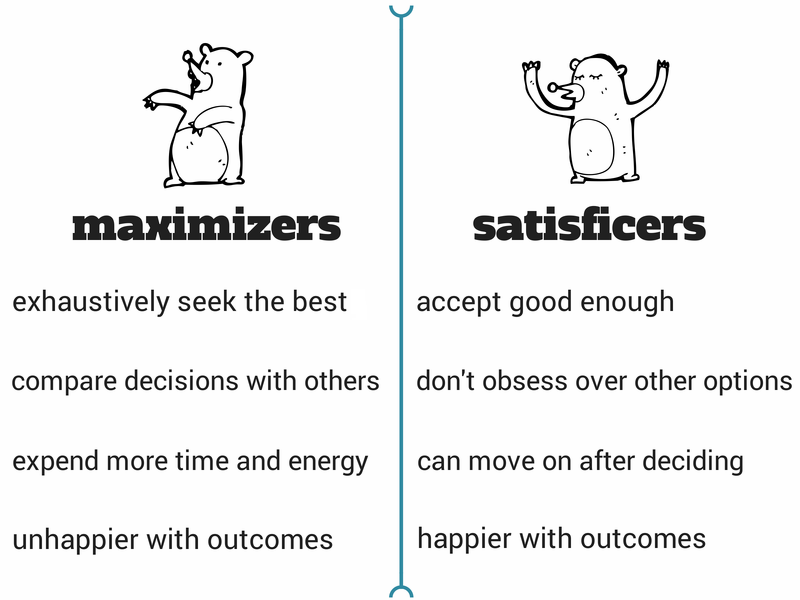
Barry Schwartz’s research showed that people tend to fall into to one of two groups when making decisions – he called these groups satisficers and maximizers. Maximizers desire the best possible result while satisficers desire a result that is good enough to meet some criterion. That doesn’t necessarily mean satisficers settle for crap. Their criteria could be lofty – but, as long as it meets that criteria, they don’t care about it being the best. Most people are a mix of both. That said, most people default to one of the two.

(Thanks to the source for the image)

Barry Schwartz argues that satisficers tend to be happier than maximizers as maximizers spend a lot of time and energy on many decisions that just don’t matter as much.

I agree.

I am not sure what I was growing up but I did have strong maximizer tendencies until a few years ago. Over the years, however, I’ve learnt that there are very few things worth maximizing. For the most part, being a satisficer is stress free and rewarding because you often rely on research done by others. I also think you spend way too much as a maximizer sterilizing instead of playing and editing instead of creating.

Sure, you could spend hours polishing that draft. But, polishing is best done to things that are worth polishing. And, it often takes many years of creating before you arrive at things worth polishing.

So, the next time you’re facing hours of endless research to purchase something, consider asking a couple of friends who tend to have similar tastes. Or, just go on Amazon and pick the most popular item.

Contrary to popular belief, you don’t always need the best. Good enough, for most things, is good enough. And, for the few things that you determine to be worth maximizing, make sure you enjoy the polishing…

Building Lost Boy 6 seconds at a time – The 200 words project

Ruth Berhe is a Canadian singer-songwriter who, as an 18 year old in 2013, began posting 6 second Vine video covers of popular songs. She gradually gained a following.

In December 2014, she posted a video of a line that she made up about a song, inspired by a television series, themed around Peter Pan. It garnered 84,000 likes in a week – an unusual response for a 6 second video of hers at the time. She took note of the popularity, created a full song titled “Lost Boy” and posted it on YouTube in January 2015. She then released it on iTunes in February 2015. Columbia Records then signed her in July 2015 and she released 4 songs in November 2015 including “Lost Boy.”

Lost Boy cracked the “Top 50” and is a very unusual Top 50 song as it is a piano ballad with no beats and no adornments. Ruth literally built this song and her fledgling music career one 6 second video at a time, thus teaching us all a lesson on how to use the “minimum viable product” approach to build a successful product. Thanks, Ruth, and good luck!

She started to add lines in Vine-able increments. “I would finish studying, come down stairs, and add a line to the chorus,” she explains. “In a week, I had a chorus, so I decided I should turn this into a full song and take it to YouTube. – Ruth Berhe

lost boy


Source and thanks to: Wikipedia, Billboard.com, Added note – Lost Boy is a song that I’ve come to love thanks to the radio. I thought the story behind the song was fascinating.

The things that made them great

A close friend reflected on a recent interview experience with one of the world’s most sought after companies. Out of 5 interviewers who interviewed him, he was sure that 2 of them had not taken 30 seconds to skim through his resume. He was also willing to bet that the other 3 hadn’t a clue where he was from either – he just didn’t know for sure. They seemed to only care about his technical expertise. We were both surprised because they didn’t seem to be doing the things that made them great.

The things that made them great.

We’ve seen this often with companies. They start small and do the small things extraordinary well. Then, they scale and promise to do so in a way that would maintain what’s special about them. But, somewhere along the line, they stop doing the things that made them great. They stop paying attention to the small details and stop treating customers as human beings.

Before we file this away in the “not relevant for me” category, we see this happen just as much with people as well. Once you build a great reputation, you will be told that you won’t need to do the pre-work or follow up. “Don’t worry about that. You’re going to be great.”

If you believe that, you’ve gotten it all wrong. Great people and companies do the things that made them great even when it doesn’t seem necessary.

Greatness isn’t in the going up. It is in the staying up.

the things that made them greatImage Source