Batch processing meetings

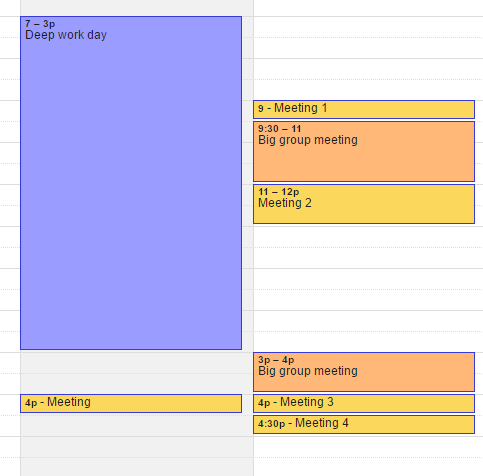
One of the first things to do when you get some semblance of control over your schedule is batch processing meetings. The worst days are those where you have 6 meetings with 30 minute gaps between them. The attention residue alone will prevent you from getting anything done. This isn’t easy to avoid because most places tend to have 3-4 standing meetings that involve a larger group of people that can’t really be moved.

There’s a 3 step process that I’ve come to rely on to get more out of the week –
1. Assign meeting days. Depending on the larger group meetings, assign 2 (or 3) days of your week as meeting days. Every time a new meeting comes up, schedule it on these 2 days.
2. Schedule meetings yourself. As far as possible, take charge of scheduling your meetings so you can batch process them. When you schedule them, look to do them either side of your larger meetings so you do them back-to-back. Where possible, try to find ways you can do that for the other person too. If not, don’t worry – take it as your reward for doing the work. And, when in doubt, schedule them for the back end of the day so you keep your mornings free.
3. Protect your deep work days. As time passes, begin putting in blocks on your deep work days so no one schedules meetings.

If this works well, you will soon find 2-3 days in a week where you have large stretches of time available to you for deep work. And, during your meeting days, you will find smaller extended stretches to dive in. While it helps greatly to develop a mentality where you use every block of time available to you to dive into deep work – perhaps simply by putting your headphones on -, I’ve realized that it works much better when you build a schedule conducive to it.

And, as you might have guessed, the principles surrounding batch processing meetings can work just as well if applied to admin work, email, etc., etc.

One of the simplest ways to find value is to look for what is scarce. In our age of distraction, focus is scarce. And, the onus is on us to build schedules that enable us to focus and get the most out of the day. It isn’t the hours we spend work that counts, it is the work we get done in those hours.
batch process meetings

Geography and success

Ever since Jared Diamond wrote “Guns, Germs and Steel,” multiple historians have come out with books explaining why attributing historical dominance to such factors isn’t right. A better theory, they explain, is to study the link between geography and success. Peter Zheihan, in his book, “The Accidental Superpower,” crystallizes this view beautifully. The success of a society is inextricably linked to its geography. More specifically, there are 3 factors that typically lead to dominance –

1. Ease of internal navigability – In past centuries, this meant being connected internally by waterways that helped with administration, trade and a sense of unity. This was a big reason for the dominance of the Egyptian civilization.

2. A location that isn’t easily attacked – Great Britain enjoyed this geographical advantage during the rise of their empire. And, the Egyptians enjoyed the security of the desert that surrounded them.

3. A land conducive to agriculture and industrialization – This would ideally involve arable land, a large enough population and convenient location of land to internal navigation systems.

geography and success, superpower, self, competition, luck

Even one of these factors can give rise to a superpower if it is accompanied by mastery of technological power. For instance, one of the crucial technologies that tilted the balance of superpowers was deep water navigation. The Spanish and Portuguese mastered travel by sea. But, once England learnt this, they became a superpower. Germany’s dominance was due to land that was conducive to industrialization. All these powers did multiple things right (and wrong) once they became dominant – for instance, Germany invested heavily in universities and research. But, the cause of their dominance was geography.

America’s uniqueness lies in the fact that it actually has all of these 3 factors in spades – most navigable rivers, an East coast that is practically a river due to sheltered “barrier islands,” a place that is practically impossible to attack, largest amounts of arable land on the planet, a large population and arable land that is, at most, 150 miles away from water for transport. All of these combined to give the US an incredible advantage in the past 200 years.

As you can tell, it is a fascinating book. I could go on explaining what I’m learning and reading but I thought I’d bring this back to ourselves. As I understand the incredible impact of geography on success, I also realize that it is likely to be very similar when considering individual success. There are 3 takeaways here –

1. When studying success, we rarely talk about geography. But, being born in Hollywood and the bay area respective likely played a big role in John Lasseter becoming John Lasseter and Steve Jobs becoming Steve Jobs.

2. Never compare paths. No one was was born with the exact same circumstances as you. In a sense, every person’s geography is different. And, if you’ve moved away from your home land, it is likely to be very different. Comparisons are not productive because you don’t understand the benefits of their geography or they, yours. The only thing that matters about your path is that you did the best you could to achieve the best possible process and outcomes. The rest is gravy.

3. Our own geography is completely arbitrary. Instead of being born into our families, we could have been born into a slum in India or Africa with very few means to make our way up. It is remarkable that you and I were born into circumstances that allow us to read, write and take food, shelter, and the like for granted. It is so important that we maintain perspective, stay humble and be happy.

And, lest we forget, it is also so important that we make our geographical advantage count by being the best we can be.

Desalination and constraints

Israel is one the driest countries on the planet. By figuring out how to desalinate water – a problem we’ve talked about for the longest time – , Israel also makes more fresh water than it needs. They’ve cracked the desalination problem just as they cracked the drip irrigation problem a few decades ago. They’ve developed well systems used in Africa and biological digesters that can halve your water usage. In Israel’s case, desalination and constraints went together – one wouldn’t exist without the other.

desalination and constraintsIsrael’s desalination plant – Thanks to the Scientific American and IDE Technologies

When we talk about constraints, we often say – “If only I had more <budget/time/bandwidth>, I would….”

Perhaps the lesson to be learnt from Israel’s desalination adventure is that we should change the language. Figure out what you need to do and then say you need to figure it out while acknowledging the constraints. “I need to do <x> and I need to do it given <constraint.”

There’s always going to be someone with more resources and less constraints than you. And, that is cause for celebration, not sadness. If you find that changing, just remember this story about desalination and constraints. Remember Israel…

The 2 project design

In a conversation with Cal Newport after he published his latest book, Deep Work, a friend asked him how his writing projects fed into his “real job” as a researcher and professor. He explained that his books had no impact on whether he’d receive tenure. But, since he wrote about how to work better, his findings fed into how he approached work. He also added that his experiences had led him to believe that it is only possible to really do justice to 2 projects at any given time – your work and one other meaningful project. It is an idea that stuck with me and one I call “The 2 project design.”

We must all take time to design our ideal lives. A simple life design process will typically have 3 steps –

1. Setting a few design principles – we’ll call them values or guiding principles. This should ideally do 2 things – state your overall priorities and commit to a few habits/systems you’d like to have. For example, overall priorities in my case are self-care, framily-care (framily = close friends and family), work-care, and world-care. A few habits/systems I’d like to have are sleep 8 hours, eat healthy, exercise, read, and catch up regularly with framily.

2. Create the design constraints – These habits/systems should now give you design constraints. For examples, my systems take away 8 hours every night, 30-40 mins during the day around exercise, another 30 mins reading, etc. They also set boundaries on what the ideal work day would be. Once I have this down, I do a quick check to make sure if my schedule is in alignment with my principles.

3. Design for a maximum of 2 “good work” projects. I think we all want to do good work – however we want to define it. Good work speaks to our need for purpose and our need to answer that existential question – what should we do with our time? For most of us at this point of time, one of these projects is our paying job – our work. I would consider thinking of this in this way –
The career project – present and future. Think of the career project as having 2 parts. The first part is the present – this is all the stuff you do every day to be employable and earn your keep. The second part should be thinking about and working toward your future. This need not be more than a few hours per week. But, it matters that you think of it and work toward it.
The learning project. The second side project I’d strongly consider is the learning project. Do something, anything, to aide your overall learning and development. Some of this learning could feed into your career projects. But, it matters that we invest in ourselves. The key distinction between these 2 projects is that the learning project is not done with any intent to monetize. It is, in a sense, “not-for-profit.”

All this will need to be applied to your context, of course. If you are pursuing a career in research, for example, you may not need to spend time working on your “future” as that is what you do as part of your job. But, for the many who fight fires on a daily basis, having a future component is critical. My learning from attempting side projects over the years is that these side learning projects help you learn and grow in ways you will never imagine. But, after having attempted one too many, I have come to realize that Cal is spot on – focus your energy on your career project and ONE central learning project.

Once you design these, it’ll be interesting to see where they all have overlap. For example, if you are hugely passionate about not-for-profits and social impact, maybe you’ll design your learning project as running a not-for-profit on the side and make sure you do plenty of daily reading on the topic. These overlaps/”synergies” will develop over time. Another example – if you care about spending time with framily, maybe a couple of your exercise slots will involve playing games with them. The possibilities are endless.

Designing your life is a very personal experience. There is never going to be a “right” way to do it. If you are sharing your life with a partner, it makes sense to be as coordinated as possible. In that sense, there may be a few “right” constraints. But, beyond that, it is your life to design. What matters most is that we’re intentional about it and that we iterate our way into a design that works.

2 project designThanks to source for the image


The fat hypothesis – Part I – The 200 words project

In 1955, US President Dwight Eisenhower suffered a heart attack. Eisenhower insisted on making details of his illness public instead of pretending it didn’t happen. So, the next day, his chief physician, Dr Paul Dudley White, gave a press conference at which he instructed Americans on how to avoid heart disease – stop smoking and cut down on fat and cholesterol. In a follow-up article, White cited the research of a nutritionist at the University of Minnesota, Ancel Keys.

Keys’ “diet-heart hypothesis” (or “fat hypothesis”) stated that excess saturated fats in the diet – from red meat, cheese, butter, and eggs – raises cholesterol, which congeals on the inside of coronary arteries, causing them to harden and narrow, until the flow of blood is staunched and the heart seizes up.

Keys was brilliant, charismatic, and combative. When faced with opposition, he used a 5,000 subject study he had conducted in 7 countries that proved his hypothesis. With support from the President and his physician, he destroyed any opposition to his hypothesis. His work was central in the 1980 dietary guidelines issued by the US government that made fat the enemy.

There was just one problem – Ancel Keys was wrong.

Keys was the original big data guy – a contemporary remarked: “Every time you question this man Keys, he says, ‘I’ve got 5,000 cases. How many do you have? – Ian Leslie, The Guardian

fat hypothesisThanks to source and health.gov for the image


Source and thanks to: The Sugar Conspiracy by Ian Leslie in the Guardian – a fantastic piece of journalism that inspired this 4 part series.

2 questions for better conversations

We’ve all been in conversations where all we seem to be doing is discussing stuff that doesn’t really matter. Even sharing what happened to us is only fun for a while. These conversations often feel devoid of emotion. Here are 2 questions I’ve found to help with better conversations –

1. What have been among your biggest learnings since we last caught up? (of course I’d say that)
2. What are the decisions you are struggling with/mulling about and how can I help?

2 questionsThanks to source for the image

The second question is a recent learning from a conversation with a much wiser friend. I was amazed at how quickly it cut through the noise into a discussion of what actually mattered.

I’ve noticed a marked difference in conversations that involve discussions with one or both questions. The good news is that we don’t always have to be the person asking the questions – we could just weave this in to the end of our updates when we catch up with our friends to make them deeper and more meaningful.

Better questions -> better conversations.

Characteristics of great advice

Great advice typically has 3 characteristics –

1. It begins by exploring questions that are deeper than the question asked. If, for example, the question asked is “what advice would you have for me to be successful here?,” the deeper question is “how will you measure success?” The first step, as a result, is to take a step back. If you don’t find a deeper question, that’s okay. The key is just to be willing to dig deeper.

2. Next, the principles/governing assumptions are called out. Continuing the thread on advice to be successful, the principles could be self-awareness (understand yourself), intention (figure out what you want) and a learning mindset (keep focused on the journey and getting better). Getting to principles or governing assumptions requires a bit of thought.

3. Finally, it deals with tactics. For a long time, I scorned tactics as I felt they hurt more than they helped. Most bad advice tends to just be a list of tactics. If the principles are stated, then we ought to be able to figure out the tactics ourselves – or so I thought.
I’ve come to realize that tactics often serve a different purpose – by boiling difficult things down to a set of concrete ideas, they help inspire those listening to take the all important first step. It is an important component of great advice.

That’s my advice on the matter in any case. :-)

Thanks to source for the image

Machines take away horrible jobs

Quartz had a feature a few days back about the struggles of young women working in tea gardens in North East India. Tough conditions, bad wages and inhuman treatment are features of horrible jobs. That’s the bad news. The good news is that it is likely machines will replace those women within the decade. That should be celebrated because machines take away horrible jobs.

But, it will likely result in political propaganda with politicians promising to bring those jobs back.

Politicians in countries who promise to bring back jobs to their respective countries omit two truths. First, it is that those jobs are not really coming back. A piece of manufacturing that required 1,000 workers is likely best done now with 20 engineers and a collection of robots. Second, when those jobs were around, workers constantly complained of inhuman conditions.

The jobs our politicians want to bring back are never the ones we wake up wanting to do.

In our desire to avoid conversations that matter, it is easy to blame machines. So much easier to do that than to discuss the real issues on the table and so much easier to postpone the inevitable socio-economic disasters that are in the making if we continue to avoid the flip side of technology innovation.

But, for those of us who are willing to see things as they are – machines are going to take away large portions of what we do. Anything we consider repetitive is going to be done by a machine. Anything that requires functions we’re not very good at (searching vast amounts of information, statistical analysis) will be done by machines. We will be freed to do other, better stuff. In the post industrial world, machines in industries freed us to create job titles like ballerinas, violinists and zumba investors. This time will be no different. In having machines replace large parts of what we do, we will go back to answering that all important question – “What should we do with our time?”

The conversations we should be having are all around the question – how do we bring about changes to an economic system that was built on the foundations of an industrial world?

The machines are here to stay. They will continue to take away horrible jobs and, then, horrible pieces of our jobs. Let’s focus on what we need to do to support the many workers who are and will continue to be displaced by the shift.


Audi car factory in Germany – thanks to the Telegraph for the image

HT: The Inevitable by Kevin Kelly

The energy management question

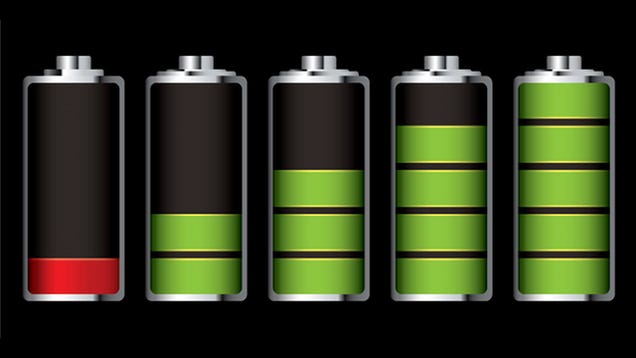
If you are feeling energetic, you don’t need much time to get what you want done. But, give yourself in a lethargic state large amounts of time and you will likely not get much done. Hence, it follows that energy management is way more important than time management. A key first step in good self energy management is – what activity best recharges your batteries?

For most people, the answer to this question is one of sleep, food, exercise, listening to music, interesting work, social time or a hobby. The answer does change according to context. But, it is very likely every one of us have a stack ranked list. Knowing the list is helpful because you have a clear action when you’re feeling low energy. If you’re feeling low energy in the middle of a work day for example, you just work through your list and rule out what’s not possible. If taking a nap is not possible and if you just finished lunch, perhaps you could take a quick walk or give a friend a call? And, if it is closer to the end of the day and you aren’t feeling the best, maybe the best thing to do is wrap everything up and go to bed.

So, how do you figure out the list? You might have a hypothesis intuitively. But, there’s few better ways to understand this than to test it over a period of time. Observe your energy during the day and get good at understanding what works best when you feel low energy. Try out different solutions during bouts of low energy and make your list over time. A likely side effect of doing this is also understanding what causes bouts of low energy. For example, there might be certain kinds of food that may not be helping. Or, you might find that going two days without exercise has very negative effects on your energy.

Our productivity is a direct function of our energy management. And, understanding how to do that well requires us to keep asking ourselves that question – what activity best recharges our batteries?

energy managementThanks to Lifehacker for the image

The gratitude loop

Small things go wrong all the time. Things break down, people act in unexpected ways, and minor plans fail. The “ideal” you shoot for hardly ever works out as per plan because of small nits. When these things happen, we tend to have a choice between two paths – the victim loop or the gratitude loop.

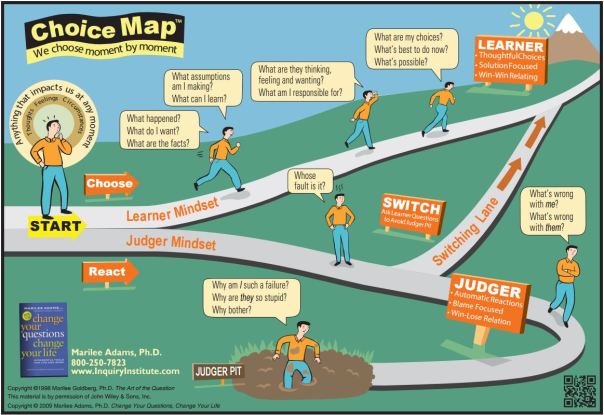
The principle involved is similar to the idea that we choose between judger questions or learner questions at any given point of time (HT Marilee Adams for the wonderful choice map that I’ve shared many a time). It just extends the concept a bit.

the gratitude loop

When we’re dealing with small annoyances, the smallest reaction of anger can lead us down the victim loop. It begins with some level of denial, then some irritation, then some more irritation, anger and general unhappiness. This loop involves heavy doses of playing victim and, thus, not taking responsibility for something that happens to us. The obvious flaw in our thinking is that we point to the fact that it is somebody or something else’s doing. But, if it is affecting us, it really is our responsibility. In every case.

The gratitude loop does something different – it treats what is going on as a non-issue and gives thanks for the fact that nothing worse happened. Faced a flat tire? Thankfully it wasn’t the engine. Sprained your angle? A fracture would have been long lot worse. You get the idea.

The beauty about the gratitude loop is that it tends to take us down a path of increasing gratitude. For every small annoyance we face, there are literally a hundred worse things that could have happened. And, since nothing monumentally bad took place, all is really fine. We just have to learn to see it that way.

How we deal with small annoyances is a measure of the strength and size of our character. If we react to every annoyance and make mountains out of mole hill, then we really are small people. To be able to transcend that and focus on bigger and more important things, we have to learn to get over the small stuff.

In the long run, how we deal with the small things are the big things.