But, what can you do?

When you see bad stuff happen around you that you cannot control, it is tempting to begin to feel powerless and hopeless. After all, what can you do? There are people out there who are more powerful and influential than you who’re unable to do much. So, where does that leave you?

I think the only answer that makes sense is – get better. Be a better person by taking the time to define and live by your values, stay healthy, learn more, engage in deep conversations – especially those that express opposing viewpoints -, and grow. Sure, some on-the-street activism this afternoon may create a short term stir. But, if you want to create long lasting change, you have to play the long game.

As you do this, you will likely influence more people than you realize – at home, at work, and in the community. If all goes well, you will also have real influence in these communities because you chose to lead by example. And, over time, that influence can translate into cultural change – the only kind of change that lasts. There is a lot of space for all our communities to be more open, more inclusive and more caring. For this change to happen, it will need an insider, i.e. you, to lead these communities through this change. Today might not be the day for that. But, if you care enough, that day will come soon enough.

Until then, you will have to hope that there will be others who are willing to take the plunge and lead. But, you don’t control that. So, stay focused on what you can change. The more you do that, the more you will be able to change – in yourself and in the world around you.

Let them know

When you change behavior for the better thanks to something you learnt from someone, let them know.

If someone did something that led you to change your behavior, that’s incredibly powerful. This isn’t just about making them feel good (it will do that for sure), it is about letting people know that did something that had impact. Even reasonably self aware people tend to be much more aware of their shortcomings than their strengths. And, knowing what you do well or what you do that impacts others is incredibly valuable data.

The other beautiful effect of this habit is selfish – you learn to both notice and appreciate things well done. It begins to feels easy and natural to take a moment to let the store manager know that a store clerk is doing a fantastic job. It also becomes habitual to not just say “he did a good job” but to say “I find her ability to listen carefully and then work toward finding a good solution extremely valuable.”

When this becomes habitual, an amazing other thing happens – you just spend more time grateful for the good things that happen to you. As the saying goes, it isn’t happy people who are thankful, it is thankful people who are happy.

let them know, gratitudeThanks to the source for the image

The it is what you make it approach

Of late, whenever I am asked if a certain experience has met or exceeded my expectations, I typically respond with a variant of “it is what you make of it.” There are two reasons for this.

First, there are certain experiences decide I’d like to go through. Whether that is marriage or graduate school, it doesn’t matter. It just matters that experience x passes my decision criteria at the time. Once I make the choice to go through that experience and assuming it works out, there is little point in going in with high expectations. Not only do these result in inevitable disappointment and unhappiness, they focus us too much on the past and sunk costs. Both of these don’t matter – we presumably made the best possible decision with the information we had then and sunk costs should be ignored anyway. Essentially, once you make it to wherever you want to go, all bets are off.

The second and more important reason is that all of life is a lesson in the idea that “it is what you make of it.” In almost any environment, my experience has been directly proportional to how much I give to it. The only choice, then, is how much I give or what I make of it. I could choose not to do much – and that’s okay. I could choose to do a lot – that’s also okay. But, it would be foolish to expect a ton from an environment where I am not engaged.

You can say all you want about how disappointed you are with your choice of job/school/partner. But, the fact remains that there are only 2 things you can improve – how you choose (books have been written on this and for good reason) and, once you choose, how much you engage.

Whatever “it” might be, it is what you make of it. Make it good, make it meaningful, and make it count.

it is what you make of it
Thanks to the source for the image

Positive signals on cars

Why do cars not have positive signals for others on the road?

The only 2 signals you can make to another person are either flashing lights or a honk. While the former is typically viewed as a warning, the latter is firmly about relaying the “you screwed up” message.

My hypothesis is that there is both a market and a need for 2 positive signals – a sorry signal and a thank you signal. Here are 3 reasons why –

1. The sorry signal is particularly useful for when you make mistakes. Now, the person who honks behind you knows it was done unintentionally.

2. There are so many nice gestures on the road – a driver making space for you in the lane so you can cut, another who allows a mistake without honking and yet another who waits patiently while you offload a passenger on a busy road. There ought to be a way to celebrate this.

3. The road can be a negative, stress inducing place. This stress has knock on effects in other parts of our lives. A bit of positive affirmation could go a long way. Instead of screaming about that idiot who cut you off abruptly when you are home, you can now reflect on that wonderful sorry and thank you gesture after he/she made a mistake.

How would you execute? There are 2 ways – the outward signals could either be extra lights in different places or it could be a small screen where either message flashes when a button is pressed on the steering wheel.

Here’s hoping that happens…

positive signals, cars(Thanks to the source for the image)

Serena, Cristiano and Roger

In professional sport, athletes that are usually celebrated are in their prime – typically between 27-29. These athletes typically rack up awards and trophies. Today, however, I wanted to take a moment to celebrate three athletes on the other side of 30 who all had great weekends.

First, Serena Williams. My defining Serena Williams moment was in the Australian Open 2003. If my memory serves me right, she was 5-2, 40-0 down in the final set and, against all odds, went on to save three match points and win the match 7-5. She was not just an incredible talent, but an incredible fighter too. Serena had her downs – some upsets, some on-court controversy, some difficult personal circumstances. But, since 2012, she has won 9 out of 15 possible grand slams. That is incredible. I haven’t watched Serena play in years but, my god, even following her exploits on the news is inspiring. She is now tied with Steffi Graf for a record number of grand slam titles in the Open Era (22) and is only 2 behind Margaret Court. On current evidence, there won’t be many who’d bet against her beating that.

Second, if you aren’t a Real Madrid, Manchester United, or Portugal fan, there is a lot not to like about Cristiano Ronaldo. There were many Cristiano moments from his time at Manchester United – his debut as a teenager with colored hair against Bolton 13 years or so ago, a Champions League semi final performance when he destroyed Arsenal Football Club almost single-handed, his blistering counter attacks among others. Cristiano left Manchester United to join Real Madrid for a record transfer fee and massive expectations. He has since gone on to score 364 goals in 348 appearances – that is unprecedented. What makes Cristiano incredibly annoying is that he loves the attention a bit too much and revels in his own greatness in a way that goes against any idea of humility. Even yesterday, despite having to leave the pitch at 25 minutes due to an injury, he was back on the sidelines toward the end egging his team on and irritating football watchers all over the world.

The other side of this story is that Euro 2016 has demonstrated a different side to Cristiano Ronaldo – it has shown a player who has truly stepped up as a leader, an inspirational force and one who has sacrificed his individuality for the team. Time and time again in Portugal’s run to the final, Cristiano was the perfect team player. It showed in what his teammates had to say about his inspiring message to them at half time. It showed in how they all spoke of him after the defeat. It showed in the result – Portugal were massive underdogs. Humility will never be his strength. On the flip side, there is something to be said for his incredible self belief. As a well written Football365 feature put it, “it’s not even so much that he thinks he’s great, rather the thought he might not be doesn’t occur to him.” He expects to perform. And, he inevitably does. That this victory came from the sidelines must have, in some ways, been incredibly sweet.

Finally, there are many who termed Roger Federer’s loss in the semi finals as a failure, as a time when Roger choked. In some ways, he did. The match was his to lose in the 4th set. The issue here is that Serena Williams’ dominance at the age of 35 almost makes Roger Federer look bad. I say almost because the field is entirely different. Depending on how Novak Djokovic’s career unfolds, in terms of statistics, Roger Federer will either be the greatest of all time or the second greatest player of all time. There are, however, some things numbers will never capture. Novak Djokovic is a great athlete. But, Roger Federer on song was a surreal experience. If Sampras could “walk on water,” Roger Federer seemed to be able to walk on water and paint at the same time. Last week, we saw a different Roger Federer – a fighter who had to dig really deep to play his best. This has been the case over the last few years. Pete Sampras and Bjørn Borg had long retired at 35. His one time adversary’s, Rafael Nadal’s, body seems to have given up. But, Roger continues to soldier on.

I once wrote here that, while Roger is the genius, Rafa was the better role model because we could all channel his fighting spirit in our lives. Roger, in his peak, would likely have dismantled Marin Cilic and Milos Raonic in 3 sets and moved on to win Wimbledon. But, age and slowing reflexes requires him to dig deep into those reserves of grit and tenacity that we all know he possesses. We take it for granted that a 35 year old Roger Federer still reaches the final 4 of a grand slam. That is a measure of his genius. He doesn’t reach it like he did in his prime – without losing a single set. Instead, he fights his way back from 1 or 2 sets down in at least one match, if not two. But, he still makes it – somehow.

That, in my mind, is a measure of his greatness.

It’s been a very inspiring weekend watching these athletes set an example. I am very grateful to them for choosing to be the best they can be and showing us what is possible when you combine single minded focus, a great work ethic and determination. Thank you Serena, Cristiano and Roger.

The phonograph – The 200 words project

Thomas Edison, working on improving the mechanics of the flow of paper as it moved through the telegraph, was busy recording the various dots and dashes. Work was not going well. The machine gave off a light musical rhythmic sound that resembled human talk heard indistinctly. He wanted to get rid of this sound but he couldn’t. And, over the course of the next few months, the noise continued to haunt him.

A few months later, he had a sudden thought – could that weird sound just have been hearing himself indistinctly? So, he spent the next few months studying sound. That single epiphany led to the discovery of the phonograph – thus laying the foundations for every music and record player produced since.

In studying great inventors, Robert Greene noticed their habit of processing and evaluating every idea that entered their mind. They viewed every idea as a possibility. Most led nowhere. However, some worked and they were often big ideas. Nobody could have discovered the phonograph in Edison’s time by rational thought. It needed a leap provided by chance and, luckily for us, Edison was open to it.

Like seeds flying through space, ideas require the soil of a highly prepared and open mind to take route in and sprout a meaningful idea. – Robert Greene

mastery, phonograph, edisonImage Source


Source and thanks to: Mastery by Robert Greene

PS: This marks edition 125 of the 200 words project and edition 400 of weekly synthesized notes of interesting stories and ideas (the version before the 200 words project was not shared here). Here’s to 400 more..

Reflections from my AirBnB experience – 1 cancellation and 2 declines

A peer of mine from graduate school recently had a bad racist experience on AirBnB. AirBnB did a very good job responding to it – with prompt action from customer service all the way to a tweet from Brian Chesky, the CEO and co-founder. I have complete empathy for AirBnB – the quality of your experience on their platform depends on the civility of your community. And, there is a lot that isn’t civil in the environment in the world today.

I only booked with AirBnB once. So, I felt I didn’t know enough about the platform to write about it then. I had a great first experience. Quick confirmation I could stay, great host experience, etc.

My second one, however, has been everything but that.

Part I – House owner association changes: In anticipation of a trip 2 months away, a group of friends and I had a booking set on AirBnB for a friend’s wedding. However, 4 weeks before the trip, we received a note from the owner that she would have to cancel. The house owner’s association (HOA) had changed the rules around having AirBnB guests. Ouch. So much for our grand plan of saving money by booking early.

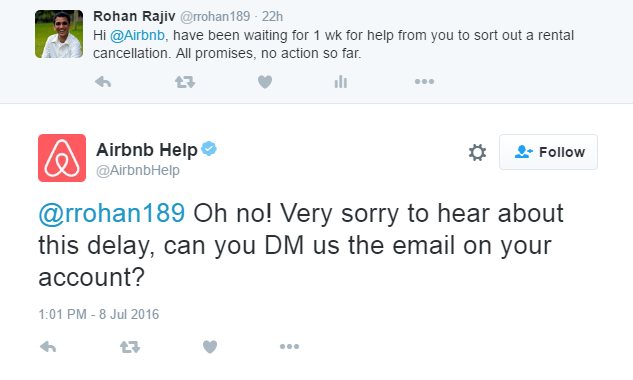
Part II – No response from AirBnB. We called AirBnB on Friday and explained the situation. They sympathized and promised prompt action. No news for 4 straight days. So, we called them again on Wednesday. Again, we were assured someone was on the case. On Friday, frustrated, I sent a tweet to AirBnB saying all we had heard is words, no action.

AirBnB

They responded immediately on Twitter and finally followed up with an email. I asked for some sort of monetary compensation for our abrupt cancellation and their lack of response. We had to move from a net spend of $550 for the trip to a place with a net spend of ~$1000. My customer service representative said he’d manage a credit $80. But, he was also going to be off this weekend and he’d be back on Monday to help if we had more questions.

Part III – 2 declines. As we all still wanted to stay together, we decided to suck it up and attempt to secure another booking. There were 2 potential places that looked open to 8 guests. So, we sent one a request. As seems to be common with AirBnB hosts, we got a prompt response – declined.

Now, we were left with the final, most expensive option. Again, prompt response – decline.

We’ve obviously moved to looking for hotels.

As I reflect on this experience, I was left with a few thoughts –

1. At AirBnB, hosts experiencing changing HOA rules are likely not that uncommon. Why not have a blanket policy for sudden cancellations instead of treating it like a bespoke request? E.g. Maybe we given $50 credit per person who was booked on the reservation. That would help prevent this back-and-forth while acknowledging it as a cost of doing business.

Maybe another part of the response would be to actively work with the cancelled guest to find another reservation? Either way, I think the first step would be to give the customer a call and work with them to sort this out. Emails wouldn’t cut it – definitely not after having them wait a week for a note from you.

2. If I were Brian Chesky/AirBnB’s senior executive team, I would worry that a customer only got a response when complaining on Twitter. Does it take 7 days to respond to a customer without a reservation? Do we really need to resort to public shaming for that?

3. AirBnB has come under a lot of flak for racism. Friends of friends who are African American have tested this by creating fake white profiles to get around it and prove their point. Maybe this flak would reduce if it at least mandated that hosts give a reason for declining people? Calling the hosts who declined me/us as racist is the easy and lazy answer here. I would like to believe that is not the case and that there are other reasons that I don’t know or understand. A simple message explaining these reasons would go a long way. And, if it is doubts the host has, perhaps it can be a discussion? E.g. an assurance that there won’t be alcohol consumed at home or an extra security deposit for a large group?

I wrote to both hosts after the decline. One of them got back to me saying the listing was a mistake – they didn’t intend to leave it open after July 4th. I understand that. The other hasn’t as yet.

4. Beware compounding problems. The declines may have been less of an issue on another booking. But, overlay the cancellation and the lack of support from AirBnB and you can see how it all compounds.

5. I was reflecting on my intentions with this post. I realize there are 3. First, it is ask “what did I learn” from a disappointing service experience. Second, it is a reminder to myself to be grateful for the sort of first world problem this is. I am grateful to have the sort of options I have today – it isn’t something I’d have had a few years back. And, I am very grateful for that. Finally, it speaks to the power of incentives – since AirBnb only responded to my appeal on Twitter, I figure this might be the best way to be heard (see point 2).

Overall, this experience underlines the importance of that one principle – ownership. All of this could have been solved with a couple of phone calls and I do wish AirBnB had taken more ownership of the problem. It is still a fantastic idea – if I had a choice between a hotel room at the same price as an AirBnB, I would choose an AirBnB because I’d love to stay in a home when away from home. But, there is a lot to worry about when it comes to the execution.

Maybe AirBnB is doing just fine and doesn’t need to pay attention to these small misses with a customer or two.

But, then again, the true test of a business is not how things work when all is well.

How to drive people crazy

In his Conscious Business audio book, Fred Kofman lays out the steps to drive people crazy based on prior research on schizophrenia. The steps are as follows –

1. Start by establishing that the other person is dependent on you. Make it clear that the other person would not be able to fend for themselves without you (this is effectively the first step to the bullying)

2. Phase I of the “double bind” – establish an objective and a consequence. An example objective consequence would be – “I want you to take more risks. You play it too safe. If you don’t do that, I will <insert consequence>.”

3. Phase II of the “double bind” – establish a contrary objective with a consequence.” The example here would be – “I want you to not fail. Your failure costs you and us so much. If I find you failing, I will <insert consequence>.”

4. Phase I of the myth of discussion – make it clear you aren’t willing to discuss any objection to your contrary goals. The moment they bring up the apparent contradiction, refuse to discuss it by becoming angry and blaming it on them. “This is exactly what you always do – you always cause trouble and ruin the peace.”

5. Phase II of the myth of discussion – pretend that everything can be discussed. At the same time, pretend that you are always open to discussing things. “In our family, everything can be talked about in the dinner table.”

I took away a few notes from this –

1. The research on schizophrenia shows that the environment plays a big role in the condition. Typically, it is caused by people around the victim who engage in the pattern of behavior described above.

2. Why do people put up with this clear contradiction? It takes maturity to step up and say – “Hey, what you’ve told me makes no sense as they contradict each other.” It feels obvious from the outside but it isn’t.

3. I say this because I spent some time in an environment that was very similar. And, yet, as obvious as it might be now, I didn’t have the courage to stand up and call it out.

4. When we read notes on extreme behavior like this, we tend to file it away as “not relevant.” However, it is likely that every one of us has worked in a company that has exhibited this behavior. That is why I picked the “Take risks.. but don’t fail” example. It is very common. Fred Kofman calls this “organizational schizophrenia.”

drive people crazy, contradictions(Thank you Dilbert!)

5. The principle behind this is the power of inconsistency of messages to mess with our minds. Something for us to keep in mind as leaders, managers, parents and teachers. Or, as Fred Kofman puts it, now that you know what it takes, don’t do it. :-)

When is it your responsibility

The best proxy to our real age – not the number we get when we subtract our birth year from this year – is to observe when we consider something to be our responsibility.

If we can never find it in us to own up to a problem that affects us, we’re still where we were when we were children. It is anybody’s fault but ours.

If we understand we should take responsibility but don’t want to, we’ve hit our teens but haven’t quite made it past them.

Adulthood begins the moment we accept that anything that affects us is our responsibility. It doesn’t mean that we need to respond to everything that happens and make it our problem. It simply means that we are aware that it is a situation where we have the ability to respond and where we must choose whether or not to do so.

As an added bonus, taking responsibility for what happens to us is a big part of being mindful/conscious because consciousness is simply being aware of our choices at any given point of time. And, of course, the choices arrive the moment we decide to take responsibility for what happens to us…

responsibility, consciousnessImage Source

Little strokes of luck

I asked myself a question the other day – do I pay attention to little strokes of luck?

I was hoping for a package to arrive by 4:30pm as I needed to collect it from location A. I was planning on collecting some stuff from location A at 4:30pm anyway- so, this would be very convenient. If it didn’t arrive, I’d have to travel to location A again and lug that package.

It turns out the package arrived at the very moment I was about to leave. I was able to request the UPS person (despite his grumbles) to wheel it to the car so I wouldn’t have to push it all the way.

It was a small stroke of luck – but it worked out. And I was very grateful.

We all pay attention to the big strokes of luck in our lives. We clearly remember those times when, against all odds, things worked out. We also tend to vividly remember when luck deserted us.

When it comes to the small things, however, I find that our memory can play tricks with us. We remember those times when our queue took so much longer. But, we regularly forget when the little things work out. Or, at least my mind tends to do that. This incident was a nice reminder to be thankful for those small strokes of luck. As Richard Wiseman’s experiments on luck demonstrated, being open to the possibility of being lucky is a big part of being lucky. And, being grateful when things work out is a nice way of making sure we remain aware of and open to the possibility of getting lucky.

little strokes of luckImage Source