
5 books that might change your mind – 2016 edition

Here are 5 books I read this year that might change how you see the world –

1. The Accidental Superpower by Peter ZeihanIf you haven’t considered the world from a lens of geopolitics, The Accidental Superpower will likely blow your mind. I found the first half of the book particularly powerful. It included a view of the history of super powers from the eye of geopolitics. And, despite having read a similar view on history in another book, this was beautifully synthesized. Following that, Zheihan explains what’s going on by focusing on population demographics. Again, fascinating. The second half focuses on prediction. And, prediction is very hard. So, I took that bit with a helping of salt. After reading the book, I did wonder why we don’t teach geopolitics at school. I guess it flies against the face of our general narrative about what makes super powers. Geopolitics contends that it is all about geography.

(Note: There’s another geopolitics based book “The Next 100 Years” by George Friedman. Friedman was Peter Zheihan’s former manager.)

2. The Inevitable by Kevin Kelly: Kevin Kelly talks technology in a way only he can. He takes twelve verbs that technology has impacted (cognifying, sharing, updating, etc.) and takes them to their logical end. In that process, he gives us a view into what our future might be. It is powerful.

3. Shoe Dog by Phil Knight: One of the most beautiful books about entrepreneurship I’ve read. It isn’t a manual in the way “The Hard Thing about Hard Things” is. Instead, it is a story from the heart of Nike’s legendary founder. It feels authentic and real while also being It is not just about the fact that it is beautifully written (it is), it feels authentic and real. Phil Knight takes us on a journey where he impresses upon us the strength of his belief that the world is a better place when we run with great shoes.

He makes mistakes and a couple of very questionable ethical decisions. Yet, we find it in our heart to forgive him. Somehow, he makes us feel the desperation that drove him in that moment. And, he then goes onto teach us how mission driven businesses are built. He explains that a business is about money just as living is about pumping blood. You need both. But, life and business are about a lot more than that.

And, while you are at it, I’d recommend picking the Audible version. Norbert Leo Butz does a fantastic job.

4. The Only Investment Guide You’ll Ever Need by Andrew Tobias. An oldie, but a goodie. At its heart, it is really simple. Andrew Tobias explains that a penny saved is actually a lot more valuable than a penny earned since Ben Franklin didn’t have to deal with taxes in his time. So, save a lot more than you earn. And, once you do that, develop a simple approach to investing. Of course, he patiently lays out all the ways we can do that. But, this book isn’t so much about investing as it is about a mindset.

5. Daring Greatly by Brene BrownBrene Brown brings her research on shame and vulnerability together in this beautiful book. It is fascinating to learn that women have about 10 shame triggers. And, appearance and body image top the list followed by parenting. Men, on the other hand, have one very powerful trigger – showing weakness, or in her research’s terms, “being a pussy.” She also inspired my theme for 2017 – engagement. She wisely pointed out that we spend too much time asking questions like – “Am I being good/perfect?” Instead, we should ask – “Am I being engaged? Am I paying attention?” No good comes from seeking perfection. ”
(Quick note: The audio book narration didn’t work for me in this case.)
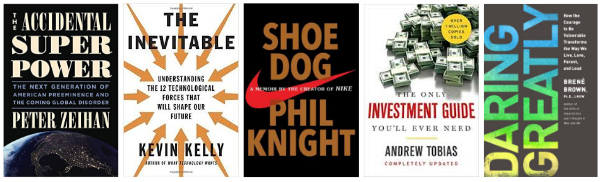
Here’s the Amazon list.

Books that almost made this list:
The Road Less Traveled by Scott Peck is a classic. The first half of the book was incredibly impactful. I especially loved his definition of love.
Peak by Anders Ericsson is the ultimate guide to deliberate practice research from the master himself.
Deep Work by Cal Newport rails against our distraction filled work environments and presses us to think deeper about depth in our work.
Persuadable by Al Pitampalli beautifully explains why it is important that we change our mind.
And, finally, Einstein by Walter Isaacson has a life lesson about not taking ourselves and our world seriously in addition to the expected lessons on curiosity and perseverance.

Other resources: Past lists of “5 books” – 2015, 2014, 2012, 2011. Book reviews here and book notes here.

Happy reading!

The world sucks – vote for me

“The world sucks – vote for me.” That’s the vote-getting narrative that has worked wonderfully well for our politicians. And, the media has complied as well. That’s not because they want to, but because their business model requires them to sell negativity and fear. As humans, we’re drawn to that stuff.

The folks at “The World in Data” from the University of Oxford have created a public good to help counter this. They are a team of 3 who’ve gathered evidence on data around indicators of progress such as extreme poverty, education, and child mortality. And, to make it easy to consume, they’ve helped us visualize this in “The World as 100 People.”

the world in data

Of course, the world doesn’t suck. In fact, things are better than they’ve ever been. Does this mean things are better for everyone? No, it doesn’t. There is and always will be plenty to do. But, it also means a lot of the current narrative around the state of the world is nonsense.

What is the probability of “The World in Data” actually making the difference they seek? Very low. They don’t have the megaphones that our politicians have. And, there aren’t that many folk who are interested in looking at empirical data if it doesn’t show up as a sensational article on their Facebook feed.

But, maybe we could help improve the odds? Perhaps we could share their findings, one person at a time? Maybe we could better educate ourselves, our families and our communities? And, maybe, just maybe, we could use all this data to make better decisions.

Thank you, “The World in Data” team, for giving us the opportunity to make a difference. Now, it is on us to spread the word.

PS: Their blog has only 58 followers on Feedly. That’s a travesty. Let’s fix that.

Wish you perspective

This is the season where we wish people “happy holidays” and “happy new year.” Typically, in addition to these wishes, we also add a wish for good things. These good things could be health, happiness, love, prosperity, etc., etc.

But, here’s the thing (and there’s always “the thing” :)), all these good things are useless without perspective.

If we’re unable to appreciate what we have, what we have is useless.

So, my wish for these holidays and the new year for you, and me, is perspective. Here’s to more of that.

Think day

The end of December is holiday season in most parts of the world. And, traditionally, there’s a lot to do during these days. There’s a good chance you’ve got some travel planned or are having a family get together at home. I’m sure there are more things you’d like to do with your time than there is time. Nevertheless, here’s one idea I’d love to throw in the mix – take a “think day.”

There are 3 broad ways to approach the think day –

1. A career focused think day. A career focused think day can be about thinking deeply about how things are going in your career. What are you doing well? What could you be doing better? Are there skills you’d like to focus on in 2017?

2. A craft/industry focused think day. When you are in the thick of things, it is hard to focus on what is going on with your craft or industry. So, how about taking a day to read and think about what is happening in your industry? Find an industry analyst or publication you trust and go through their summary of important changes in 2016 and predictions for 2017.

3. A life focused think day. Take time for an audit of how things have been going in 2016. Pick 2-3 things you’d like to focus on, see if you can roll it up into a theme and make a simple plan for daily/weekly practices to help execute these themes. The key here is simple. If you can’t remember it off the top of your head, it is probably too complicated.

Of course, there’s enough in here for three days (or more). But, starting with just one day dedicated to one of these would be a huge win. The beauty about a think day is that there isn’t a clear outcome expected. Instead, the only thing that matters is that you go through the process. The fact that most people around us are slowing down means we finally have the bandwidth to take stock.

So, here’s to giving it a shot.

PS: If you are feeling too busy for a think day, Bill Gates used to take a “think week” twice a year.

I would never behave like that

When we see behavior we don’t like, it is tempting to write it off. “I would never behave like that” or “how could he/she do that?” might feels appropriate.

But, is it?

Would you really “never” behave like that? Given the same upbringing and an identical situation, you probably would, too.

Instead, a better question is – “what would it take for me to behave like that?”

There always are a few situations that might result in behavior you didn’t like. Perhaps if you felt out of luck and stressed? Or, if you felt desperate to find a job? And, what if you were in financial stress? Or, if that behavior was rationalized because of good results in the past?

Asking the “what would it take?” question inspires more empathy than the write off. It is also a lot less hypocritical.

We are only as kind to others as we are to ourselves. One way, then, to be kinder is to learn to be kinder to ourselves. But, the other approach works, too. As we learn to be kinder to others, we learn to be kinder to ourselves.

Also, as a rule, it is good to be careful with “always” and “never.”

You don’t know what I’ve been through

“You don’t know what I’ve been through. If you did, you would understand why I’m behaving this way.”

Sounds great in theory. In practice, “you don’t know what I’ve been through” is the ultimate excuse for jerk behavior.

Of course, they don’t really know. They can’t know. They didn’t experience that bad break up, the passing away of a loved one or get screwed over by someone they trusted. Not in the way it happened to you at least.

But, it doesn’t matter. Adversity is an opportunity for us to learn more about ourselves and become wiser about how the world really works. If you are simply wearing that adversity as a badge to justify bad behavior or if all it did was close your mind to new possibilities, then that experience was, sadly, wasted.

The universe will throw us adversity opportunities every once a while to learn and grow. It is up to us to use them well. When we do, it’ll show in the wisdom behind how we operate. And, when that happens, they will want to know what you have been through and how can they go through similar experiences and grow through them.

If they don’t want to know what you’ve been through, telling them isn’t going to help. As far as people go, pull tends to work much better than push.

Voice of confidence

The voice of confidence is different from what many people imagine.

Before you do something
What people imagine: This is going to be AWESOME. I am going to be the best.
The real voice of confidence: This might not work… and that’s okay.

When things don’t work out
What people imagine: This sucks. All my plans are not working. Do I suck? No, it is due to all those idiots around me.
The real voice: We learnt something. We’ll try again tomorrow.

When things do work out
What people imagine: I am so good. So so good.
The real voice: We learnt something and it is great that this worked. Let’s try the next thing tomorrow.

The voice of confidence isn’t loud and doesn’t appear strong. It almost appears to quiver at times with vulnerability and is generally soft.

But, let’s not mix volume and clarity.

PS: If you are wondering, confidence and courage are like twin siblings. You could substitute one for the other in this post and it’d still be true.

Private victories, public victories

Segmentation is one of the basic marketing tenets. If you build a product, target a segment that will love its strengths and ignore its shortcomings. Similarly, if you want to build a blog that becomes massive (assuming you aren’t someone famous already), you are better off focusing on some niche. Examples of such niches are productivity, personal finance, minimalism, health, etc. Going after learning in as broad a sense as this blog does isn’t a winning strategy. For those of you manage to stick on despite this very broad focus, I try every once a while to explain what this blog is about. An idea that will help frame this is – private victories precede public victories.

I am re-reading the 7 Habits very slowly. And, it was nice to be reminded of the logic behind Covey’s structure – focus first on private victories and, only then, will public victories follow. This is the basis of the character ethic that Covey describes. It is about bringing a certain sustainability into life and happiness by being effective. So, what does that even mean?

I’ll go back to my concentric priorities image. If we think of the world as a series of priorities – you, your people, your work and your community – private victories are focused on you, your people/relationships and parts of your work.

The principle is straight forward – you will be able to lead others only once you lead yourself. And, to lead yourself, you have to first understand how to be proactive, to think long term while focusing on what you control and learn to prioritize.

The first time I read Covey’s book, I spent all my time attempting to put the “private victories” portion in action. I had such a long way to go. However, as I read it now, I feel more comfortable with this portion of the book. I am still giving it plenty of thought but I find myself thinking about optimizing existing approaches versus building them from scratch. This process has taken 7 years. And, I’m sure it’ll be a few more years before I spend more of my time attempting to live part II.

How does this relate to this blog? I write about what I most need to learn. And, this blog is and has been shamelessly self focused over the past 8 and a half years. That will likely change with a time. But, for now, it is me teaching myself how to develop a perspective that is both effective and kind. That is why this blog is some parts happiness and other parts productivity, minimalism, some finance, health etc. It isn’t the most effective marketing strategy and is certainly not a case study in segmentation. But, I don’t intend this to be any of that.

This is about growing into character – one learning at a time, over a very long time. It is hard work. But, it is also an awesome process. As is evident in the sheer number of topics I write about, there isn’t any prescribed way to go about this process. Sure, there are a few principles that help. But, for the most part, you are on your own. It is just a journey that requires consciousness and engagement.

And, mostly, it is a journey.

PS: “For those of you manage to stick on despite this very broad focus, I try every once a while to explain what this blog is about.” – if you’ve stuck around for a while, you probably don’t need an explanation. So, you probably guessed this – this is more a reminder of the “why” for me than it is for you. Thank you for your attention. :)

Unglamorous moments

I was thinking of a whole host of unglamorous moments today.

Listening to the radio while stuck in traffic.
Attempting to calm your hysterical kid in the middle of the night.
Having to make an emergency run to the grocery store because your partner forgot to get something.
Going through an ordinary day of work.
Eating your staple food for dinner.
Recovering from the flu.
Working through a thousand cell spreadsheet one cell at a time.

You’ve been through most or all of this. So, you know exactly what I’m talking about. And, yet, when we think of our lives, the movies tell us that the list of moments should probably look something like the following.

Winning a prestigious award in front of family.
Getting promoted to <insert fancy title> in <insert famous company>
A happy, all smiles, re-union with friends in a beautiful island somewhere.
Watching your kid/partner/family member do something awesome.
Etc.

You may be lucky to have a few of those glamorous moments come by a couple of times in your life. But, for the most part, you are going to live a life full of unglamorous moments. And, here’s the amazing part, if you have the privilege to go through these unglamorous moments without having to worry about your health, safety or shelter, you have everything in place to earn your happiness.

How do you that? By developing a perspective that helps you constantly experience gratitude. And, I mean constantly. If you are stuck in traffic, it means looking around and being thankful for everything in your life that enables you to be stuck in that traffic. Your car, your home, your people, your job, this planet, etc., etc. There’s always plenty to be thankful for. But, it requires perspective and an appreciation for those unglamorous moments.

That matters because of two truths. First, the occasional glamorous moment that gets consigned to the highlight reel is a result of millions of these unglamorous moments well done. And, second, the ratio of unglamorous moments to glamorous moments is probably in the range of a billion to one. So, if you’re wasting these moments in the search for glamour, that’s a real pity.

We earn our happiness, one unglamorous moment at a time.

Involving others in solving problems

There are pros and cons to involving others in solving problems. There are two quotes that represent both sides of the argument. The first is “many hands make light work.” And, the second is “too many cooks spoil the broth.”

Both of these quotes focus on the work itself. And, they’re both right depending on the context.

However, of late, I’ve found another interesting benefit when involving others – luck. Sometimes, solving problems requires a bit of luck; it involves an accidental find or a flash of insight that cracks the problem. And, over the past few months, I’ve found myself in situations where a little bit of extra luck went a long way in solving a tricky problem.

Every once a while, it is better to be lucky than good. And, when we feel we’re running out of luck, involving others can help turn the tide.