The best habit

The best habit is the one that’s slightly better than your current one. And, yes, this applies to diets, exercise, reading, sleeping and everything else you can think of.

This is because sticking to your better habit is way more important than attempting a radical change that brings you back to your old ways.

When attempting difficult change, revolutionary change feels very tempting. And, for extreme cases (e.g. getting off an addiction), revolutionary change is probably the only option. After all, desperate times call for desperate measure.

But, for all other changes, an evolutionary works much better. It isn’t as exciting. But, it is many times more functional.

Big changes are small changes applied consistently over time.


HT: Ken

Signing up for good habits

It’s that time of the year when we make commitments to sign up for good habits. So, we commit to eat healthier, exercise more, read more. And, we do these things to get smarter, fitter and better.

It is important to think of these outcomes when we sign up and plan to do these things. Research on motivation has shown that extrinsic rewards matter when we plan to do things. So, when we’re about to sign up for a job, we think we care about the pay package and the prestige of the job.

However, extrinsic motivators are an illusion. Once we’re in the job, all that matters are the intrinsic motivators – who we work with and what we do. The job isn’t just a route to getting the paycheck. It is what we do – 12 hours a day. And, we better make it good.

Similarly, it is fine to begin signing up for good habits with the smarter, fitter and better outcomes. But, the outcomes are just a side show. For, once we get started, it matters that we re-focus on the process of doing these. And, what we always find is that, virtues aside, eating healthier, exercising and reading more add a tremendous amount of energy and happiness to our day.

It turns out that that good habits are worth doing simply because they’re good.

State of Tech in 2016 – 4 core business models focus

There are many ways to write “state of industry” posts. One approach is to project the future based on trends established this year. Another is to project the future based on the current strategies employed by the top industry players.. I did some version of that in 2014 and 2015. This year, I thought I’d focus on a different approach – go back to first principles and look at business models.

This approach will help us pivot from the industry’s perspective to the customer’s perspective and, thus, not be too focused on technology fads (e.g. Segway, Google Glass, etc.)

We’ll approach this in 3 parts –

I. The 4 core business models
II. 2016 – what we saw
III. 2017 and beyond – what we might see

Couple of notes of caution

  1. This is an attempt to focus on things that are likely to matter most in my personal opinion. It’s not an exhaustive list. I’ve pointed to 10 posts at the end which, together, should add more context and analysis.
  2. I’ve spent a lot of time on context/foundation given how important it is to power meaningful discussion.

I. The framework:

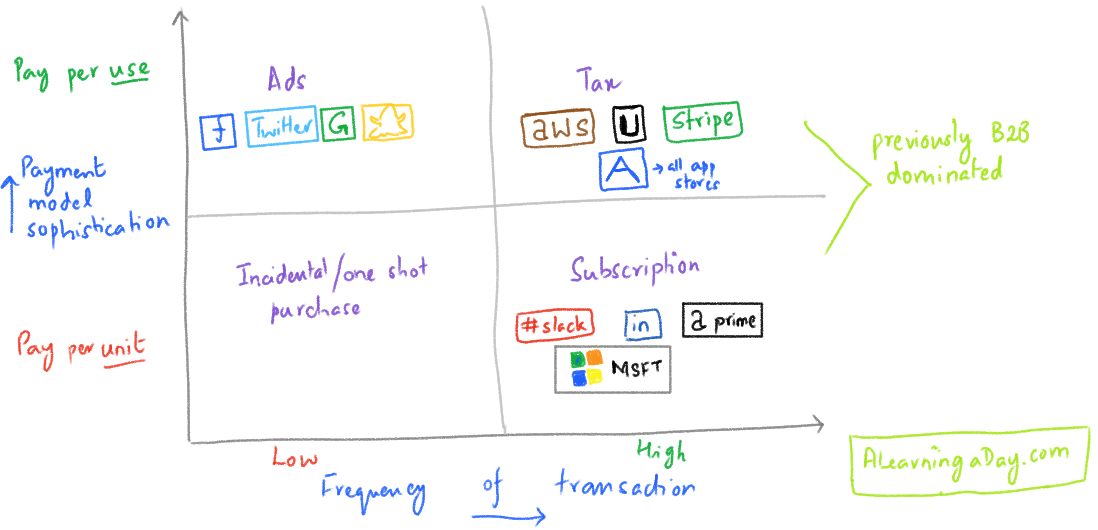
I contend that there are four fundamental business models on the internet and, since we’re talking about money, lay them out in two axes – frequency of transaction (a proxy for customer loyalty) and payment model sophistication (pay per use is much more sophisticated than pay per unit). There are many, many customer acquisition models (e.g. freemium). However, all these models bring us back to these 4.
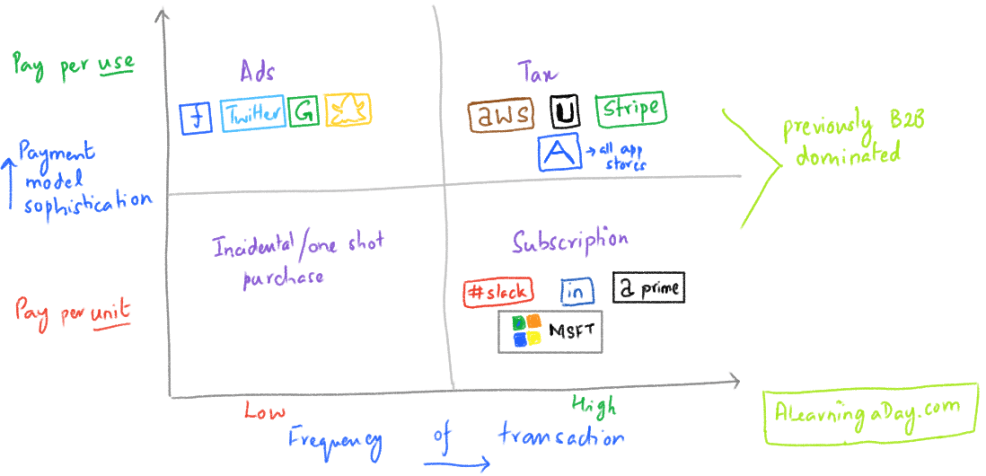
  1. One-shot purchases: This model is used by anyone who can or has sold stuff online. Thanks to the internet, we can go into business on the internet and sell anything to, pretty much, anyone.
  2. Subscriptions: Or something-as-a-service. Thanks to the flexibility and collaboration cloud based services provide, the internet has enabled more subscription businesses than ever before. In essence, it hasn’t “created” subscription businesses as often as converting previous “one shot purchases” to subscription businesses (think: Adobe’s conversion to Photoshop-as-a-service and Microsoft’s ongoing conversion to Office-as-a-service). Subscriptions used to exist before but the internet has turbo boosted them.
  1. Ads: Ads have always been a constant 1% of the GDP long before the internet. Ad money just goes where consumer attention goes. However, there was an old world marketing managers quote – “Half of our advertising budget is wasted. The problem is we don’t know which.” While this hasn’t been fully solved by the internet, the amount of data available means digital marketing measurement system is light years ahead of old world systems. Now, advertisers can pay per click or even per conversion.Typically ad businesses jump into this matrix from outside of it altogether. You rarely see a business based on “one stop shopping” become an ad business. Instead, we see social/consumer networks that focus on user growth (and no revenue) that hit critical mass that then morph into ad machines (think: Facebook, YouTube, Snapchat).And, ads are low on customer loyalty because advertisers aren’t loyal to the platform. They’ll go wherever customers spend time.
  1. Tax: The tax model focuses on earning money when your customer earns money. It is powerful because it is aligned to a customer’s revenue growth versus a growth in headcount (as in the case of most B2B subscription services). On the internet, tax is typically how platforms (think: App stores, AWS, Uber, AirBnB, PayPal, Kickstarter) make money. Everybody wants to become a platform because the tax model is very lucrative. But, it is also very hard to get critical mass as a tax based business and typically take vast amounts of funding, grit and luck.

An important note – these models are not unique to the internet. The old world had examples of each of these models. For example –

  • One-shot purchases (massive scale): Traditional retail
  • Ads: Traditional newspapers
  • Subscriptions: Traditional newspapers or cable
  • Tax: Book or game publishing

However, the internet changes the nature and scale of these models. And, in doing that, it completely disrupts existing businesses.

Disruption. Every conversation about disruption calls for the customary nod to Prof Clay Christensen. Over the years, Prof Christensen replaced the term disruptive technology with disruptive innovation because he recognized that few technologies are intrinsically disruptive or sustaining in character; rather, it is the business model that the technology enables that creates the disruptive impact. Disruptive technologies, thus, are often novel combinations of existing off-the-shelf components.

Just to make that point, let’s consider one industry that is currently being disrupted – retail.

Traditional retail was built on assumptions of scarcity. The main business model was “one shot purchases” –

  • You walked into the retail outlet, bought something and walked out.
  • Retailers strived for transactional loyalty, of course. So, retailer loyalty cards were important. Once you committed to a Sam’s Club membership, you were likely to make more of your purchases at WalMart. And, that mattered. However, proximity to your home mattered a LOT more.
  • Retailers had limited shelf space. So, they typically had a few large companies across various categories that fought hard for that shelf space. These companies – P&G, Unilever, Kraft, Black & Decker, etc. – were very profitable. They, then, used these profits primarily to sponsor advertising which ensured customer demand and, then, guaranteed distribution at retail outlets all over.
  • They guaranteed distribution at retail outlets by a series of extensive discount and rebate schemes (i.e. a channel strategy) that enabled them to pass some of those big profits to their important retailers.
  • While these companies dictated terms with most retailers, important retailers like Wal Mart had the upper hand. In a world of scarcity, aisles at Wal Mart were scarce and critical to success.
  • So, even if Iam’s had the best pet food product on the market, they needed access to that limited shelf space to reach the mass market. So, being acquired by P&G made a lot of sense.

Isn’t it amazing how a discussion on traditional retail touches all industries that sold product (i.e. all consumer packaged goods) and traditional advertising?

On the internet, retail is built on the assumptions of abundance. The dominant business models are subscriptions and tax.

  • You have access to anything, anywhere. You could, literally, find the same item on many websites. In many cases, you could actually just by-pass the online retailer and buy straight from the creator.
  • So, the value of the retailer now lies in your loyalty. If you are subscribed to Amazon Prime, you will perform your product search on Amazon, and not Google. That is the difference between success and failure on the internet. (Side note: In such a noisy world, branding matters a lot. Hence, the success of the likes of Apple and, so far, Tesla)
  • Subscriptions are not the only way to build a retail business, of course. There are multiple platforms that make money via the “tax” model. Etsy, eBay, and even Amazon, enable third party sellers to sell their wares.
  • But, if you are a small business looking to sell on the internet, you can now leverage the power of subscriptions to sell to your customers. And, Dollar Shave Club, Birchbox, et al, have led the way in doing that. In a world of abundance, subscriptions is how modern retailers ensure your loyalty.
  • Of course, selling music or razors or books on the internet is different from selling on the cloud. You don’t have to worry about all the crazy distribution costs. Everything can be much cheaper.

Retail is still in the early stages of being disrupted. But, as Benedict Evans points out, it is only a matter of time. And, while retail is fundamentally about a customer buying something, the way it happens determines the economics of the whole process. And, the internet has changed how buying happens. Stay tuned.

II. Reflect on what we’ve been seeing up in 2016

One shot purchases. Of the 4 internet business models, one shot purchases makes less waves because it is, by far, the least sought after model. This is the piece of the internet reserved for the small businesses who can just create their own little online store with tools from the likes of a Magento or Shopify. The goal, here, is to build a brand and figure out a way to build a subscription.

There’s too much going on to trust that a customer will come back to you.

Subscriptions. Subscriptions, once again, had a big year. Let’s go through a few of the big moves.

  • LinkedIn was acquired by Microsoft in the biggest acquisition in tech history. A big move for Software-as-a-service. ~70+% of LinkedIn’s revenue is subscriptions.
  • The competition for B2B messaging-as-a-service intensified. Microsoft and Facebook took on Slack and HipChat for the B2B messaging-as-a-service market. This is important because the eventual winner of this race could create a platform for Bots and make money as a “tax” off its bots – à la app store.
  • Apple signalled its attempt to commit heavily to subscriptions (“services” in their words – i.e. AppleCare, iCloud). This is another demonstration of the might of subscriptions on the internet. This isn’t Apple’s first experience with the idea of subscriptions. It is easy to forget but it sells many iPhones effectively as subscriptions. Pay every month for 2 years. Then, upgrade to the next phone. Many Apple loyalists are perennial product subscribers. The difference, this time, is that subscriptions on the cloud require a very different “ship fast, iterate quickly” culture as opposed to pseudo-subscriptions in a product based world which are based on “ship once, get it absolutely right and maintain the customer connection via financing.”
  • The App store enabled app developers to charge via subscriptions. About time. There’s still a lot of work ahead for the app store to make this process easier. But, this was a start.
  • Soap-as-a-service. The launch of Amazon Dash buttons beautifully illustrates why the tax and subscription models are the place to be. P&G would like you to get the “Tide” Amazon dash button so you don’t ever do a search for a competing product. And, Amazon loves it because they charge P&G a tax for every Tide satchel stored.
  • SaaS investments (mostly B2B) are going very strong. Crunchbase data shows that global SaaS funding has gone from $1.5B in 2010 to $7B in 2015.
  • Hundreds of start-ups are building interesting, viable B2C subscription businesses – something-in-a-box. Just check this list of 70+ start-ups that all sell something-in-a-box. Wines, food, fashion – you name it and it is there.

Ads.

  • Facebook and Google continued to grow at ridiculous rates. Facebook and Google have been taking in most of the ad growth and conquering the very lucrative mobile display ads and search ads respectively.
  • Facebook had all sorts of measurement issues. This led to a call for better 3rd party verification of metrics. Or, maybe another ads behemoth that can challenge Facebook to keep them honest.
  • Snapchat grew in momentum. Snapchat is on its way to a reported $30B+ IPO. They followed the playbook to build a social network based on ads – start with a risque use case for a small core of users, keep innovating to meet the needs of a larger group, make fun of ads, refuse to monetize, continue growing. And, finally, when they hit critical mass, run ads anyway. To their credit, Snapchat have done well with different ad formats. But, at the end of the day, ad businesses are about attention. And, Snapchat has a better grasp on millenials’ attention in the US than almost all other businesses (Instagram is probably the only other real competitor)
  • Non social media publishers were frustrated at only seeing a small percentage of ads revenue. A lot of the money in the ad space is in the “tax” business model – all of ad tech is effectively a tax. All this results in large publishers growing frustrated about only seeing a small percentage of ads revenue on their site.
  • Internet TV took on real TV. Netflix and Amazon Prime Video are among the top 6 global content creators. YouTube, Facebook and Snapchat video all went after TV budgets as part of the ever expanding digital pie. The more people transfer their TV viewing time to the internet, the quicker this shift will happen.

Tax.

    • Everybody who wants to be a platform should learn from Amazon. They continue to show us how the tax model is done. AWS, Amazon Fulfilment service, Kindle are all great examples of this business model. There are many ways Amazon could do more of this – could there be a delivery-by-Amazon tax service (feat: drones) coming in the future? And, Alexa is clearly headed to be a platform tax in our homes.
    • Stripe becoming a powerful tax business. All of payments is built on the tax business model. So, Stripe’s growth as a payment provider is significant this year (worth $9B now). Stripe added an innovative customer acquisition model with “Stripe Atlas.” For a fee, Stripe will help you incorporate your company in the US (all of us can be global one-shot purchase or subscription retailers, of course). And, of course, Stripe will automatically become the payment tax for your business. Brilliant.
    • The race to become the platform of everything transportation related intensified. Uber pulled out of China. Lots of investment in Asia with companies like Didi, Ola and Grab. The action will continue.
    • AirBnB had a challenging year – even with tremendous growth. AirBnB moved traditional hotel stays (largely one shot purchases) into a tax model – similar to Uber. And, similar to Uber, they’re trying to do a lot more than what they started with – flight bookings, travel planning, etc. However, there’s a lot of regulation against being the one global platform for rooms. And, AirBnB has been fighting that. Then, of course, there are all the issues with discrimination on the platform.
    • Lots of consolidation in ad tech led by Adobe and Salesforce. Ad tech, as mentioned above, is a classic example of tax revenue. There was a ton of consolidation in the ad tech world as Adobe and Salesforce acquired companies to be an advertisers one-stop “data management platform.”
    • Slack and Facebook trying to be tax platforms a la WeChat. Their play – bots.

III. Explore what we might see in 2017 and beyond – with a lens on the trends everyone talks about.

I am no prediction expert. But, I thought we’d touch on 4 interesting emerging technologies and what I think their dominant business models would be.

Artificial intelligence. I think AI having 2 kinds of implementations –

  • For existing businesses, I think of Artificial Intelligence as a loyalty creator. I think deep learning will help existing technology giants deeper their connection with customers. It is hard not to bet on the giants (e.g. Amazon, Microsoft and Google) thanks to the massive amounts of data that powers their efforts. This is happening already.
  • But, that said, I also expect many entrepreneurs leverage open source libraries like TensorFlow to create interesting implementations in niche fields (examples here) that the big companies won’t bother going after. We should either see some very high value start ups acquired by the giants and a potential giant-of-the-future emerge by building an extremely sticky product for a small niche and, then, gradually expanding. And, I expect these to be subscription businesses. I think it is unlikely we’re going to see a tax based platform given the giants’ moves to open source AI.

Related note on self driving cars – could the future of cars be a shift from one shot purchases to subscriptions? Since disruption lies in business models, subscriptions may be the future of car ownership. In a world with rented self driving cars, maybe we’re looking at a future where we pay company X a fixed amount for unlimited use in the year?

Augmented reality/Virtual reality. There are lots of options in play here. Snapchat has taken a stab at augmented reality through their glasses. That suggests AR/VR could be an interesting play for consumer attention and, potentially, monetization via ads. This isn’t hard to imagine – you are in your virtual Facebook/Pokemon Go world and there are billboards everywhere with ads for you to look at.

However, I think there’s potentially a few subscription businesses in AR/VR. Think: $1000 a year for travel subscriptions (spend time in your dream locations) or $500 a year for gaming tournaments (play X virtual games with your global team).

Finally, we could envision “tax” based monetization as well. An AR/VR company could help you buy clothes that fit a virtual you and charge retailers per use (perhaps a more advanced version of LikeaGlove?).

The Internet of Things. I think a successful implementation of internet-of-things is going to result in 2-3 massive platforms who make their money as a tax. We need the equivalent of the iPhone and Android ecosystems for our toasters. The road to that sort of standardization isn’t really clear. But, if and when that happens, I think tax will be the way to go. And, if I had to bet on a company to do this, I’d bet on Amazon. What if private label Amazon toasters could connect to the internet and be controlled by Alexa?

Related and very interesting, what if an embedded chip in your Tide packet could send a signal to your Amazon Dash button to put a Tide refill packet in your cart?

Bitcoin and Blockchain. Bitcoin has had its best year yet. I think Bitcoin, a digital currency with near zero transaction costs, will make the implementation of “pay-per-use” even more prevalent. But, it will also accelerate the – everyone is a retailer on the internet phenomenon. One reason that shift isn’t happening fast enough now is because of cross-border currency restrictions. Just imagine what happens when all those something-in-a-box subscription businesses have easy access to a global market. Another example – if micro-payments become real easy, could we pay per article read? Then again, if this cross border stuff happens, there will likely be new regulation hurdles.

The underlying Blockchain technology commoditizes trust and identity. I don’t understand the full implications of what online communities built on Bitcoin would be. But, as it is decentralized technology, a blockchain based Facebook will likely not see ad profits accrue to a comparatively tiny group of folk as they do today. Potentially very disruptive. But, my sense is that we’re still 4-5 years from seeing this playout. Also, blockchain tokens are a very interesting implementation of the tax model.

Conclusion: There is a lot going on in tech and it is hard to really understand going on by following the news. A simpler, and yet effective, approach is to create mental models that help us make sense of all of this. One such approach is to look at the core 4 business models. At the end of the day, every promising technology has to prove its worth to survive. And, thinking about how emerging technology could change existing business models can be a powerful way to think about the future. At any rate, that’s how disruption is done.


10 interesting posts in case you want to dig deeper.

  1. Disruptive innovation: Disruptive Innovation by Wikipedia
  2. Internet scale: Mobile is eating the world by Benedict Evans
  3. Infinite Shelf space: Dollar Shave Club and the disruption of everything by Ben Thompson, Stratechery.com
  4. Tesla’s brand: It’s a Tesla by Ben Thompson, Stratechery.com
  5. Disruption in publishing: Publishers and the smiling curve by Ben Thompson
  6. SaaS funding: Just How Global Is The SaaS Startup Phenomenon? By Tom Tunguz
  7. Google and Facebook’s ad growth: Google, Facebook Leave Rivals Struggling for Digital ‘Nirvana’ by Melissa Mittelman and Alex Sherman, Bloomberg
  8. Snapchat’s impressive growth: While We Weren’t Looking, Snapchat Revolutionized Social Networks by Farhad Manjoo, NYT
  9. Amazon’s tax success: The Amazon Tax by Ben Thompson, Stratechery.com
  10. Bitcoin’s best year: The underpinnings of bitcoin’s bull run look way more solid this time by Joon Ian Wong, Quartz

(Thanks EB, Kaushik, and Pranav for all the edits on this – and to all other friends who helped with the thinking)

2017 Themes

I had 3 “look back” posts in the past ten days or so that all built up to my annual review. After all that looking back, the time has now come to look forward. I don’t like new years resolutions as I’m not a fan of “goals” based thinking. Instead, I prefer thinking in terms of direction and process. So, I prefer thinking of the new year in terms of themes.

My theme for the new year is engagement. I believe engagement is the answer to the debates around managing energy versus managing time. As with most important things, it isn’t an either/or. And, I also believe engagement is a principle that a good life is anchored around. And, as with all life principles, it is very hard to consistently live it. Also, I think of engagement and consciousness (the ability to be aware and to choose) as sister concepts. They share the same core.

While engagement is the high level theme, my audit and reading pointed to 3 sub themes.

The first theme is – “Seek to understand and then to be understood” – from my holiday re-read of “The 7 Habits.” I am way too impatient and, as a result, interrupt far too much than I’d like. I’d like to do better, a lot better. This isn’t something that’s easy to measure. So, I intend to just check in with myself every day for starters as I build my instincts around this.

The second theme is health. As I grow older, the idea of being very fit grows increasingly more appealing. I haven’t done as bad a job at this so far. But, there’s plenty of room for improvement. I used Mr Money Mustache’s excellent post on “Staying fit with no gym in sight” to reflect on this and piece together my health plan. The first part of this plan is to moderate my diet better – my diet is still pretty carbohydrate heavy (I love rice!). And, having just discovered the benefits of doing a full body work out during the week, I’ll aim to keep that going through this year.

The final theme is information. Again, there are two pieces. First, I’ve been working on streamlining my information diet over the past couple of weeks. I massively cut down on my news consumption and went through a review of every source I regularly consume on Feedly. I also took a good look at my work email flow and consumption habits and have made a few changes. The idea here is to be a lot more conscious about this as I still check my email and feeds far more than I’d like. The second piece of this theme is doubling down on reading books. I have a reading list that I cannot wait to get to. And, I’d like to spend more time on deep book reading over shallower sources.

I expect to see a step change in my level of engagement/consciousness if I work through these sub themes. But, as with all good processes, the journey is sure to be filled with learning. While seeking to understand will help me improve on my interactions with others, I see my approach to health and information as crucial. The better my health and information diets, the more energy I expect to have to be engaged through the day.

Lots of work to do. Onward.

PS: Peter Koehler, a reader, has done a nice job co-creating “The New Years Reader” – to be read aloud and shared with your close friends and family. Hope you enjoy reading it as much as I did. I contributed a thought to it as well. The theme should look familiar to you. :)

“We are a by-product of our questions. Perhaps we stop asking ourselves about how we can be better/best at something this year and, instead, ask ourselves – “How can I be engaged every day? How can I make sure I am being conscious about my decisions?”

All this would take is a commitment to spend 3 minutes to ask yourselves these questions at the start of your day, every day. And, a calendar reminder to re-commit to this habit every weekend.

Wishing you more engaged, more conscious days this new year. As we live our days, so we live our lives…”

Products and services I’m thankful for

Products and services I’m thankful for this year.

Blog
1. InMotion hostingAmazing hosting provider. Period. 
2. Readability for WordPress – part of the Yoast SEO plugin. Readability reminds me to use more active voice, connect my sentences better and keep them shorter. Thank you for being my English coach.
3. BulletProof Security plugin for WordPress. For keeping this blog safe from multiple spam attacks – thank you.
4. Feedburner: For delivering these notes to you, for free.
5. WordPress: Solid, again.

General tech
1. The Audible app. For making me smarter and better over our 8 year friendship.
2. My iPhone: For surviving being soaked in water, again.
3. Microsoft OneNote: I’m not sure what I’d do without you.
4. Dropbox Pro: Mr.Dependable.
5. Amazon Prime: A textbook example of how to keep adding value to customers. I’ve recently fallen in love with Prime video.
6. Sling TV: For making it possible to watch Manchester United without cable.
7. Lastpass on Chrome: A dream come true.
8. Google Drive: As above.
9. Windows: 18 years and going strong.
10. PowerLogic GLX-20 Mouse: They don’t seem to make these anymore. The two I bought have been reliable companions since 2013. I don’t go anywhere without them.
11. Gmail: Continues to be a game changer.

Information
1. The Quartz newsletter: For making me smarter.
2. The Economist: As above.
3. Feedly: Simple and reliable.
4. Stratechery: My favorite source of tech analysis

Baby
1. Earth Baby diaper services: Disposable diapers are the third largest contributor to landfills in the US. The Earth Baby team set out to fix it by composting bio degradable diapers. Inspiring environment friendly mission aside, they offer best-in-class customer service as an add on.
2. Lucie’s List: Awesome.
3. The Happiest Baby on the Block video: I was told this was a must watch for all parents-to-be. Rightly so.

Physical world 
1. Costco: Awesome.
2. World’s softest sock: Lives up to its name.
3. American Express: They keep raising the bar.
4. Ikea: Much love.
5. Oliver & Kline Ceramic Knives. Say goodbye to steel knives.

This list turned out to be much longer than I thought. But, I guess that’s a good sign. There’s a lot to be thankful for. :-)

Internal tension and conflict

Internal tension and conflict are to be welcomed, not avoided.

We have two selves within us – our primitive, amygdala driven, emotional self and our more modern, pre-front cortex driven, rational self. If that wasn’t enough, our brain also broadly splits into two parts – the more creative (right brain) and the more logical (left brain).

Given these differences, at any given point, we’re going to have different parts of us wanting different things. For example, on a vacation, our right brain may want no structure. But, our left brain may want us to plan and accomplish more. And, when we’re stuck on whether or not to spend money on fun, our rational self may disagree. Similarly, we might feel our rational self calculating the odds of a new project while our emotional self is pushing for it. Or, vice versa depending on our risk tolerance.

But, there’s unmistakable value in this conflict. Our vacations may be a whole lot fulfilling if we got a bit done. And, maybe there’s a cheaper and equally fun alternative to that expense. And, perhaps we could do more to mitigate a few of the risks of that new project before diving in anyway.

The parts of us that provide dissenting opinions are not to be ignored. Conquering fear is courage. Ignoring it is generally a sign of stupidity.

We need to learn to dance with our internal tension and conflict. It is in reconciling this tension and conflict that great things are done.

The mentor excuse

“Will you be my mentor?” – is a question most successful folk get. Sadly, it is the wrong question. And, unfortunately, it is more an excuse than a question.

First, it is the wrong question because mentorship doesn’t work like that. The two largest elements that contribute to successful mentorship are chemistry and proximity. And, if proximity isn’t hard enough, chemistry is an unknown and one that isn’t all that hard to divine. Put it differently, if someone wants to be your mentor, you will know. But, of course, you will need to find an excuse to interact or work with that person frequently first. This is not to say finding an uber successful super star mentor is impossible. But, the odds are low.

Next, it is an excuse if we identify mentorship as sequential to attaining mastery. It isn’t. The reliable approach is by using a tremendous amount of grit. A mentor is just a bonus on our path to mastery.

It is also a rather poor excuse because you can spend time with any hero/heroine you’d like to emulate. Warren Buffett? You can spend days reading his notes to investors. Or, Jessica Alba? There’s plenty written about “The Honest Company.” Elon Musk? Enough written about him and by him to keep you busy for a month.

There’s enough out there to help us get smarter, better and inspired. Waiting for mentorship is a poor excuse indeed.

PS: Your greatest first mentor is you. But, if you insist on finding others, just know that when you buckle down and do good stuff, consistently, you’ll find yourself attracting other potential mentors and heroes as well.

10 questions – Annual review

I’ve shared the 10 questions I used to do my annual review for the year below. A couple of quick notes before we dive in.

First, I used to share these in a PDF for folks who like to print it. But, I’m not sure how many of you print things anymore. So, I decided to simplify the process and just share the list. (Updated: Link to PDF on request :))

Second, I set out, every year, with plans to make wholesale changes to these 10 questions. And, while that happened once, the changes have largely been evolutionary, not revolutionary. So, it is nice to settle on these questions given my self-imposed 10 question constraint.

Finally, I’ve been keeping my annual reviews from past years on my OneNote. It is a real treat to be able to take a quick look at these notes from the past 6 years. It is a wonderful reminder that there is so much to be grateful for. So, if you decide to use these questions (or make your own), I hope you’ll consider keeping a record.


10 Questions – Annual Review

Part I – Look back

1. One word/line descriptions:
The Theme or peak moment
a) 2016 was the year of
b) 2017 will be the year of

Runners Up Theme or peak moment
a) 2016 was also the year of
b) 2017 will also be the year of

2. What were my 3 greatest successes/memories from 2016?

3. What were my 3 biggest learnings from 2016?

4. How did 2016 fit in to the big picture/contribute to the big dreams in my life? (i.e. did any dots connect?)

Part II – Look forward

5. What are the themes I am thinking about for 2017? Are there any “process goals” I want to commit to?

6. What skills I want to develop in 2017 (professional and personal)? What action am I going to take to develop them?

7. Who/what were my biggest sources of inspiration this year? Are they high on my priority list to engage with (if they are people) or to do (if they were actions) for 2017?

8. If I am the CEO of “Me Inc”, who were my board of directors/advisors/sponsors this year? How do I plan to engage with them in 2017?

9. What are other thoughts for 2017? (miscellaneous – dreams, thoughts, planned breaks I am looking forward to, etc.)

10. What are my 3 most important core beliefs or principles? And, are my goals aligned with these core beliefs?


Happy reflecting!

Building a Personal Mission Statement

I’ve been mentioning “The 7 Habits of Highly Effective People” a lot more than usual of late. I decided to re-read my favorite book after a fun conversation about books a few weeks back. And, I’m glad I did that. One of the exercises in Habit 2 is to draft a Personal Mission Statement. Interestingly, this is identical to the idea that Clay Christensen talks about in the “Finding your purpose” part of his great book. However, I didn’t make the connection. Instead, I spent a lot of time attempting to decode his notes. Now, I wish I’d thought of going back to Covey’s work as he lays it out quite beautifully.

I thought I’d share my Personal Mission Statement with you. It is now in its 5th iteration, I think. I’ll also share what I’ve learnt from the process in case you’d like to consider building one for yourself. The act of doing this has added an incredible amount of clarity in my life over the years. So, should you choose to do it, I trust you’ll find the exercise valuable as well. And, if you’re looking for more convincing, think about this – what would you think of an organization with no mission or vision statement? And, why should you be any different?

That said, over to the learning.

Learning 1 – Approach building a mission statement like a hypothesis test. Let me start with a quote from holocaust survivor and logotherapist extraordinaire, Viktor Frankl.

Ultimately, man should not ask what the meaning of his life is but rather must recognize that it is he who is asked. In a word, each man is questioned by life; and he can only answer to life by answering for his own life; to life he can only respond by being responsible.

Frankl wisely tells us that it is up to us to find meaning in our lives. A way to do that is to ask ourselves – what must our life be for it to be meaningful? Or, in other words, how will you measure your life?

There isn’t a single, easy answer. But, it isn’t an unsolvable riddle either. Once you decide to do it, approach it like a hypothesis test. For instance, the first version of my one line mission was – “To inspire and be inspired.” But, it didn’t feel right after a while. So, my next version had something about relationships and impact. Then, someone who knew me well said it should be about “active relationships” since I loved building things with people I cared about and engaging them. And, thus, the next iteration happened and so on.

Start with a hypothesis. And, keep revisiting till it feels right.

Learning 2 – If you are stuck, take a trip into your future and paint the picture of your ideal life. Thinking about what you’d like your life to be 20 years from now is often a nice place to start. Or, you can go straight to your funeral and imagine what people say about you. These are all ways to get ideas flowing.

Learning 3 – There isn’t a template. Your mission statement can be 1 line, 1 page or 10 pages. Whatever it is, make it your own.

Learning 4 – Simplicity helps a ton though. Over time, I’ve found myself consistently shortening my mission statement. This is partly because I’ve come to appreciate and strive for brevity over time (the irony about this post being very long is not lost on me :)). And, partly, it is because I’ve found my mission statement to be most useful when I can easily remember it.

For example, my one line mission gets shortened into three values in my mind – people, learning and impact. And, my principles are integrity, love/growth and consciousness/engagement (a new addition). This makes it so much easier when I am stuck on a decision.

Learning 5 – It helps, at first, to make these actionable and check in on these from time to time. I started with daily checks, then a long list of weekly checks combined with a log of how I spent my week. This, then, become a shorter list of checks that took 5-7 minutes every weekend. As of last month, it is a much shorter list (shared below) that takes a couple of minutes. I expect to have no such checks in a few years. But, for now, I find it helpful to check in with myself every weekend to build my instincts as they generally suck at first.

Okay, now to my current version.


My personal mission statement is the same as my “why” or my “purpose”
Build active relationships with framily (close friends and family), learn, and strive to have a positive impact on my world and, in time, “the world.”

These also form my 3 core valuesPeople, Learning, Impact.
(These align with my intrinsic motives – learning and impact are high and my values remind me to make sure I remember that people are all we have.)

3 principles that govern my life and that I need to commit and re-commit to:
1. Integrity: Integrity is making and keep commitments. I commit to walking what I talk and talking what I walk.
2. Love/Growth: Love is the will to extend oneself for one’s own or another’s spiritual/mental growth. So, I commit to doing small things with extraordinary love and to continuous growth.
3. Consciousness/Engagement: To focus on consciousness is to commit to the process of life, to experimentation and to the idea that “this might not work.. And that’s okay.” The important questions I need to ask are not about perfection or performance. Instead, they are – “Am I engaged? Am I being conscious about my decisions?”

I live and measure these in my 4 roles (in order of priority):
1. Leader of self
2. A caring member of my framily
3. A learning focused teammate
4. A responsible community contributor, i.e., the world


And, here’s a screen shot of my check in list.

Hope this helps. Happy reflecting!

Abuse

Abuse is a pattern of behavior used to gain and maintain power and control. And, it is more prevalent than we think. In fact, the likelihood that you have either been mildly abused or engaged in mild abuse is high.

If that sounds shocking to you, go back to when you were a kid or teenager. Is there a chance you engaged in a pattern of behavior to mess with another kid? That’s an example of mild abuse. And, the chances are high that you were that other kid at some point in your life.

Abuse is prevalent wherever there is plenty of insecurity (hence, the teenager example). The higher the insecurity, the greater the chance people display bully behavior. And, when they display bully behavior frequently, they become bullies for the long term. We’re naturally wired to think of physical or sexual abuse when we think of abuse. However, there are plenty of other means – digital, emotional, and mental. And, it isn’t easy to realize you are being abused in these forms. It is like the story of the frog in boiling water. You start with mild abuse and the pattern of behavior escalates.

It isn’t easy to spot this. And, it is hard to end it because you fear for your happiness and well being. The longer you’ve been in the pattern, the harder it is. It is also confusing because it always uses love or care as a front – “I know best.”

But, know this – if you are in a relationship where you walk out of most interactions feeling worse about yourself, it is time to walk away. And, if you find yourself feeling helpless because of another human being, again, time to walk away. Most abuse is disguised as love. But, remember, love means respect – in action, not just in words.

And, if you’ve identified yourself to be in such a situation, get help – either find a therapist or find places online that offer professional help.