Being disciplined about the critical path

Whenever I have a list of things to do, I find it very tempting to knock off everything except the one I need to be working on. It is always easy to justify doing something else (“I’ll have to do it anyway”).

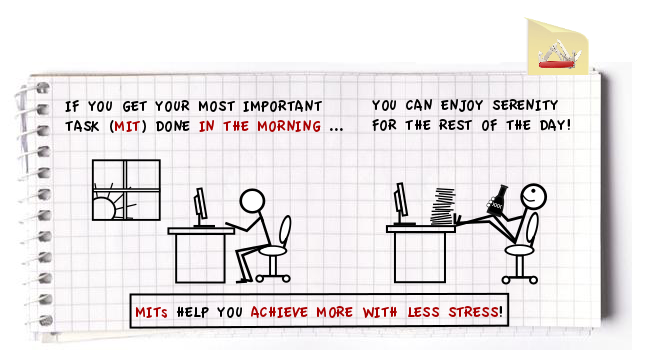
Over the past weeks, I have, however, attempted to become more disciplined about working through the critical path. And, I do this by resolving to work on nothing but the highest priority item.

3 notes from having done so –

1. This approach makes negative stress caused by things you control non-existent. With this approach, you know you’re always making the right decision and that feels great.
2. You give yourself more time to iterate and polish since you’re not pushing things till the end. As long as you take the time to prioritize frequently, this approach enables you to get ahead.
3. And, by getting really ahead of stuff, you can proactively push items early in the critical path so you get started and let subconscious processing work its magic.

Fighting the resistance, and thus building your willpower muscle, is a habit. It is one I’m working hard on.
critical pathImage Source

(A long PS: Critical path is a term that makes a lot of sense after taking a course in Operations Management. I was, however, fortunate to learn about the concept before graduate school from a story from Seth once shared on his blog . The technique of doing nothing but the higher priority item/”MIT” as in the image above is another one I learnt two years ago from Roy Baumeister’s fantastic book on Willpower. It sure has taken me a while to implement both these lessons and is a good reminder of how long it takes for me/us to really learn, synthesize and act on important ideas.)

Welcome to Foundry – setting expectations 101

Foundry Group venture capitalist, Seth Levine, shared his note to portfolio companies recently. A few of my favorite bits were –


I work for you. This is core to our operating philosophy at Foundry. Treat me like someone on your team.

Communication is key. The more information we share the better we can work together (for example, I’m happy to have access to your admin dashboard and pull the data or have you (or an internal system push it to me).

You can’t send me too many emails. Let me do the filtering, not you. Send me anything/everything you think is interesting/relevant. If I have something to say I’ll respond, if not I won’t (I generally avoid “thanks” kind of responses – you don’t need that filling up your inbox).

Leverage my partners. You should feel free to reach out to Jason/Brad/Ryan any time you’d like. We don’t silo at all at Foundry and everyone is available to you. Copy me if you want, or not – up to you. Assume that information is completely fluid on our end so anything you tell them I’ll be up to speed on as well.

My mobile number is xxx-xxxx. That’s the easiest way to reach me (text or voice).

I use Voxer a lot with others that like that communication method – let me know if you’re on that.


A good friend of mine regularly draws my attention to the art of setting expectations. And, this note from Seth was a fantastic example of how to set expectations.

And, on a different note, my favorite line in the post is one for team geeks –  “Assume that information is completely fluid on our end so anything you tell them I’ll be up to speed on as well.

That’s the sign of a fantastic team.

Thank you, Seth and Foundry Group team, for sharing.

setting expectations

Earphones at dinner

We were at dinner at a restaurant last week when a father, mother and their daughter (likely a teenager) sat down in the table next to ours. We were engrossed in conversation as we were catching up with a friend we hadn’t seen in ages.

A few minutes later, our friend said – “Check out the quality conversation at the next table.”  Sure enough, all three of them were busy on the phone.

Minutes passed. Dinner had been served but that was just a side show – they were still on the phone.

A few minutes later, we saw the teenager abandon all pretense and put on her headphones. The Dad seemed busy on WeChat. The mom alone was silently eating her dinner.

It isn’t unusual to see phones being used at the dinner table. Earphones, however, are a completely different matter.

That is, at least, what I thought.

But, are they any different? Pulling out our phone at dinner is us implicitly saying – “This is more important than the food and the people on the table.” So, what makes putting on earphones any worse than texting?

This, to me, speaks to the danger of marginal cost thinking. Just as saying “just this once” is a recipe for disaster, making an excuse for a “small thing” isn’t any better.

Small things, done repeatedly, become the big things.


Image source

Good relationships and the good life – The 200 words project

The Harvard study of adult development, one of the longest studies ever done, studied the life of 724 men over 75 years. The men were from 2 groups – a group that attended Harvard college in 1938 and another from Boston’s poorest neighborhoods. Every year, they were interviewed about their work, their home lives, their health, and were also tested medically with blood tests and brain scans. Over the last decade, the study also expanded to wives and children.

So, what did they learn? 3 common sense lessons about relationships –
1. Loneliness kills. People who were more isolated were less happy and had worse health.
2. It isn’t about the number of social connections but the quality of your close social connections. Living in the midst of conflict was found to be really bad for health.
3. Good relationships don’t just protect our bodies, but our brains. The memories of people with high quality relationships stayed sharper, longer. Good relationships were simply those where, despite disagreements, both people felt they could count on each other.

The good life, they found, is built on good relationships.

Many of the inner city Boston men ask us, “Why do you keep wanting to study me? My life just isn’t that interesting.” The Harvard men never ask that question. – Robert Waldinger :D

Image Source


Source and thanks to: TED talk by Robert Waldinger, the 4th Director of the study

Behind the curtain

1: A wise friend’s friend and ex-colleague, an accomplished entrepreneur, was once in a room with one of the richest, most successful businessmen of our time (let’s call him Mr.Forbes). They were discussing a potential business initiative and Mr.Forbes seemed to be behaving somewhat difficult through the discussions. He seemed to be putting an undue amount of pressure on himself to make absolutely sure the venture would be a big success. After the meeting, this friend asked one of Mr.Forbes’ close friends and associates about the behavior. “Yes” – the friend acknowledged, “he’s just very hard on himself because he’s worried people think of him as a one trick pony.”

2: David Heinemeier Hansson, the co-founder of Basecamp, has a fantastic post in 37 Signals blog about “The day I became a millionaire.” In the post, he shares what many of us know deep in our hearts. After a certain point, money doesn’t make you any happier. Of his realization, he says –

If anything, I began to appreciate even more intently that flow and tranquility were the true sources of happiness for me all along. It was like I had pulled back the curtain on that millionaire’s dream and found, to my surprise, that most of the things on the other side were things I already had. Equal parts shock and awe, but ultimately deeply reassuring.

He adds –

I can only speak to the experience I did have. The one I do share with millions of people who have the basics taken care of, but who still yearn for the treasure perceived to be behind the curtain. For those who might contemplate giving up all manners of integrity, dignity, or even humanity to pull it back.

3: In a conversation with a couple of close friends recently, one of them pointed out that my point of view on someone’s behavior is likely because of “negative goggles.” It was a comment that made me pause and ask myself a couple of questions – “Am I aware of an unconscious bias in my judgment of the situation?”, “Am I being judgmental when it isn’t necessary?”, and “Am I giving with expectations?” It didn’t take me long to answer these questions. I cleared myself of the unconscious bias and I believed I was applying judgment only when concerned with the specific discussion. But, I did feel I’d given something in this situation with certain expectations. The nature of the situation was such that I felt myself entangled in it and I hadn’t let go. That wasn’t something I’d intended to do and the conversation helped me take a simple step that helped me resolve it.

These stories and a certain friend’s recent experiences have exposed me two truths –

1. When you don’t have your basics, i.e. shelter, food and security (or the lower ends of Maslow’s hierarchy of needs), taken care of, life is a fight for survival and making ends need. This happens to us occasionally during times of adversity. In such cases, our life has little do with our sense of self. If you are the daily wage laborer who has to work 16 hours to make ends meet, you don’t have time for much reflection. Even if it might make your life better, your priorities are different – it is about earning your bread and notching up a win for the day. Similarly, if your kid is very sick, your own well being is put on hold as you care for your kid. Again, during such times, it isn’t about you.

behind the curtain, life, needs, self

2. Once you do have your basics taken care of, life, in many ways, is everything you do with your sense of self. Notice how the upper pyramids have to do with love/belonging, esteem and self-actualization. For example, to be loved, you have to be, and feel, lovable. This is what lies “behind the curtain” of most human beings you and I know.

It is this struggle that explains Mr.Forbes’ behavior. It is this struggle that David Hansson refers to. And, it is this struggle that I went through this morning. The quality of our lives has everything to do with how we feel about ourselves. It doesn’t matter how much wealth or material success we have. If we don’t feel good, life isn’t going to be good.

So, how do we feel good or love ourselves? Here, I will go back to Scott Peck’s definition of love – “The will to extend ourselves for our own or another’s spiritual growth.” Or, to put it simply, to love, we must grow. And, to grow, we must love. Growth doesn’t come easy, of course. Self-growth is a constant cycle of learning, reflection, control and awareness. It is a cycle of – self-control -> deliberate action -> reflection or self evaluation -> self knowledge -> self awareness. It is easier to not complete the loop. Self evaluation is painful. I have been working over these years to give without expectations. And, yet, when I caught myself doing so this morning, it pained me. But, ignoring it isn’t going to solve the problem. Response is. And, now that I know this happens, I can be more aware and exercise better self control next time. It is an incredible loop. But, it is hard work. You can avoid this loop for a while (for years, in case of some people), but the pain felt as you grow is nothing compared to the pain felt when you don’t.

It is always better to do the work.

As Scott Peck says –

Life is difficult.
This is a great truth, one of the greatest truths. It is a great truth because once we truly see this truth, we transcend it. Once we truly know that life is difficult-once we truly understand and accept it-then life is no longer difficult. Because once it is accepted, the fact that life is difficult no longer matters.

It doesn’t matter who you are. The fact that life is difficult remains unchanged. If you, like me, are blessed to be free of worries around your basics, maybe this ought to be a reminder that our life is ours alone and we make of it what we will. It is best spent when we stop wondering what is behind the curtain of other people’s lives (especially those who’re more wealthy or more successful by some measure or other) and become better at loving ourselves.

So, it all comes down to this – we’ve been dealt a hand of cards. It isn’t easy to play it right. But, choose to grow, and we have the opportunity to make it meaningful, to make it count.

It truly is a wonderful life.

Desiderata

I was reminded of the poem Desiderata yesterday. I thought I’d share some of my favorite lines from the poem-

Go placidly amid the noise and haste, and remember what peace there may be in silence.

If you compare yourself with others, you may become vain and bitter;
for always there will be greater and lesser persons than yourself.

Take kindly the counsel of the years, gracefully surrendering the things of youth.

Many fears are born of fatigue and loneliness. Beyond a wholesome discipline, be gentle with yourself.

And whether or not it is clear to you, no doubt the universe is unfolding as it should.

I first heard about Desiderata around this time 4 years ago from Gary, an inspirational shoe repair shop owner, in London.

That last line, in particular, is one I’ve thought about and shared repeatedly. It resonated deeply with me as it came to me at a period when I was struggling with letting go. I won’t say I’m fantastic at letting go now but I think I’m infinitely better than I used to be.

So, yesterday, when I caught myself fretting at a minor disruption to my plans, I remembered Desiderata and realized that it was time to take a deep breath, take stock and move on.

The universe is unfolding as it should.

Not perfect

The easiest way to get rid of the obsession with perfect is to simply commit to doing a few things consistently. Imagine you conducted a certain kind of meeting every week. Some weeks are going to be great and some, well, not so great. That’s the beauty about committing to something consistently – you understand how hard it is to repeatedly do simple things right.

It doesn’t mean you don’t hurt when you walk out of something you did knowing it wasn’t perfect. But, you do become more tolerant of the idea over time and make peace with it.

For example, on most days, after I finish writing here, I do a bit of editing and find myself saying – its not perfect but it works. On the rare occasion, I do manage that perfectly edited post. On most days, however, I don’t. There’s always the next thing I need to get to and the aim is just to do my best given the constraints.

My learning has been that perfection is what you make of it. There isn’t any objective measure. In my case, perfection here is thinking about what I’ve learnt, showing up every day and doing my best to communicate these lessons in a manner that makes sense and that, every once a while, leads to something insightful.

The results don’t always reflect it but I’ve learnt to make peace with that and trust the process. As Dory might say, what really matters is that we keep swimming.

not perfect, keep swimmingSource

Working capital and cash conversion cycle – MBA Learnings

Let’s imagine a company we called Nile, Inc. Nile is a vegetable retailer who has the following metrics –
Cost of Goods Sold (COGS) = $365
Average inventory = $10 (they have low levels of inventory in general)
Sales = $1095
Accounts Receivable = $30
Accounts Payable = $30

Based on these metrics, we can do the following calculations –

Inventory turnover = COGS/average inventory = 36.5
Nile, Inc. turns over its inventory 36.5 times a year. That’s a good sign. The more turns means the more efficient its inventory buying process.

DSI or Day Sales Inventory = (1/Inventory turnover) *365 = 10 days
This means it takes Nile, Inc. 10 days to convert its stockpile of inventory into cash. If Nile turned its inventory slower, it would take longer. Since it is a vegetable retailer, we can imagine it requires to turn fresh produce quickly.

Receivables Collection Period = Accounts Receivable / (Sales/365) = 10 days
This means it takes Nile 10 days to collect its receivables. This is common in businesses that work with consumers as credit card money comes in within 5-10 days.

Payable Period = Accounts Payable / (Sales/365) = 10 days
Nile takes 10 days to pay its suppliers – a short payable period for most businesses. But, this is on account of Nile’s size. As Nile grows, it is can extract longer payable periods (e.g. 100 days).

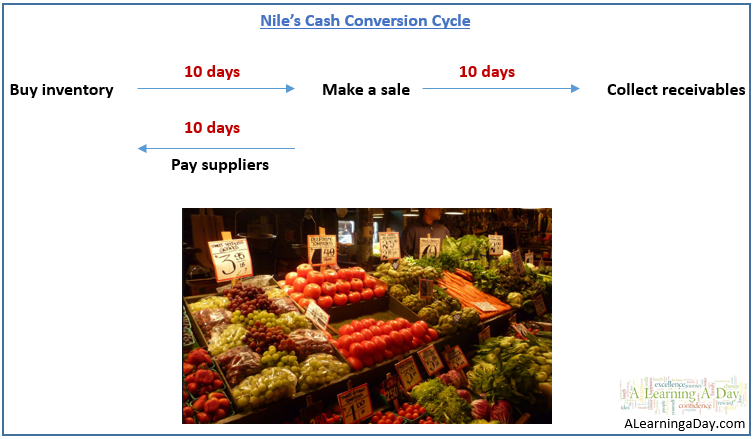
So, if we now think of what this looks like –

cash conversion cycle, working capital

So, Nile takes 20 days to convert inventory to cash – 10 days to convert it from inventory to a sale and 10 more days to convert the sale to a cash. However, since it takes 10 days to pay suppliers, we can now reduce the  20 day number to 10 days.

10 days is Nile’s Cash Conversion Cycle. The Cash conversion cycle is an important idea since this means Nile requires 10 days worth of “working capital” (Current Assets – Current Liabilities on the balance sheet) to keep its business solvent. Since, at any given point, Nile will require enough cash to support 10 days of operations, if it doesn’t have the cash itself, it will always need access to a revolving line of credit that can make sure the business runs. Reducing the cash conversion cycle is an attractive prospect for most small businesses as it means less dependence on external capital. It also reduces the working capital requirements of the firm.

Amazon is an example of a firm that does an outstanding job with working capital management. Amazon’s cash conversion cycle (CCC) is actually negative. This means Amazon receives cash very quickly, turns over its inventory quickly and takes much longer to pay its suppliers. So, the business is practically throwing off cash. Negative CCCs work well for growing businesses. However, when a business stops growing, these cycles can be painful since it means you have to pay your suppliers greater amounts than you make.

Aside from a thank you to all our Finance professors, I’d like to also give a thank you shout out to Prof Aswath Damodaran from NYU Stern. Prof Damodaran has some fantastic resources available online for different kinds of finance problems.

Stacking meetings and owning your calendar

If ever there was a principle for managing your schedule as a knowledge/office worker, it would be – “Own your calendar.” Until you have help to do this for you, take those few extra minutes every day to own meeting invites yourself where possible. This will enable you to do two things that add value –

1. You can stack meetings so you have more uninterrupted gaps to do focused work
2. You an group meetings on a certain project to avoid unnecessary context switching

While switching contexts fewer times in a day is a big win, I think the biggest benefit is more uninterrupted gaps. As long as you get into the discipline of switching off your notifications during uninterrupted time, these stretches will end up being among the biggest sources of value you add to the world.

An uninterrupted stretch isn’t a guarantee that you’ll end up doing work that matters. But, it sure maximizes the chances.

Calendar, stacking meetings, owning

Inspiration without structure

Many organizations spend hundreds of thousands of dollars to bring in inspirational speakers to speak to their employees. When employees walk away from these talks feeling inspired, it all seems worth it.

structure, inspirationSource

But, when they go back to their desks and get to work, reality hits them. While the talk inspired them to think about innovative ideas, their organization never really encouraged innovative ideas. Sure, they said they wanted more of them. But, you always found yourself embroiled in organizational politics when you attempted to push change through.

Leaders and managers often wish for a more inspired work force. But, in situations like this one where there are no structures to support inspired employees, inspiration can often be counter productive. Employees in such organizations walk away from attempts at inspiration feeling frustrated and cynical.

There are two important takeaways for us as leaders –

1. If we seek to inspire our team, the most important thing to do isn’t to give an outstanding talk about why we do what we do. It is to provide the structure within which our team can go out and express themselves. This means providing them clarity on why we do what we do, establishing clear norms and expectations on how we do our work (our culture) and being open to helping them define goals that help the team move forward while also helping them to learn, grow and hone their abilities. Structuring work well requires openness to change and a great deal of thought as good structure needs to provide a certain amount of flexibility without it feeling like anarchy.

2. If we seek to be inspired ourselves, no amount of inspiration will help if we don’t have structures in our life that help support doing work that matters. This means a world class collection of habits that help us focus through the day, be present with our loved ones and take care of ourselves.

Inspiration without structure is like an artificial flower – it looks good from a distance but it doesn’t feel or smell like the real thing.