Deconstructing critic behavior

Behavior is a function of 2 things – a characteristic of the person interacting with a characteristic of the situation.

This is a simple yet powerful definition as it helps us understand why different people react to the same situation differently. And, most importantly, it explains why the same person might react to the an identical situation differently on different days. It all depends on which characteristics are interacting at which time.

Seth had a fantastic post on “Reading between the lines” the other day when he cautioned against analyzing rejection too much. His conclusion was –

If you really want to know why someone didn’t like your work, you’re going to have to put a lot more effort into it understanding the person who rejected you. Reading the tea leaves in the rejection letters and one-star reviews is pretty worthless.

I was part of a team that ran an event for a diverse group of 600 people last year. And, while we had many positive reviews, a bunch of indifferent reviews, we also had a few one star reviews. In one of these cases, one of the one star reviewers took it out on one of our team members about how she hated us for it. And, as discussed it the next day, we came to the same conclusion – when you get such a strong reaction, this isn’t so much about the situation itself, but the person. It is similar to the idea – “If you are angry or bored, it is really your problem.”

This is not an easy lesson to learn though. This is because there are very few people (~5%) who “build.” Most of the others spend most of their time either maintaining or criticizing. So, the small proportion of builders get a disproportionate share of the negative feedback since the critics tend to react negatively to change. But, Seth’s post is a great reminder that we ought to read into the constructive stuff and ignore the rest.

And, in this case, perhaps revisit this definition of behavior and remember that behavior is caused by an interaction of 2 things – so, it is not all about you.

critic behavior
Image Source

From wholeness and not from wounds

An idea from author Shefali Tsabary that has stuck with me since I first heard it is – “Parent from wholeness, not from your wounds.” In saying this, she refers to parents having a choice – to parent from love or to parent from insecurities. We all either know this first hand or have seen the difference. Parenting from wounds typically demonstrates certain patterns like – parents who push their kids to achievements they wish they had, parents who bully their kids because they got bullied themselves, etc.

I heard of a student suicide yesterday from the same high school I went to. While it is definitely a horrible experience for any parent to go through, I understand that the student’s reason for doing so was that he felt he was a disappointment to his parents. The apparent recurring conversation in the house was that his results weren’t living up to the sacrifices his parents had made and he said so in his note. Unfortunately, such conversations are far too common. I’ve spoken to many who’ve grown up feeling inadequate simply because they felt they’d disappointed some “loved” one (I use love in quotes because that definitely isn’t love). And, in one phase of my life where I chose to be loyal to someone who exhibited similar characteristics, I remember feeling horribly inadequate and occasionally depressed.

I think Shefali Tsabary’s idea can be extended to all of life to say – “Live from wholeness, not from your wounds.” It doesn’t really matter which relationship it is applied to. If we have close relationships, let us be lights, not judges. When it doesn’t work and when we feel ourselves reaching to our wounds, let’s learn to understand those triggers and walk away. And, if we can’t walk away because of the nature of our relationship, maybe it is a sign that we ought to grow out of those wounds.

Life is too short to live in the unhappy throes of pain, fear and insecurity. There’s enough of it going around. A big part of living a good life is developing the courage to recognize that being happy and loving from wholeness is not about conquering our demons, but about realizing that there are things more important than paying attention to them.

Talking out of and acting out of problems

There’s a great story in the late Stephen Covey’s 7 Habits book that I think I write about at least once every year. A man attending his seminar complained to Covey that his wife kept calling him every hour to check on him. He just couldn’t seem to get her to be reasonable. Curious, Covey asked him how they’d met.

The man sheepishly said that he’d met her at another seminar and cheated on his ex-wife.

“You can’t talk yourself out of a problem you’ve acted yourself into” – were Covey’s wise words.

It is an idea I think about every once a while. I led a discussion yesterday when we were discussing reactions to a mistake that was made in the past weeks. Our responses to it were all over the map. After we heard from everyone, however, I didn’t have any intention for us to attempt to explain away the mistake. It happened. It sucked. We learnt from it. Not everything was going to be perfect. But, we’d pick up the pieces and move on. As with these things, I just hope we have a track record of action that far exceeds the one stumble. And, besides, if we were going to right the issue in the future (and part of it was acknowledging we might not be able to), we were going to do so by acting our way out of the problem.

“You can’t talk yourself out of a problem you’ve acted yourself into” is another way of saying “Don’t listen to what people say, watch what they do.” It is my belief that this understanding is a bedrock of emotional intelligence. It is a lesson I’ve learnt the hard way and is one I try to remember as I go about my days.

acting out, talking out of problems, acting out of problemsImage Source

Seriously – what you do and who you are

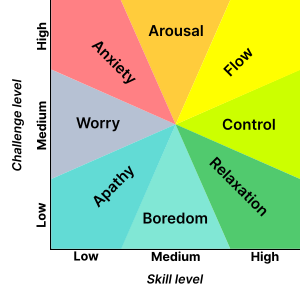
Experiencing flow requires us to take some things seriously. Taking a craft or a hobby or a job seriously means we care both about developing skills and, then, testing those skills by challenging ourselves.

taking what you do seriously, serious, flow, challenge,(Thanks Wikipedia for the image and Prof Mihaly Czikszentmihalyi for the gift of “Flow”)

Since experiencing flow has been shown to be an essential part of living a fulfilled life, taking nothing seriously is a sure-shot route to unhappiness.

However, once you start taking what you do seriously, you can fall into the trap of taking yourself seriously. As we immerse ourselves in what we do and tend to identify ourselves with what we do, we can often lose sight of the lines that separate what we do and who we are; even if what we do is one of the surest expressions of who we are and what we stand for – so, the relationship is definitely complicated. However, the blurring of these lines is both trouble and a recipe for the sort of insecurity and unhappiness that accompanies a loss of perspective.

So, by all means, take your craft seriously. But, be wary of taking yourself seriously.

(Filed under “note to self” :-))

Transparency and full disclosure

Full disclosure is when we share everything we know with our stakeholders.

Transparency, however, is focused on what our stakeholders need to know. It requires us to understand them and, most importantly, make a few judgment calls on what works best for the particular context.

There is a whole collection of organizations that runs teams built on a complete lack of transparency. That approach can work (Apple is a famous example) but it makes certain important assumptions on how innovation occurs. The belief system in such places is that a collection of central teams of innovators knows the answers and create the path for everyone else.

For everyone else, transparency offers a path to building trusting, innovative teams and organizations. The challenge in these cases is striking the balance between transparency and full disclosure. There is a time and place for both. But, the onus is on us to make sure we understand when each must be used.

(Having made the mistake of leaning on, and being burnt by full disclosure one time too many, I’ve learnt that it is probably safer to err on transparency as a default)

HT: The trust radar in Reputation Rules by Daniel Diermeier – for a clear explanation of the difference between transparency and full disclosure in the realm of crisis management. Transparency is the first step in Prof Diermeier’s “trust radar” below.

full disclosure, transparency

Buying jeans

Like you, I’ve bought jeans since I was probably 10 years old. The nice thing about buying jeans once you are past your adolescent years is that they stay with you for a long time. I think one of my pairs is 10 years old and I still love it.

As I was largely using 2 pairs of jeans and since one was rapidly deteriorating, I decided to buy 4 more pairs of jeans over the course of last year since I wear jeans every day and since my job after graduation won’t require me to wear formal pants anymore. In doing so, I unwittingly ran it as an experiment. In the first run, I bought what I thought was the perfect pair of jeans as it was just the color I was looking for. However, as you might guess, there’s more to a good pair of jeans than color and I realized a few days in that the pair didn’t feel comfortable. I still wear it but I don’t love it.

In my next round of jeans shopping, I decided I would prioritize feel. And, so, I did. The pairs turned out to be very comfortable. But, I realized that one of the three pairs had a really small pocket. This makes carrying my collection of items – a phone, headphones, a handkerchief (old fashioned, I know), a Fitbit and a key nearly impossible. So, I use that pair slightly less than I’d have hoped.

Now that I’ve bored you with what must seem like painfully minor details about my wardrobe, let me get to the lessons I’ve learnt –

1. Things that seem obvious often aren’t so. You’d think I would know how to buy a good pair of jeans by now. But, I only figured the process out with experimentation. My priority list expanded from color to comfort to usability (pockets). This should have been obvious but, somehow, it wasn’t. A little bit of thought can help us get to the kind of clarity that makes things obvious.

2. Conscious buying is very important. I don’t like shopping. Maybe that explains the absence of a priority list for buying jeans? I do my clothes shopping in a few hours once or twice every year. As a fan of a generally minimal wardrobe (everything I own can easily fit into 2 suitcases), being conscious while purchasing clothes is very important. That is the only way to minimize waste and make sure I make full use of whatever I buy.

3. The scientific method. The process of experimentation is vital to making good buying decisions. Jeans are a very rare buy in my case. It has been at least 4-5 years since I’ve bought a pair. As a result, I wasn’t high up on the learning curve. However, I’ve bought t-shirts more often and I’ve gotten much better at buying t-shirts that I actually like and feel comfortable wearing. This wasn’t the case a few years ago. But, you experiment and learn.

A bit of thought tends to go a long way.

buying jeansImage Source

The Power of Glass – The 200 words project

How often do we think about the impact glass has on our lives?

Glass making became mainstream as part of the Roman Empire. However, innovation occurred when glass makers from Constantinople relocated to Venice (the world’s top trading hub) after its fall. Since making glass involved high temperatures, accidents resulted in Venetian buildings being burnt down. So, all glass makers were exiled to the Venetian island of Murano. This led to an era of innovation among glass makers thanks to experimentation and sharing of ideas.

While the invention of the printing press has been lauded for its role in spreading radical ideas, it led to an important realization amongst now-literate common folk – they couldn’t see! The inventors from Murano rose to the challenge and churned out 3 massive innovations – spectacles, the microscope and the telescope. Within 20 years, Galileo had made the telescope famous. While it took longer for the microscope to have mainstream impact, Robert Hook’s study of insects and corks in the 1600s resulted in the naming of a fundamental building block – the cell. Discovery of microorganisms and vaccines followed.

In terms of impact, however, glass was just getting started. More next week.

A world without glass would strike at the foundation of modern progress: the extended lifespans that come from understanding the cell, the virus, and the bacterium; the genetic knowledge of what makes us human; the astronomer’s knowledge of our place in the universe. No material on Earth mattered more to those conceptual breakthroughs than glass. – Steven Johnson


Image Source


Source and thanks to: How We Got To Now by Steven Johnson

The benefits of being tough with yourself

I found 5 posts in the archives when I searched for the phrase “be kind to yourself.” I’m sure there are many other posts that have variants of that message.  A big part of learning is being able to take failure in your stride and move on. And, a big part of my learning journey over the past few years has been learning to be kind with myself.

Today, I thought I’d offer you, and myself, the counter point. There are a lot of advantages to being tough with yourself. For starters, it is impossible to truly reflect and evaluate yourself if you treat yourself and your actions as perfect. For me, however, the biggest benefit is that it helps me not take criticism to heart. If someone tells me that something I did sucked, it is rare that it catches me completely by surprise. There is a good chance I gave myself a bit of a hard time for doing so. And, if I did that, I’m probably working away on a solution. (Being told you sucked still hurts of course – it just hurts less).

So, if you’re the sort who is tough on yourself, fret not. Be tough – push yourself to extend yourself, learn and grow. Just don’t be so tough that it stops you from doing anything at all.

For, mis-steps are guaranteed. What matters in the final analysis is that we create space for a creative, constructive and corrective response.

tough, being tough with yourself

(“Its tough being a kid sometimes” – this pic of the reflective kid cracked me up.)

The Piano Guys

Great music is a very special thing. I love listening to instrumental music when I need to buckle down and focus. Over the last few days, I’ve been tuned into an album called “Wonders” by “The Piano Guys.” I blogged about their wonderful rendition of The Lord of the Rings theme once three years ago. Their continued excellence since has converted me from occasional listener to ardent fan.

If you haven’t spent time listening to The Piano Guys, please consider this a new year’s/birthday/valentine’s day gift from me. The place to start would be their wonderful YouTube channel – aside from incredible music, their videos are very well made.

As hard as it is to share just one of their songs, I’d like to share one of my current favorites – Home by Phillip Phillips.

[embedyt] http://www.youtube.com/watch?v=aF-Z1A0ujlg%5B/embedyt%5D

Thank you, The Piano Guys team, for gifting us with great music and, in my case, productivity.

the piano guys

The first step to fixing something

is acknowledging that something is broken and taking responsibility for it.

When you do face the fact that something is broken, it is worth remembering that, when you committed to do something, you implicitly committed to the idea that it might not work. So, stumbling and falling are part of the deal. And, once you’ve stumbled or fallen, taking responsibility and picking yourself up is the only real way to get back on track.

The hardest step, however, is not the picking ourselves up. It is the acknowledging and taking responsibility.