The tension between relationships and processes

Every leader or manager faces one particular type of tension on most days – the tension between relationships and processes. The balance is hard to strike – lean one way and you  become too nice or lean the other and you become unnecessarily dogmatic.

The keys, in my limited experience, are as follows –

1. Understand what your natural leanings are. Depending on how you like to operate and what drives you, you will have a natural leaning to either being too nice or too strict with rules. Understanding this is critical to figuring out what you need to work on.

2. Communicate your expectations and follow through on consequences. Next, communicate your expectations frequently and clearly. Everyone working with you should have a clear understanding of the norms associated with working with you and what happens when they aren’t followed.

3. Treat different people differently. Finally, keep an eye out for spectacular performance. Every once in a while, you are confronted with spectacular performers who feel that the norms and processes get in the way. The more creative the endeavor, the higher the chances you will meet with rule breakers. Again, there isn’t so much of a right answer as much as there are two questions – how much of the rule bending can you make peace with? and, most importantly, at what point does the rule breaking affect the culture of the team?

As with all good tensions, what matters isn’t the answer. What matters is repeatedly asking the question, looking inward, communicating clearly and doing the best to balance the various forces at play.

It isn’t easy. Mistakes are guaranteed.

But, that’s how we get made.

Tension(Image combined from 1, 2, 3)

Falling is guaranteed

It is impossible to learn how to skate or ski without falling. When you’re skating, you just learn to fall in a manner that doesn’t break any bones. When you’re skiing on the other hand, falling on your face is totally fair game.

Falling is such a critical part of the learning experience. First, you learn how to fall. Next, you learn how to pick yourself up and get back on track. And, over time, you learn how to not fall. Putting all your energy into not falling when you start only impedes your learn curve. Learning wouldn’t be possible without falling.

The challenge is that falling and failing are often viewed together. They seem to be similar and they’re even spelled similar. However, falling is just the falling down. Failing is the staying down.

Falling is a guaranteed part of the learning experience. Failing is not.

"Falling is guaranteed"Image Source

10x, not 10% – The 200 words project

The Eastman Kodak company in its heyday was like the modern day Google. As the chart below shows, its success was thanks to the dominance of film cameras – at one point, Kodak captured 90% of the film and 85% of the camera sales markets in the US. Then, digital cameras entered.

Kodak, 10x, not 10%

Were digital cameras a surprise to Kodak, then? Absolutely not. The digital camera was invented in 1975 by Steve Sasson – a Kodak engineer. However, when Sasson showed his invention to executives, management squashed the idea. While it is easy to criticize Kodak executives given hindsight, they did the rational thing and protected their highly profitable business line. Kodak, like many companies, was more focused on growing at 10% than by 10x.

While this note could be one about companies learning to disrupt themselves, this idea can be applied just as easily to personal productivity as well. Very often, we focus on 10% improvements over changing the way we approach things – simply because the small change feels easier. If we can’t bring about massive changes to our own habits, how can we point fingers at Kodak?

If Kodak executives had asked what it would take for the world to snap one trillion photos a year, a new understanding would have emerged. Clearly, you wouldn’t get there by selling film. – Ken Norton


Source and thanks to: Ken Norton’s essay – 10x, not 10%

Tim Cook on RoI

VentureBeat had a nice article yesterday on Tim Cook becoming the Silicon Valley’s conscience with his stand on various important social issues. There was one anecdote that stood out –


In March 2013, I was in Cupertino for Apple’s annual shareholder meeting. After 18 months leading Apple, Cook had been feeling some heat from investors over the stock’s performance. During the meeting, Justin Danhof, director of the National Center for Public Policy Research’s Free Enterprise Project, had criticized Apple for its connection to industry groups that believe global warming is caused by human activity. At one point, Danhof confronted Cook and asked him to commit to only taking on projects that help the environment or fulfill other social justice aims if they directly benefit Apple’s bottom line.

Cook, clearly trying to remain calm, shot back: “When we work on making our devices accessible by the blind, I don’t consider the bloody ROI [return on investment]. When I think about doing the right thing, I don’t think about an ROI.”

Cook then offered his own bottom line to Danhof, or any other critic, one which perfectly sums up his belief that social and political and moral leadership are not antithetical to running a business. “If that’s a hard line for you,” Cook continued, “then you should get out of the stock.”


In our push to hold people accountable to something measurable, we’ve long attached ourselves to metrics such as returns to the shareholder, RoI, etc.

All that’s good and very important – especially when you are starting out. But, once you are solvent and reasonably successful, it is your responsibility to work on projects that create long term good in the world. If not you, then who? The RoI may not be as good as an existing project that sells something to people who don’t fundamentally need it. But, it doesn’t matter. Just because an RoI is easily measured doesn’t mean it is right to measure it at every excuse.

Some of the most valuable things we do are things that aren’t easily measured and that can’t easily be quantified.

Thank you for showing us the way, Tim.

RoI, Apple, Tim Cook

When playing law enforcer

2 things help a lot when you are playing law/policy/rule enforcer –

  1. Take a moment to understand why the law exists in the first place
  2. Explain the rationale to the person you’re speaking to

Doing this helps avoid two issues that make such interactions tasteless – mindless policy-itis and a lack of empathy. Mindless policy-itis is when we say “It is not possible because that’s not how we do it here.” And, a lack of empathy is when we just shove the rule on someone’s throat without ever taking the time to understand why they might be asking for clarification or an exception.

Norms, rules, policies and laws are very important. But, when they don’t involve life and death situations (and, instead when they deal with – “Can I get a refund?” or “Can I return that product?” or “Can I please come to this event?”), it is worth revisiting why they were created. Every once a while, we might just realize it is worth making an exception or, in some cases, realize it is worth re-writing the rule.

law enforcer

The main thing

It is going to soon be 8 years of daily writing on this blog. During these 8 years, I’ve spent 2 years or so as an undergrad, 4 years as a consultant and about 2 years as a graduate student. During this time, there have been a collection of other projects on the side. But, in every one of these phases, there always was a “main thing.”

Toward the end of my undergraduate years, it was finding a job. As a consultant, it was delivering quality work for clients. And, as part of my graduate student experience, I’d say thinking about career direction, then switching careers and now preparing to give it my best shot is the “main thing.” For simplicity, I’m going to categorize all of these under “Professional” and put everything else I do with my time under the “Personal” category. If I have to now think of the “main thing” personally, it has always come down to one thing – building and maintaining a collection of strong, meaningful personal relationships.

I call these the “main thing” because there is such an incredible amount of noise – more so today than ever before. There are so many avenues for people to hear about what you’re doing and give you feedback – whether or not you want or need it. But, if you’re looking to create value, it is particularly challenging to cut through the noise and focus on what matters. Do the number of likes on your most recent post really matter? What about the number of people who said they’d come to that event you’re hosting?

The “main thing” idea is very helpful because it puts everything you do in perspective. For example, when I go back to the full time work world in 3 months, the main thing professionally is doing great work. Everything else is secondary. If I am able to do that, it is likely it will spill onto everything else I do – e.g., I will likely have richer insights to share here. And, if all goes well, insights from the act of reflection here will spill back onto my work. But, the main value driver in the long run will still be the work. Similarly, I may have 2000 friends on Facebook but it won’t matter if I don’t feel strongly connected to a small group I trust. As Stephen Covey once said, the main thing is to keep the main thing the main thing. This isn’t easy but having clarity on this greatly helps separate the signal from the noise. And, the quality of our lives is directly proportional to the ability to keep the main thing the main thing.

Once you identify the main thing, it is easy to understand what single thing you do drives value. In my case, that single thing is “deep work” time – time I have carved out where I am focused 100% on my work or the important people in my life. No email, no phones and no nothing else.

So, simplifying this whole thing further, the quality of my life is directly proportional to the amount of time I spend in deep work mode. You might object to calling time spent with those close to us as “work.” But, I’d argue being 100% present takes work. Mindfulness, the same concept as “deep work mode” is hard.

It was only a year or so ago when I first realized this. And, it has greatly simplified how I think about my day and my life. Over the past 3 months, I’ve been working hard to be more mindful about scheduling “deep work” time. And, yesterday afternoon, I felt a certain discomfort as I was about to get some food. As I dug a bit deeper, I realized that I was feeling that way simply because I hadn’t spent a chunk of time in a state of depth for 2 days. Something or the other had come up and I had worked on multiple projects and felt my attention was very fragmented. I was itching to sit down, shut off distraction and focus on an afternoon and evening spent in depth. So, that’s what I did. And, it felt great.

Through all of this, I am probably most pleased about that discomfort I experienced. It reminded me to do what drives value in my life. And, long may that continue.


the main thing

Responding to mockers and haters

I shared a post on “To do” Archives yesterday with a picture of my own archives list. While it is possible to author blogs (possibly even daily ones) on specific topics without revealing a whole lot about yourself, I’ve found it nearly impossible to write one based on learning without baring your soul. I say that because so much of what we learn is based on who we are. So, in writing here every day, I definitely end up sharing my quirks.

One of my quirks, for example, is my morning routine – a topic I’ve written about plenty of times. Getting that first hour and a half right is an important part of starting the day and I love building momentum by checking off a few simple tasks. In this case, I shared a screenshot of my lists yesterday and I can still remember the trepidation when I used to share such stuff here a few years ago (even if there was barely anyone who read it). I still find it a bit uncomfortable. That discomfort doesn’t go away with time – I think you just develop a thicker skin.

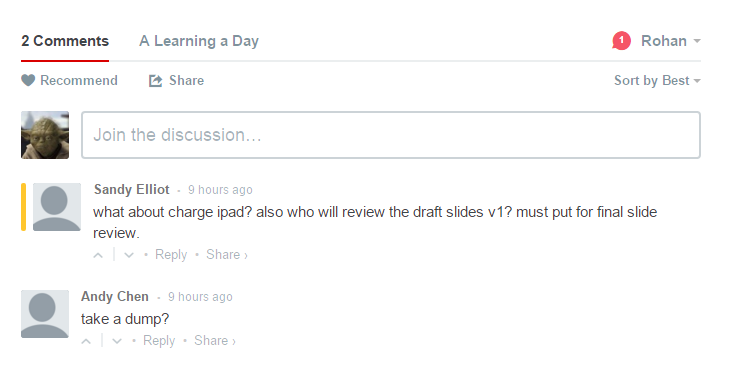
I woke up this morning to 2 comments from yesterday’s post mocking my lists.

responding

The reaction a couple of years ago would have been that uncomfortable feeling of the muscles in the stomach constricting followed by a need to either say something sarcastic or perhaps vigorously defend why the lists are the way they are.

But, the beauty of doing this for a long time is that you learn, over time, to see the light side and keep a bit of perspective. When you take a few leaps and put yourself out there, it is always possible for you to fall flat on your face. Sometimes, even without falling flat on your face, there are people who stand on the side laughing at your attempt.

But, if you do happen to be one of those leapers, you are generally very empathetic of others who’re out there giving it their best shot. Yes, it doesn’t always work. And, no, it isn’t always perfect. But, in putting themselves out there, they’re attempting to be the best they can be. And that, to me, deserves all the respect in the world.

So, my suggested response to those who mock you is to just walk away. It isn’t worth engaging. I’ve found it much more worthwhile to move onto building the next thing.

(A side note: There exists an age-old philosophical debate among bloggers about whether or not you should turn off comments. Seth Godin is one of the strong proponents of turning them off while many others, e.g. Fred Wilson, are big proponents of leaving them on. I’ve found more positivity than negativity as a result of leaving them on. However, this can change as you move from a small-time blog as in my case to a large blog with a lot of haters and trolls.)

Keeping a To do Archives file

I’ve used Microsoft OneNote as my “to do” list tool for 8 or so years now. Over time, it has become more of a life organization tool and has records of my thoughts on nearly every project I’ve worked on in the past few years. However, I use it most to list and work through key priorities and tasks – so, it is a nearly always open on my laptop.

Two years ago, instead of deleting my list of tasks once I was done for the day, I began transferring it to another OneNote file I call “To do Archives.” This “To do Archives” file has a daily chronological list of all tasks I’ve completed in the past two years.

I think I started doing this because I thought I might find it useful. I’ve probably checked in once a while for specific purposes – more so at the identical OneNote file at work. But, the real benefit of doing this has been something intangible – every time I start the day and transfer a few of the morning routine items to this list, I see this vast repository of tasks and feel a sense of positive momentum. “I’ve gotten so much done all these days. Why should this day be any different?”

And, indeed, why should it?

Momentum is a beautiful thing.

Todoarchives2(Example archives from last week – with names removed)

What do I need to believe for this to be true

Clay Christensen boiled the art of providing recommendations about the future to one very insightful question – “What do I need to believe for this to be true?”

I was working through an interesting problem recently and was trying to understand why I was convinced solution A was the best solution given the context. Bringing it back to this question led me to identify the two key assumptions that I needed to believe for this to be true. We, then, wrote those assumptions down so those who might struggle with the same questions in future years could revisit the assumptions and check if the context still held true.

Listening to your gut/intuition is an important decision making tool as your intuition often sees patterns before your conscious mind can process it. However, if you want to continue learning from the decisions you make, it helps taking a few moments to ask yourself – “What do I need to believe for this to be true?” The moment you put down those assumptions, you create a ready-made decision making process – both for yourself and others.

what do I need to believe, assumptions

Fiber Optics and Selfies – The 200 words project

Thanks to its unique properties and ability to manipulate light, glass (continued from last week) lenses led to cameras and, thus, photography, videography, television and movies.

However, glass’ next biggest impact came from fiber glass. Fiber glass’ properties made it extremely useful for materials ranging from jet engines to computer chips. In time, scientists found ways to send signals via fiber glass and that, in turn, resulted in fiber optic cables which were much more efficient than copper wires. Thus, a string of fiber optic cables transports all information (cue: hundreds of selfies) between North America and Europe. Amazing!

All these advances have led to never ending jokes about the selfie epidemic. However, selfies aren’t a new thing. Drawing self-portrait was an obsession among artists. However, self-portraits didn’t exist till the 14th century – until our band of Murano glass wizards coated the back of glass with an alloy of tin and created the first mirror. Until the fourteenth century, it was impossible for people to see a clear image of themselves.

As with many things in modern life, it begins and ends with glass.

(Note: While glass making changed so much after it became mainstream, the reason the invention of glass took so long was because of the high temperatures required to make it. So, we ought to tip our hats to the inventors of the furnace who made the magic of glass possible. :))

The World Wide Web is woven together out of threads of glass. – Steven Johnson

fiber optics, selfiesImage Source 


Source and thanks to: How We Got To Now by Steven Johnson