I know what I need to do

I know what I need to do. It is going to be painful, hard and, truth be told, the resistance is screaming in my ear asking me to figure out ways to avoid it.

There are definitely ways to avoid it.

I can choose to ask many people for their advice and choose to listen to someone who shines light on an easier path.

I can choose to make a list and just begin working on other projects – never mind their priorities.

I can choose to listen to the resistance, complain and find ingenious ways to procrastinate.

Or, I can just suck it up and do it. Like most times, when I listen carefully to myself, I know exactly what I need to do and how it needs to be done. Perhaps, instead of attempting to figure out escape routes, I should just realize that the high anticipated pain and the strength of the opposition from the resistance provide the strongest clue that this is exactly the obstacle that needs to be overcome.

The obstacle is, almost always, the way.

resistance

The Chief of Staff

A close friend recommended the TV show “The West Wing” to us. We’re twelve episodes in and are loving it. The show is incredibly well written (thanks Aaron sorkin) and keeps you entertained on story, screenplay and dialog alone.

An incredible scene at the end of a recent episode has the President in conversation with the Agricultural Secretary as he’s leaving for “The State of the Union” address. The Agricultural Secretary is the person who is chosen to take charge in case there’s a disaster. The President gives him two minutes of advice of what he should do in case the worst happens. Then, he asks –

“Have you got a best friend?”
“Yes, sir.”
“Is he smarter than you?”
“Yes, sir.”
“Would you trust him with your life?”
“Yes, sir”
“That’s your Chief of Staff.”

It is an incredible scene because you see a wonderfully deep relationship between the President and his Chief of Staff. And, this dialog brings it all together.

The Godfather made the adage – “It’s not personal, it’s just business” popular. I think that is a sad way to approach the work we do. We often spend more time with folks we work than we do with our own families. And, many of my closest friends have come from the teams I’ve worked on.

In reality, it is business AND it is personal.

No pie charts

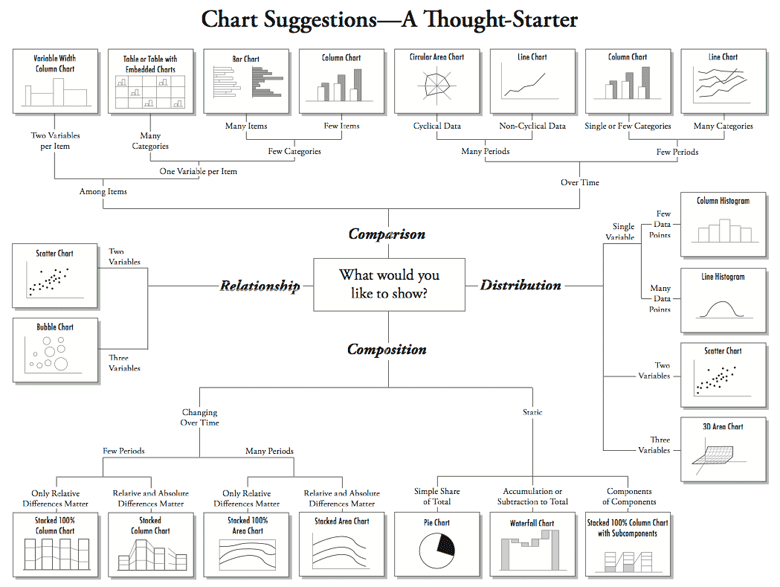
“Never use a pie chart.” – said one of my favorite senior consultants with a lot of passion. “For every case where you might want to use a pie chart, there is a better chart out there.”

With more data present than ever before, understanding how to visualize data is a useful skill. To that end, I thought I’d share a “chart suggestions thought starter” infographic. Most of it is common sense.

But, as you and I have likely experienced and been guilty of ourselves, common sense is not common practice.

chart-suggestions, data visualization, pie chartsThank you to the team at Extreme Presentation Method

Basic Income Guarantee

The reason hard real world problems are hard to solve is because the causes of real world problems are not simple to understand. What causes poverty, for example? If someone tells you there is one simple solution to the problem, you can be certain that person has gotten it wrong.

That said, with a bit of thought, we will likely be able to identify a few likely causes. But, identifying a lack of education as a cause for poverty only takes us so far. Bringing quality education to low income regions requires better infrastructure, better teachers and a general improvement in out-of-school lifestyle. Hard problems are hard for good reason.

Brussels was bombed thrice today – there is likely a strong link between these bombings and the attacks in Paris as the people behind the Paris attacks were known to have grown up in Brussels. Like poverty, a problem such as terrorism has multiple causes. We can be certain, however, that low household income is a cause. Poverty and crime tend to go together.

Over the past few years, we’ve been hearing increased agitation around the subject of income inequality. The various “occupy” protests from a few years back were a result of that agitation. These aren’t going away. Donald Trump owes much of his success so far to the pent up anger in American society around the unequal distribution of wealth. Thomas Pikkety’s famous book on economics effectively demonstrated that, left to a natural flow of events, inequality only gets worse in society. The reason previous centuries have escaped this problem is because of regular war (a costly escape but an escape nonetheless) – one of the best redistributors of wealth. However, in a society that is as peaceful, on average, as ours today, this problem is likely not going away soon.

Compounding these issues is the sheer speed at which technology is progressing. AlphaGo was supposed to have the capability of beating a top human Go player in ten years. This means jobs that we expected computers to replace 10 years from now will likely be replaced in five. A recent White House report to the US Congress estimated that there was an 83% chance that a worker earning less than $20 per hour will eventually lose their job to a machine. I think the probability is at a 100%.

All of this brings me to the central thesis of the post – there is a need for conversations to be had about the possibility of a “Basic Income Guarantee.” This scenario involves decoupling income from work and working toward redistributing wealth across society. Of course, the solution isn’t to approach this as the only solution. But, it is important to acknowledge that this is a possible solution and important that we at least begin to have discussions on conducting experiments in select geographies to see how it might work.

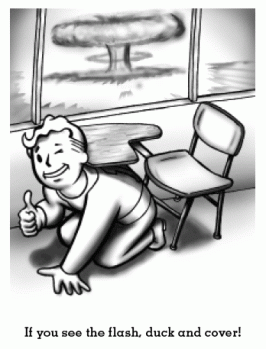
The combination of poverty, unequal distribution of wealth and technological progress will not make for pretty viewing in ten years. This is not a hard problem as much as it is a combination of many hard problems. As the article by Scott Santens that inspired this post nicely said, ignoring these problems will be tantamount to the laughable “duck and cover” strategies to avoiding nuclear blasts during the cold war.

Brevity isn’t all that important

The smartphone obsessed reader would have you believe that brevity is what defines good writing. More than a paragraph? You must really suck as a writer. One scroll is all the attention a reader will give you before they move to the next thing.

Here are five things I’d take over brevity –

1. Useful
2. Inspiring
3. Thoughtful
4. Memorable
5. Clear

Brevity matters, sure. I’d love for what is written to be as short as possible. However, if it means becoming less thoughtful or less useful, I’d prefer the long version – thank you very much.


Inspired by David Heinemeier Hansson’s excellent post – “Simple just isn’t that important.”

Bothered by limitations – 10x thinking – The 200 words project

Continuing last week’s thread on 10x, not 10% – 10x thinkers, Ken Norton observes, don’t surrender to limitations – they get bothered by them. They look for ways around them, or things they can do to blow through them.

Google’s “Project Loon” is an example of 10x thinking. Project Loon is attempting to use weather balloons to bring reliable internet connectivity to underserved populations around the world. Whether Project Loon succeeds or not remains to be seen, but they’re trying.

A wonderful example of blowing through limitations comes from the 1960s when faster cargo ships and containerization revolutionized international shipping. However, when freighters from Hawaii reached San Francisco harbor in days instead of weeks, they were still forced to wait for many days since their documents needed to clear customs after arriving via postal service. Adrian Dalsey, Larry Hillblom and Robert Lynn saw this as an opportunity – while ships were still being loaded in Hawaii, they drove from dock to dock picking paperwork. They, then, put them in their luggage, got on a flight to San Francisco and got the papers ready by the time the ships arrived.

Dalsey, Hillblom, Lynn => DHL.

It’s often easier to make something 10x better than it is to make it 10% better. – Astro Teller, Google[x]

10x


Source and thanks to: Ken Norton’s essay – 10x, not 10%

The 35k lesson

Every time I look back at a painful experience, I attempt to re-frame it by asking myself what lessons I learnt from that experience?

There was one such experience for which I paid what was effectively “tuition” of thirty five thousand dollars – a massive amount. For a long while, I was annoyed at what led to that experience. But, once I passed it through the re-framing filter, I realized that the most important lesson I’d learnt from that experience was one about emotional intelligence.

I was listening to “Mastery” by Robert Greene during that period and I distinctly remember the moment Greene spoke about emotional intelligence as (paraphrased) the ability to ignore what people say and, instead, to listen to what they do. In listening to what they do, he asked us to pay careful attention to their behavior when the chips were down, how they behaved when they thought no one was watching, their choice of partners, etc. It was one of those moments of clarity for me. I finally realized what I was meant to learn from thirty five thousand dollar experience.

A few days ago, I wrote about the idea that “falling is guaranteed.” The flip side of that idea is that, as you take bigger risks, some of those falls become rather painful. You might break a metaphorical bone and pay the tuition for that experience – this can be money, burnt relationships, dents in your confidence or a sense of discomfort when you think about it. As you pay this tuition, it is tempting to want to block this experience off entirely and not think about it. But, my experience has taught me that there is a lot to be gained from wading in within that discomfort and pain and really extracting the value from the tuition paid. My emotional intelligence fall came with scars. I live with them everyday. But, I look at them now not with disgust, but with gratitude for what they taught me.

The saying – “Success comes from good judgement. Good judgment comes experience. Experience comes from bad judgment” – holds absolutely true. The part that is missing is that the experience follows only after careful reflection and analysis of our errors in judgment.

That process is painful and uncomfortable, but worth it.

experience, lesson

27

I asked myself what the major themes of the past year were as I woke up this morning. And, it was the sort of morning when about ten different theme ideas came to mind. But, I love a synthesis with three ideas instead of ten. There’s something about bringing things down to three ideas. As a friend nicely put it – it isn’t that there are only three things, it is just that there have got to be the three most important things.

After bringing it down to three ideas, I asked myself if I could bring it down to the one idea. And, it turns out that that is possible too. Everything I have learned comes down to one central idea – love is the single uniting life principle. And, to live life well is to live it with extraordinary love.

I have referenced psychologist Scott Peck’s excellent definition of love here a few times over the past months – “Love is the will to extend one’s self for the purpose of nurturing one’s own or another’s spiritual growth.”

To love, then, requires us to use our will to extend ourselves to grow and to enable the growth of others. It begins with learning to love ourselves. To love ourselves, we have to sign up for a journey toward continuous growth of the mind and spirit. In doing so, we expand our capacity to love others. But, to truly love others, we must be able to help them on their own journeys.

All of this brings us back an idea related to the central idea – doing things with extraordinary love is hard work.

It is hard because it requires us to commit to growth. Growth requires this constant cycle of self reflection, self awareness, self evaluation, and self improvement. This can be a tiring prospect because you are always aware of the fact that this is a journey of work that never really ends. One of the pit stops on my journey right now is to be less reactive – I thought I’d become better about this but realized recently that I still react way too quickly, too often. This is something I need to monitor over the coming months. Once I get past that, there will be the next thing, and the next thing.

If that isn’t tiring enough, love, the verb, requires us to pay attention. This means committing to depth and intensity when we spend our time in activities of our choice and it means actively saying no to the many distractions that would happily have us fragment our attention. Depth is hard and I certainly struggle with it every day.

Finally, to be able to mindfully grow and focus deeply, we need to learn to think strategically about our choices and understand the trade offs that enable us to do less, but better.

All of this is hard work. Committing to love means committing to this hard work every day, regardless of the weather or good mood.

This commitment is what I’ve been made aware of in the last year. It is a commitment I have, thus, consciously made – to do the small things in my life with extraordinary love. I fall short of it nearly every single day – I stumble one way or another by either saying something stupid, reacting quickly instead of taking a deep breath and responding or doing something I shouldn’t have done.

But, in doing that, I have also learnt that learning to love means falling regularly and learning from those experiences. It means being intensely focused on choosing the part of learning no matter what the situation entails. It means giving it your best shot and making peace with the fact that you only control processes, not outcomes… and that it matters less what the end result is simply because our lives are lived en route.

And, I’ve realized that if we can bring ourselves to keep perspective along the way and do things that are consistent with our values, we give ourselves that incredible gift – the gift of a life well lived.

(Past birthday notes: 26, 25, 2423)

Updating 180 book reviews

I went down a blog maintenance rabbit hole yesterday and checked and updated all reviews on my book review blog. I had been liberally sending folks over to the blog over the past few years and realized I needed to do a quick check as to whether some of my earlier entries made sense. I had 3 interesting observations from the experience –

1. Themes. It felt like going back in time to different phases of my growth. For example, there was a phase of reading sales books because sales was a part of my role for a start up in undergrad, a phase of reading books on personal finance and investing, a happiness phase, a marriage books mini phase, an MBA book phase, etc.

2. Reviewing and recommending. I changed a few reviews yesterday as I realized my review methodology settled after 80 or so books. It took me a while for me to understand what I appreciated in a book and when things resonated. I think I’ve normalized all reviews now.

The interesting thing about reviews is that they have a lot to do with the specific time in which I read the book. I have come to understand that there is an aspect of reader readiness for many books. If you aren’t ready for an extremely insightful book, you’re not going to make the most of it. So, when I send folks over to the blog when they ask me for recommendations, I always request them to just take the reviews as a guide. Instead, I request them to send me a few books that pique their interest and give me a sense of what they’re looking for. The chances are high that we’ll be able to find something that they’d be ready for. It isn’t so much about what is a great book – it is about what you need to read at that particular point of time.

3. What I remember. As I went through roughly 8 years worth of books, I asked myself what I actually remember from these books? And, I realized that it was often a few ideas combined with a feeling that really resonated for the books I considered “great.” But, I also realized that I wouldn’t have remembered this if I hadn’t taken the time to write down what I remember, synthesize and share.

That brought me to the final learning – the hard part about reading isn’t just reading. That’s where we ought to start. However, if you really want to absorb what you learn from books, it pays to take the time to take notes (~3-4 mins for every 20 mins you read), synthesize and share. That’s when you give yourself time to absorb and assimilate what you read.

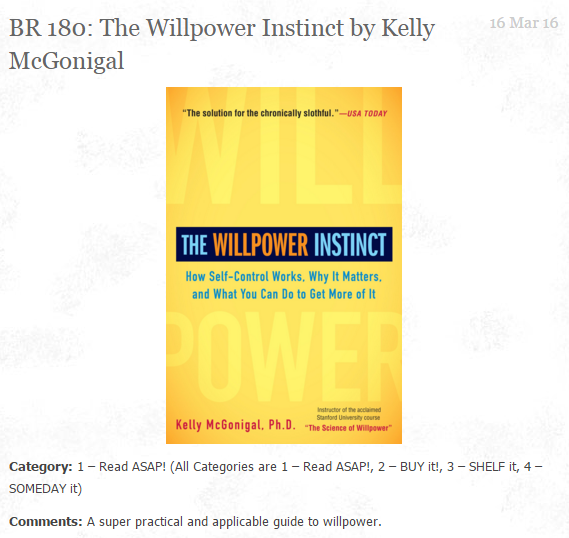
Willpower

Unite or Divide

As a leader, you tend to have two choices – do I unite the people I lead or divide them?

Uniting people when you are leading huge communities or nations is actually not great strategy in most times. Our natural instincts encourage us to seek out divides and this is especially true in times of distress. And, in every century, we’ve seen plenty of leaders take the divide strategy. Adolf Hitler was probably the poster child of the divisive leader in the last hundred years. But, history offers many such examples – as a student of Indian history, I am painfully aware that “divide-and-rule” was colonial Britain’s chosen strategy to colonize India in the 19th century.

You can see why leaders pursue divisive strategies. They work fantastically well in the short term in most times. But, in the long run, however, they crash and burn. Organizations that become overly political stop innovating and performing. Countries that become divisive struggle to make progress. For all the negative aspects of the human condition that dominate during a period of time, one thing is for certain – humanity always triumphs in the long run. But, it is hard to play for the long term – just ask Angela Merkel. Despite showing humanity and leadership, she has only been losing popularity within Germany.

That is why it takes so much character to be a great leader of a nation. That is also why we deservedly sing the praises of Abraham Lincoln years after his passing. He could have done just fine as a leader by not abolishing slavery. But, in doing so and in resisting short term populism, he became great.

As I spend time in the US during this presidential campaign, I hear many surprised voices at the amount of support Donald Trump’s campaign seems to be receiving. The more I think of it, the more I realize that it doesn’t surprise me as much as it did a couple of months ago. We’ve seen this trend all over the world post the recession – every country has pushed for more protectionism. Even Singapore, which is about as pragmatic as a nation can get, became a touch more protectionist to appease popular sentiment. Why should the US be any different?

Brandon Stanton, the founder of “Humans of New York” had a powerful open letter to Donald Trump today, in which he said something insightful – “You are not a ‘victim’ of the very anger that you’ve joyfully enflamed for months. You are a man who has encouraged prejudice and violence in the pursuit of personal power.”

Leaders who choose prejudice and violence do so because it serves them well in the short run. They couldn’t care less about the downstream effects because they will always be insulated from them. The “divide-and-rule” policy eventually led to the separation of India, Pakistan and Bangladesh. Many lives were lost due to these separations and they continue to be lost to this day.

The leaders who caused that have come and gone. But, the people have to live with those choices.

It is up to us to choose wisely.

Source