Sharing praise and concentrating criticism

The best leaders I’ve worked with have been generous with the good things – the moment they were praised, they shared it with the team and gave us credit.

They also showed us the way by taking all the criticism of bad outcomes on them. The buck always stopped with them. When things went wrong, they didn’t muck around with excuses and politics. They just debriefed, learnt from the experience, rolled up their sleeves and got right back to work.

I’ve met quite a few good leaders who’ve done a good job sharing joy, but very few who’ve concentrated criticism. I recognize it is hard to do in large corporate contexts with all the politics – as someone told me once, you don’t want to be caught apologizing too often. However, I’ve found few things to be as inspiring as a leader who simply shoulders the criticism and says – “The buck stops with me.” You might know within the team that she/he had little do with the problem. But, externally, you always knew she/he’d had your back. It also inspired courage in other members of the team to stand up and say – “No, this was my fault” and avoid the blame game.

The biggest objection people have to the idea of concentrating criticism is that people might think less of the leader in the process. While I concede that could be true in many political cultures, in cultures which are built around meritocracy and getting stuff done, I have noticed that your respect for such a leader only goes up.

At least, that is definitely what I’ve found and this is why I’ve tried hard to copy these behaviors.

sharing praise, concentrating criticismImage Source

Any special requests? – The 200 words project

When Derek Sivers ran CDBaby.com, one of the first places to buy music by independent artists on the internet, he intentionally built a reputation for delighting customers by just being human and authentic. For example, one of CDBaby’s biggest sources of PR was artists who exclaimed – “Somebody actually answers the phone! In 2 rings!”

Every CDBaby order form had a “Any special requests?” question. So, when one customer asked for cinnamon gum, the team sent cinnamon gum with the order and delighted the customer. Thousands of people heard about it.

Then, another customer who bought a CD with a squid on the cover asked, as a joke, for a plastic squid. It was somewhat fateful that an East Asian artist had actually sent the CDBaby team a plastic squid as a thank you. So, the team sent that to the customer.
The delighted customer created a video of the experience (http://sivers.org/squid) and shared his experience far and wide.

Organizations are collections of people, after all. Reminding customers of that fact can create remarkable experiences.

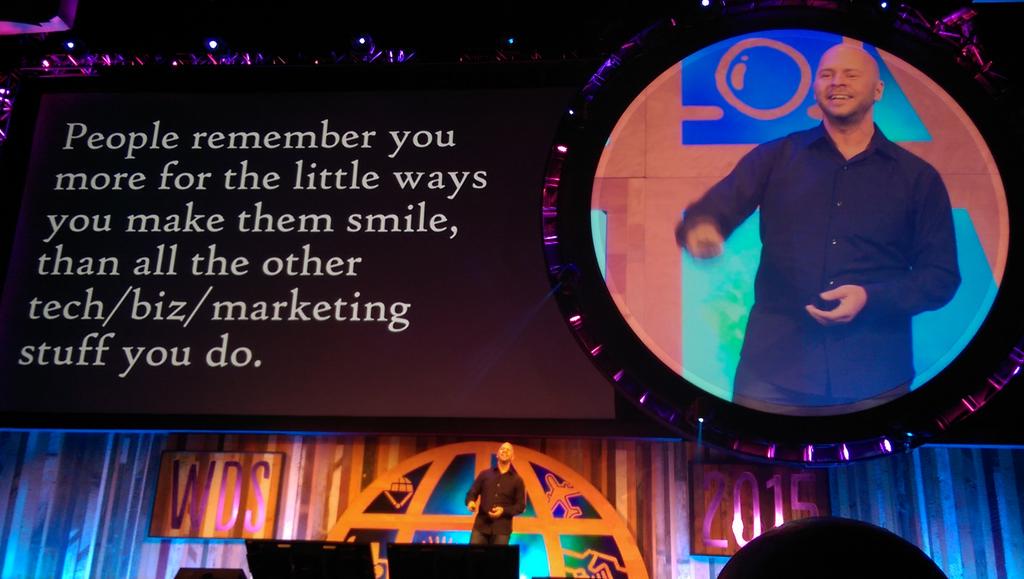
People remember you more for all of the little ways you make them smile over all the cool marketing you do.  – Derek Sivers

special requests, squid


Source and thanks to: Derek Sivers’ talk at WDS

Dealing with Death

A reader wrote in a few days ago expressing his devastation at a recent loss of a dear one. He couldn’t see himself getting over the loss any time soon and asked if I might have suggestions that might help.

Questions like this are really difficult. Even if I have dealt with loss before, every person has their own unique story and mental make up. And, I’ve realized over time that, no matter how close or similar your situation, you don’t ever truly know how another person is feeling. I asked him for a few days. And, the more I’ve thought of it, the more I’ve come to realize that I have only thoughts and lessons to to offer – no suggestions. So, here goes..

First, I have learnt that we must not deny or attempt to hold back our emotions. They are what they are. The answer after incidents that overwhelm us is to fully immerse ourselves in them and experience them. Only once we experience them can we accept what has truly happened. And, until we accept them, there is no way out. This is probably the hardest part of dealing with loss. I have known folk who’ve gone decades with having really accepted a loss of a life – it is not for the faint hearted.

Next, I have learnt that we must allow ourselves to play victim.. for a while. Jennifer Aniston once said that, when bad things happened, she gave herself 24 hours to play victim. I love that idea. Take the time you need to play victim but know that it is a limited window.
There’s a beautiful story story about a woman who went to The Buddha and asked him to bring her young son back from the dead. He said he would do it if she could bring food from a house in the village that hadn’t experienced loss. So, the woman knocked on the door of every house in the village and found that every home had experienced loss. Birth and death are a part of being human, she realized. Life must go on.

Master Yoda once said something very powerful – “Death is a natural part of life. Rejoice for those around you who transform into the Force. Mourn them do not. Miss them do not. Attachment leads to jealously. The shadow of greed, that is.”

In talking about the dark side, he pointed to a beautiful insight about the human experience. Mourning doesn’t do justice to the lives of those who are gone. Celebration does. Those who are gone stay with us in more ways than we imagine – their memories and ideals influence us and the way we lead our lives. Mourning does no good to anyone but ourselves. If those who were gone meant so much to us, maybe we ought to consider celebrating their lives by doing more good on their behalf?

I wrote yesterday that it is reflecting on deep experiences, and not age, that leads to wisdom. Adversity has the power to transform us into wiser and better people if we let it. Of course, you may ask, why this? And, why not something else? Nobody knows. All I’ve come to realize that the universe is unfolding as it should. We will likely never have the capacity to understand why it unfolds in this way.. but it does. We just get to choose our response.

And, when I think of responses to adversity, I am reminded of what has to be one of my (many) all-time favorite stories. A teenage girl was contemplating suicide after a few setbacks in school and in a relationship. She told her father that she was feeling suicidal. He took her to the kitchen and began boiling water in 3 vessels. She began ranting and railing about his insensitivity. But, he told her to wait. He then put in a potato, an egg and a few coffee beans into the 3 vessels.
Five minutes later, he said – when faced with water, people tend to react in one of three ways. Like the potato, many go in seemingly strong but come out soft and broken. Others, like egg, go in with a soft inside and come out hardened and cynical. But, then, when you look around, you notice the coffee beans – they go in, transform themselves, change the color of the situation and, if that wasn’t enough, add a beautiful aroma too. Now that you are faced with adversity, I ask you – what do you want to be? The potato, the egg, or the coffee bean?

The loss of a life is as difficult a test as they come. There isn’t an easy way out of it. But, there is a way out of it. It will require us to accept the pain, dig deeper, learn, grow and transform ourselves in the process. That isn’t easy. But, it is possible. It isn’t easy to do so alone. There is no way we would have emerged out of our losses if it wasn’t for our friends and family. But, we did. And, we are grateful for it.

Often, we seek to push very hard to change a situation we deem unfavorable without appreciating the fact that it is us who are meant to change.

Death, more than any other life event, can help us understand that this life is short. It is up to us to make it meaningful, make it count. We can choose to be the coffee beans.

death, coffee beans, potato, eggsImage Source

Age and wisdom – correlation and causality

If you ever want to understand what Economists describe as the “Identification error” – mistaking correlation for causality – just take a look at the relationship between age and wisdom.

There is undoubtedly some loose correlation between age and wisdom. Take a random 60 year old and a random 20 year old and it is likely that the 60 year old is wiser. While there exists this loose correlation, age and wisdom do not have a causal relationship. Or, to put it differently, growing older doesn’t automatically make you wiser.

Wisdom is defined as the quality of having experience, knowledge and good judgment. I would simplify this further as “the quality of having knowledge and good judgment.” This is because good judgement comes from experience, which, in turn, comes from bad judgment. This explains the loose correlation between age and wisdom. As we age, we tend to have more experiences and these experiences could improve our judgment.

To understand why it is hard, it is helpful to understand what I think are the pre-requisites or causes of wisdom –
An array of diverse experiences. If you have done the exact same job for 20 years, you have, in some ways, lived through the same year 20 times. The experience gained from such an experience is very narrow.
Reflection and assimilation of your learnings from these experiences. Even if you have had diverse experiences, there is no guarantee you’ve learned from them. Learning requires a commitment to reflection and assimilation.

It is hard enough to push yourself to find diverse experiences. And, it is exponentially harder to then extract the depth of insight from your experiences. That is why wisdom isn’t common and why it is flawed thinking to assume that age leads to wisdom.

It isn’t the years in your life that count. It is the life in those years.

age, wisdom, learning, depth of experience, diverse

Reflect on it and then you will be done

Reflection is sometimes sold as a “do-it-once-in-a-while-and-you-will-be-fine” thing. Structures in organizations emphasize that as well – quarterly earnings, yearly performance reviews, etc.

The reality is that it works something like this – Have an idea -> Reflect -> Do something -> Reflect -> See outcome -> Reflect -> Tweak your idea -> Reflect -> Try again -> Reflect -> See outcome this time -> Reflect.

As long as you are attempting things, reflection is what ensures you are learning from the process.

reflect, learn

Reflection, nearly always, makes you realize you are inadequate. The point of reflection isn’t to feel good. The point of reflection is to learn. And, getting comfortable with feeling inadequate is the first step to learning.

There hasn’t yet been an exercise coach who has found ways to make people fitter without having them experience pain.

The parable of the wind and the sun

A few incidents had me talking about the effects of kindness over force to a wiser friend. She remarked that our discussion reminded her of the parable of the wind and the sun. Ever since we had that conversation, the parable has popped into my head as I reflected on a couple of places where I stumbled recently. Here is the story – thank you Bartleby.com.


The Wind and the Sun were disputing which was the stronger. Suddenly, they saw a traveler coming down the road, and the Sun said: “I see a way to decide our dispute. Whichever of us can cause that traveler to take off his cloak shall be regarded as the stronger. You begin.”

So, the Sun retired behind a cloud, and the Wind began to blow as hard as it could upon the traveler. But, the harder he blew, the more closely did the traveler wrap his cloak round him, till at last the Wind had to give up in despair.

The Sun, then, came out and shone in all his glory upon the traveler, who soon found it too hot to walk with his cloak on.

wind and the sun, pressure, kindness, severity

Moral of the story: “Kindness affects more than severity.”


This is an example I know to be true and one that I remember very clearly. However, in Hogan’s terms, people who have “Boldness” as a defining characteristic tend to default to arrogance and aggressiveness under pressure. So, as I recently discovered, I have remembered this in the good times and completely forgotten this when under pressure.

A great lesson – one that I definitely need to do better at.

Added note: I am reminded of the quote – “When you want to fight fire with fire, remember that the fire department uses water.” :-)

The tour guide at Giza

Does the tour guide at the Pyramids of Giza truly appreciate its beauty? Or, is it just a daily chore that helps him/her earn a living?

Giza

For most tour guides, I am guessing it is likely the latter. The small fraction who’ve still manage to maintain child like wonder are likely to be the exceptional tour guides you’d want to travel with.

It is hard to keep perspective of greatness if we are exposed to it every day. Or, in other words, awesome things can cease to be awesome in our minds pretty quickly if we let them.

Just for today, let us be that exceptional tour guide and keep an eye out for the greatness that we regularly take for granted.

A few thoughts on culture

As part of my annual review process at the end of every year, I ask myself – “Who/what were my biggest sources of inspiration this year?” It is a useful question as I think about all those people who’ve had a repeated positive impact on me. Inevitably, Seth Godin takes the top spot. I have been reading Seth’s blog for five years or more now, sharing his posts and thoughts here and, most importantly, revisiting his posts from time to time. Often, when I think of the topics he tends to write about, I realize that my definition of a particular idea came from one of his posts.

One such seminal post and idea is “change the culture, change the world.” This post boils culture down to one line – “This is what people like me do.” The first time I read this, I asked myself and all my friends (I think they got tired of hearing about this post within a week) – “What is it that people like us do?” And, we ended up attempting to coordinate a “Mastermind Group” across three continents to discuss various topics that mattered most to us. We decided our culture was one around having conversations that matter. The project didn’t work because of timezone issues but it is one that demonstrated to us how much we cared about having conversations that matter. I have continued to implement that idea ever since – at graduate school, I have time set aside every week for a conversation that matters with a group of friends.

I realize now that my answer to the question about my biggest source of inspiration was actually incomplete. There is one other person who has influenced me in a way similar to Seth – Clayton Christensen. While he doesn’t have a daily blog that I know of, his book “How Will You Measure Your Life?” got me started on a path that has gone on to help me define how I live. I listened to Clay’s TEDx talk and read his excellent article (which, unfortunately has been put behind a paywall by the folks at HBR) and I was again left thinking about culture. Clay’s insight was – “Ultimately, people don’t even think about whether their way of doing things yields success. They embrace priorities and follow procedures by instinct and assumption rather than by explicit decision—which means that they’ve created a culture.” Or, “this is what people like me do.”

I’ve written before about how you build culture in a team. Building culture and sharing the culture are two different things, though. While you might imagine any great culture would be automatically shared, it doesn’t work that way. As I have repeatedly learnt, “build it and they will come” is fundamentally flawed. Our culture is built around “best selling” or, in the case of the internet, “best sharing?”

I think the way culture is shared is by sharing stories. It is like the famous collection of Macy stories which talk about Macy’s employees who go to incredible lengths to please a customer. It is the Zappos person who was on the phone with a customer for many hours. Stories are powerful.

As I reflect on their power, I see the effect they have had on my life. In two days, I’ll be leading and participating an initiative called “The Good Life Sessions” in my final quarter in graduate school. The Good Life Sessions is a three part series of workshops that gets to the questions – “How will you measure your life?” through a series of other questions that help break that large question down. As you might imagine, there is a lot of Clay Christensen in the Good Life Sessions.

I also start these sessions and pretty much any initiative I lead by saying – “This might not work.” While I say this to myself every time before I take a leap, I say it in public generally to shocked reactions – “What do you mean? It should work. Do you lack confidence?” Those close to me understand it. Those who are getting to know me give me feedback about it and tell me I must stop saying it. And, folks listening either love it or hate it. This is one of those things where I choose to ignore all that is said and say – “This is the cost of me doing things. This is how I approach things and this is part of me being me.” “This might not work” is a Seth idea that embraces the fact that anything worth doing begins with an acceptance that it might not work.

As this example illustrates, Clay and Seth have shared their cultures with me and their cultures are an important part of my culture and how I operate. And, they’ve shared this without us ever meeting in person. Clay doesn’t even know I exist.

That is how I’ve come to learn that cultural change is incredibly powerful. It is a big part of what I have spent my time learning about and pushing for during my time in graduate school over the past year and a half – to encourage more reflection, more conversation, and more understanding. And, as you might imagine, a big part of this is just attempting to be all of this myself – because that’s what Clay and Seth have taught me. You have to be the change you wish to see.

And, most importantly, no one is going to pick you to make cultural change. You have to pick yourself.

culture

The Curry workout – The 200 words project

Stephen Curry, considered one of the greatest NBA shooters of all time, owes a lot of this success to a unique practice regimen devised by his trainer, Brandon Payne.

Payne’s philosophy is focused on improving “neuromuscular” efficiency – training the connection between mind and body. One such novel workout requires Curry to wear a pair of military-grade strobe glasses that strobe at different speeds, impairing vision, while Curry dribbles a basketball with one hand and catches a tennis ball with the other. Take away that stressor on the senses during the game and Curry’s reaction times are faster.
Overloading the brain and body during practice and then contrasting it in order to get immediate feelings of improvement are what Payne does in his skill work with Curry.

As Diamond Leung, a journalist, wrote about Curry’s regime, he realized that there was a lesson in all this for him and us. Thanks to all the stimulation from our devices, we are already wearing strobe glasses and are in the midst of a struggle to focus on any single activity long enough to carry it out with imagination, verve and precision.

The Curry workout is perhaps the ultimate call for mindfulness.

curry workout

When I’ve got something intricate to work on, I now tend to visit coffee shops with bad Wi-Fi. That forces me to keep working on the task at hand, even if I’m stuck for a little while. It also gives me a chance to peel back the project to first principles every now and then, and to do some sustained, free-form thinking about what I’m trying to accomplish… it’s hard to know when breakthroughs will happen. Getting rid of sensory overload doesn’t instantly guarantee success. But it improves the odds. – Diamond Leung


Source and thanks to: Mercury News article on Stephen Curry and Brandon Payne

The short straw

We were recently in passport control on our way back to the states. As we were in transit at the airport, we had transit passengers from various other flights and one of them seemed to be a flight heading back the UK. As per usual, passport control for non-citizens, non-ESTA countries (effectively Europe) was under staffed. We weren’t clear why the Brits weren’t on the ESTA queue. But, stuck in our queue, we heard one annoyed British accented voice after another complain about how preposterous the wait was. Some even called friends and family to tell them how ridiculous this was.

My wife and I found this all pretty amusing for two reasons. First, British passport control is actually among the most unfriendly to anyone who isn’t white skinned (even if the officers are a diverse mix). Often, they make you sorry for having taken a tourist trip to see their country. And, they take incredibly long, too. A below average wait at Heathrow if you are Asian/African is an hour. I once waited 3 hours at passport control after a 2.5 hour flight. That’s right – my travel time was shorter than my wait at passport control.

Second, none of the others on the queue yesterday had anything to say at the wait. It was just another day, just another flight. Wait 1 hour? No problem. At least it is not a pat down. Made to feel unwanted when visiting another country? That’s just business-as-usual.

The good news is that drawing the short straw every time for arbitrary reasons – i.e. birth and the color of your skin – helps you keep perspective when you face what should only be (for your own sanity at least) minor annoyances.

short straw