Where energy and inspiration come from

Anton Chekhov once said – “Any idiot can face a crisis. It is day-to-day living that wears you out.” And, day-to-day living can play havoc with our ability to sustain positive, optimistic energy. That is especially the case if we don’t understand where energy and inspiration come from.

Where energy and inspiration come from, energy, optimism

Energy and inspiration come from a clarity of purpose – a clear understanding of why we’re doing what you’re doing. Absent this clarity, the day quickly becomes a grind. It is this clarity that enables us to be energetic and, then, inspirational. Our energy translates to inspiration when we’re able to communicate that clarity of purpose and transmit that energy onto others.

When we run out of energy, we’re often taught to look outside – “find some motivation.” So, we spend time surfing the internet looking for ways to inspire ourselves during a difficult workday with a nice article, video or song. But, motivation is extrinsic. It is a short term boost that may work for a few minutes, perhaps even a few hours. If we have to find a longer term solution, we will have to look within and answer that difficult question – “Does what I do matter? Why?”

There are no shortcuts to harnessing that internal energy. We need to take the time to lay out a hypothesis for why we think we exist and then be able to explain why what we spend time doing fits into that hypothesis. And, we have to remind ourselves about this why every day.

That’s how great things are built and great obstacles are overcome – one energetic, inspired, optimistic day at a time.

The sugar conspiracy – The 200 words project

(continued from parts 1, 2 – this is part of a 4 part series based on a wonderful piece of scientific reporting on “The Guardian” about a war among nutritionists that has affected our generation in more ways than we know).

Knowing that John Yudkin posed a hypothesis about sugar that challenged his own hypothesis about fat being the enemy, Ancel Keys went on a political offensive. Yudkin was a mild-mannered man, unskilled in the art of political combat. Over time, Keys’ campaign to discredit Yudkin worked – his book “Pure, White and Deadly” was rubbished as science fiction and he died in 1995 – a disappointed and forgotten man. Robert Adkins, a Cardiologist, who recommended a high-fat, low carb diet also became a hate figure thanks to the Ancel Keys movement.

In the last decade, a collection of scientists led by Robert Lustig have re-invigorated research on the effect of sugars and awareness has been on the rise. However, even in 2015, the US dietary guidelines didn’t incorporate the new research. Steven Nissen, chairman of Cardiovascular medicine at the Cleveland Clinic, called the new guidelines “an evidence-free zone.”

Yudkin once said that if only a small fraction of what we know about the effects of sugar were to be revealed in relation to any other material used as a food additive, that material would promptly be banned.

It is only now that that message is reaching the collective consciousness.

The final edition with lessons learnt coming up next week.

When I asked Lustig why he was the first researcher in years to focus on the dangers of sugar, he answered: “John Yudkin. They took him down so severely – so severely – that nobody wanted to attempt it on their own. – Ian Leslie

The sugar conspiracyThanks to Pete Gamlen for the image


Source and thanks to: The Sugar Conspiracy by Ian Leslie in the Guardian, more about Robert Lustig here

Earth Overshoot Day

Earth Overshoot Day is the day in the year when we use more of the planet’s resources than it can regenerate. The first such day was December 24, 1971. This year, it was on August 8.

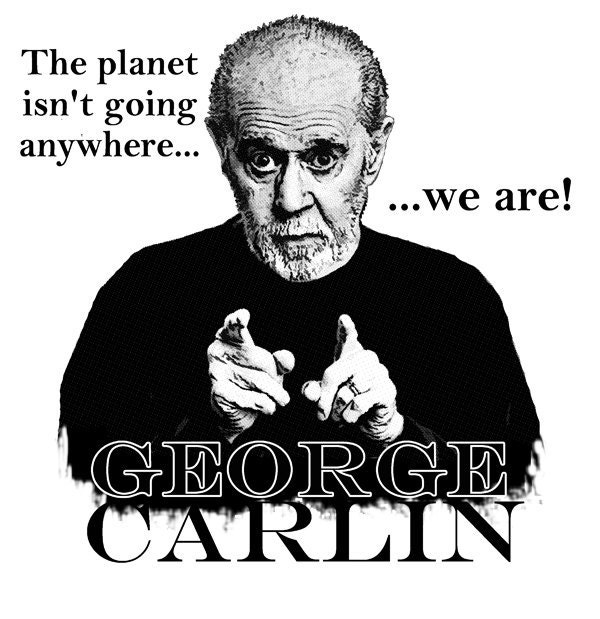
There is a witty and smart George Carlin piece on “Saving the planet” –

“The planet has been through a lot worse than us. Been through earthquakes, volcanoes, plate tectonics, continental drift, solar flares, sun spots, magnetic storms, the magnetic reversal of the poles … hundreds of thousands of years of bombardment by comets and asteroids and meteors, worldwide floods, tidal waves, worldwide fires, erosion, cosmic rays, recurring ice ages … And we think some plastic bags and some aluminum cans are going to make a difference? The planet isn’t going anywhere. WE are!”

The environment has largely served as a thorny issue in the past generation’s narrative. There is still a massive contingent of people who think it is all a conspiracy. The problem with pointing to everything as a conspiracy is the same as the boy crying wolf – when the wolves actually do come, you are doomed.

It is certain to be the dominant issue in the next generation, however. Maybe it’ll help if we renamed the issue from “Save the environment” to “Save humans?”

Earth Overshoot Day, environment, humansThanks to Etsy for the image

PS: If you are wondering what you can do – pick 5 out of this list to reduce your carbon footprint and be more conscious of energy consumption in your home and the office. This isn’t about the environment. This is about us…

HT: Elijah Wolfson from the Quartz Newsletter for writing about this

Today’s sacrifice

When a close friend and I started playing tennis a few week’s back, the quality of our game was woeful. We had both learned a bit of tennis a few years back but were very out of touch. Since we both were competitive, we chose to play with points. However, our rallies were short and full of unforced errors. A few week’s later, our games are much better. Playing once a week goes a long way in bringing about a certain rhythm and activating our muscle memory. But, a factor that I’ve realized helps my improvement is one I call “today’s sacrifice.”

Right from our first game, I picked one aspect of my game to sacrifice. For example, on day one, my serve didn’t work. But, instead of going for a tame serve that gets the ball in, I focused on making it better and lost plenty of points in the process. This didn’t work in the first game and through most of the second as well. But, come the third game, my serve began working a fair bit. Now that I’d climbed the steepest part of the serve hill, it was time to work on the next shot.

It sounds incredibly simple – as you jump into play, set a learning goal (Anders Ericsson would call it “purposeful practice”) and sacrifice a bit of today’s productivity for tomorrow’s growth. But, its applications can be mind blowing if applied to everything we do.

This is the goose and golden eggs fable all over again – easy to understand but nowhere as easy to apply. We know that today’s investments will lead to more growth and productivity. But, caught in the throes of the day-to-day, it is so easy to push today’s learning away and just focus on maximizing current production. Perhaps the way to do it is simply to implement this idea in every aspect of our lives – in a way we think nothing of it when we do it. Perhaps we do this by scheduling 30 minutes every day to do one of the following – learn something that might be useful or, if you haven’t done so, getting a bit of sleep, getting some healthy food, going to the gym, or picking a book that will help us grow. Over time, maybe we’d expand the sacrifice time to an hour, maybe even two.

After all, today’s sacrifice is tomorrow’s reward.

Thanks to Kidsworldfun for the image

Purpose of the quantified self

The purpose of the quantified self idea is not to quantify everything we do. Instead, it is to develop awareness and make better decisions.

purpose of the quantified selfThanks to Technori.com for the image

The hypothesis with quantifying the number of steps we walk, for example, is that we will develop a sense of the amount of movement we need in a day and design our life accordingly. For example, you might realize that a normal work day doesn’t cut it and that you need to schedule at least one walking meeting every day.

Of course, there is something visceral about being presented with numbers. As humans, we feel the need to optimize it and often do so at the expense of other harder-to-quantify parts of our life. The salary is a perfect illustration of this obsession.

The future of the quantified self movement is likely a smart chip that is embedded within us which would provide us a daily read of all our vitals. Again, it isn’t the numbers that will matter but the decision about what to do with them. So, chips will presumably be smart enough to guide us to take appropriate action.

The purpose of most numbers in our personal life is to get to a point of awareness of our behavior. Ideally, budgeting becomes a 5 minute exercise every week because we trust ourselves to make the right calls. It follows, and this is the counter intuitive idea, that the purpose of quantification is to stop quantification.

As always, the numbers are what they are. What matters is what we do with them.

Not getting recognized

One of the biggest reasons for workplace unhappiness is a feeling that employees are not getting recognized for the work they do. Appreciation is such an important factor in us staying motivated.

As I slowly make my way through Walter Isaacson’s biography of Albert Einstein, I’ve come to realize that what has blown me away about Albert Einstein is not what I expected. I expected to be in awe of his combination of creativity and intelligence. And, while his ability to channel his creativity and impudence into Physics is a fascinating lesson, I have been in awe of his ability to soldier on despite no recognition for the longest time. I wrote about him not getting a job (only made possible by a friend whose father had sway over the Swiss patent office) for about 2 years after getting his P.hD a few weeks back. It turns out that was only the warm up act.

Not getting recognizedThanks to Biography.com for the image

In 1905, Einstein wrote 4 papers that provided the foundation for modern physics – on Brownian motion, the photoelectric effect and special relativity.  But, even as of 1907, Einstein hadn’t landed an academic job. Frustrated, he applied for a position as a school teacher to teach Math. He also offered to teach Physics in his application. But, he was told he didn’t even make the short list. He was then refused admittance for a research assistant position despite submitting his 4 papers which were gaining fame thanks to the endorsement of Max Planck, then the greatest theoretical physicist on the planet.

He finally did land a job in 1908 and was finally granted Professorship in 1912 – a full 7 years after his “annus mirabilis” or extraordinary year.

It is such a wonderful lesson for all those of us who complain about not being recognized for our work. Yes, there always are those who seem to get instant recognition. But, if it is merit-based recognition we seek, it is worth remembering Albert Einstein’s journey to remind ourselves to chase merit, not recognition.

In the long run, good results follow good processes.

Values cost money

One of the more memorable quotes from a talk I’ve been to was one in my first week of graduate school. We had the CEO of Beam speak to us about some of the decisions he had to make as CEO. He spoke of a famous decision about a formulation which they had to reverse because their customers were upset by the decision. That reversal cost them a lot of money. But, as he remarked then, “Values cost money. It isn’t a value if it doesn’t cost you money.”

It is easy to observe this in practice – do the companies you work for actually spend money or resources on things they consider important? If they don’t, the value is just a word on a wall.

But, easy as it is to point our fingers to organizations, this is applicable in our lives too. Fresh after reading “How Will You Measure Your Life?” and “The Honest Truth about Dishonesty” in 2013, I had decided that I wasn’t going to be the media pirate that I had been for 7 years or so. I used to (and continue to) write about topics like honesty, integrity and the like on this blog. And, writing about ideas I don’t put into practice felt like the worst form of hypocrisy. I remember how painful the reversal was. I told myself that I’d buy all or most of the media I’d pirated as a way of purging my history and starting fresh. That initial upfront investment cost close to $2,000. But, I felt clean – it is hard to explain how beautiful it felt without that pressure.

That’s the beauty about committing to values you care about. If you don’t live by them, you feel a pressure to do so. If the pressure doesn’t come from within, it likely comes from things you do or from people around you. A spouse or partner who tell you to stop working and demonstrate how much you care about the family by investing time into your relationships – that’s an example of values pressure.

And, if you do live by them, values cost money.

Values


Simple philosophy

Every once a while, I find it nice to stumble upon simple philosophy to focus my mind.

This week (month?)’s line came to me yesterday as I caught myself pondering about some unknowns – “Work hard, learn and don’t take life too seriously.”

There’s not much we control. All we can do is keep giving things our best shot and keep getting better so what we do adds more value and, hopefully, is more enjoyable.

Once we’re able to do that, it helps to keep a bit of perspective. Life is shorter than we think.. and the frowns, anger, irritation and envy are generally not worth it.

PS: I realize this isn’t all that profound – hence the “simple” in the title. :-)

simple philosophy


Written while listening to another excellent piece of simple philosophy – “Try Everything” by Shakira.

The fat hypothesis – Part II – The 200 words project

(Continued from “The Fat Hypothesis – Part 1‘)

Despite making fat the enemy in the 1980s, replacing butter with margarine and eggs with muesli, it emerged the obesity rates in the US and UK more than doubled in 20 years.

It turns out that despite its monumental stature, the Ancel Keys 7 Countries Study was horribly constructed. It was hard to avoid the conclusion that Keys chose the 7 countries because he suspected they would support his hypothesis (he omitted France and Germany from a list of European countries presumably knowing they had low hard disease rates despite saturated fats rich diet). And, when the study’s lead Italian researcher, Alessandro Menotti, went back to the data, he found that the food that correlated most closely with deaths from heart disease was not saturated fat, but sugar.

The most prominent doubter of Keys’ fat vilification drive was John Yudkin, then the UK’s leading nutritionist, who noted that while humans have always been carnivorous, sugar – a pure carbohydrate stripped off fiber and nutrition – had only become part of our diets recently. Saturated fats, by contrast, are so intimately bound up with our evolution that they are abundantly present in breast milk.

Unfortunately, Keys was not open to debate.. (more next week)

fat hypothesisThanks to Lane Kenworthy for the image

If Yudkin published a paper, Keys would excoriate it, and him. He called Yudkin’s theory “a mountain of nonsense”, and accused him of issuing “propaganda” for the meat and dairy industries. – Ian Leslie


Source and thanks to: The Sugar Conspiracy by Ian Leslie in the Guardian – a fantastic piece of journalism that inspired this 4 part series.

On our terms

Success isn’t an objective term. It only exists in our head. To make peace with an idea that can seem very elusive, we must define it on our terms.

Dan Kim, a programmer at 37 signals, wrote yesterday about a quote from Marissa Mayer that infuriated him – “My husband [the venture capital investor Zachary Bogue] runs a co-working office in San Francisco…And if you go in on a Saturday afternoon, I can tell you which startups will succeed, without even knowing what they do. Being there on the weekend is a huge indicator of success, mostly because these companies just don’t happen. They happen because of really hard work.”

on our terms, weekend work, success

Dan picks apart that comment – I can see where his frustration comes from. As a father who cares about spending time with his kids, he hates the “work on weekends to be successful” message.

We tend to be hugely biased by our own experiences. So, I can also see where Marissa Mayer comes from and what her biases are. I don’t agree with them but, hey, what do I know?

Dan, however, goes on to end the post by saying something that rings very true. He points out that Marissa Mayer is very successful by most objective business measures – finances, title, industry stature, etc. He then goes on to acknowledge that, while he will never be a success in Marissa’s world, he’s never been so happy to be a failure.

It is a realization we must all come to at some point in our lives. It is often the difference between a life that is happy and one that is filled with insecurity and discontent.

That isn’t to say we shouldn’t pursue things that matter to us. Happiness and success lie in the pursuit. It is just a reminder to not spend time chasing someone else’s dream. Let ours be a life well lived… on our terms.