If it matters

If it matters to you, let it matter.

The “it” may be something obscure that very few care about. And, that’s okay.

Too often, people go out of the way to over compensate for how they feel about something that matters to them. They pretend they’re above it when they’re not feeling that way. That’s just wasted energy. Alternatively, they get angry with themselves for caring so much about something that should not matter. The key words in that previous sentence are “should not.”

The world is a special place because people care about such a wide variety of things. That ability to care about things that we think should not matter is what makes us weird. And, it is that weirdness that makes us human and special.

If it matters to you, embrace it. Let it matter. Do something good when you get the small things working exactly as you like them.

Which book

Which book are you reading now?

Seth Godin had a fantastic post a few days back called “Fully Baked.” His observation is spot on. Surgeons, lawyers, and the like need to keep studying to keep their licenses. On the other hand, the rest of us can continue working without really reading or understanding what is going on in our domains. His push to us – “Show me your bookshelf, or the courses you take, or the questions you ask, and I’ll have a hint as to how much you care about levelling up.”

Excited? Great. Now, let’s tackle that elusive question – which book do you read? I’ve realized that book recommendations are hard to do right because of two reasons – timing and interest. First, the same books hit us with varying impact depending on where we are in our lives. Second and more obvious, reading a book in a topic or industry of our interest makes a big difference too.

So, when I’m asked for book recommendations, I generally share the link to my book reviews blog – www.RohanRajiv.com. I review and share notes from books I have read here every three months or so. It contains every non-fiction book I’ve read in the past 8 years. They are sorted by category and by rating. Priority 1 or “Read ASAP” are books I consider incredibly powerful. But, that need not be the case for you.

However, biased as I am, I think it is be a good place to start. Once you do this, feel free to send me (rohan at rohanrajiv.com) the five books that sound most interesting along with a sense of what you are looking to explore or learn. I would be happy to recommend a couple based on what I know. You can also choose to take a sneak peek at what I learnt from the “Book notes” link at the bottom of reviews in the past couple of years.

This is probably not exactly what you are looking for. But, it is an open offer to anyone reading this – I am happy to work with you to answer the “which book?” question. It is a great question. One of these books you decide to read is sure to change your life.

I hope it helps.

Giving an A – The 200 words project

In his graduate class at the New England Conservatory, Benjamin Zander gives each of his students an “A” at the beginning of the year and asks them to write a letter describing who they will have become by the following May when the class ends. Teachers, and society at large, he notes, tend to treat “A” students quite differently from students who are given a C minus.

So, when students are given an unconditional ‘A’ in the first class of the year, it makes the students and the teacher committed partners on a fascinating and joyful journey, where, for the time being, standards are in the background, and there is no striving — just engagement, participation, and expression. Mistakes became indicators of that which needed attention, and no longer carried any stigma. Painful comparisons to others melt away. And, rather than focusing on pleasing the teacher, each student explored their own talent, and expanded their own artistry. They are liberated from fear and their performance is likely to surprise and delight their teachers, themselves and all who hear them.

The question for us – do we start teaching/mentoring/parenting by giving the other person an A? What effect would that have?

The practice of giving an A transports your relationships from the world of measurement into the universe of possibility. This A is not an expectation to live up to, but a possibility to live into. – Ben Zander


Source and thanks to: The Art of Possibility by Ben and Roz Zander

(The 200 words project involves sharing a story from a book/blog/article I’ve read within 200 words)

Might be short

I’ve heard myself say “life is short” many a time over these years. I realized somewhat belatedly the other day that life isn’t necessarily short. It is, after all, the longest thing we do. And, while some lives are short, many live long lives. I have come to realize that what I meant to say all along is that life might be short. And, I think adding that might is rather important.

Whenever I think about this link between life and death, I am reminded of Dag Hammarskjöld’s profound quote – “In the last analysis it is our conception of death which decides our answers to all the questions life puts to us.” My encounters with death have taught me two things – treasure life and those who you love.

Death, to me, is the ultimate reminder that both life and the living are special. Love life. Build things that matter. Make it meaningful. Make it count. While you are it, remember to treasure those on the journey with you and those who choose to love you.

Treasuring those we love is very hard when we are in the pursuit of that elusive mistress – impact. It becomes much easier if we accept one fact – that our life might be short. While it might end up being long – it is a balance of probability after all – we are just so much better living it assuming it just might be shorter than we think or hope.

This is what makes being happy so difficult. It requires us to embrace the toughest of all paradoxes – to embrace the idea that we must build as if we’ll live forever while expressing love like there might be no tomorrow. This might not work. This might. It might not be short. It just might.

The tension of might is how we get made.

Release notes

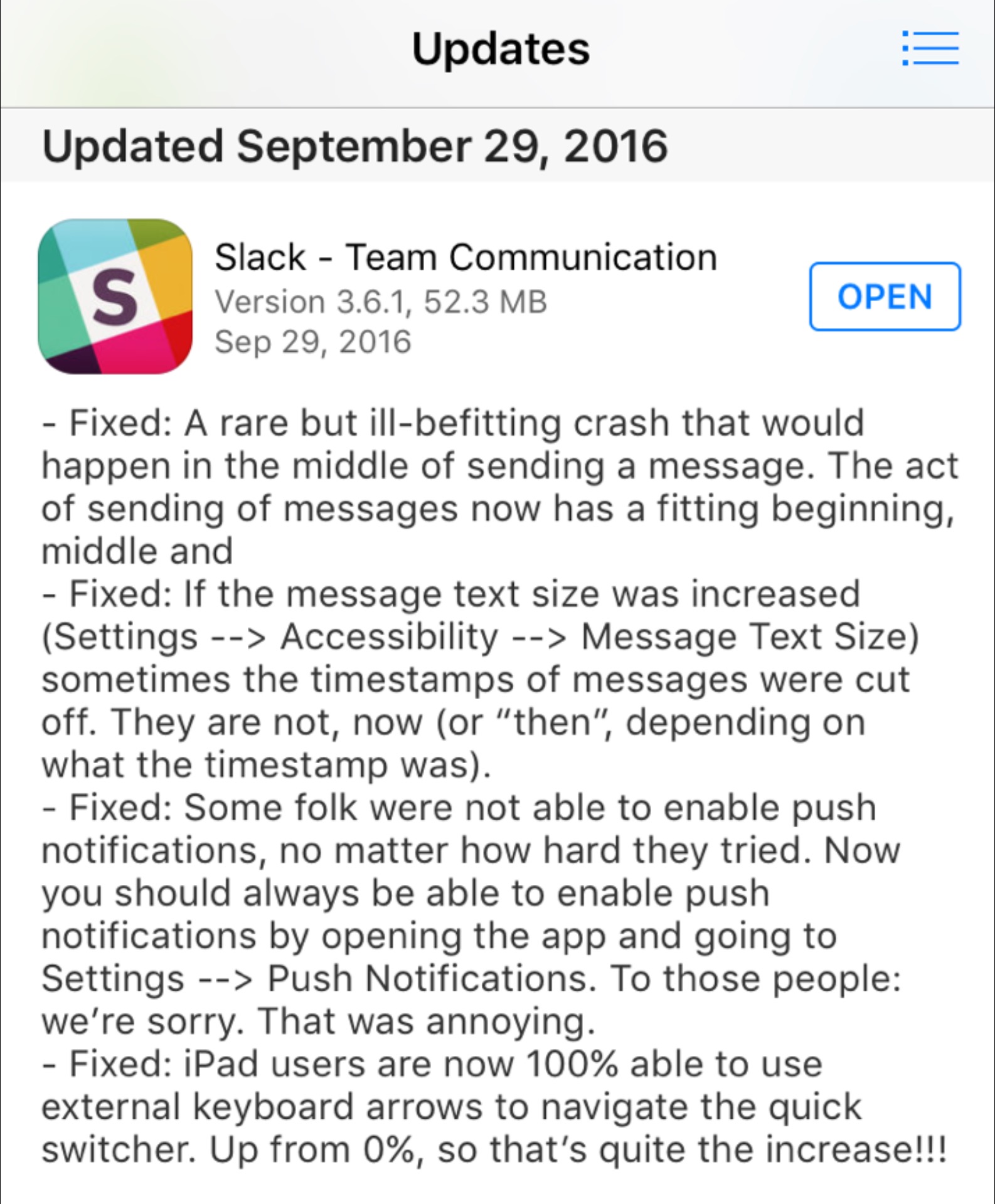
App release notes are the notes that accompany an app update. Most people don’t read these as they are generally very staid and boring. “v2.1 – bug fixed on pressing send button in screen in some iOS devices.”

Over time, however, developers realized this was a nice way to showcase their creativity. So, companies like Medium, Tumblr, Pinterest, et al, created notes that were a almost random. This evolution got a bit annoying for hardcore users who wanted to understand what was fixed. “Jam packed full of amazing things” and “bug fixes” didn’t do it.

Release notes need to be functional – they need to inform users on what has changed. However, that doesn’t mean you can’t inject creativity. A good friend shared Slack’s release notes as an example of their sense of humor (Thanks Kaushik!). Slack is a workplace collaboration/messaging tool used heavily by engineering teams.

slack-release-notes

Slack has a history of doing this. Just type “app release notes” on Google Image Search. They are specific about the bug (functional) but always describe it with humor.

slack-release-notes

I think of this as an example of doing small things with extraordinary love. After all, release notes could just easily be a tedious exercise. However, you can almost feel the love as Slack works through fixing one bug after another.

We can all add personality and character in the small things we do.

All we need to is decide to do the small things with extraordinary love.

Five career priorities

There are five career priorities –

1. Location
2. Industry
3. Company
4. Role
5. Team/people

Every career choice we make comes back to how we solve for these. We can make career decisions easier for ourselves by keeping four things in mind.

First, we ought to know that it gets harder to change multiple priorities. If you are trying to change just a role or team within your company, that is likely among the easier things to do. It is harder to change companies, industries, locations. And, of course, it is harder to change two or three things at a time. That doesn’t mean it can’t be done. It is just very hard. Location can be particularly hard for those who weren’t born with American or European passports. And, for most people, graduate school tends to a way to enable such change.

Second, every time you make a move, it helps to create a stack rank of these priorities. What are you trying to achieve? And, at what cost? It is rare you are going to end up with the perfect combination. You have to know what you are willing to trade off. Also, I’ve noticed that when most folks make career decisions, they focus on points 1-4. That is natural. There is just one problem – the people we surround ourselves with have a massive impact on our daily well-being. So, beware ignoring the team/people priority.

Third, the first two priorities are the hardest to solve for. So, if we can find a way to resolve this or simply eliminate them, it’ll ease any transition. For example, if you are focused on one industry, you can now focus on four priorities instead of five.

Finally, the best way to think about career moves is to layer a longer term / directional perspective. Instead of attempting to change multiple priorities today, look to work on changing one or two at a time. For example, you can make a move across industries within the same role as a starting point. Then, attempt to change role and so on.

As a bonus point, it is easy to second guess your past career decisions when you try to make changes. It is easy to look around and feel “behind.” But, it is worth reminding ourselves that we’ve gotten here by doing the best we could with what we knew.

Now that we know better, we will do better.

IKEA

Clay Christensen pushes product creators to look at their products as a vehicle to get a particular job done. FedEx, for example, fulfills the job of getting a package from here to there as fast as possible. Disney does the job of providing warm, safe, fantasy vacations for families. Great businesses get this concept. And, IKEA is a great example of a great business that does.

On first glance, IKEA is just a simple furniture store. Why hasn’t someone just copied their product line and catalog? IKEA focuses on the job it is hired to do while its competitors define their businesses by product or customer segments (high end, low end, etc.). IKEA gets hired to quickly furnish or re-furnish a house. So, they are designed for just that. For example, furniture is easy to carry, deliver home, and assemble. There is a kids area so parents can focus on the shopping. Furthermore, there is even a restaurant so you don’t worry about your next meal. Finally, lest we forget, they are also very affordable.

My wife and I have been IKEA shoppers since we left home for university ten years ago. So, this isn’t just a cool case study. We’ve visited IKEA in every place we’ve lived – typically within the first week of getting there. Seeing products with Swedish name tags around our home is normal for us. The table and chair I’m using to type this has Swedish roots. I know furniture connoisseurs scorn their furniture. But, we love it. And, here’s hoping we never get too fancy to continue loving it.

IKEA released a beautiful one minute ad about a mom taking her son shopping.

[embedyt] http://www.youtube.com/watch?v=4V1V7aToJR0%5B/embedyt%5D

It is a beautiful example of being “on brand.” They get what customers come to them for and keep things simple… consistently. It shows.

Field of Dreams fallacy

“The Field of Dreams” was a movie from 1989 that made the line “If you build it, they will come” famous. It is a beautiful line. There’s only one problem – it is almost never true.

This is a hard lesson for most people to grasp. It certainly was the case for me. But, building a product alone doesn’t guarantee success. Even a product as irresistible, in hindsight, as Facebook, had some savvy marketing behind it when it launched. And, we call the most successful books “best-selling,” not best-written.

Products rarely sell themselves. Perhaps one product in a million manages that. They almost, always, need a story. It is generally too late if you are stuck crafting a story after the product is made. So much better to build the product and the story together. In the long run, the product is the strongest part of the marketing. In the short run, you need to build a story that makes the product desirable in a manner that is consistent to what it is really about.

Don’t fall for the “Field of Dreams” fallacy. Don’t build it and wait for them to come.

Plan for them to come. Tell a story. Make them come.

Compounding

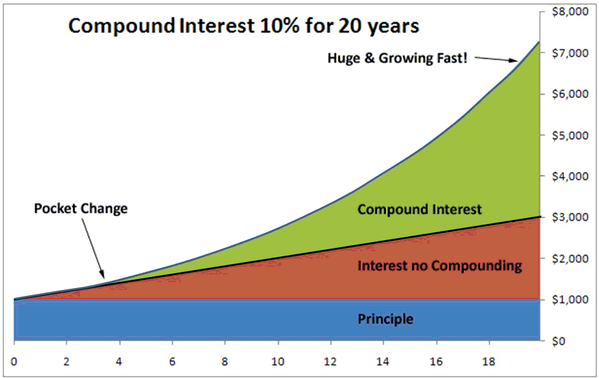
Compounding is a simple and powerful concept.

A $100 saving compounded at 10% per month gives us $110 in month 1.
In month 2, compounding doesn’t just give us $10. It also gives us 10% of the $10 we earned in the previous month to a total of $11. Now, our amount at hand is $121.
The following month, we receive interest on the $100 and then the $21 to a total of $133.1.

Compound interest starts off as pocket change but soon becomes the primary value of the saving.

9062942Thanks to source for the image

Here’s the kicker – compounding doesn’t just apply to money.

My hypothesis is that everything worth developing or learning compounds. Fitness, self control, initiative – you name it and it likely works that way. Heck, even learning compounds.

Every trait that makes us better people is hard to develop at first. Start exercising today and it feels hard. The results either feel negligible or absent. But, climb up that curve and suddenly things feel different. There’s a momentum where there never was one. There’s an understanding of how pieces tie in together.

So, if you are aiming to get started on a habit that you think will make your life better – start today. Compounding is more powerful when you start earlier and do it for longer. And, for those of you who feel stuck after putting in effort for a while, push through. Keep at it. It is tough at first.

But, it’ll get easier. And, most importantly, it’ll be worth it.

Ray Dalio investment autopsy – The 200 words project

In 1975, at the age of 26, Ray Dalio founded Bridgewater Associates – a hedge fund.

6 years in, Dalio felt the debt levels in the government pointed to the fact that the US was on the brink of a recession. So, he began betting on it and publicizing it. But, to Dalio’s surprise, the stock market surged and it led to a tremendous embarrassment and loss of fortune.

To make sure that never happened again, he began keeping detailed records of every trade he made and began noting what happened with every investment – learning from both his success and painful losses. As Dalio puts it, pain + success = progress. As he reflected on these investments, he kept finding “rules” that governed how markets worked and kept refining it. At Bridgewater, he built a culture of “radical transparency” challenging his employees to question his decision making and assumptions.

As author Al Pitampalli observes in his book, Persuadable – “Does he have an ego? Absolutely. Many say his is over-sized. However, he realizes that having false self-confidence would cost a lot.”

In essence, Dalio built his success by being very persuadable to new assumptions and data with an inspiring process.

(In case you haven’t watched it, his video on “How the economic machine works” comes highly recommended)

Ask yourself – how much do you let what you wish to be true stand in the way of seeing what is really true? – Ray Dalio


Source and thanks to: Persuadable by Al Pitampalli, Principles by Ray Dalio

(The 200 words project involves sharing a story from a book/blog/article I’ve read within 200 words)