Bell Labs, de Forest and SONAR

Bell Labs, the “idea factory,” was a result of anti trust law. Between 1930-84, all phone calls went through AT&T. They convinced the government a monopoly was necessary. So, the government made a deal with AT&T to make its patents/ideas public in return. Thus, Bell Labs’ inventions were open to everyone.

In 1910, inventor Lee de Forest tried amplifying radio signals to transmit human voice. This was a successor of the morse code telegraph invented by Marconi. Bell Labs’ engineers built on this to invent radio broadcasting.

While de Forest hoped radio broadcasting would spread classical music, it was jazz that actually broke through. Jazz sounds were better suited for primitive radios. Thus, the radio was monumental in bringing African-American culture into the white American living room.

Amplifiers followed. Then, “distortion” led by guitarists Jimi Hendrix and Led Zeppelin. And, alongside, in World War II, a device called SONAR began being used in World War II to detect submarines. This was thanks to a Canadian scientist who was intrigued by the challenge of preventing sea crashes like the titanic by bouncing sound waves off objects in the sea. Thanks to sonar, ultrasound followed.

(The story of sound continued from last week)

Amplifiers freed us from any constraints that we had artificially solved via operas and cathedrals. Adolf Hitler was one of the first exponents of this. But, it also made Martin Luther King’s speeches possible. Similarly, SONAR’s most powerful use was ultrasound which helped countless mothers during their pregnancy. But, it also led to massive female infanticide in Asia. Technology has always been a double edged sword.  | Steven Johnson (paraphrased)


Source and thanks to: How we got to now by Steven Johnson

When good intentions become a problem

Good intentions are great. They matter a ton.

But, good judgment matters more.

Every once a while, we meet individuals who combine good judgment with good intentions. Such people are rare. If you’ve found somebody like that, stick around.

Good judgment comes from soaking in lessons from others’ experience, experimenting and reflecting on one’s own experiences and squeezing every drop of learning out of previous displays of bad judgment. This is hard. And, for many, it shows up long after they most most need it.

 People often think they want to work with and build relationships with people with good intentions. That is true and assumes good judgment. But, given a choice between the intent-judgment combination, I’d index higher on folks with good judgment. There have been many great entrepreneurs and business leaders who’ve demonstrated great judgment even if they weren’t the bastions of good intention. I’d rather work with them than with someone who cares but has no idea about what they’re doing.
The road to hell is paved with good intentions and bad judgment.

Synthesis and the learning loop

Synthesis is how we get from knowledge to learning.

We take a big step toward learning when we’re able to extract what is useful from all the knowledge, facts and data that we’re exposed to. And, we do this by developing mental models when we force ourselves to synthesize. These mental models, in turn, help us get to wisdom – understanding how to use the learning after we run facts through our mental model.

That, in turn, spurs action as wisdom brings about clarity. Besides, to learn and not to do is not to learn.

This loop can be self re-inforcing as the action can help us develop better mental models, and so on.

But, the key step is synthesis and that is incredibly hard. Think about how easy it is to just read the news or interesting articles or blogs over the internet without ever thinking about the implications of those ideas in our life.

That is is why synthesis is the entry point to this learning loop. It is a rite of passage of sorts.

We don’t learn until we synthesize.

Car scratch

I came back to my car the other day to a collection of scratches in the front corner.

Damn.

How did that happen? When did that happen? Why hadn’t I noticed it? Why didn’t the person who did it let me know?

I kept working through questions until I came to – What can I do to fix this?

It turns out that I couldn’t really do much. Someone had probably grazed the corner of the car and driven away. But, that’s that. I could either choose to get it re-painted or ignore it and drive away.

I chose the latter.

Clarity is often a question away.

Un catchy titles

Everyone is fighting for your attention. One way to win this fight in the short term is to make every title a catchy title.

“Here’s what you need to know NOW.”

“Click this to learn the real secret of success.”

“You won’t believe what happened in XYZ yesterday.”

“ABC and DEF have declared war on each other.” (you’ll click to find out they haven’t)

Some of these catchy titles are, in fact, untrue. So, you realize you’ve been played all along. That, in turn, adds some distrust in the system and so on. But, the media companies will say they don’t have a choice. They do – but it isn’t an easy one when your business model is built on people clicking your articles. The catchy title fight is, thus, a street fight fought in mud and slush. Everybody involved gets dirty.

But, you and I don’t need to play that game.

We have the choice to just write about what we want to write about without trying to con folk into clicking. Yes, less people will see our work today. And, yes, we’ll have to do all that work to earn an audience (assuming that’s what we want) over time.

But, the folks who will have visited will have come seeking to understand what we’ve written. And, thus, we’ll have given ourselves a shot at actually reaching and, maybe influencing, the kind of folk we want to reach.

Everybody wins when that happens.

How Privilege Works

There are 3 things to know about privilege –

1. The definition of privilege is misleading. Privilege is “a special right, advantage, or immunity granted or available only to a particular person or group of people” We aren’t privileged based on this definition, are we? What about all those rich folk we know?

2. We are privileged when the next lucky break has a diminishing return in terms of our ability to solve for real needs. There comes a time when the next lucky break doesn’t matter as much as the previous one. For some of us, it is when we went to a college or graduate school that catapulted us in a league we couldn’t have imagined. For others, it is after we worked at a little known company that ended up doing wonderfully well. After this, sure, the next lucky break would make us more comfortable. But, it wouldn’t be life changing in the same way. That’s a sign of privilege.

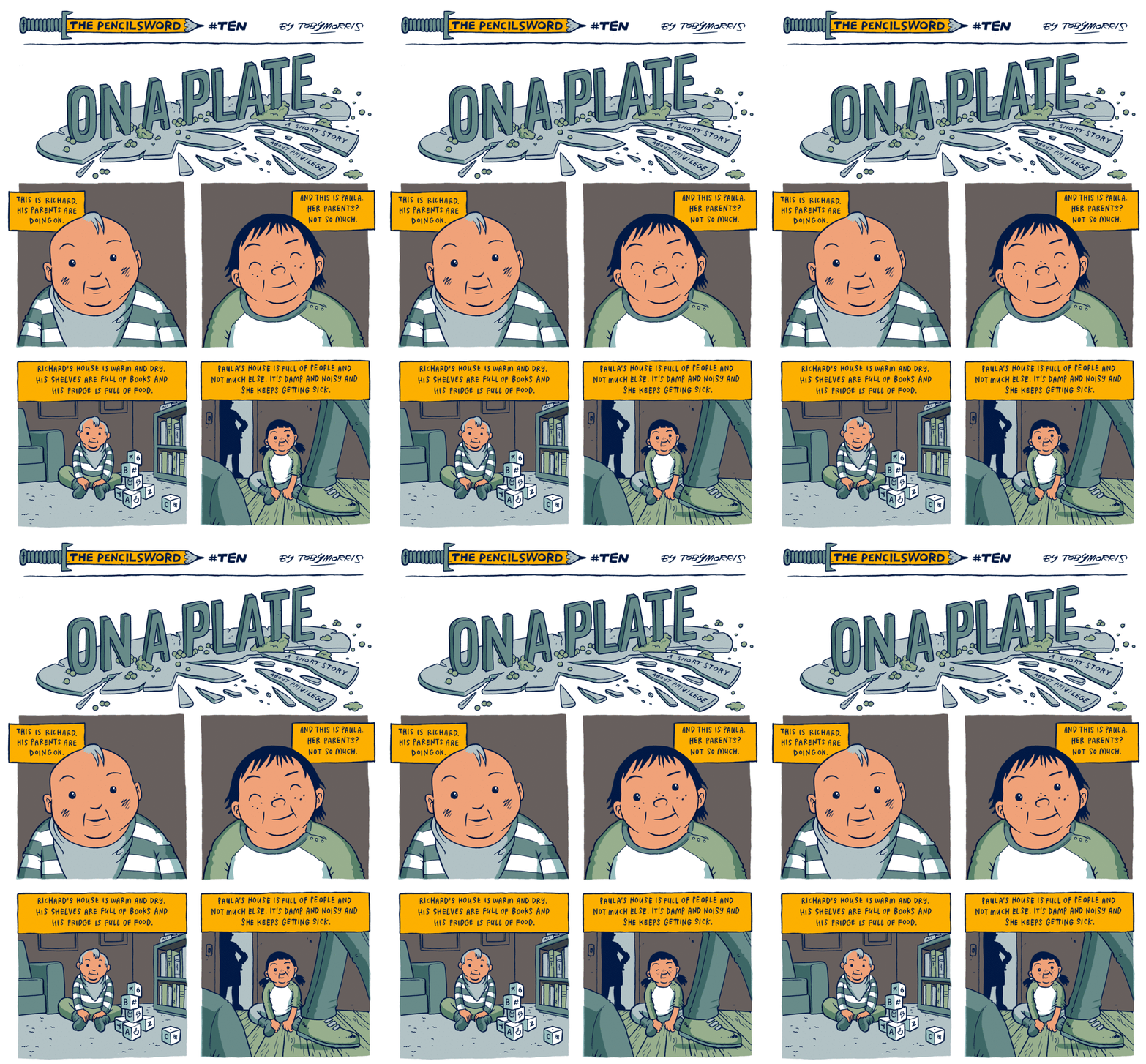
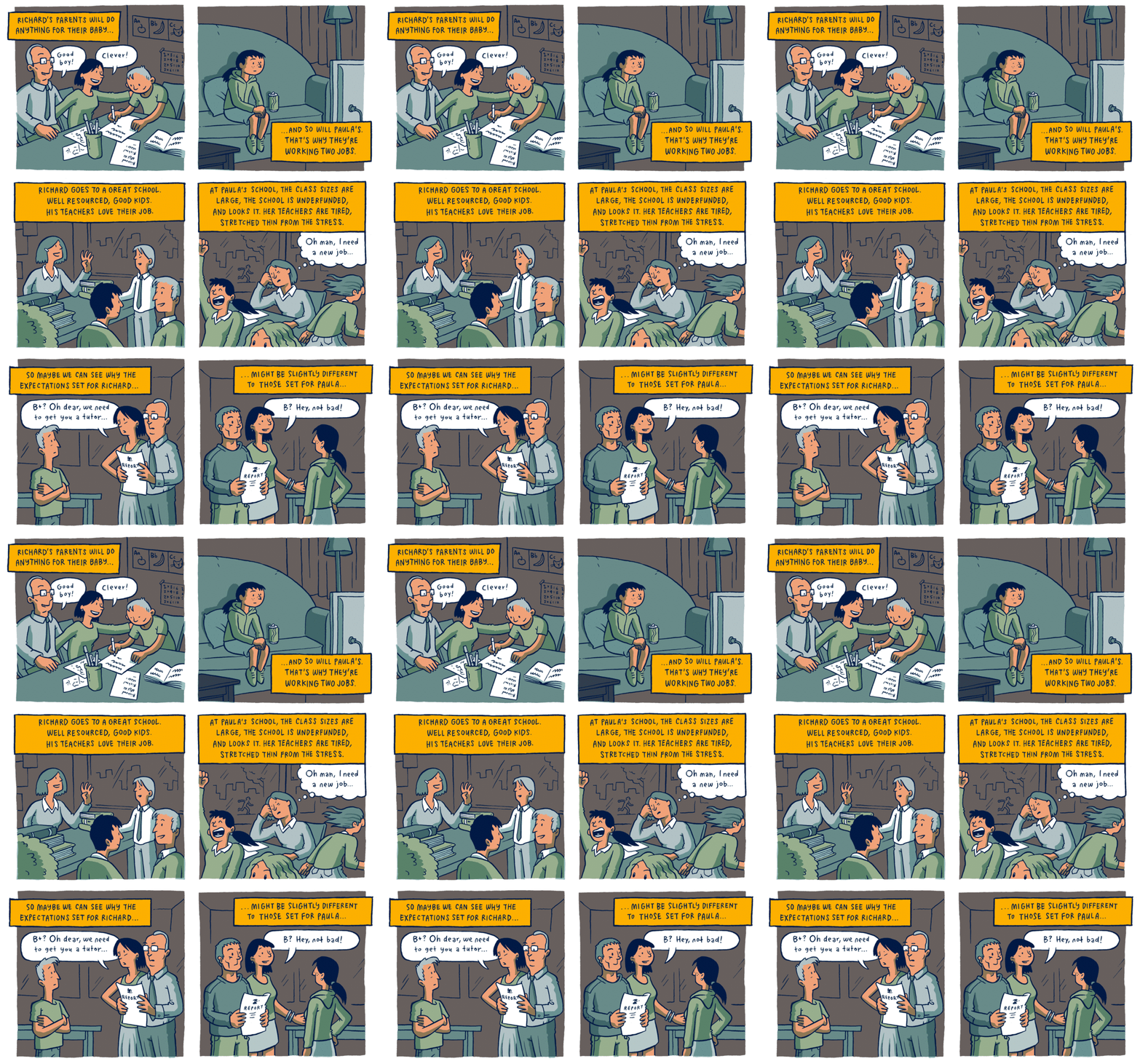
3. Privilege accumulates over time. An obvious source of privilege is family wealth and power. We’ve all heard some variant of Jeb Bush or someone else we know to be privileged calling themselves “self made” and snickered.

But, I’d argue many of us are guilty of that hypocrisy. The reason it is so hard to pinpoint is because it accumulates over time. Once you get that lucky break – born to parents who have the means to educate you well or born in a country filled with opportunity  or got that internship that changed your life – privilege compounds. And, a few years in, it is nearly impossible to look back objectively.

I was talking to a friend about this and he pointed me to a comic that nailed describing this. Thanks “The Pencilsword” and Toby Morris for an awesome illustration.


Life happens in unexpected ways

Amy Krouse Rosenthal died a few days ago. If the name sounds vaguely familiar, you might have read her beautiful piece – “You May Want to Marry my Husband.” There are few things more powerful than a reminder of our mortality and that life happens in unexpected ways. And, Ms. Rosenthal’s note provided that for the a large section of the 5 million odd people who read her piece.

In her piece, Amy says – “I want more time with Jason. I want more time with my children. I want more time sipping martinis at the Green Mill Jazz Club on Thursday nights. “More” was my first spoken word (true). And now it may very well be my last.”

And, writing about those lines, Bryce Roberts (whose blog I enjoy reading) wrote a post called “The Time Thief.”  In it, he said –

Notably she wasn’t asking for more time with her phone. Or with the brands that she’d built a relationship with.

They say that there is a war being waged for our time and attention. That companies of all kinds are competing for little spaces in our days and in our brains and in our shopping baskets. As with every war, there are winners and there are losers. If the brands, and social networks and media outlets win, who loses?

Maybe the reason for my ugly cry was that I know who loses.

And who is losing.

Our time on this planet is limited. And, it is ever so easy spending our limited time checking our social feeds, mulling pointless corporate politics, indulging our egos or feeding ourselves mental/emotional/physical garbage.

Here’s what I’ve noticed – in the final analysis, I’m yet to hear someone who wished they’d spent more time doing that. Of all regrets, there are two that I’ve heard and read about time and time again. First, they’d go out on a limb and take that risk they felt strongly about. And, second, they’d spend more time with those they love.

Not better, more. Better does matter. But, it only counts when there’s enough.

This is probably not new to any of us. We’ve probably read this somewhere before. But, if we’re not doing it, then we’ve not learnt it.

Well, its about time.

Life happens in unexpected ways.

So, there might just less time than we think.

Let’s make it count.

The phonautograph

Scott de Martinville, a French printer, began taking a hobbyist’s interest in the physics and anatomy related to sound. Since the 1500s, scientists had concluded that sound waves travel via the air and also travel four times faster via water. They had also figured out the anatomy of the ear and how it “received” sound. As stenographers were the best transcribers of sound, Scott created a device called the “Phonautograph” in 1857 that transcribed sound into sound waves.

Image Source – Auto Engineering Society

He had sought to automate stenography and expected to create a new language around interpreting sound waves. This didn’t work.

However, Thomas Alva Edison went on to invent the phonograph which he expected would be used to send audio letters. Then, Graham Bell invented the telephone – which he thought would be used to distribute live music. They had it in reverse!

Thus, phones brought us closer. The first international line between the US and Europe in the 1950s could just handle 24 simultaneous international calls. Telephones popularized “hello” and switchboards employed women professionally. Phones also gave us Bell Labs – an organization that created nearly every major technology – radio, television, microprocessors, fiber optics, cell phones, computers.

More on Bell Labs next week.

Telephones made skyscrapers possible because they made transmitting messages between groups easy. Elevators would need to accommodate many many people if we were still doing human memos. – Steven Johnson


Source and thanks to: How we got to now by Steven Johnson

28

3 words come to mind as I think of entering my 28th year – engagement, perspective, and faith.

Engagement. Engagement is my theme for the year. For the longest time, I was fascinated by a quote from a zen master that said – “The essence of zen is to be able to focus on one thing at a time.” So simple and, yet, so profound. That is my goal this year – to be engaged through my days and to focus on one thing at a time. As I live these days, so I live my life.

Perspective. Thanks to immigration related issues, there’s a fair bit of uncertainty as to where we’ll be a few months from now. While we’re doing everything we can to sort this out, there’s little we actually control. However, as much as we’d love for the uncertainty to go away, I recognize that the “worst case” isn’t a “worst case” after all. A combination of some hard work and a few lucky breaks have ensured we don’t have to worry about the basics. That privilege is a reminder of how much I owe and is a wonderful source of perspective. The beauty of this perspective, in turn, is that it enables me to keep good humor as I go through the inevitable ups and downs. And, I hope to keep that combination of good humor and perspective with me as I engage through my days this year.

Faith. Yuval Harari’s Sapiens drove home a beautiful point. As humans, we all worship some faith. It might be traditional religions like Christianity, Islam or Hinduism or it could be non-traditional ideologies like liberalism, communism or even celebrity culture. David Foster Wallace, in his legendary commence speech – “This is Water” – wisely asked us to “be careful what you worship.”

I had an epiphany yesterday that my faith of choice is learning. And, I’ve come to be thankful for such a wonderfully benevolent faith that ignores the nature of what happens and just reminds me to ask – “What am I learning from this experience?”

Here’s to engagement, perspective and learning this year. Hope you all have a lovely day. :)

(Past birthday notes: 2726, 25, 2423)

When is it a good time

We could ask – when is it a good time to start on this new project?

It turns out that there really isn’t a “good time” to start anything. And, we’re never completely ready. Barring outrageous luck, we’ll be moving against the current and will need to learn a lot more than what we imagined.

The way forward, then, is to wait till just before we feel ready. Then, say “This might not work.. and that’s okay” to ourselves and take the leap of faith.

Any time we choose to start is a good time.