Committing to rewriting

When we write, the first draft is simply a crystallization of our thinking. The first draft, in essence, is for us. The challenge with writing well is rewriting that first draft with our audience in mind. Doing so helps us separate the process of thinking from the process of writing.

While this sounds simple in practice, this turns out to be very hard. As Barbara Minto articulately describes – “Once you put ideas in writing, they take on an incredible beauty in the author’s eyes. They seem to glow with a fine patina that you will be quite reluctant to disturb.” 

This is true – at least in my experience.

One approach to solving this problem is to lay out your thought process on a piece of paper before writing. That, however, may not work for everyone. While I’m keen to test it, I’m not optimistic about my attempts to do this well.

The alternative solution I’m more hopeful about is to start writing by making a strong commitment to rewrite as soon as I complete the first draft. Setting this expectation will hopefully make it easier for me to not get lost in the “glow” of my first draft.

Here’s to experimenting with both.

PS: Thankfully, the tools we use today are perfect editing and rewriting. It is a pity if we use our current suite of editing tools like typewriters.

Triumph of spirit

I love mega sporting events. In the space of a few days, they regularly showcase the best of humanity – the warmth of supporters from opposing countries, stunning displays of athleticism, nerves of steel, and spirit from the players. We witnessed all of this in the World Cup and Wimbledon. Since the arrival of 2 kids, I am temporarily just a score + highlights follower. But, my oh my, what scores and highlights they were.

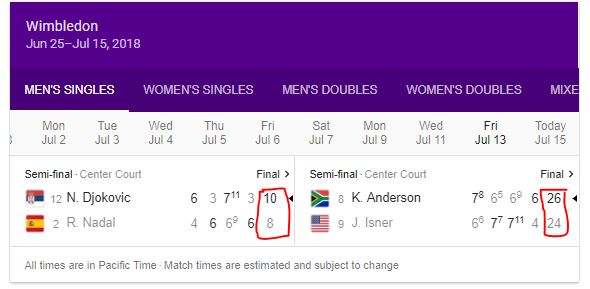
The Wimbledon semi final score line tells the story of the men’s bracket. The athleticism on display from Djokovic and Anderson was something else.

Then again, Serena Williams’ runner up run after giving birth to a baby just 9 months ago takes the gold medal for jaw dropping awesomeness.

And, finally, the world cup had so many wonderful displays of spirit. But, if there was an award for spirit, Croatia would have won it. The Croatian team has faced many trials and tribulations off the court in the past few years with a big corruption scandal. What a way to bounce back. They reached the final following stirring comebacks in every one of their three knock out games – all of which went to extra time. The final, however, was always going to be a mismatch. France’s ridiculously talented side won the world cup despite never really peaking. There’s plenty more to come from this team.

Spirit is a set of qualities that form the key elements of a character of a human. Sporting events such as the World cup and Wimbledon remind us of the power of that spirit. What do such events mean for the rest of us then?

There may be no world cups in our workplaces. But, that doesn’t mean we don’t or can’t showcase spirit. Unlike in the case of such mega sporting events, we are all running the marathon of life. And, the best demonstration of our spirit lies in how we show up everyday – at home and at work.

The world cup is now over. It is on us to take this inspiration and make it count.

Career decisions and partners

A member of our team did a fireside chat with an executive/wise friend who was leaving our organization. One of the questions he asked was about her most important career decision.

After giving it a moments thought, she said – “Marrying my husband.” She went on to share her appreciation for their relationship, for their partnership as parents, and explained that it was key to any success she had enjoyed in her career and also to her happiness.

I think about that answer from time to time.

I grew up in India where marriage is a default decision. Most kids growing up in India don’t think about whether marriage is for them. It is just something you do once you get out of college and get a job. Kids come after that.

Economic development changes the nature of such default decisions. The US in the 1950s wasn’t all that different. You found a job, married young, and had kids. That has changed and we’re seeing that change in the urban centers of India too. We all have our own unique journeys. Marriage is not for everyone. And, having kids is definitely not for everyone.

That said, if you do decide that it ought to be part of your journey, marriage does end up being a critical decision. Once you are past the honeymoon phase, your partner becomes your shrink, best friend, life coach, loyal critic, movie buddy, and romantic partner all in one. By this time, you’ve heard all of each other’s stories and know every one of your crazy quirks. It can be hard to both love and like people you know well – that’s why relationships take work.

In addition, both your personalities, likes, and dislikes influence each other and you find a thermodynamic equilibrium of sorts over time. If you then decide to have kids, you move from testing your partnership in the little leagues to playing in the major leagues. The challenges and stakes get higher as you try and balance being parents and partners while learning to trust each other’s decision making processes.

Successful careers are the result of a large team of contributors. No one does anything of note by themselves. A few succeed despite bad partnerships. But, in most cases, careers are only as successful as the strength of the partnership at the center of it all. That’s because great partnerships in life are like great partnerships in sports and business – both of you push each other and grow together to become the best versions of yourself while complementing each other as a team.

Over the years, I’ve spoken to a lot of friends and colleagues who were thinking about marriage. It is a hard topic to talk about because you don’t have many personal data points to draw from if you have done it well. It is also why I don’t write about it that much. But, if I were to speak from my experience, I’d probably say it is worth being very thoughtful about that choice. And, once we choose, it is on us to commit wholeheartedly and do the work – every day. It definitely is the among the most important decisions we get to make.

In the final analysis, this partnership and this life are completely what we make of it. And, if we want to and are lucky, we have the opportunity to work at making it special and fun – together.

The Queen died. The King died.

Take 1: The Queen died. The King died.

Take 2: The Queen died. And the King died of a broken heart.

Five extra words transformed two boring facts into a story capable of stirring emotion (“Aww”). There’s a lot of talk about storytelling with mental pictures of Steve Jobs floating around. But, if you had to be reductionist, the formula (probably) would be –

Stories = Facts + Context + Emotion

As we move from one meeting to the next pitching our ideas, it is worth remembering that facts and logic only help people reach conclusions. Stories, however, bring emotion to the table.

And, it is emotion that drives action.

(H/T Dan Pink – for such a memorable illustration on the power of stories.)

Open plan offices – counter to the counter point

Cal Newport and David Heinemeier Hansson had strong critiques of open office plans this week (Cal, David). They’re both thought provoking thinkers/writers and I understand where they’re coming from. That said, their arguments are built on the incorrect assumption that the primary purpose of open offices is to foster collaboration.

While that may be the party line, I think the two primary reasons for open offices are cost and culture. Office space is expensive and open offices are much cheaper on a per-employee basis. Cost is a powerful organizational incentive.

Culture is an often overlooked part of the discussions of open offices and is why richer technology firms have embraced open offices. Having executives work at their desks a few meters away from entry level analysts makes leadership feel more approachable and less hierarchical. It signals certain cultural values and changes the dynamic from workplaces where the goal is all about getting to that coveted corner office.

The absence of the culture variable is also the weakness in most studies on open plan offices. The effect of signaling these cultural values is hard to measure in the short term. But, just because something is hard to measure doesn’t mean it is less important.

I still think the commonly cited issues with open offices should be addressed – this critique of open offices based on their propensity to foster predatory behavior against women, for example, is important and needs to be fixed. We need more spaces and cultural norms that make it easy for people to focus. It may also be that companies with strong hierarchical cultures are just not suited for open plan offices.

The issue just isn’t as simple as is often outlined. And, it is hard to move these discussions forward if we don’t understand the trade-offs involved.

Studying and Learning

Doing well in school required us to get good at studying. To study, per the dictionary, is to devote time and attention to acquiring knowledge on (an academic subject), especially by means of books. 

Studying, however, is different from learning. To learn is to gain or acquire knowledge of or skill in something by study, experience, or being taught.

The (albeit subtle) difference lies in the outcome. Studying is focused on the process of acquiring knowledge while learning involves practical application. The real test of learning is what we end up doing with what we learn.

The challenge with teaching learning in schools is that learning is hard to test in a final exams. So, we fall back to testing students’ ability to study. Of course, the obvious downside of this approach is that it is likely we end up completing two decades in schools without a good understanding of how to learn.

The good news is that our education didn’t end with graduation. There is still time to learn how to learn. And, the beauty of learning is that we see the results of what we’ve learnt in our actions every day. To learn and not to do is not to learn. So, if we aren’t actually evolving and improving how we approach our days – every day, it is time to revisit how we learn.

It is the highest leverage thing we can do with our time. After all, studying might have helped us do well in school. But, learning helps us do well in life.

High yield savings accounts

A simple and useful piece of personal finance reminder I received recently was to move saved cash from an ordinary savings account to a high yield savings account. Where I am, that instantly changes the interest rate from ~0% interest to ~1.9%.

Of course, a “high yield savings account” is just a fancy name for an account that ensures your money keeps up with inflation. But, if you maintain an emergency fund in your savings account, for example, it is worth finding a savings account that at least ensures you don’t lose money to inflation every year.

Over time, that is worth a lot – literally. :-)

Gifts of the internet

I’ve been re-reading “The Pyramid Principle” by Barbara Minto over the past few days. It is the go-to book on learning to present your thinking in writing. I’d first read the book in 2011 and I remember feeling the book didn’t resonate. My only explanations for walking away with that feeling are i) inexperience and ii) (relative) stupidity – as my second read has been eye opening. This post isn’t about my synthesis – more on that in the next few days.

As I was working through the book last night, I decided to take a break by checking out Barbara Minto’s website. I found a contact form and wrote out a quick, short thank you to her for the book. And, voila, I woke up this morning to find a note from her in my inbox expressing her gratitude for the thank you and offering to help if I had further questions.

We’ve had a lot of conversations about the downsides of technology – excessive click bait, fake news, etc., etc. These conversations are important as every tool has its downsides. But, it is also tempting to become cynical about technology’s potential for positive impact and change. The internet’s ability to remove boundaries and enable us to connect with people we admire halfway around the world is second to none. When used with thought and generosity, it can be an incredible gift.

It is up to us to use it well.

Don’t rush to be embarrassed by the first version of your product

The intent of good quotes is lost over time. So, they are often misunderstood and misused because they are applied out of context. Reid Hoffman’s quote – “If you are not embarrassed by the first version of your product, you’ve launched too late.” – is a great example of loss of intent.

I’ve seen this quote used as an excuse to justify a crappy v1/first version product. I haven’t heard Reid talk about this in person – but, I’m fairly certain that that wasn’t the intent.

There are two good reasons to be embarrassed about v1 (in hindsight). The first is the most common – you didn’t know better and/or couldn’t do better with the tools available. The first website I put together looked horrendous. I didn’t understand the basics of web design and it was also built on an early version of Adobe Dreamweaver. Now, however, I have slightly better design skills and, more importantly, have access to amazing tools. Thanks to the likes of Bootstrap and services like WordPress, it is very easy to build a good website.

The second is the result of prioritizing one killer use case/risky assumption for your product and ignoring everything else. You may still be embarrassed by the first version – but, you’ll still have served that basic user/customer need.

Source: Unknown – thank you to whoever made this.

The truth is that you’ll be embarrassed by nearly everything you ship. Over time, your skills will improve, the tools will get more sophisticated, and your understanding of the user/customer need will get better. So, you don’t have to work too hard to cut a few corners now to ship something you’ll be embarrassed by. Time will take care of that. The key, instead, is not to knowingly do something you will regret.

So, the two questions I’d suggest asking are –

  • Is what we are shipping helping us learn what we want to learn while providing value to the user?
  • Is this our best effort based on what we know/have access to now?

If the answers to both are yes, ship away. Even if you are eventually embarrassed about what you ship, this approach will make sure you will not have any regrets.

4 shows that resonated

As I looked back at books I read in the first 6 months yesterday, I thought I’d do the same with 4 shows that resonated/are resonating.

  1. Planet Earth II (Netflix)- narrated by David Attenborough. When you are #1 and #3 on the list of the top rated TV shows of all time – in an age when you are competing with the likes of Game of Thrones, Breaking Bad, and Sherlock – you know you’re onto something special. Planet Earth II is awe inspiring, educational, and thought provoking all at once. It reminds us that being on this planet is a privilege and of the fact that privilege comes with responsibility. I’m incredibly grateful to BBC and David Attenborough for their work.
  2. Parenthood (Netflix). Parenthood is a hidden gem. It is the story of a family of 4 siblings and their kids and the complex web of relationships between them. The show takes the time to develop characters and feels real – a kid with Aspergers, a multi-racial family, marriage troubles, old age health issues, and so on. I think being a parent made me appreciate the show more.
  3. Hunters and the Hunted (Netflix) – narrated by David Attenborough. We are still in the midst of watching this. Captivating.
  4. Goliath (Amazon Prime)- starring Billy Bob Thornton. The word I’ll use to describe Goliath and the performance of the cast in season 1 is “riveting.” The first season of Goliath comprised 8 episodes where BBT, a down-and-out lawyer, takes up a case that pits him against a massive oil company and the firm he co-founded. Season 2 sees him spring into action following a murder of a friend. We’re still watching season 2 – so, here’s hoping it lives up. (Update: Season 2 doesn’t live up as the original writer left. :-()

Happy weekend!