
Xerox Parc

In 1969, the Chief Scientist at Xerox – then a rich and famous photocopier company – suggested that they ought to invest in a second research center away from headquarters. They chose Palo Alto and created Xerox Parc.

In the next decade, the scientists at Xerox Parc incubated, among other things, the first graphical user interface controlled by a mouse, graphics display, and text editor.

Of course, Xerox never ended up commercializing any of this as their executives never saw the potential of these inventions. So, many of the best researchers left to places like Apple Computer and ended up inventing the future.

Xerox Parc was a one off in many ways. It was and will likely remain among the most productive research facilities in the history of mankind (Bell Labs, perhaps, would be its only real competition). But, the retelling of this famous story doesn’t fail to inspire humility.  The executives at Xerox weren’t stupid – they were just not incentivized to recognize the potential of these breakthrough ideas. That could easily be you or me.

It also never fails to remind me of the importance of investing a small but consistent portion of resources – be it at work, in our financial investments, or in life – in research/exploratory projects with no immediate pay off.  Many of these don’t seem to pay off for the longest time.

Until they do.
The law of unattraction and problem solving

The law of attraction implies that when you really want something the universe conspires to make it happen. The law of unattraction (an ALearningaDay creation) offers the counter point – “The universe makes something happen when you have put in your best effort and are ready to walk away.” 

The law of unattraction was born out of personal experience. For the longest time, I used to struggle with pushing a result through to no avail resulting in plenty of frustration. And, often, just as I’d resolve to walk away or actually distance myself, it’d come through. Why waste time in all the angst and frustration then?

I’ve been thinking about the law of unattraction again of late and its applicability to problem solving. We don’t have breakthroughs-on-demand on problems we want solved. Instead, they pop up when we’re in the gym, in the shower, or on a walk. The key, then, is to identify the problems we want to solve and give ourselves enough space for our subconscious to do the work.

So, take those breaks in the middle of the day, go for walks, and disconnect from the email flow in the evening to create more space. If the law of attraction isn’t helping you often enough, create opportunities for the law of unattraction to work its magic.

Good for you

“When someone says something is ‘good for you’ when it is also good for them and when they don’t face the downside of the decision, it is likely not good for you.” | Nassim Taleb, Skin in the Game

The underlying structure of incentives in a system are more powerful in driving behavior than the individuals within it.

When in doubt, look for and understand the incentives.

PS: While this has powerful implications in business – whether you are hiring consultants (“extend our contract – it’ll be good for you”), bankers (“do the deal – it’ll be good for you”), or real estate agents (“buy the house – “it’ll be good for you”) – it turns out to be perfect when examining our motivation as friends and parents as well. Is what we’re saying good for them or good for us?

Endings

We love celebrating beginnings. Launches, anniversaries, and jubilees are a few examples of the various ways with which we celebrate beginnings. Beginnings are great. But, in our rush to celebrate them and encourage more of them, we often forget that they wouldn’t exist if it weren’t for endings.

This week, for example, may be a great week to end…

… the project that isn’t going anywhere.

… that relationship whose negatives outweigh the positives.

… those unproductive recurring meetings.

… an annoying habit that you know you’d like to stop.

Every ending enables us to get started on a new beginning. Endings lift dead weight, throw out baggage, and give us the mental bandwidth to start afresh.

Here’s to more of them.

3 notes on decisions for the week

3 notes on decisions for the week –

1) Being afraid of making decisions is as useless as being afraid of being judged. Both are happening – whether we like it or not. So, we’re better off accepting that fact and dancing with it.

2) Once we commit to rising above the fear and making decisions, it is a certainty that we’ll get a few of them wrong. The only useful habit when faced with these mistakes is a focus on a creative, constructive, and corrective response. Fix issues and avoid repeat mistakes.

3) Nearly every decision we’re worried about right now won’t matter a jot in the long run. The stakes are generally far lower than we think. Worry less, smile more – this will pass.

Reason, season or lifetime

A few years back, I came across a model for relationships that has stayed with me. It said people come to your life for a reason, a season, or a lifetime.

Folks who come in for a reason are like guardian angels who swoop in for a short period of time – right when we need them. Folks who are in for a season are with us for a few years – bringing wonderful memories and moments from those times. And, folks who are in for a lifetime find ways to stay with us all the way through.

It gets harder to maintain close relationships as we grow – especially if physical proximity isn’t a given. We change, others change, contexts change, and so on. A lot of the angst in relationships (as in life) comes from an inability to deal with this impermanence.

The beauty of the reason-season-lifetime model is that it reminds us of that impermanence. In retrospect, I can think back to a couple of relationships that didn’t end well – but which clearly existed for a reason or season. And, I can also think of a couple that fizzled out despite an incredible season. Trying to extend these into relationships that last a lifetime was futile.

Understanding and accepting past relationships for what they were enables us to forgive, forget, and simply savor the special moments.

It also enables us to let go of unnecessary baggage and travel lighter. On long journeys, that’s a great way to travel.

Challenging career switches and vanity metrics

Folks who are attempting challenging career switches (top graduate school or some combination of industry, function, location change) often make a mistake that turns out to be debilitating for their search. They index highly on “conversion rate.”

You know this is happening when the internal dialog is – “I applied to 7 places and no one / only one person got back to me.” They’re implicitly calculating a conversion rate of 0/7 or 1/7. While that may be bad for a standard job search, conversion rate is just a vanity metric in challenging searches.

You could have applied to 100 places for all I care – what matters is finding that ONE place that will give you a shot. A focus on conversion rate is, thus, a recipe for giving up too quickly. Having made this mistake myself, I can’t overstate the importance of avoiding it.

If you are convinced the challenging career switch is right for you, your most important allies are grit – passion and perseverance – and a growth mindset. As long as you are learning from your missteps and improving your approach, one opportunity will eventually show up.

And, all it takes is for one to work out.

Attachment to principles versus processes

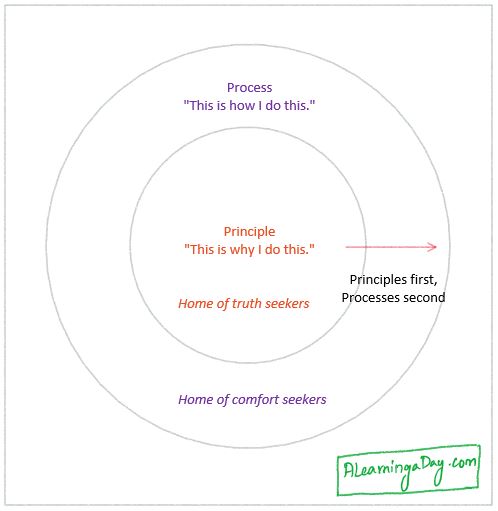
The biggest benefit of experience is better pattern matching. You’ve seen many of the today’s movies play out before and are equipped to deal with them. The downside is a growing attachment to processes versus principles. This when you say something like – “This worked before. This is how I do this sort of thing” instead of “This is why I do what I do.”

I’ve noticed this creep into my thought process from time to time when it wouldn’t have five years back.

Here’s an example – let’s say a rapid, iterative approach to product creation worked on your team in the last year. The process you could get attached to is “Rapid, iterative product creation is how to build products.” Instead, the principle probably is – “The best process to building products is dependent on the context, the company, and the kind of customer.” If you were attached to the principle, you might decide that slower, more thoughtful product creation process is what the current situation needs. Whatever the outcome, you’d consider the alternative.

The challenge with developing an attachment to a process over a principle is that the principle you implicitly choose is “Refusing to ask why means choosing comfort over growth and inflexibility over seeking the truth.”

That is the polar opposite of one of the most important life principles – change is the only constant. We either change proactively or are forced to do so by circumstance – an experience that is best avoided.

Principles first. Processes second.

Internet speed and monopoly power

My mom used to have a 16 MBPS (mega bytes per second) internet connection a few years ago in India. However, in the past 3-4 years, there’s been a slew of new competitors in the broadband market and her internet speed right now is 75 MBPS. Thanks to the competition, the costs have also gone down every year.

We had a 150 MBPS connection via Comcast at home last year. Comcast recently notified me that the 150 MBPS was actually a “special offer.” And, if I still wanted it, I’d have to pay $15 per month extra. I could keep my current rate – but they’d lower our speed to 60 MBPS.

I called up our apartment’s front office to check what my options were if I didn’t choose Comcast. She explained to me that there were none.

So, I called Comcast back and said I’d take the downgrade.

Now, 60 MBPS is more than sufficient for normal internet use. In addition, this is definitely a first world problem. However, it illustrates the cost of a regulation driven monopoly. When your users have nowhere else to go to, you can do the bare minimum and get away with it.

It doesn’t mean you should. But, the incentives to drive profits and “shareholder value” at the expense of customers with no alternatives is very powerful indeed.

Looking outward

There’s a lot written these days about millennial employees looking to find purpose at work. These discussions are interesting and speak to the challenges executives and HR professionals face as they seek to combine monetization with collaborative and inspiring workplace.

That said, I do find myself wondering how much of this is actually about the desire to find purpose at work versus seeking those powerful and elusive intangibles like happiness, equanimity, and peace of mind.

If it is the latter – and, in many cases, there’s reason to believe it is – seeking fulfillment at the office is just a distraction. Regardless of how wonderful the values might be, workplace cultures are built around incentives like pay, promotions, and performance reviews that encourage us to look outward. The powerful intangibles that we tend to seek, on the other hand, only exist when we look inward.

No amount of effort will help us find them if we spend it looking in the wrong places.

Find them within ourselves, we must.