The Art of Learning and other great books

I’ve updated my book reviews blog with reviews and notes from 8 books from the first half of the year. Of these, “The Art of Learning” was my absolute favorite. There were many lessons that stuck chords deep within.

But, “The Art of Learning” may not be the book you are seeking right now. And, if that’s the case, there are 226 other non fiction books that have been reviewed and categorized. I’ve attempted to provide a quick overview of the theme of the book, share my top takeaways, and in many cases, also shared notes I took along the way. These notes aren’t intended to be a sharing of learning – notes and summaries can’t do that as they are notes based on what resonated for the note taker. They’re simply intended to provide more color into what the book is about.

Great book experiences only become so when we are ready to soak the learning in them. Hopefully, this resource helps you find a book that you’re seeking right now.

Somewhere in there is a book that will likely change your life… I hope you find it.

Spasibo

It is one thing to deal with the disappointment of becoming the first team in ~50 years to lose a World Cup knockout game after going two goals up. It is quite another to follow that up with a spotless dressing room and a thank you note written in your host nation’s language (“Spasibo”).

Of course, the Japanese soccer team were not alone in doing this. Their fans (along with the Senegalese fans) had endeared themselves to the hosts by cleaning up stadiums after their games. I had two reflections from Team Japan’s behavior.

First, I’ve thought about the line “leave everything a little better than you found it.” That is very hard to do consistently. But, what if we at least held ourselves to the standard of “leave everything at least as well as you found it?” Would we waste less, recycle, and compost more?

Second, the behavior exhibited by the Japanese isn’t a result of inspiration leadership and great strategy. It is simply a cultural norm – “this is what people like us do in such situations.” It speaks to the power of setting cultural norms for ourselves, our families, and our teams. Culture is both strategy and leadership in the long run.

Directional answers and precise answers

I use simple a rule of thumb for the difference between attempting to convert a directional answer into a precise answer – 10x+ time investment.

Attempting to find a reasonably good pair of headphones might just take you 10 minutes on Amazon. However, if you’re looking for the best headphones you can find for your budget, you could easily spend 100+ minutes searching.

Similarly, if you want to predict the effect of your strategy on key metrics, you might be able to get to a directional range in 2 hours. But, if you want to isolate and understand every variable and its interactions, you’ll want to budget at least 20+ hours of work.

This is analogous to being a satisficer versus a maximizer. Attempting to maximize everything you do by getting precise answers is very expensive. Thus, the implication in conducting analysis as in living life is similar – assume you need directional answers unless it is clear that precise answers are the way to go.

Every once a while, you’ll realize that you’d have been better off finding that precise answer. But, thanks to this strategy, you’ll have enough buffer time to course correct. :-)

What if it were easier?

There’s no dearth of interesting “what if it were easier” questions. For example –

  • What if getting our projects resourced was easier?
  • What if good health/relationships were easier to maintain?
  • What if our teams/executives easily understood our thought process and the value we were adding?
  • What if our immigration problems just vanished? :-)

While occasionally interesting as thought experiments, the fallacy here is an implicit assumption that easier is better. If you have been so fortunate as to get things after having worked hard or after many failed attempts, you know that that isn’t the case.

So, when we face our challenges, it might just be worth replacing the “what if it were easier question” with “what would it take for me to be better?”

Easier isn’t better. Better is better.

Doing the thoughtful thing

The trouble with aiming to always do the right thing is that it doesn’t apply to a majority of situations we encounter everyday.

Every once a while, we may encounter a situation where we know exactly what the right thing is. But, more often than not, it is unclear what we ought to optimize for and for what time frame.

A better approach, then, is to aim to do the thoughtful thing. It is a great approach to minimize regret and maximize peace as it means we’ve done the best with what we know. When we know better, we will do better.

And, besides, it turns out that the right thing is just the cumulative result of one thoughtful decision after another.

When you are ready

We were scouring blogs on “potty” training for kids recently. A common question around potty training is about the right time to do it. There’s plenty of advice on timing and the recommended range is between 2 and 3 years.

But, one of the wiser pieces of advice we read was from a blogger who said – a parent’s readiness is as important (if not more) than the readiness of her child.

We’ve found this to be true every time we’ve tried to make a significant change as parents (moving baby to her own room for example). Her readiness generally follows our own.

It strikes me that this is applicable for most changes we try to make in our lives. It is easy to look around for the best time to do so.

But, there isn’t a best time. The best time is when we are ready…

Not a race

Every once a while, it is worth reminding ourselves that it is not a race. It is also not zero sum. We aren’t in a competition in any aspect of our lives. The game doesn’t end in 90 minutes or a quarter or a year.

While our default state assumes all of that, it couldn’t be further away from the truth. We’re playing an infinite game. The objective of the game is whatever we decide it should be. And, our only real competitor for comparison is our past self.

An undercurrent of perspective

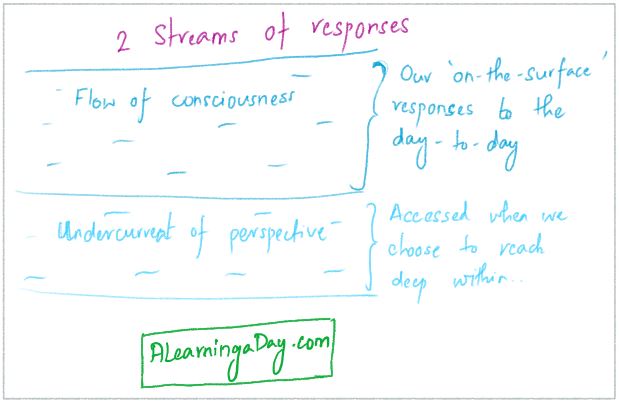
Of late, I’ve been thinking of two streams at work and in life. The stream at the top is the one that dictates our response to the flow of the day-to-day. It deals with our plans for the future, the crisis of the moment, and the many other highs and lows that we deal with in our journey.

Underneath that stream is another which isn’t easily touched – but is one we can choose to access. It flows thanks to the undercurrent of perspective. Reaching for this undercurrent means reminding ourselves that we’re not here for too long and that nothing we do will last for long.

This undercurrent can be mistaken for a morbid thought that needs to be shushed away. But, it isn’t. Instead, in reminding us of the end game, it teaches us to focus on the little that actually matters. Our petty competitions, factions, politics, and rivalries are all going to count for nothing.

It reminds us that our life might be shorter than we think. So, we’d be better served dealing with today’s issues with a smile (they will pass). And, as we’re all fighting the good fight, we could all be kinder to ourselves and each other.

Content, Structure, Structure, Delivery

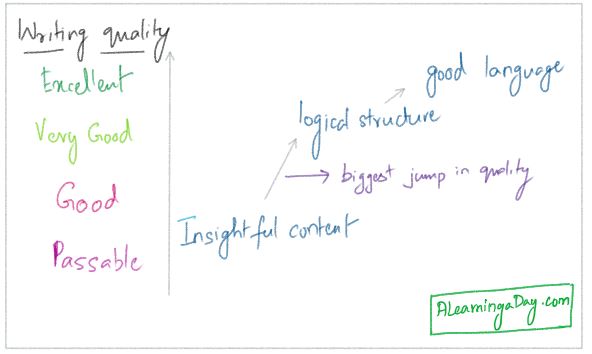
In the age of 6 page memos and product press releases (thanks Amazon), writing has become a core skill at work. Great professional writing brings together insightful content, a logical structure, and good delivery.

Insightful content is what gets us through the door when we write. This is different from public speaking as you can get away without saying much and still give a good speech. Insert a few jokes, say things your audience want to hear, and you could give a good speech. But, writing well is much harder than speaking – your content shines through (or not).

Assuming you have insightful content, the element that most gets in the way of good writing is a logical structure. While many labor under the assumption that they’d be better if their grammar, vocabulary, and language was better, “delivery” generally helps move very good writing to great writing. Structure is what moves you from passable to very good.

The challenge with structuring documents is that our first draft is often our first attempt at thinking through the idea or question at hand. And, once we put our ideas down, the initial structure becomes art that mustn’t be tampered with – in our minds. That, then, gets to the challenge of good structure – we need to find ways to either separate the thinking process from the writing process by structuring our narratives upfront. Or, we must write our first draft and then do a complete rewrite by putting yourself in the shoes of your audience.

I expect to write more about structure as I spend more time learning how to do so. However, the first step is improvement is awareness. Today’s takeaway is simple – when you write next, obsess about structure.