Job descriptions frequently cite interpersonal skills – or variants like the ability to influence cross-functional stakeholders – as a required or preferred qualification. While intrapersonal skills get the occasional mention (“self starter” or some equivalent), they don’t seem to ever make it up to the list of top 3 skills required.
What are intrapersonal skills and how do they differ from interpersonal skills? While interpersonal skills deal with the communication between two people, intrapersonal skills are about the communication we have with ourselves. They deal with our mindset, our approach to analysis and learning, and our response to situations.
We’ve likely had plenty of training on interpersonal skills. But, when it comes to intrapersonal skills, we are, for the most part, on our own. And, that’s a big miss because it is in our interest to focus first and foremost on our intrapersonal skills.
Interpersonal and intrapersonal skills are analogous to personality and character. There’s a saying that personality opens doors while character keeps doors open. That’s just one way of saying that the best long term indicator of your ability to build trustworthy relationships is your character.
Or, put another way, your interpersonal ability is only as good as your intrapersonal ability in the long run.
Oxford university scientists expect us to live to be 100+ with many routinely expected to reach 150 years. Working life will, thus, last well into 70s, 80s and even past 100. How might we approach a career if we knew it was going to last 100 years?
Here are six ideas –
Regardless of the career you choose, approach learning like a chef. When you learn something, focus on building the skill to reason from basic ingredients/first principles. Learning how to learn is a high RoI skill because you will need to learn many different skills over a 100 year career.
You don’t have to prove anything to anybody for a really long time. Judging your success in 25 years will be like awarding the NBA title to the team leading the score in the first quarter. Again, we’re talking about 25 years.
Retiring early is a misnomer. Instead, if you want a way out of your lucrative but uninteresting career, look to get wealthy enough by your desired age so you can spend the next few decades working on ideas that interest you. And, if this path is avoidable, you may want to consider it. Also, if you’re a university administrator, I hope you’re planning out your continuous learning curriculum.
It will help to find work you enjoy or feel passionate about. A great way to do that is to get incredibly good at whatever you are doing. We love things we are good at.
Your biggest performance improvements will come from improving your attitude. A growth mindset that allows for openness to new ideas will be your biggest asset.
Don’t let a setback in your next expected raise or promotion get to you. You’ve got time. :-)
Of course, these ideas apply just as nicely to any career. Maybe we should adopt them regardless?
‘Nature is quantum, goddamn it! So if we want to simulate it, we need a quantum computer.’
Those words from Richard Feynman’s keynote in the “First Conference on the Physics of Computation” was what researchers in the then nascent field of quantum computing needed to hear. It gave the field the boost that it needed to begin a multi-decade long search for the first working quantum computer.
Classical computing. In 1948, MIT Professor Claude Shannon published a landmark paper — “A Mathematical Theory of Communication.” In this paper, he laid out the basic elements of communication (transmitter, channel, receiver, etc.) and popularized the term “bit” as a unit of information.
The bit remains the building block of the computers and phones that we use today. And, thanks to Shannon’s model and breakthroughs from numerous other researchers, we were able to use computers to solve many hitherto unsolved problems.
However, there classical computers cannot tackle very complex problems because it would require insane amounts of computation. For example, cryptography relies on the fact that no classical computer can break a large number into its various prime factors (e.g. 15 has 2 prime factors — 3 and 5) easily. A 232 digit large number took scientists two years to factor using hundreds of classical computers.
So, why can quantum computers do more? Super position and Entanglement. Classical computers encode and manipulate information as strings of binary digits — 1 or 0. Quantum bits, on the other hand, can exist in a superposition of the states 1 and 0. This means that a qubit’s state could be 1 or 0 with some probability.
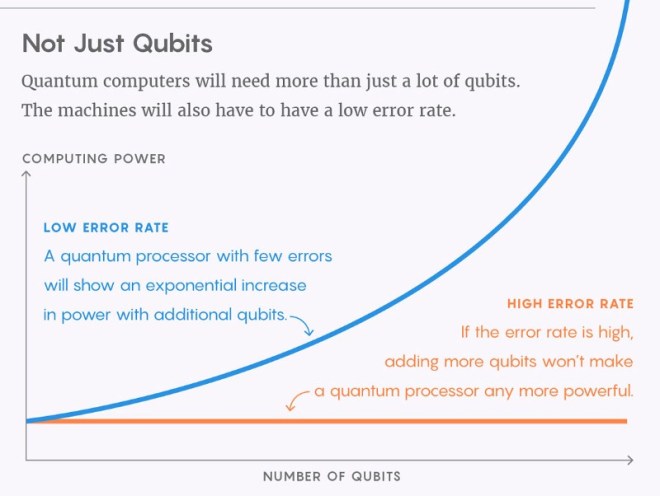
Next, to perform computation, these qubits must exist in an interdependent state where changing the behavior of one can affect the other — this is called entanglement. This means that operations on qubits count more than on simple bits. While computational resources increase linearly as we increase the number of bits on classical computers, they increase exponentially on quantum computers. So, adding an additional qubit roughly doubles the computation power => a 50 qubit computer has 2⁵⁰ computational power than 1 qubit computer.
Error rate. The challenge, however, is error rate. Random fluctuations, from extra heat in qubits for example, can change the state of a qubit and derail the calculation. So, quantum computing can only live up to its potential if all the qubits work “in coherence.”
This is a problem because a high error rate takes away any benefits of using a quantum computer.
Reasons for optimism and pessimism. 2017 was a year that brought reasons for optimism with it. IBM announced that they had created a 50 qubit quantum computer. Google and Microsoft have also been investing heavily. In addition, IBM has made a 5 qubit computer available to researchers since 2016 for free.
(Source and thanks to: Technology Review)
While all this is good, there hasn’t yet emerged a solution to get around the error rate. While some researchers believe error rates will be the reason quantum computers will never make it to the mainstream, researchers around the world are working hard on the problem. Some believe the solution will be finding a way to work with the noise rather than to eliminate it. Could there, for example, be quantum algorithms that will enable us to generate results despite the noise? There is no guarantee we’ll find a solution however.
The next hairy question is which problems will quantum computers help us solve. While there’s a debate here, it is clear it won’t be a cure all for all sorts of problems. Besides if a quantum computer’s error rate is hard to predict and if its calculations can’t be checked, how can we conclude that the problem is solved right?
We have more questions than answers at this point.
Where does all this leave us? I really struggled with putting this post together. I postponed writing it for 2 straight weeks despite reading and watching the articles and video below at least a couple of times because I wasn’t sure I understood it well enough to write about it. I finally decided I’d ship my draft today no matter what.
That, in some ways, gets to the challenge with quantum computing. It is hard to understand how it works, why it is better and, thus, what it could do.
My layman’s synthesis, then, is as follows –
After nearly four decades of research, we’ve made a lot of progress in quantum computing in the past 3 years. This is thanks to our ability to build quantum computers with more potential computing power than any classical computer.
Quantum computers will not replace classical computers. Instead, we will use them to help us solve certain kinds of problems. For example, they may help us make progress in understanding the workings of complex chemical reactions which may, in turn, help us cure challenging diseases. They may also do better at complex optimization problems than the best deep learning algorithms.
However, realizing this potential requires us to figure out how to deal with the “coherence” problem that results in error rates.
There are various groups working on solving error rates. The solution might be to build algorithms that work despite them. As a result, getting more researchers and programmers to work on quantum computers is going to be key. That said, there is no guarantee that we will find a solution.
It feels like we’re still a couple of decades away from quantum computers hitting the mainstream. But, making such predictions on technology I barely understand is likely foolhardy anyway.
So, I’ll end with a note on the topic. All my reading led me to the conclusion that the way to think about the outlook on quantum computing is simply to think of it as a superposition of optimism and pessimism. :)
Links for additional reading
Shor’s algorithm to solve factorization with quantum computers — on Wikipedia
Writing about entrepreneurship often defaults to featuring entrepreneurs as adventurous risk takers. And, generally, it focuses either on the world famous list of college drop outs (Bill Gates, Mark Zuckerberg, Sergey Brin, Larry Page, etc.) or Elon Musk (who is in a category of his own). This is both lazy and misguided because it misunderstands the relationship between financial risk and entrepreneurship.
None of the above folks took significant downside financial risk when they started their companies.
Brin, Gates, Page and Zuckerberg were drop outs from Stanford, Harvard, Stanfard and Harvard. They could have gone back to their prestigious schools if their companies didn’t work out. And, in the worst case, they would have ended their careers with tens of millions of dollars given they were setting out as programmers in an age that valued that skill.
Elon Musk didn’t set out to start SpaceX when he immigrated to the US. He struck gold with Zip2 first. His appetite to put his reputation on the line is commendable – but, let’s not confuse that with financial risk. He could lose all his money and make millions writing books and speaking if he ever wanted to. That he doesn’t is wonderful. But, let’s not pretend he’d be living on the streets otherwise.
In his book, Originals, Adam Grant has a good section on the real relationship between entrepreneurs and financial risk in a study of Warby Parker. As Warby Parker’s founders demonstrate, entrepreneurs actually need to masters of de-risking their venture. That’s why the best are obsessive about testing, rapidly iterating and finding product-market fit.
It is easy to see this in action when you are in any entrepreneurial hot-bed. Entrepreneurs rarely go out and put their savings on the line. Instead, they build a prototype on the side, attract enough venture capital interest and THEN quit their jobs to build a company. The existence of venture capital and (relatively) easy financing is key to entrepreneurial ecosystems. And, I’d argue that it is the sheer density of financing options in the Bay Area that ensures entrepreneurial minds, on average, find their way here and not the other way around. Regardless of causality, one wouldn’t exist without the other.
Finally, we generally discount the importance of privilege in the role of success. In all of the above cases and in most such stories, these entrepreneurs were based out of the United States – and often into families that had the capacity to help them if things went south. Family wealth aside, the right zip code is the biggest source of privilege on the planet. The best zip codes make it easy to build companies with plentiful access of capital and view failure as experience for the next attempt at building a successful venture.
What does all this mean? I think there are two lessons here. The first is to be dig deeper into stories that talk about entrepreneurs taking on heroic levels of financial risk. That’s not to say there won’t be exceptions. Instead, you’ll find that the exceptions prove the rule.
And, second, pay attention to conventional advice. Get to the best zip code possible, earn good educational credentials and work yourself into a position of privilege. The seeming risks that you take from a position of privilege won’t be risks at all.
We think of money differently depending on the context. For example, we may fight for a three hundred dollar discount when buying a new car. But, the same discount when buying a house would feel ridiculous. It is still the same three hundred dollars, isn’t it?
The downside of this approach is that we may be biased toward making certain kinds of investments over others. And, one tool I’ve begun to find helpful is to compare purchases to put them in context.
Let’s imagine you want to spend $100 on a hobby. It is tempting to think you’re rationally evaluating the cost/benefit of the $100. But, we’re not rationally evaluating anything – instead, we have a certain dollar amount threshold tagged to hobbies. So, I begin asking myself – what are other areas where I’m spending $100 or more? Let’s say I’ve got a vacation coming that’s got a budget of $1000. How would I think about adding $100 to the vacation with a new, cool add on? How much does that compare with the added benefit from the hobby?
Or, what about that gadget you’re considering buying?
After two or three such comparisons, it becomes obvious as to how much you value the expense you’re considering. In my case, for example, I found myself biased against making a couple of expenses that had some short term hassle and longer term benefit. I also realized I had a bias against annual subscriptions over one time payments.
My goal with expenses is to do so consciously. And, comparing purchases helps with that.
Vacuuming the home has been an ever present on my list of chores over the past few years. I cared about doing a decent job as I understand why it matters. But, it was never fun.
Until I started strapping our 6 month old baby and vacuuming the home with her.
At first, she mostly watched in silence. Then, she grew to enjoy it. And, twelve months later, it wouldn’t be the same without her. The issue is that she’s reached that point when the carrier isn’t comfortable anymore. I know it isn’t going to last for much longer – but, boy, was it a blast while it lasted.
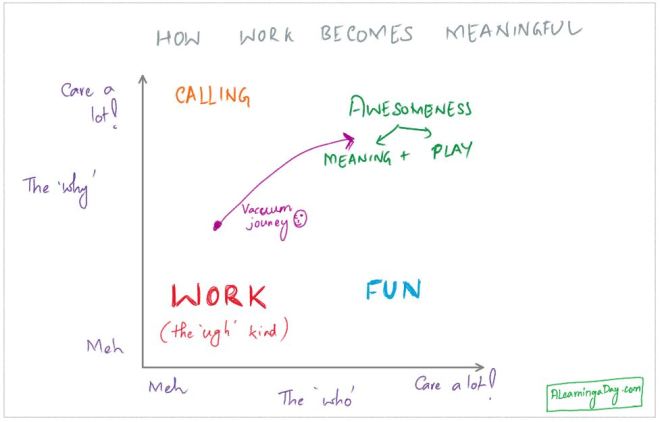
This experience with vacuuming speaks to how work becomes meaningful. The first step is for folks to understand the “why.” Why does what they do matter? Once they understand that, merging the “why” with “who” they care about makes important work feel both meaningful and playful at once. It is these sorts of environments that make for incredible laboratories to grow, learn, and experiment.
And, in environments where people combine learning, meaning and fun, they do the work (the “how”) with great care.
This is the reason powerful visions need to co-exist with a great culture. It is the culture that ensures that people feel the kind of belonging to continue to find meaning in what they do. A vision is useless without strategy. And, culture is strategy in the long run.
PS: Getting back to vacuuming for a moment – it is another one of those reminders that the days are long but the years are short.
Jeff Bezos, in his latest letter to shareholders, had a great note on what he’s learnt about great memos.
Often, when a memo isn’t great, it’s not the writer’s inability to recognize the high standard, but instead a wrong expectation on scope: they mistakenly believe a high-standards, six-page memo can be written in one or two days or even a few hours, when really it might take a week or more! They’re trying to perfect a handstand in just two weeks, and we’re not coaching them right. The great memos are written and re-written, shared with colleagues who are asked to improve the work, set aside for a couple of days, and then edited again with a fresh mind. They simply can’t be done in a day or two. The key point here is that you can improve results through the simple act of teaching scope – that a great memo probably should take a week or more.
There are two things I took away from this excerpt and the letter. First, it is fascinating to see the parallels between delivering high standards and approaching learning like a chef. To develop high standards, we must first learn to break things down to first principles, understand what “good” is and develop realistic expectations for what it takes to achieve them. For example, once we approach build new habits from a first principles perspective, we realize that the expectation that we can build a new habit that matters in 21 days automatically sets us up for failure.
The second lesson is about the difficulty of writing well. As Bezos notes, writing well is a product of revisiting and rewriting. In that sense, writing well is a lot like building a new habit – committing to something matters a lot less than constantly re-committing to it.
Prof Scott Galloway of NYU has an interesting weekly newsletter where he talks about the state of big technology and his thoughts on life. On Friday last week, he had a fascinating edition summing up his approach to life strategy. While I’m sure I’ll share a couple of the nuggets that resonated in coming weeks, my favorite was “Sweating vs. Watching Other Sweat.”
The ratio of time you spend sweating to watching others sweat is a forward-looking indicator of your success. Show me a guy who watches ESPN every night, spends all day Sunday watching football, and doesn’t work out, and I’ll show you a future of anger and failed relationships. Show me someone who sweats every day, and spends as much time at events as watching them on TV, and I’ll show you someone who is good at life.
As hunter gatherers, we spent time in jungles facing enemies, predators and diseases. This setting rewarded safety. You were better off staying away from a bush with a suspected snake than veering close to it.
Most of the world’s population hasn’t lived in such an environment since we transitioned to an agrarian society. But, if we compressed 4 million years of human evolution into 24 hours, agriculture made its appearance at 23 hours 55 minutes.
(H/T Seeking Wisdom by Peter Bevelin for this insight)
This dichotomy is what makes understanding human – why, even our own – behavior hard. We assume rationality and logic to be drivers of action when insecurity and fear turn out to be better predictors of action.
Behaving like hunter gatherers is counter productive in a world where the fundamental assumptions are different. However, we cannot change if we don’t understand how entrenched these behaviors are.
Acceptance follows understanding. And, change comes with acceptance.
At the end of his book “Things a Little Bird Told Me,” Twitter Co-Founder Biz Stone made a profound comment about wealth. He said money amplifies who you are as a person. I think about that from time to time when I see/hear about extraordinary displays of wealth. There are those who use it to buy incredible private jets and boats and then there are others who find different uses for their money that amplify who they are in ways that can be very inspiring. Mashpi Lodge is one such fascinating project.
Roque Sevilla, a successful businessman and the former Mayor of Quito (Ecuador), decided to buy 130 hectares of “cloud forest.” Cloud forests are fast disappearing thanks to deforestation. And, Roque purchased this forest from a logging company for less than $400,000. To put that into perspective, that is half the median price of a home in many major cities.
A picture of the Mashpi Reserve with Mashpi Lodge in the center. Source and thanks: National Geographic
In the 17 years since he purchased it, the resident Biologist has discovered multiple animal species – various amphibians, monkeys and even Puma – that had been lost to the world for decades.
He also demolished the logging mill and replaced it with an incredible 100% sustainable hotel called “Mashpi Lodge.” His goal was to share this special experience with others and, perhaps, inspire them.
I haven’t been there myself but was so glad to stumble upon an episode of Mashpi Lodge on “Amazing Hotels” on Netflix. If you are interested in learning more, there’s a 6 minute video of Roque describing the Mashpi project.
It is a very inspiring story. I’m hopeful many others follow his lead.