Easy and hard

Things that are easy to do: Procrastinate, criticize a person or initiative, destroy spirit, waste time and resources, be negative, forget commitments or don’t bother making them in the first place, over promise and under deliver, give in to the resistance, use fear as an excuse, never apologize, sacrifice authenticity and avoid the truth.

Things that are hard to do: Build something, fail, be happy, acknowledge failure,  be positive, embrace the struggle, express love, stand up for what you believe in, never tolerate disrespect, empathize, give, share joy, lead, follow, hug, and create.

We face the choice between easy and hard every moment. The more mature we are, the more choices we see. However, maturity only helps us see the choices – only our will power and determination can make us consistently choose the harder path. The hard path is, well, hard. But, it is better. And, even if we start with the best of intentions, after a series of inevitable failures, it may feel like the effort is not worth it.

Until it is.

The anxiety will be forgotten

Think back to your best 3 memories in the last 10 years. If you’ve put together a mental picture of the most memorable times you’ve had, my question for you is – what was the anxiety of the moment then?

You and I know there was one. It took a bit of thinking for me to remember what might have been the anxiety of the moment. For instance, in my final year of university, I was worried about my first job and I was worried about another big rock a couple of years later.

We always have a significant cause to be anxious about. Anxiety is a powerful tool used by the resistance to stop us from being our best self. If we give it too much importance, it can destroy our ability to focus on the present – one of the most important contributors to our happiness. And, today’s post is just a reminder to be present, smile, focus, and enjoy the day for what it is.

The challenges will never stop. The struggles will always make their way into our lives. Embrace them. The fact that they are around means all is normal in the world.

As you know, these anxieties will be forgotten. Our most memorable moments were not worry free. But they were fun, learning-filled, joyous, and meaningful.

They were all those things because we were present and made them so. Let’s remember to continue to do that.

Ooch before you leap – The 200 words project

.Here’s this week’s 200 word idea from Decisive by Chip Heath and Dan Heath.

 In 2006, John Hanks, an executive at “National instruments,” was thinking about making a bet on wireless sensors. The technology had a lot of promise but it needed to be understood if it would survive tough environments like mines and oil rigs.

So, Hanks did what National Instruments usually does – “Ooch.” An ooch is a small experiment to test a hypothesis. He worked with Electrical engineers at UCLA to install wireless sensors in a jungle in Costa Rica for an experiment to understand changes in carbon dioxide in the forest. If they were to work, they would have to not only be accurate but resistant to heavy rainfall and other elements of nature.

They worked. After a few more ooches, John and team began developing wireless sensors with $3M investment and that business has been a key part of National Instruments offering since.

This is common practice in some professions, e.g., designers call it prototyping. If it is not normal practice in what we do, perhaps we should consider an “ooch” before we make major decisions e.g. spend two weeks in a new place before we make a permanent shift.

Ooch before you leap

Source and thanks to: www.EBSketchin.com

‘The best way to show that a stick is crooked is not to argue about it or to spend time denouncing it, but to lay a straight stick alongside it’ | D.L.Moody

The novelty of “new” disappears pretty quickly

This is a line I repeat to myself every time I get started on a new project, initiative, or a relationship of any sort. The novelty of new disappears quickly.

To thrive in the long term, we just better be consistently good. As A G Lafley of P&G said, “get good or get out.”

Yes, it is going to be hard and yes, there are going to be many trials along the way.  But, you know what? Nobody cares. You either deliver or you don’t. The hero and the coward feel the same things. They just respond differently.

We are what we  repeatedly do. And delivering on our commitments consistently is not an act, but a habit.

Learning and digging gold

An inefficient gold digger needs many good mines to extract a good harvest of gold. An effective gold digger, on the other hand, needs only one.

Learning is similar. You don’t need to have 20 years of experience to have sufficient learning. You can extract 20 years worth of learning from 1 year if you set your mind to it. Growing old is not an option but growing up by making the most of the experiences life throws at you definitely is.

So, while “am I learning” is an interesting question to ask in a situation, it isn’t terribly useful. Yes, you are learning something most of the time. But, asking yourself “am I extracting maximum learning out of this?” changes the game.

Just one trait about effective gold diggers – they don’t stop when they get one mine right. They keep working and widen that gulf. Learning is not different. Ask those who take time regularly to read, for example, and they’ll remind you that there is no difference between the ones who don’t read and the ones who can’t. Learning, like any other skill, needs work – perfecting it requires constant deliberate practice.

Understanding management debt

Ben Horowitz, the former CEO of Opsware and now-successful venture capitalist, has a great post on management debt. He offers a slightly deeper explanation in his excellent book – The Hard Thing About Hard Things.

I have been thinking about management debt over the past few months but didn’t have a term for it. I am now able to put the word into context and would like to share some of my lessons.

Management debt is when a leader or manager (I will stick to “leader” for simplicity) takes a call that works better for the short term than for the long term. Any such decision is equivalent to the leader taking a loan for a short term pleasure and will require the leader to pay it back with interest. The rates of interest on certain kinds of management debt are really high. In his blog post, Ben details 3 situations where he’s seen management debt –

1. Putting two in a box – Trying to keep two talented folks in his company during a reorganization by making them co-heads.
2. Over compensating a key employee when she has a better job offer because she is key to a current project.
3. No performance management or feedback process – leading to surprises when things don’t work well.

I haven’t managed a billion dollar company and, while I am sure my experiences don’t compare to those of Ben Horowitz, I have found myself guilty of using management debt multiple times without realizing it on multiple projects. And my lessons are as follows.

I. Define culture early – it is hard to change. Culture is set by a set of principles that defines your approach to work. This needs to be defined really early or things get really messed up down the line. One such example is a project I’ve lead for nearly 3 years – when we started, we took a scrappy approach towards getting things done. I figured that the focus ought to be to just get results and we’d find time later to define how we’d like to do it better. So, we took nearly a year to define our values, ways of working, etc., and just kept the habit going. And, you know what? 1.5 years later, we still haven’t gotten past our scrappiness. Heck, we don’t even know what our values are.

The extent of the damage is evident because another member this team and I are also part of 3 other project teams and we behave differently in those. Culture is powerful and is hard to change once it is set. I am still not clear how to solve the problem with the culture issues in this project – clearly, I’m still paying the interest on my management debt.

2. Create a 6 month feedback process. I’ve worked on projects where there was an attempt at weekly performance management and then run projects with no performance management. I find that a 6 month feedback process is reasonable and important. 1-3 month feedback can work okay on short engagements but feedback systems shorter than that become carrot-and-stick systems in my view and don’t give people enough time to get comfortable. If you think this is hard to do in a busy day job, I can assure this is harder when you are working on a project(s) in addition to your day job on weekends with limited time. That said, it is important. Else, you are just taking on more debt. And, I have learnt that the interest on this one is costly.

3. Create a list of management principles. As I’ve been thinking about 1 and 2, I’ve realized that what I am missing is a list of management principles. I have an implicit list but it’s clearly not been enough to provide clarity. These management principles will help you stay true to your goals and will ensure you are firm and insistent on the right things. Once you have these principles defined, don’t compromise.

I am going to explore this topic in greater depth over the next few months. More to follow on setting culture, designing feedback processes, developing management principles, and the like.


Email and constructive communication

I was once part of a heated email chain a couple of years back. As with most heated email chains, this began with a misunderstanding which was only amplified with time. I was the junior-most member of the team and was more the by-stander who was being called on from time to time to produce one number or another.

At one point, our senior-most team member sent an email to a couple of us on one side of the argument that read something like this – STOP REPLYING TO THE EMAIL CHAIN. WE WILL TAKE THIS OFFLINE AND SORT THIS OUT.

He immediately set up some time with each of us, listened to us, focused on the next steps and  methodically worked his way through the issues. And sort it out we did.

Emails are good for a whole lot of things – sharing status updates, ensuring information is shared, asking questions and engaging in discussions, and setting up real life conversations. They are, however, not good for any communication that isn’t constructive and almost always make things worse. Deprived of context and facial expressions, we always assume the worst.

The learning for me was simple – the moment you sense an email thread going negative, take it offline. And, as my wise colleague would say, STOP.

Lynn Lee, co-owner of Awfully Chocolate – The Real Leaders Project

Dhanya, from the Real Leaders team, has been on a roll lately interviewing women she admires. If you live in Singapore, you’ve definitely heard of Awfully Chocolate’s wonderful chocolate cakes. And, today, we present an interview with the co-owner of the successful chain.

Lyn Lee is a co-owner at Awfully chocolate, a successful chain of chocolate parlours. They have branched into other food initiatives, and are running branches across Asia, based out of Singapore. Lyn co-founded a small parlour back in 1988 with her friends when they realized they wanted to create, own and run something for themselves. They perfected a chocolate cake recipe with is a rage in Singapore today in 20 years. The brand and Lyn herself have grown in so many many ways since the initial days. Today Lyn mentors many youngsters.

My favorite bits –

“I told my friends, “I love eating chocolate and there is this idea of this perfect chocolate cake which I just think would be great.”

“We were careful.  It was more like a hobby at that time because we all kept our day jobs.  One of my friends got retrenched, so she was looking after the store in the daytime.  The rest of us would run there after work, or we would go there on weekends.  It was this fabulous adventure and it was great fun.”

“Over the years we learned from franchising that there is no perfect franchise.  Some of them work so well that we’ve become best friends; we’ve become partners.  Now, when we do franchising we actually make sure that we have a staff member who’s prepared to live in the franchise country for six months to one year, whereas previously it would be shorter time and it would be more visits.  Now we treat it as if it’s one of our stores.  We really stay close with the process.  That has yielded better results.”

“I tell people that I’m a mom and I have three kids.  I really try to spend as much time as I can with them, but I just don’t do it in the conventional way and I don’t think there’s anything wrong with that.  So many women especially – and we want them to have families and we want them to settle down – but I tell them that there must be a way, and don’t be afraid that your way is slightly different.”

“I like to think that if you make the correct small decisions, it is just as good as the epiphany you didn’t have. These small decisions are not hard. Don’t choose the job by the hours you need to put in, or how close it is to you. Sometimes you choose it for the pay package. Think of what you’re going to be doing, what you’re going to learn. Think of the wider things.”

The full version, as always, on RealLeaders.tv

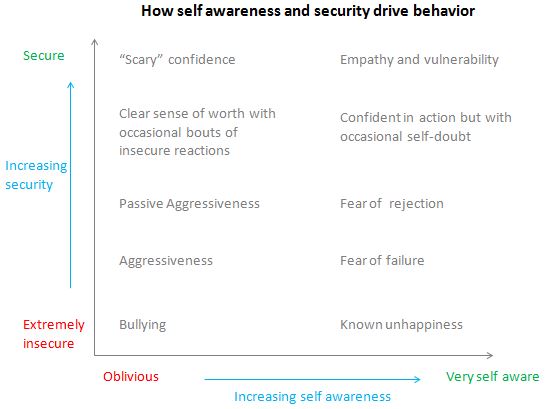
How self awareness and security drive behavior

Below is a 2 x 2 that describes how self awareness and security drive behavior. This isn’t a well researched graph. Instead, it is one that I’ve put together from observing myself and other people.

Before we dive in, I’d like to quickly describe the axes –

X Axis: Self awareness – Oblivious stands for an inability to be self aware.
Y Axis: Security – Secure doesn’t mean the person has no insecurities. Secure just means that, on average, the person is a lot more driven by security than insecurity. Every one of us have our insecurities but some choose not to be driven by them. Another possibility here is that, sometimes, environment plays a role in increasing the insecurity level.

Self awareness and security 2x2

I can’t say I am happy with every data point I’ve described on the graph. I recognize the ones I have experienced well. I have also not marked many interesting points in the middle which is probably where we spend most of our time. However, I think this should work for all practical purposes. Over to the takeaways –

1. Aggressive behavior always arises from insecurity. Vulnerability can only rise from confidence. The causes of these two behaviors are often swapped. Vulnerability, the ability to ask for for help, the ability to be kind, etc., can only come from a place of worthiness.

2. I find it very helpful to think of my behavior within a particular situation on this chart and understand what drives it. For example, I was on a call yesterday when I started out behaving aggressive. The call was a first-of-a-kind discussion in my experience with 10 people via Google Hangout on a topic that would have really benefited from a face-to-face meeting. I had no idea if we’d even be able to facilitate such a discussion via a video call with it’s lags and disconnection. 5 minutes into the call, once I began to realize that there was no need to worry and that I should really calm down, I began to settle. Soon, I was back to normal behavior.

3. My idea of normal behavior has changed a lot over the years. From my limited experience, it is easier to move right before you move upwards. We can all work harder on our self awareness by setting aside more time for reflection and taking stock. It begins there. Insecurities are a harder beast to tackle. They are often so deep rooted that it takes a fair bit of self awareness to even realize that is the case.

4. I’ve deliberately stayed away from the concept of “ego.” I’ve observed large egos when you feel insecure and manageable egos among the more secure folk. That said, I am always left with the feeling that there’s more to that word. So, I’ll come back to it when I feel I’ve understood it enough – maybe 4 years from now. :)

This graph is a culmination of observations over the last 4 years or so and is the first time I’ve been able to put these thoughts and ideas into a frame. These ideas have had a lot of influence in making me a happier and more secure person. And, if there is anything I have learnt, it is that we can all benefit from self reflection. Positive change almost always begins there.

The value of doing nothing – The 200 words project

Here’s this week’s 200 word idea from this Morningstar article on the value of doing nothing.

Michael Bar-Eli et al analyzed 286 penalty kicks in top soccer leagues and championships worldwide. As the ball takes approximately 0.2 seconds to reach the goal, the keeper has to decide whether to jump about the same time as the kicker chooses where to direct the ball. The researchers found that the goalkeeper almost always jumped left or right as they typically choose action over inaction. But, interestingly, the data revealed that the optimal strategy for the goalkeeper was to stay in the centre of the goal.

Just like the goalkeeper, investment professionals too feel compelled to play every trade that is out there in the market. The median holding period of the top 100 stocks by market capitalisation in the U.S. has shrunk to a third from about 600 days to 200 days over the last two decades.

As far as investing goes, there is high value in doing nothing. After all, as Warren Buffett says, benign neglect, bordering on sloth, remains the hallmark of his investment process.

Value of doing nothing

Source and thanks to: www.EBSketchin.com
Related source for all interested in personal finance and investing – Our learnographic on personal finance

‘”Do nothing” are the two most powerful – and underused – words in investing. The urge to act has transferred an inconceivable amount of wealth from investors to brokers.’ | Morgan Housel