The best habit

The best habit is the one that’s slightly better than your current one. And, yes, this applies to diets, exercise, reading, sleeping and everything else you can think of.

This is because sticking to your better habit is way more important than attempting a radical change that brings you back to your old ways.

When attempting difficult change, revolutionary change feels very tempting. And, for extreme cases (e.g. getting off an addiction), revolutionary change is probably the only option. After all, desperate times call for desperate measure.

But, for all other changes, an evolutionary works much better. It isn’t as exciting. But, it is many times more functional.

Big changes are small changes applied consistently over time.


HT: Ken

5 books that might change your mind – 2016 edition

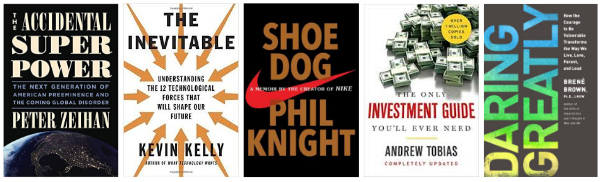
Here are 5 books I read this year that might change how you see the world –

1. The Accidental Superpower by Peter ZeihanIf you haven’t considered the world from a lens of geopolitics, The Accidental Superpower will likely blow your mind. I found the first half of the book particularly powerful. It included a view of the history of super powers from the eye of geopolitics. And, despite having read a similar view on history in another book, this was beautifully synthesized. Following that, Zheihan explains what’s going on by focusing on population demographics. Again, fascinating. The second half focuses on prediction. And, prediction is very hard. So, I took that bit with a helping of salt. After reading the book, I did wonder why we don’t teach geopolitics at school. I guess it flies against the face of our general narrative about what makes super powers. Geopolitics contends that it is all about geography.

(Note: There’s another geopolitics based book “The Next 100 Years” by George Friedman. Friedman was Peter Zheihan’s former manager.)

2. The Inevitable by Kevin Kelly: Kevin Kelly talks technology in a way only he can. He takes twelve verbs that technology has impacted (cognifying, sharing, updating, etc.) and takes them to their logical end. In that process, he gives us a view into what our future might be. It is powerful.

3. Shoe Dog by Phil Knight: One of the most beautiful books about entrepreneurship I’ve read. It isn’t a manual in the way “The Hard Thing about Hard Things” is. Instead, it is a story from the heart of Nike’s legendary founder. It feels authentic and real while also being It is not just about the fact that it is beautifully written (it is), it feels authentic and real. Phil Knight takes us on a journey where he impresses upon us the strength of his belief that the world is a better place when we run with great shoes.

He makes mistakes and a couple of very questionable ethical decisions. Yet, we find it in our heart to forgive him. Somehow, he makes us feel the desperation that drove him in that moment. And, he then goes onto teach us how mission driven businesses are built. He explains that a business is about money just as living is about pumping blood. You need both. But, life and business are about a lot more than that.

And, while you are at it, I’d recommend picking the Audible version. Norbert Leo Butz does a fantastic job.

4. The Only Investment Guide You’ll Ever Need by Andrew Tobias. An oldie, but a goodie. At its heart, it is really simple. Andrew Tobias explains that a penny saved is actually a lot more valuable than a penny earned since Ben Franklin didn’t have to deal with taxes in his time. So, save a lot more than you earn. And, once you do that, develop a simple approach to investing. Of course, he patiently lays out all the ways we can do that. But, this book isn’t so much about investing as it is about a mindset.

5. Daring Greatly by Brene BrownBrene Brown brings her research on shame and vulnerability together in this beautiful book. It is fascinating to learn that women have about 10 shame triggers. And, appearance and body image top the list followed by parenting. Men, on the other hand, have one very powerful trigger – showing weakness, or in her research’s terms, “being a pussy.” She also inspired my theme for 2017 – engagement. She wisely pointed out that we spend too much time asking questions like – “Am I being good/perfect?” Instead, we should ask – “Am I being engaged? Am I paying attention?” No good comes from seeking perfection. ”
(Quick note: The audio book narration didn’t work for me in this case.)

Here’s the Amazon list.

Books that almost made this list:
The Road Less Traveled by Scott Peck is a classic. The first half of the book was incredibly impactful. I especially loved his definition of love.
Peak by Anders Ericsson is the ultimate guide to deliberate practice research from the master himself.
Deep Work by Cal Newport rails against our distraction filled work environments and presses us to think deeper about depth in our work.
Persuadable by Al Pitampalli beautifully explains why it is important that we change our mind.
And, finally, Einstein by Walter Isaacson has a life lesson about not taking ourselves and our world seriously in addition to the expected lessons on curiosity and perseverance.

Other resources: Past lists of “5 books” – 2015, 2014, 2012, 2011. Book reviews here and book notes here.

Happy reading!

Low flame

When we try to make changes in our lives, we often try to make changes on high flame. Making changes on high flame involves putting a lot of heat on something and expecting near instant change. When we do this, we forget that a lot of great cooking gets done on low flame.

The classic high flame approach is the new year’s resolution. We put a lot of pressure on ourselves in the month of January and expect instant results. The downsides are obvious – we often walk away feeling burnt from the experience.

The low flame approach is a much slower, longer term approach. It involves consistent heat over a long period of time. If you follow the low flame approach, building a strong culture in your organization will not revolve around a culture and values push. It will involve a steady set of initiatives over a long period of time. Similarly, there is no big product launch, only a consistent iteration on your minimum viable product.

The biggest benefit of adopting a low flame approach is when we’re making changes in our personal life. The best way to get fitter is to eat healthier and fit regular exercise into our weekly schedule. This never happens easily. Changing our schedule involves a lot of slow tweaking over time. While we might be able to force a change every once a while, we need to slow down, observe ourselves and allow time for the momentum behind the change to build up.

Slow, consistent, thoughtful, long term – there’s a lot of power in the low flame approach to change.

Leadership and consistency – The 200 words project

Essayists like Ralph Waldo Emerson who shaped the 19th century view on leadership defined it around heroic consistency of message – no matter what the evidence. So, political campaigns are now lost the moment a candidate switches views on a topic. While political candidates are often guilty of changing views based on when it suits them, we also end up punishing those who’re changing it because of better data.

The greatest leaders, however, have always been incredibly persuadable.

Abraham Lincoln, for example, was a notorious flip flopper who changed his views on the civil rights movement as new data presented itself. Sadly, the 2012 “Lincoln” movie made no mention of this inconsistencies –Pulitzer Prize winning historian Eric Foner lamented the absence of his hallmark of greatness – his capacity for change and growth. Even black scholar and activist W E B De Bois, who was often critical of Lincoln, admired his always critical and flexible brand of leadership.

As Jeff Bezos says – people who were right a lot of their time were often people who changed their mind. Perhaps we should revisit our responses when we see our leaders change their point of view based on sound evidence?

Abraham Lincoln is the greatest figure of the 19th century. He was to be admired not because he was perfect but because he was not and yet he triumphed. Out of his contradictions and inconsistencies, he fought his way to the pinnacles. And his fight was within as well as without. – W.E.B De Bois

leadership, consistency, change, flexible


Source and thanks to: Persuadable by Al Pitampalli

Go backward or go forward

In a huge step forward for 3D printing, Airbus unveiled the world’s first 3D printed aircraft earlier this month. The aircraft was tiny and windowless – yet, it was the star of the show.

In a survey of folks in the aviation sector in Germany, 70% of the respondents believed that airline parts would be 3D printed in airports by 2030.

Can you imagine the number of jobs that will be lost when that happens?

When faced with a proposition as scary as this, we have a choice – we can either focus on moving backward or focus on moving forward.

Focusing on moving backward would mean lobbying government to put all sorts of restrictions and tariffs to stifle innovation in 3D printing. It would mean doing everything in our power to keep the status quo or even reverse it if at all possible. This is the corporate version of fundamentalism and is one most incumbent companies practice. If this is your approach of choice, good luck.

Moving forward, however, would require us to embrace the scary idea that 3D printing will not just take away jobs in airline manufacturing but in many other industries. There will be millions of people displaced. The solution to this problem will not be obvious now. But, that doesn’t mean there isn’t one. One thing is clear, however – we will only get there if we accept that change will occur whether we like it or not. It has its way of forcing its way through.

We can choose to either ride the wave or be drowned in it.

To have a shot at change

To have a shot at retaining employees, you have to first accept they will leave.

To have a shot at making the sale, you have to accept that the customer may have no real need for your product.

To have a shot at exercising regularly, you have to first accept that it won’t happen unless you intentionally find place and energy for it in your schedule.

To have a shot at maintaining deep relationships, you have to be willing to let those you love go.

To have a shot at success in your project, you have to be willing to accept that it might not work.

To have a shot at becoming a better person, you have to first accept that your natural instincts will likely not lead there.

It feels easier to hold onto ideas that pre-suppose success and change – as if they were so easy. The keyword in that sentence is to “hold on.” Holding on always feels easier. Letting go is hard. But, to be able to lead change, we need to be able to accept change ourselves.

Again, the counter intuitive shows us the way – the first step in being able to change is accepting things as they really are and not as we want them to be.

change, accept reality

Observing vs. Judging

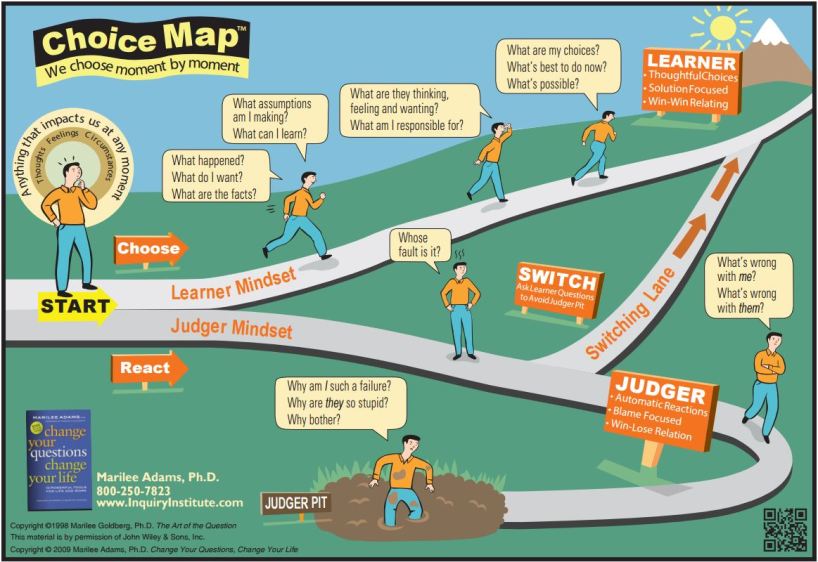
One of the biggest changes in my attempts to change my own behavior in the past 2 years or so has been in the realm of observing vs. judging.

As an example, let me pick on a current trend – I haven’t been meditating in the last week and a half. I generally do so first thing in the morning but, due to a combination of a cold and a couple of disruptions, I’ve been waking up later than usual. In some ways, the core issue is disruption in the morning routine. The usual instinct would be to ask “judging” questions and attempt to use a firm hand – e.g. force myself to get back to routine tomorrow.

However, the approach I take instead is to just observe. In observing, I find myself asking learning questions, e.g, “why is this happening?”, “what are the consequences of this trend?” and even “how long will this continue?” I am my own guinea pig. :-) In addition to this, I also take note of a weekly count of meditation sessions during my week review time on Saturday.

Over time, I’ve built confidence in the fact that observing coupled with the act of measuring consistently tends to bring the changes I want to bring. And, this happens because I take off the pressure that judgment brings.

An example of this approach has been exercise – over 60 weeks that I have data for in the current system (I have some old data too elsewhere), my average exercise sessions in a week has gradually increased with time. It currently stands at 5.2 which means roughly 4 x 25 min sessions and 1.5 days of walking 10,000 steps at least. This is better than it was last year and the improvement has come from the same observe and measure process. Similarly, my average meditation count for 60 weeks is 1.7. However, if I take a 1 year look at this, we’re at 2.7 (3 is the target).

As with all meaningful life learnings, the guiding principles are consistent. In this case, it is playing the long game and focusing on learning questions versus judging questions.

observing, measuring, learning, judging

It is just the applications that are different.

What do people like you do?

The main beach at the Thai island town of Krabi has 6 Indian restaurants within a 100 metres of each other. That’s quite a number for a town of that size. What astonished me was the enthusiastic salesmanship outside the restaurant and outstanding customer service in the two places I visited. In isolation, this is amazing as I am fairly sure the same restaurants in India would have had forgettable customer service.

Add context to it, though, and it makes sense. Between the 6 restaurants are many many Thai and western restaurants run by equally enthusiastic staff. The customer service bar is high and every one needs to step up their game to survive. The staff at these restaurants don’t think of what they’re doing as special. That’s just the norm to them. It is what they need to do to survive. And, perhaps most importantly, it is what “people like them do” in Krabi. Their tribe just gets customer service.

So, what do people like you do? What are the tribes you are a part of known for?

If you are striving for personal change, perhaps you should stop punishing yourself for your seeming inability to do so and focus on joining tribes that are known for what you are striving for. If you want to get fit, make friends with people who exercise.

The most powerful change is one of culture.

Making the world better

Atrocities happen every day of the week on this planet. This was one of those that had me swearing out loud. A man felt it went against his family’s honor for his pregnant daughter to marry someone against his wishes but felt it was perfectly okay to murder her with his son and a few goons.

There is a lot wrong with the world. There is no doubt about that. There is a lot right too that goes unmentioned. It feels, as a result, that we have two principal duties to help make the world better. Focus on the right in our lives and do more of it. This is the only way to keep our spirits up without getting bogged down by everything that is wrong with the world.

At the same time, we must work hard on changing what is wrong. A lot of what is wrong with our attitude towards other races and women can be made much better. It starts within. We have to pledge to be open to differences ourselves and hopefully change the culture of our families and friends to reflect that. Change occurs in ripples. It begins with changing ourselves or, at the very least, teaching ourselves to think. There is a real dearth of people who can do that. Atrocities like the one above are typically committed by men (yes, it is always men) who are unthinkingly following some norm or order.

The world will never be perfect but it can become better, much better. In making ourselves better, we make it a bit better and I think that’s as worthwhile a cause as any.

Every market/client has problems and every market/client is special

There is a nice consulting truism that serves as a reminder from time to time – every market/client has problems and every market/client is special and, most importantly, no one really understands this (especially not those people sitting in headquarters).

I’ve seen this across clients and across country organizations within the same client. Every country organization says exactly the same thing when starting out on a discussion around change.

What they are really saying is – Take time to listen to and understand us. If we don’t feel listened to, we’re not going to listen to you.

They’re right in part. The listening helps us in understanding the nuances that will enable us to ask the right questions. The basic principles will still work (they are basic principles for a reason) – we just have to customize them to suit the needs of our clients.

But, first, you have to listen to be heard.