Just build it

It is easy to feel stuck with the status quo. “That’s how things work here” and all that. Our natural reaction to that is a powerful emotion – discontent. When you feel that sense of discontent and annoyance at the status quo, don’t just swallow it and walk away.

It is worth remembering that everything that exists today, i.e. the status quo, was created by human beings just like you and me. They weren’t necessarily smarter or better – they just channelled their discontent to build things.

Choosing to build what you care about doesn’t mean success is assured. If anything, the odds of failure are extremely high. But, the odds of becoming wiser are really high too. It might not work. And, if it doesn’t, you’ll extract valuable learnings from it anyway.

A bunch of friends and I were discontented with the options available for charitable giving. We wanted something more long term, more sustainable. So, we’ve created our own. And, boy, are we struggling! I think we might have made every misstep in the book so far – we took too long to decide a name, we took too long to get our act together and get ourselves registered, we didn’t realize our first potential partner didn’t have legal authorization until the last minute, etc., etc. We’re making so many mistakes that I intend to create a series around the challenges of building a charitable organization as soon as our revamped website is up (coming very soon). But, it promises to be a very interesting journey. We wake up knowing we’re in complete control of having the sort of impact we want to have in the lives of those who were born with far less than us. And, it is quite a challenge to build a 100 year project – which is what we aspire to do.

So, if you’re feeling stuck and discontented, channel that emotion. Build what matters to you. You’ll scream a bit, learn a lot, grow, and have fun in the process. And, most importantly, you’ll realize that everything we see around us is all invented by people just like us..  about time we got to some inventing as well.

Mix strong opinions with big ears

Venture capitalist Brad Feld had a fantastic post up yesterday – “Mix strong opinions with big ears.” Go read it.

“I know a lot of people who have strong opinions. I know a lot of other people who are excellent listeners. The venn diagram of the intersection of the two is uncomfortably small.”

I love this. I have strong opinions myself. My ears could be bigger. In Brad’s words –

“Big open ears doesn’t mean that you just listen. It means you are a good listener. An active listener. One who incorporates what he is hearing into the conversation in real time. You are comfortable responding with a modification to an opinion or perspective as a result of new information. You are comfortable challenging, and being challenged, in the goal of getting to a good collaborate answer, rather than just absorbing information but then coming back later as though there was never any information shared.”

One of my favorite wiser friends does this really well. You always feel listened to even if he completely disagrees. And, after you finish, he’ll explain why he feels you’ve missed the point. In contrast, I often let my impatience comes through.

This isn’t easy. It is no wonder Aristotle said “It is the mark of an educated mind to be able to entertain a thought without accepting it.”

That’s why “mix strong opinions with big ears” is a great line. It is both a guide of an ideal state as well as a guide for what to look for in advisors and sparring partners. I’ll remember this in my next passionate debate. Thanks Brad.

Why talk about failure?

I talk a lot about failure in this blog – about the emotions involved, about picking ourselves up, about focusing on the process, and about ensuring we learn from them. I thought I’d write about why I do this.

I find that there aren’t enough blog posts about normal life on the internet. You have tons of blog posts around how to sell better, market better, build a better company, and so on. You have many praising successful people/reflecting on why people were successes. And the ones that have real life applicability are those that talk about the “7 ways to be happy” or the “30 things you need to do stay productive.” I read/skim through all these sorts of posts but I don’t think they do the topic of failure justice.

When we play an opponent who is 7% better than us, experiments have concluded that we only win 30% of the time. However, we feel great about winning since winning has that challenge. If we seek learning and growth in our times, the circumstances (our main opponent) is regularly 7-10% better than we are. This means a failure rate of 70-80%. That’s normal life – you fail a lot and win sometimes. The win feels great and, more often than not, the previous failures don’t matter as much because it only takes one good thing to work out. That one break can change everything.

So, we spend 70-80% of our lives facing challenges and failures. And, yet, we don’t talk about it. Instead, we find our resolve to fight further dampened when we compare the highlight reels of our friends on Facebook to our dirty “behind-the-scenes” video.

That’s why I talk a lot about failure. In a way, it tells me everything is normal in the world. I hope it tells you that too because we all have our troubles and challenges. We all are defined by the choices we make. And, if you are going through a tough time now, life has repeatedly demonstrated to me that a good process, a good heart, and hard work make it through in the end.

We do. We fail. We learn. We love. We laugh. We live. I guess that’s really what this blog is about.

The joy of hitting rock bottom

Whenever I go through a tough phase, I always look forward to that moment when I hit rock bottom. That’s the moment when things can’t feel any worse and when anything that follows will be an improvement.

How do you know you’ve hit rock bottom? From past experience, you just know!

Rock bottom is a great place to be as the only way is up.

If you’re going through a tough phase, don’t push rock bottom away. Welcome it with open arms. Failure is not in hitting rock bottom. Failure is not working hard to make it back again. Falling is inevitable. Failure is not.

A life well lived enjoys more failures than successes. Rock bottom is just part of living and thriving. It teaches us humility and makes life interesting. Pick yourself up. Get on with it.

The Curve Ball Will Come

Out of every 100 plans we make, 95 of them will have a curve ball.

There are 2 issues with curve balls –
1. They are hard to plan for (there’s a reason they’re called “curve balls”).
2. They surprise us. And we hate surprises.

We can attempt to mitigate the planning issue by working out various possible scenarios – from best case to worst case. But, that’s no guarantee we’ll be able to mitigate it. Preparation is good, however.

What we can do is ensure we eliminate the emotion of surprise. Just expect a curve ball every time you make a plan. I’d even say – be surprised if a curve ball doesn’t come. It generally will. Don’t be surprised. Curve balls are about as certain as summers every year.

And, it’s the curve balls that make the journey interesting and learning filled anyway…

The Big Rocks

We always have 3 types of tasks – big rocks, small rocks, and minutiae.

The minutiae are the easiest to get done. We get checks on our checklist for sending our email, following up on something, and cleaning something else. We face the resistance when we do minutiae but only at about 20% of it’s strength. The resistance doesn’t mind the minutiae much.

The small rocks are those tasks that need a bit of thought and effort. They’re more or less in our comfort zone. We need to get these done and we face the resistance at about 50% of it’s strength.

The big rocks are where we face the resistance at full strength. The resistance conjures up excuses the moment we think about them. At our end, we KNOW it is these tasks we must tackle. But, the resistance convinces us that it is better to direct our energies into the small rocks and minutiae because we know we’ll get those done. There are no guarantees we’ll get the big rocks done. The resistance paints these frightening prospects – most of them involve us unable to deal with the debilitating failure.

You know what the big rocks are. You have the big rocks in order for your day, your week, your month, and perhaps even for your year. There aren’t resistance or procrastination hacks that can help us get through to our big rocks. We just have to make the decision to not tolerate the resistance and procrastination. We only get what we tolerate.

Our efforts at plugging away on our big rocks may not work. We just need to suck it up and get on with it.

Cannibalize your own business – The 200 words project

Here’s this week’s 200 word idea from The Everything Store by Brad Stone and Steve Jobs by Walter Isaacson.

When Barnes & Noble decided it was time to wake up to the threat of Amazon.com in 1997, they created their own website, secured investment and spun it off as a private company. However, Barnes & Noble did not put their best employees in the new company as they didn’t want it to cannibalize their existing 2 Billion dollar business. We know who won that battle…

Amazon, on the other hand, cannibalized themselves many times over – a notable example was when they added “Mom & Pop” sellers selling 2nd hand books to their book catalogue, thus placing them in direct competition with the big distributors selling new books. This upset many people, internally and externally, since new books made more money. But, it was completely aligned with their principle of helping customers make better purchases.

Apple, too, under Steve jobs actively cannibalized their own business. When Apple insiders pointed out that the iPhone would eat into the sales of the iPod, Jobs was vocal in that it is better for Apple to cannibalize its sales than a competitor.

So, how do you go about cannibalizing your own business? Coming up next week..

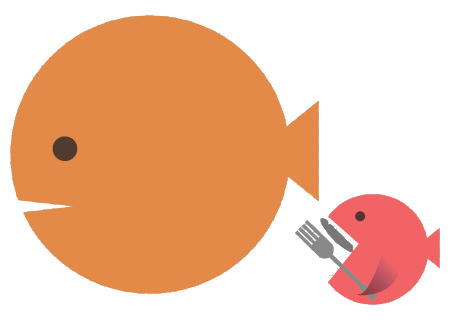
clip_image001Source and thanks to: www.EBSketchin.com

‘If you don’t cannibalize yourself, someone else will.’ | Steve Jobs

Staying safe

John Nicholson, a football writer, had a very good post on the (legendary?) manager of Arsenal football club, Arsene Wenger.

Arsene Wenger had a few good years at the start of his tenure at Arsenal when he was seen as the “innovator” with a different approach to management and football. Over time, however, the other managers caught on and Wenger lost that edge. He delivered 7 trophies in his first 500 games and exactly 0 in his next 500 and Arsenal have consistently been also-rans – almost there but not really. John Nicholson points to conservatism for that run. Arsenal have been afraid of taking that gamble and have thus stagnated.

While John Nicholson largely sees people as conservatives and risk-takers, I tend to thing we have both within us. Of course, we lean towards one side or the other for most decisions but we do have it in us to be both prevention-focused and promotion-focused. There are times when it is fully advisable to be prevention focused – if you are unsure about the safety of that bungee jump vendor, don’t do that bungee jump. Yet, for the most part, I think we’re better off being promotion focused. (Unless you are a lawyer and maybe, even then, you’re better off being cautious at work and throwing the caution to the wind at home).

I think it makes for a more interesting and maybe even a happier life. Yes, regular risk-takers see a fair bit of pain but they also see learning and wisdom. There’s almost nothing more dangerous than the status quo and nothing more debilitating than stagnation. It’s good to ask the questions, push our boundaries, look for new possibilities, try different things, fail, gain some perspective and then try again. The journey will have more failures than wins but wins feel much better when they are few and far between.

And, as John Nic says, “if you never fall in love you’ll never have your heart broken but what kind of life is it to live which pulls back on the big stuff for fear of both the heartache and the glory it can bring.”

There are few things as dangerous as staying safe.

How privilege is built into the system

A kid born into a family that is well off has 2 massive advantages –
1. Parents that are well educated (largely the case)
2. Parents who can afford good education

For the purposes of this, let’s take well educated parents as a proxy for good parents. We can argue about this for days but I think it is safe to say that well educated parents are much more likely to be good parents in that they can ensure their kids build on their skills, learning, and network.

Second, these kids have parents who can invest in their education – good schools, good books, great technology, etc.

Both these advantages typically kick-start a chain of events that looks something like this – good school -> good university -> good first job -> good graduate school -> better job and career prospects.

Yes, some parts of this chain are debatable – if/when you do graduate school, etc., but this chain is significant. Even if we agree that a good university is a proxy for a reasonably successful career, that’s still a huge advantage. For detractors who like to point to successful companies being built by university drop outs, let’s take a moment to remember that Microsoft and Facebook had their beginnings in Harvard dorms and several others in other illustrious universities like Stanford.

I’m spit-balling a bit with the numbers here but let’s assume the average top 500 university has an undergraduate student population of 3000 students per year. That’s only 1.5 million people. And, say we assume a world population of 7 Billion and assume identical distribution across ages between 1-70, we’re looking at around 100 million people sharing the same age.

Essentially, that’s about 1.5% of the population. I wouldn’t be surprised if the actual number would 1% or less.

How easy is it for a kid born in a low income family to be part of this privileged 1%? I’d say very very hard. This analysis would probably get even more interesting if you then dug into numbers within top graduate school programs across disciplines. I’d be willing to bet that that those seats are largely a smaller percentage of this privilege 1%. And, once we include a new variable – the location of birth – I think you will see that the chances of a kid born into a low income family in a less affluent country has practically a 0 percent chance of ever seeing the kind of life many of us take for granted. And, this doesn’t even consider the odds for a kid whose parents abandoned him/her at birth..

And, of course, all of this is decided by something you have no control over – birth.

This post is not some clarion call to stop complaining, keep perspective, and be happy every single moment. It could be. But, I recognize we are human. That doesn’t mean we can’t work on being happier, complaining less, and giving thanks more often.

This post is about doing 2 things –

1. Take a moment right now to recognize your privilege. If you are in the top 1% of privilege, then recognize it and give thanks. You and I were born lucky. Let’s be humble about it.

2. Do something to help a few kids who were born in tough situations. Even a little goes a long way. I’m sure have expenses but you can easily pledge 1 or 2% from your salary to give to kids who haven’t had your luck. It’s a big problem. It’s a tough problem. We’ve just begin getting our heads around it at Help2Grow. That doesn’t mean we are going to make headway in solving it. It’s a tough problem.. but there are few worthier problems to try solving.

Our mind’s ability to get used to anything

An idea that never ceases to amaze me is the ability our minds have to get used to anything. We all like to think we have control over the future. Many of us like to have plans and get very attached to these plans. And, when we discuss the possibility of our elaborate plans not working out, we sometimes wonder if we can even handle it. “Unimaginable” sometimes pops to mind.

It turns out, however, that we are actually really bad at predicting how we feel. And, that’s because we largely feel okay. We like to believe life is some sort of fairy tale. Big ups, big downs, etc. Well, it is not – in most cases at least.

Our mind has a great defence mechanism thanks largely to it’s ability to tell stories and find meaning around these stories. These stories ensure we never feel debilitated by disappointments – that’s how we’ve managed to even survive inhuman concentration camps.

It’s a great thing to keep in mind the next time you feel you are attached to a particular outcome. If it works out, that’s great. And, if it doesn’t, don’t worry – you’ll find a new outcome to get yourself attached to in no time. Your mind is the ultimate “don’t-take-it-personally-instead-move-on-and-get-shit-done” machine.