Musician John Ondrasik had a very practical answer for my question about his education when I interviewed him – He struck a deal with his parents that he’d be allowed to pursue music as long as he completed a degree from a normal college. So, John completed a degree in Applied Math and Physics from Berkeley and then went onto become a successful musician.
Simple concept. But one that isn’t done often. For instance, for a long time, I’d work very hard only on one plan A. I didn’t believe too much in having other plans as I felt it’d distract me and mess with my commitment to “the” plan. Over time, I’ve learnt that that isn’t too smart. 2 reasons –
1. I got too attached to plan A. Failure was taken very personally. 2. There is hardly ever a right/”the” plan. Well, maybe there is but we don’t generally know it when we see it. Experimentation and openness always opens up more possibilities than we can otherwise think about.
A key part of a successful personal process is relegating failure to a non-event that is great for reflection. And, the way to do that is to make multiple plans and always remember that the universe wholly approves making multiple plans – why else do we have 26 letters in the alphabet?
Here’s an idea – if you’ve never tried something yet, reserve your expert comments.
If you can’t cook – no judgments allowed on someone else’s cooking. If you haven’t started a weekend project in addition to your job – no criticism allowed on someone else’s project.
Your judgments (as well intentioned as they are) aren’t helping. No, really. They aren’t.
Before you pass that comment, try it first.
And, you know what happens? Once you try it and appreciate how difficult it is to just be the person doing things, your comments stop. And, in fact, when you actually get really good at whatever it is you try, you play the role of the wise expert who only offers encouragement and support. After all, there always are more detractors than necessary.
Sarcasm from the stands is easy. Support from the field is tougher.. and better.
Here’s this week’s 200 word idea from The Black Swan by Nassim Nicholas Taleb (a hat tip to Ian M for sharing the story). Regulars here might remember this story from a blog post 2 months or so ago – this is so good that I had to share this twice.
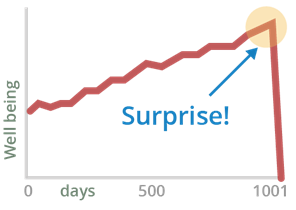
The graph below describes 1001 days in the life of a thanksgiving turkey. Mr.Turkey feels great about his life for a long time. He is well looked after and begins to expect food every time the farmer visits. This expectation gets reinforced with time and Mr.Turkey only feels better and better. Then, the farmer shows up with an axe one day and Mr.Turkey learns quickly that his expectations were catastrophically off the mark… And now Mr.Turkey is dinner.
We have many great examples of turkeys in real life – the company on the brink of disruption that was oblivious to the fact that it needed to change its business model, the executive who thought of himself as indispensable, the insensitive family member who never learnt to be nice, and so on. Because, like the turkey, they get fat, complacent, and begin ignoring the signs of the road ahead.
The lesson for us? If we’re feeling great about our companies/teams/ourselves, that’s great. But, we need to guard against being carried away for too long. Extreme emotions dull our sensitivity to obvious signs. We’re only as good as our next game. Let’s not be turkeys..
As I prepare to head for some much awaited down time, I found myself wondering – Does Seth Godin ever takes a vacation?
Well, of course he does. But that’s not my point.
I felt a certain laziness today – to think about something I’ve learnt and share it – and that’s when I remembered Seth. I’ve been putting a blog post up every day for 6 years (My first two years were more quotes than posts but I’m counting them for now). Over these years, many many friends and acquaintances have attempted regular blogging in earnest before fading away. But, Seth has been a constant source of inspiration – unwavering in his commitment and incredibly consistent in his message and in the quality of his writing.
I still have days when I struggle with conveying a learning – not because one doesn’t exist but because I either feel my writing isn’t good enough or because I’m just not in the right mood. It is on such days that I remember Seth’s consistency and just press the publish button. And, occasionally, I find myself reading a post and saying to myself – that’s worthy of Seth’s blog. It doesn’t happen often enough. I’m hoping that it will over time.
Thanks, Seth, for setting the bar high. I hope to pass the inspiration forward as well.
The law of attraction implies that when you really want something the universe conspires to make it happen.
I’d like to offer the counter point and propose the Law of Unattraction – The universe makes something happen when you have put in your best effort and are ready to walk away.
I can’t explain the number of times when I’ve really wanted a result to happen and, despite my best efforts, it didn’t look like it would happen. I’d then go through the reaction of annoyance and anger before realizing it was time to walk away and plan for life without it. And, just like magic, that result would come through.
So, if the law of attraction hasn’t worked for you despite a great process – walk away. Maybe the law of unattraction will work its magic…
Steven Pressfield had a fantastic post up the other day on his reflections of an anecdote from journalist Thomas Friedman’s book.
Beirut in the 80s was the Hobbesian Wild West. There was a war going on with Israel; artillery shells were raining down at all hours. At the same time a Lebanese civil war was raging; local militias, criminal gangs, extremist-religious armies and kidnapping rings ran rife. Death came out of nowhere and at all hours. Entire city blocks would be leveled by truck bombs, for which no group even took the trouble to claim credit. At the morgue (when anyone cared enough to transport bodies to the morgue), corpses were not even afforded the dignity of being identified. It was an era of out-and-out anarchy, where death was frequent, random, and meaningless.
And yet people lived their lives. Kids went to school, businesses found ways to stay open, Tom Friedman pursued his journalistic calling.
Tom Friedman writes – “Maybe the most popular Beirut mind game … was learning how to view one’s environment selectively.
I learned to be quite good at this myself. Late one afternoon in the summer of 1982, I was typing a story at the Reuters bureau when the crackle of machine-gun fire erupted in the park across the street. Another American reporter, who had just arrived in Beirut, ran to the window [and] became transfixed at the sight … he rushed over to me and said excitedly, “Did you see that? Did you see that guy? He was holding a gun like this right in his gut and shooting someone. Did you see that?”
I just looked up from my typewriter at this fellow and said, “Was he shooting at you? No. Was he shooting at me? No. So leave me alone, would you?”
Here’s what I find most inspiring – we all live in Beirut in our minds. It is full of distractions with the resistance suggesting this procrastination idea or another. We always have stray thoughts about this worry of the moment or that. It’s easy to be caught up in this or that. What triumphs in the end is an unerring sense of purpose and unwavering commitment to doing the right thing. Or, as Steven Pressfield says, it is about asking 3 important questions…
I’ve been swimming nearly every day in the past few months. The water is beginning to become warmer but this wasn’t the case 2 months back. I’d be jumping into what felt like shards of ice (I’m exaggerating of course – the temperature was probably around 21-22 and cold!) at the end of a long day with no one in the pool but myself. In short, I was prime target for the resistance. It had this big voice in my head telling me to go back every time I stepped near the tool.
So, of course, I did exactly the opposite. I wanted to understand the resistance and decided to spend a few days studying it. I discovered there are 3 weapons the resistance uses consistently.
1. Time. The first thing the resistance says is “You don’t need to do this today. You can do this tomorrow.” It hates deadlines and loves playing for time and procrastinating. To give you an example, in the first few days, I’d manage to get into the water (at waist level) and it would take a full 3-4 minutes before I willed myself to start swimming. These 3-4 minutes were spent in dialog with the resistance. So, after a while, I just started jumping in. No time for negotiation.
2. Disregard of your reputation. The resistance doesn’t care about the past. You could have a reputation as a resistance fighter and it wouldn’t matter. The resistance is all about the here and now. The only thing it hates is confidence. After a while, I started gaining confidence that, no matter how cold the water was, I wouldn’t turn back. Once it knows you know, it finds it hard to fight you.
3. Lack of clarity. This idea is building on the idea of confidence. If you walk in saying – “I’m going to swim 30 minutes and will do it no matter what” – it is hard for the resistance to negotiate. Clarity is the death blow. Use it.
Eventually, that’s how I kept up my swimming habit – I jumped in when I was unsure how cold the water was, I had clear goals and objectives and always repeated to myself “I’ve never regretted a swim yet”, and I built confidence over time that I’d jump in now matter what.
Of course, this is applicable far beyond the pool to every activity that makes us better – getting important things done, studying, exercising, reading, etc. It’s the same 3 weapons.
Once you understand the resistance, it is easier to fight it.
I’m listening to Sir Alex Ferguson’s autobiography and a point Sir Alex raised was his worry if a player’s transfer came too easily. He spoke about 2 instances when he went about signing players who seemed like “no brainers” and faced no resistance to sign them. He worried. And rightly so – they didn’t turn out to be successful at Manchester United.
The same point came up in a discussion with a friend yesterday – he said the best things in life come in somewhat absurd circumstances. There’s that maniacal effort, that surge of effort and emotion as we close in, and that craziness before it happens.
I’ve found that to be repeatedly true as well. Most things worth having have come in crazy circumstances. And, I can think of a couple of instances where everything looked like smooth sailing on major projects before the whole thing fell apart.
If something important is happening all too easy, maybe it’s time to pause and ask – why am I so lucky?
And, if you are looking at something important happening and find the schedule leading up to it absolutely nuts, good for you. That’s just a sign that all is normal in this world.
Dhanya interviewed Josephine Ng after seeing her on TV in a show about women CEOs in Singapore.
Josephine retired from running an ad agency, and now runs a social enterprise that provides development opportunities for women of any age. She and her husband run this business together. It’s a simple idea – they run expert-managed alteration houses in Orchard. The venue looks less like the regular alteration house we would have been to and more like a classy fashion house.
“Business concept wise, we felt there was a huge market gap for high quality alteration. If you look at Singapore, or even Asia – alteration has been very hole in the wall, very messy, they would start looking for your things everywhere. There would be threads all over the place.”
“As for the group of people we wanted to help, we sought to speak to social initiative experts. Single mothers were a group of people who came up. They would like flexible work hours, and ideally work from home even. So we put sewing and single mothers together. If they have the basic skill, we could help them improve/teach them and help them earn a decent living.”
“Currently our beneficiary group includes matured women. More than 50% of our staff includes women above 59 years of age, formerly employed women who for whatever the reason can’t go back to their employment.”
“When they first come in it’s a huge culture shock for them, with or without skill. Even with skill they find that we are very particular about our workmanship. Every little thing matters in our work – the thread colour, inseam finish, outside finish, straightness of line.”
“One of the things I am very proud of doing is this – of creating women who can think about what they are doing, and not do it blindly. They learn to put in the extra effort, to show care.”
“I remember this as our very first experience. When we redecorated our workspaces, we thought a lot about the customer’s view. Coming from an ad agency, that was very important to us, the ambiance. We spent money on doing up the decor and the especially the lights. When they went in, they asked why the lights were so dark, and why were the cabinets all black. To them the setup of the tailor’s work station was important. And we ended up realizing how our thought process went against what was really important.”
“It’s always about this one thing – whether we are doing enough to create value.”
Thanks Josephine for taking the time. Full transcript, as always, on RealLeaders.tv
Here’s this week’s 200 word idea from The Everything Store by Brad Stone…
While Apple relied on its inspirational founder to relentlessly disrupt industries and cannibalize its own profits, Jeff Bezos characteristically followed a book. Clayton Christensen’s book – “The Innovator’s Dilemma” – pointed out that companies who successfully disrupted themselves created separate autonomous entities and staffed some of their best people to lead the venture.
After watching Steve Jobs disrupt music, Bezos realized that he had to do the same for books. Just as Jobs, a die-hard music lover, had an understanding of music, Bezos understood books and knew the future would be carrying digital libraries in one hand.
So, in 2004, Bezos pulled out Steve Kessel, who was heading Books (one of Amazon’s most coveted divisions) and placed him as Head of Digital – a new department. Under Kessel’s watch, Amazon started a separate company in the San Francisco Bay Area- Lab 126 – which consisted of a small group of hardware hackers who were tasked to disrupt Amazon. After a few initial proposals and ideas, they began working on an e-reader that would revolutionize the industry. The result was “The Kindle.”
Source and thanks to: Amazon.com
‘If you’re competitor-focused, you have to wait until there is a competitor doing something. Being customer-focused allows you to be more pioneering.’ | Jeff Bezos






 A Learning a Day