Things that will not change

Amazon founder Jeff Bezos was recently asked about what Amazon might look ten years from now given all the changes sweeping through the world thanks to technology.

His response was that, instead of looking at what would change in the next decade, Amazon preferred to look at what would not change. So, there may be big shifts in the devices customers use to shop, for example, but customers will always favor low prices. A focus on things that will not change helps anchor Amazon to its objectives.

News websites and blogs called described this line as “Jeff Bezos’ advice to entrepreneurs.”

I think of it as advice for life. As we think about our lives in the coming years and decades, it should be clear that a lot of what we think will happen will not actually take place and that there will be more change in the way we do things than you and I can probably imagine. Instead of focusing on that, we’re better off focusing on what won’t change – our values and principles. It is worth thinking intentionally about these values and principles as we adapt to all that happens around us.

Despite its focus to lower prices and deliver a customer-centric experience, Amazon does make the odd misstep. We will, too. Change demands a relentless focus on what really matters.

It won’t be easy… but, boy, will it be worth it.

Despicable behavior and internet ethics

Critic Anita Sarkeesian has been the subject of intense harassment and abuse (a.k.a “trolling”) from the gaming community after sharing her views on how women are portrayed in video games. She shared 1 week of tweets from trolls from on her blog last week. Just as a preview, she has the following content warning before her tweets – Content warning for misogyny, gendered insults, victim blaming, incitement to suicide, sexual violence, rape and death threats.

Now, a question – how many of those who tweeted would have the guts to say that to her in person?

I would be surprised if one out of every hundred had real courage. The most courageous people would look to give Anita a call and discuss her point of view or perhaps disagree with her with a critique on her own. Despicable behavior is a hallmark of gutless cowards. And, unfortunately, such pseudo-macho behavior is a hallmark of cowardly male behavior on the internet.

There are 2 thoughts that come straight to mind –
1. In short term, Twitter needs to take a hard stand against trolling. We need to think of it as bouncers in a club. Users should be given a warning (strike 1), thrown out for a few days for abusive tweeting (strike 2) and then banned from the service altogether if there’s a third strike. I know this would run counter to the typical social media mantra of “we want all the users we can get,” but, Twitter is fairly niche and is really well positioned to take such a stand. (And, it looks like they’re thinking about it)

And, my hypothesis is that a few such actions will stop the rest from such behavior. Cowardice doesn’t do too well with hard action. It is just a question of creating norms – you rarely see such trolls on LinkedIn..

2. In the long term, we need more education and discussion around ethics on the internet. I spent a lot of time as a secondary student learning to write letters as part of the English curriculum. Now, I write letters just once a year but, at least, some of those learnings have been useful in the world of email. Services like Twitter are completely new territory and we need to think intentionally about ethics and norms.

And, the other question for the long term is whether we can figure out ways to reduce emotional distance between two people on services like Twitter. Emotional distance is what makes it easy for a coward to throw insults on Twitter but not in person. It doesn’t feel as “real” and we forget that the people at the other end are real people – a lot like us (see Derek Sivers’ excellent 3 min video if you haven’t as yet). I’m not sure how we’d do that as yet. But, there has to be a way. And, I’m sure we’ll find it.

Relevant costs and their implications on decision making

Fred Wilson, partner at Union Square Ventures and investor in most networks we know and love (Twitter, Tumblr, Etsy, Kickstarter), has a great post on sunk costs this week. It is a must read. My favorite part is –

‘This is a hard thing to do. It is human nature to want to recover the sunk costs. We face this all the time in our business. When we have invested $500,000 or $5mm into a company, it is really easy to get into the mindset that we need to stick with the investment so we can get our money back. If we stop funding, then we write off the investment almost all of the time. If we keep putting money in, there is a chance the investment will work out and we’ll get our money back or even a return on it.

Even though I was taught about sunk costs in business school twenty-five years ago, I have had to learn this lesson the hard way. Most of the time that we make a follow-on investment defensively, to protect the capital we have already invested, that follow-on investment is marginal or outright bad. I have seen this again and again. And so we try really hard to look at every investment based on the return on the new money and not include the capital we have already invested in the decision.’

This seemingly simple insight is what relevant costs in Microeconomics is all about. When making a decision on new investment, don’t consider past investment. It isn’t relevant. What is relevant is the return you are going to get on your current investment. What about the past investment then? Well, you should have thought that through carefully when you were making that decision. Nothing can be done about it now. As humans, we hate the idea of loss. And, the relevant costs concept attempts to guard us against exactly that.

We don’t have to be venture capitalists to have experienced relevant costs. We have seen relevant costs play in bad relationships that we held onto because of an abundance of memories, we’ve seen ourselves follow on on bad bets in poker, and we’ve probably made many a bad decision in attempting to stick with an existing investment hoping it’ll sort itself out – despite the signs telling us otherwise.

Relevant costs essentially give us a great guideline for decision making – make decisions looking forward based on today’s data. Yesterday’s investments don’t matter.

We all know that we can’t drive using the rear view mirror. Yet, as Fred points, out, we tend to do it more often than not. Microeconomics provides us with tools to think about decisions and guard against being predictably irrational.

As with all good things, it is up to us to put them to good use.

Shorter strides

The skies delivered 19 odd inches of snow in our area this weekend. Yesterday was bright and sunny and the snow had just begun to melt. I normally walk fast with as long a stride as I can muster. As I began doing that today, I felt my snow boot slip just a bit a couple of times. Cue: a change of style – I needed to take shorter strides.

It worked like a charm.

There must have been inspiration in the air as I realized right then that I’d stumbled onto an interesting learning. It begins and ends with the core idea – when in slippery territory, take shorter strides.

I think this idea has many many applications –
When low on budget in your company, design experiments with quicker feedback cycles and undertake fewer expansive projects.
In a poker game that is high stakes and “loose,” keep your money close and play tight. Weigh every move carefully.
When you’re slipping on your life’s “process,” slow down and start taking small steps towards getting back into the zone.
When you’re running out of money in your start-up, focus on your customers and cut out any additional projects (inspiring ex-entrepreneur and VC Ben Horowitz describes this as the difference between peace-time and war-time).
When in a challenging period where every second of your productivity counts, plan out every half an hour in your day carefully. Sweat the small stuff.

Summer will eventually arrive, of course. We will then be able to take longer carefree strides and try out our ambitious and expansive bets. But, not now.

Winter is all about difficult weather and slippery terrain. It is about nailing the basics and ensuring we have enough to make it till summer. For now, we’ll just focus on shorter strides..

Seeking tension – the MLK Jr. way

Martin Luther King Jr., in a famous letter from Birmingham Jail, said –

“There is a type of constructive nonviolent tension that is necessary for growth. Just as Socrates felt that it was necessary to create a tension in the mind so that individuals could rise from the bondage of myths and half-truths to the unfettered realm of creative analysis and objective appraisal, we must see the need of having nonviolent gadflies to create the kind of tension in society that will help men to rise from the dark depths of prejudice and racism to the majestic heights of understanding and brotherhood.”

He makes a profound point – tension is not a necessary evil, it is a necessity. It needs to not be avoided, but welcomed.

So, we must seek it in every form – the tension that comes from having set a tough target, the tension that comes from the expectation to prepare hard and perform, the tension that comes from holding two conflicting ideas, the tension that comes from making a tough values based decision and the tension from having difficult conversations that matter.

Move towards tension and the struggle it brings and conquer it repeatedly with great processes that you develop as you go.

Growth can’t help but follow..

Partitioned cookies – The 200 words project

Here’s this week’s 200 word idea thanks to Decisive by Chip Heath and Dan Heath.

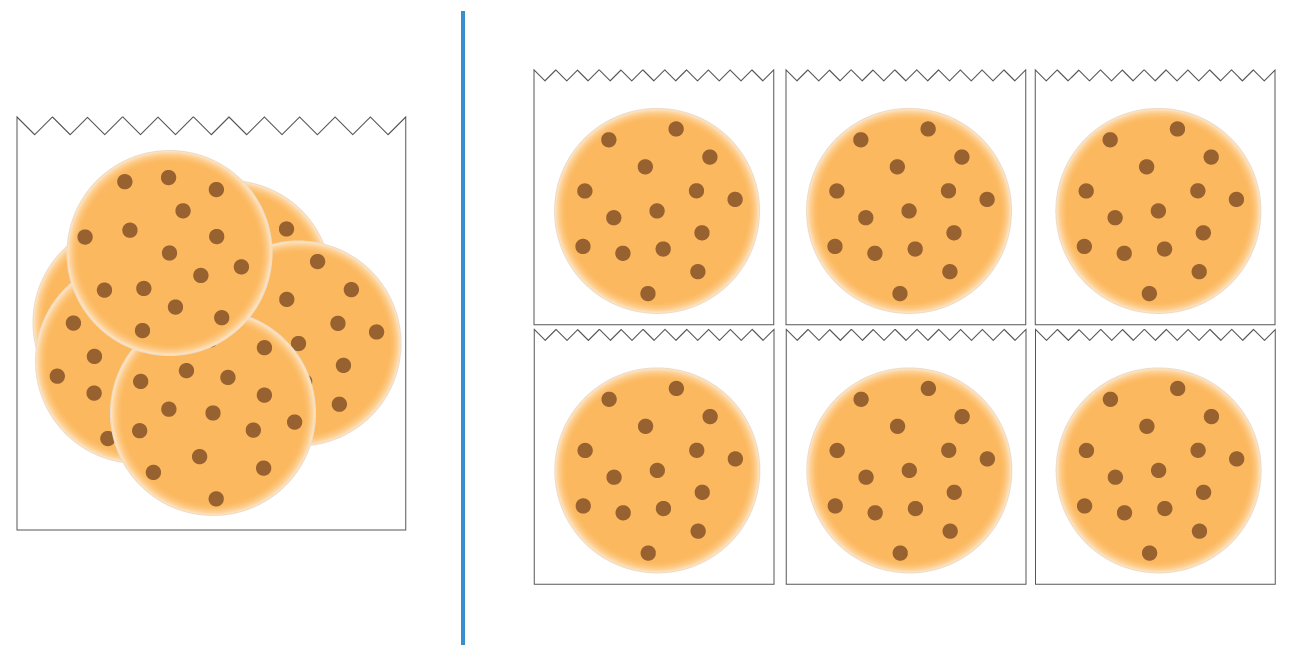
Participants volunteered to help with a cookie tasting study (that must have been a tough decision) that was actually a test on how partitions affected decision making. They were to report back once they finished their cookie jar with 24 cookies each. Participants took 6 days on average.
However, in boxes where each cookie was individually wrapped, participants took 24 days to finish the cookies!

Similarly, participants gambled less when their funds were divided into different envelopes. Day wage workers managed their finances better when they split their wages in different envelopes. And, venture capitalists made better overall decisions when they split their investments in different rounds.

Partitions like these make sure we set boundaries so we don’t just escalate our commitment to existing choices. These boundaries ensure we make conscious decisions (do I really want another cookie?). Chip and Dan Heath suggest setting up more partitions in our day for conscious decisions – e.g. a call from the family at 5pm to check in on our productivity and ensure we head home in time for dinner.
Partition Cookies

Source and thanks to: www.EBSketchin.com

‘My approach to living with purpose has always been to create the life I want, one conscious decision at a time.’ | Oprah Winfrey

Availability bias, news, and Google vs. Apple/Amazon

I think it is possible that the amount of news coverage an event receives today equals ten years of news coverage in the 18th century. This amount of chatter greatly affects perception. And, the amount of chatter is definitely not correlated to accuracy.

An example from this week is the news on the earnings from all the major technology companies. We had news from Apple, Google, Amazon, Facebook, etc. A lot of the news in the past 4 years around Apple (since Steve Jobs left) has revolved around whether Apple has what it takes to continue making money without their visionary founder. And, until a year ago, I was in that camp.

And, this last quarter, Apple sold 74 billion dollars of products. To put that number in context, that is more than the revenue of a collection of the next few technology firms (Microsoft, Google, Facebook) put together. And, in that one quarter, Apple’s profits were larger than Google’s revenues. There are similar negative perceptions about Amazon’s stock. Google, on the other hand, has had a consistent stream of positive press for its ‘moon shots’.

But, here’s a dose of reality –
– Apple makes money by selling premium devices to the high end of the market. The high end of the market isn’t going away any time soon.
– Amazon is still less than 2% of North American retail and, once cloud computing takes off completely, Amazon Web Services could dwarf its e-commerce sales in 10 years.
– Google is searching for ways to compensate for its declining advertising revenue by investing in a whole host of businesses. Google’s stronghold was on the desktop/laptop. Mobile hasn’t worked nearly as well. That’s not to say it won’t figure out the next step. It is just that the news around Google in comparison to firms like Apple is often dis proportionally positive.

All this news and chatter affects our perception. Information that is easily available to us feels right because we can easily recall it when making decisions. But, just because we’ve heard something 10 times doesn’t necessarily mean it is right. Availability bias, however, is something we fall prey to repeatedly and is a big part of being human.

The <15 word summary of the post so far could very well be interpreted as – ‘Beware news. Dig deep to understand what is really going on.’

But, the point I’m hoping to make is a level deeper – it is to think intentionally about the content we consume. This means –
1. Audit your sources of content – news, feeds, facebook, twitter, linkedin friends, etc. – and understand where we develop points of view on what’s going on in the world
2. Develop a content consumption habit and plan in alignment with the sort of person you want to be. If you want to think deeply about the automotive industry, find the best automotive industry blog and shelve time spent on reading stuff that doesn’t add value

These small decisions inform the way we think about and approach the world and our lives. Let’s approach them with care.

When to be disappointed and when not to be

When to be disappointed
When you ‘mail it in’ instead of giving the process your best shot
When you don’t prepare as well as you should have
When you don’t perform to the best of your ability
When you don’t relax and enjoy the occasion

When not to be disappointed / when disappointment is wasted emotion
When you aren’t picked
When the result isn’t what you’d have liked
When there was someone more suited for what you were going for than you
When you didn’t click with the people you were in conversations with

When I was a secondary/high school student, I cared about my exam performance a great deal. And, the fact that my parents’ questions revolved around whether I had prepared well and given it my best shot used to infuriate me. I didn’t understand it and couldn’t get why they didn’t see my point – I didn’t care how well I prepared. I only cared that the results turned out good.

I was obviously wrong.

As you can tell, the message here isn’t ‘don’t be disappointed’ or ‘avoid disappointment.’ It is – learn when to be disappointed and when not to be. Be very disappointed if you didn’t do the process justice. And, use that disappointment to inform the next process. There is no excuse to make the same mistake twice.

If you did do the process justice, let go. This is hard to stomach. But, that’s about all you can do.

In the long run, doing the process justice is all that is going to matter. The cream always rises to the top..

If by Rudyard Kipling

There came a moment yesterday when I was reminded of ‘If’ by Rudyard Kipling. So, I whipped my phone out, searched for it and read it aloud.

I first read the poem in my English textbook in my 8th grade and I loved it. For the uninitiated, it is Kipling’s letter to his son. I’ve posted the poem here a few times in the past 7 years but, somehow, it never gets old. Even to this day, there are some lines I repeat to myself at times – “if you can trust yourself when all men doubt you, but make allowance for their doubting too,” “and yet don’t look too good, nor talk too wise,” and “if you can meet with Triumph and Disaster and treat those two imposters just the same.” There are many incredibly powerful lines and, no matter what your current emotional state or need may be, I trust you’ll find a line that resonates.


If you can keep your head when all about you
Are losing theirs and blaming it on you,
If you can trust yourself when all men doubt you,
But make allowance for their doubting too;
If you can wait and not be tired by waiting,
Or being lied about, don’t deal in lies,
Or being hated, don’t give way to hating,
And yet don’t look too good, nor talk too wise:

If you can dream—and not make dreams your master;
If you can think—and not make thoughts your aim;
If you can meet with Triumph and Disaster
And treat those two impostors just the same;
If you can bear to hear the truth you’ve spoken
Twisted by knaves to make a trap for fools,
Or watch the things you gave your life to, broken,
And stoop and build ’em up with worn-out tools:

If you can make one heap of all your winnings
And risk it on one turn of pitch-and-toss,
And lose, and start again at your beginnings
And never breathe a word about your loss;
If you can force your heart and nerve and sinew
To serve your turn long after they are gone,
And so hold on when there is nothing in you
Except the Will which says to them: ‘Hold on!’

If you can talk with crowds and keep your virtue,
Or walk with Kings—nor lose the common touch,
If neither foes nor loving friends can hurt you,
If all men count with you, but none too much;
If you can fill the unforgiving minute
With sixty seconds’ worth of distance run,
Yours is the Earth and everything that’s in it,
And—which is more—you’ll be a Man, my son!


He definitely left the best for the last and this also happens to be one of my mom’s favorite lines. “If you can fill the unforgiving minute with sixty seconds’ worth of distance run, yours is the world and everything that’s in it” – never a truer word spoken. Thank you, Mr.Kipling.

Paul Bennett on Design – MBA Learnings

Paul Bennett, Chief Creative Officer at IDEO, the famous design firm, was at school yesterday. He delivered an engaging 50 minute talk on his perspectives on love, beauty, religion, and death. I am not going to attempt a perfect summary of the talk. But, I thought I’d attempt what I took away..

– We are all designers. Businessmen design businesses, teachers design classes, etc. This was the all important base line we started with. Now that we understand we are designers, let us learn to think like one and understand the sorts of barriers design is breaking through in today’s world.

– Design transcends agenda. This was a profound line from a conversation with a princess from the royal family in the UAE. Paul had conducted a brainstorming session in Dubai where he’d asked designers for their dreams for Dubai. The women designers had written some really powerful thoughts along the lines of “we want to matter.” Paul had shared these in his TEDx talk the next day as a way of thinking about designing Dubai in the future. As a designer, sharing these wasn’t about judgment. It was about transcending the agenda and meeting purpose.

– Remember to answer the question. He spoke of the moment when he had been diagnosed with diabetes. He was listening to the doctor throw all sorts of medical terms when he had just one question in mind – “will I be able to eat during thanksgiving?” Sometimes, all we’re looking for is answers to the simple questions – e.g. “will I be okay?,” “do I have a real shot at this opportunity?,” or “will you give me a hug?” Let’s design for those.

– Death and religion. Paul spoke about how IDEO is designing for taboo topics like death and religion. These topics are entering the mainstream and they make for great design opportunities. And, while topics like “designing for death” remains somewhat morbid, the fact is that most human beings share common misconceptions and irrational fears around death. Can we make the experience better? (We don’t know yet but we’re certainly going to try!)

– Conversation is design. This was the most powerful insight I walked away with. In the vein of us being designers, I think we can extend the “we are all designers” insight into the idea that we all design lives, moments and experiences. And, maybe, we could make more of an effort to design conversations that matter? It isn’t easy to have these conversations around topics like religion, fear, death, and all the other difficult issues that we face in society. But, if we don’t, who will? And, how will we inform our responses to these topics if we aren’t exposed to viewpoints different from ours?

I loved Paul’s talk. He was warm, vulnerable and humorous. It definitely made me think.

And, I think I’ve walked away with ideas for a couple of my projects as well as for my lives. I can think of 2 that I’m going to work hard to implement –

1. Consciously design experiences when designing products, services and events. Apple just sold its one billionth iOS device in what was a quarter described as “monstrous.” They get this idea. Buying an iPhone is designed as an experience. Unwrapping it is part of the experience and using it is definitely another. In the final analysis, it is because we don’t remember what we did.. we do remember how we felt.

2. Have more tough conversations. The inner geek in me loves this idea. In some ways, the talk reminded me of why I am in school – to get exposed, to think, to reflect. There are so many great conversations to be had. And, it is up to me to make them happen.