Confidence and commitment

The next time you tell yourself that you aren’t doing something because you lack confidence, I would suggest checking once again if the issue is one of confidence or one of commitment?

Too often, we use confidence as our excuse for not giving enough thought to something that requires it, for not taking a small leap, and for not pushing hard to become a better version of ourselves. Confidence, however, is just a lazy out. We don’t need more confidence in the world. We need more commitment. More unwavering commitment results in more confidence and the confidence built on commitment is the kind that lasts anyway.

Imagine you are considering a small leap – say building a relationship with someone you admire. Instead of using the “I don’t have confidence” excuse, how about doing the following –
– Give a lot of thought to why the person might want to connect with you
– Consider what it is that you might be able to add to the person life or perspective
– Commit to building a relationship for the long term

Once you do, you can begin reaching out and finding ways to connect, build and maintain a relationship. It won’t always work – that’s the case with all kinds of relationships. But, hey, it just might.

Either way, you’ll never know until you commit.

commitmentImage Source

The Leicester City story

Premier league minnow Leicester (pronounced “Lester”) City won the English Premier League yesterday. That is huge. To win the premier league, you win and draw more games over the course of the 38 game season that every other team. In the last 20 years, there have only been 4 winners – Manchester United, Arsenal, Chelsea and Manchester City. The reason there are only 4 winners is because it was believed that it took a tremendous amount of financial clout to build a squad that would last the season. Leicester City’s entire side was assembled with less than 10% of the financial resources of the bigger sides. They were supposed to be favorites to be in the bottom 3. And, yet, here they are.

In every way, this is a historic event. Kudos to Leicester – for pulling off what no one thought was possible. And, for doing it with admirable consistency.

The obvious questions follow – will they be able to keep it up? Will they buy new players to sustain a challenge next season? Will the big teams get their mojo back?

All of these questions, obvious as they might be, completely miss the point. John Nicholson, on Football365, said it beautifully –

Whatever age you are, I guarantee you this: the 2015-2016 season is a season you will never forget. We are living through a moment that will still astonish in 50 or 100 years’ time. As it comes to pass, now is the moment to embrace it, enjoy it and be inspired by it, so that whenever it looks like the odds are against you, whenever it looks hard to achieve something, whenever we take on people with more money and power, we can tell ourselves, if Leicester can do it, we can do it. And that is priceless.

So true. It is a fantastic story.. and one that will inspire many an underdog team for a very long time. Congratulations Leicester!

Your future self equation

My future self equation is as follows –

Futureself

You grow at the rate of your learning and are limited by your self-belief. Both of these have compound effects – which I think are critical. Learning compounds. Start on the journey today and your mental models are going to be much better than me if I start ten years from now. We might both go through the same learning experience at that point but, you will learn a lot more on account of your superior mental models.

Self doubt acts as the discount rate in the whole process. This is because our belief in our own abilities and discipline directly influences whether we take on long-term learning challenges. The lesser our self belief, the more we will focus on the short term.

So, what is the rate of learning then? It can be broken down to three factors –

1. Rate of reflection. This is how much you extract from every experience you go through. There is so much learning in our own experiences if we take time to dig in and understand what they are.

2. Rate of learning from written work. This is what you learn from what others have shared in writing. This might just have been “learning from books” before blogs and the internet emerged. Books likely still dominate thanks to their generally solid signal to noise ratio.

3. Rate of learning from people. Your rate of learning is directly proportional to the kinds of people you spend time with. The more you spend time with people of value, the more you are likely to learn.

So, in summary, my thesis is – the growth in your future self as compared to your self today is directly proportional to the amount of learning you extract from your own experiences, from what you read and from the people you meet. This learning and growth compounds over time and is only limited by your own belief in yourself.

The supermarket willpower test – The 200 words project

The local supermarket is one of the best places to understand what we know about willpower.

A well-functioning super market will begin by having free food samples in the bakery section near the entrance. As a group of Stanford researchers showed, eating sweets increases people’s propensity to buy more and makes them over-sensitive to dopamine triggering “for sale” signs.

Somewhere close, you’ll also see green and healthy food. It makes a lot more sense to have vegetables near the checkout line so your tomatoes don’t get crushed by other stuff you buy. But, vegetables help you stock up on good karma (“moral licensing”). You can then proceed to spend the karma you earned on unhealthy stuff.

Milk, bread and eggs are all the way at the back – if you came for a quick run, you still need to pass all the tempting stuff en-route – twice.

Finally, even if you managed to make it to the checkout counter resisting everything, you have candy and gossip magazines waiting for you while you wait. After all those vegetables, tossing one of these wouldn’t hurt, right?

The test isn’t over till you are out of the examination hall.

“he odds of going to the store for a loaf of bread and coming out with only a loaf of bread are three billion to one. – Erma Bombeck

supermarketImage Source


Source and thanks to: The Willpower Instinct by Kelly McGonigal, The Power of Habit by Charles Duhigg

Why me?

One of the little changes I’ve been happy about making over the past couple of years is not asking “why me?” when things don’t work out.

This change was due to a story I shared here a few years back. When tennis legend Arthur Ashe announced he had contracted HIV due to a poorly administered blood transfusion procedure after a heart surgery, he received letters from fans who asked why, of all people, had he been chosen to have AIDS?

To this Arthur Ashe reportedly replied – “The world over– 50,000,000 children start playing tennis, 5,000,000 learn to play tennis, 500,000 learn professional tennis, 50,000 come to the circuit, 5,000 reach the grand slams, 50 reach the Wimbledon, 4 make the semi finals and 2 make the finals. When I was the one holding the cup, I never asked god “Why me?”.

It is a story that has stuck with me since.

If I’m not asking “why me?” when things do work, I have no right to ask “why me?” when things don’t.

Thank you for the gift of perspective, Arthur.

Why me?

Tiger – Spy in the Jungle

Thanks to some wonderfully innovative camera techniques involving elephants carrying cameras on their trucks and placing “log cams” at various parts of the forest, the BBC Wildlife Specials crew led by the one-and-only David Attenborough have a fantastic three part series called “Tiger – Spy in the Jungle.”

As elephants are treated as harmless inhabitants of the forest, they can come and go as they please. And, they do so with aplomb. Over a 3 year period, David Attenborough tells us the story of a mother raising 4 tiger cubs. Innovative filming techniques were required because tigers are solitary animals whose behavior is very different when humans are not around. It is also not easy to film in the dense Indian jungles.

I found it fascinating to watch the tiger cubs’ learning process. It begins with play among the siblings. Then, it is following their mother when she goes hunting. Their mother hones their skills over time through some skillful coaching intended to develop specific skills – the ability to carry the carcass, to complete a kill, to get as close to the prey as possible. It reminded me a lot of the process of deliberate practice. It was also delightful to see the cubs take every opportunity to play.

David Attenborough and BBC’s work to capture nature’s great sights and sounds is such a treat. I find that it elevates my understanding and appreciation for nature. Every one of these animal focused documentaries remind me how beautiful these animals are and how important it is for us to do our bit to maintain the delicate balance in nature.

This and more available on Netflix. They come highly recommended.

Tiger, Spy in the jungle

2 questions for most team dysfunctions

If you’ve worked in teams long enough, you realize pretty quickly that most dysfunctions come down to the answer to just two questions –

How much do you care about the cause and about each other?
How much do you trust each other to do the right thing?

They tend to be related. The more you are sure your teammates care, the more you are likely to trust and vice versa.

You know the best part? Neither is an innate ability we are born with. Both involve us making a choice.

Jobless Einstein

Albert Einstein was unemployed for two years following his Diploma. He was rejected from every research post he applied in Europe. He came to believe that a part of it had to do with the fact that his impudence had annoyed his thesis adviser. The rejections were tough for him to stomach because he (contrary to how he’s occasionally been portrayed in popular culture) was an excellent student.

Einstein’s letters from the time speak to his frustration, frequent disappointment and, at the same time, many bouts of optimism and self belief all at once. At his lowest point, he was so disheartened that he considered giving up his pursuit of a career in Physics for a career in Engineering at his father’s firm or even selling insurance.

Just when all hope seemed lost, his Marcel Grossman’s attempts to secure him a position as a patent examiner came through.

His Nobel prize winning papers were submitted while he was still an examiner.

This is Albert Einstein – probably the single greatest scientific mind that has ever existed – having difficulties finding a research job. Maybe we should remember that when our “plan A” doesn’t work out.

And, maybe, just maybe, when faced with plan B, we’ll remember what he did and knock the socks off our plan B.

jobless einstein

Yes, but, how much?

People throw around “I care about…” a lot. The pertinent question when you hear that the next time is not “Oh really, how nice!” but to say – “Yes, but how much?”

A few examples…
…do you care enough about your health to not just sign up for the best gym in town but to actually exercise 4 times a week?
…do you care enough about your family to walk out of the office in the evening and spend time with them?
…do you care enough about your mental energy and capacity to make decisions to get enough sleep?
…do you care enough about learning to actually read or to spend time with people who push you?
…do you care enough about your friends to interrupt your schedule to be there for them when they need you?

Sure, asking “but how much” might make you look impolite. So, ask different questions, politely if you will. But, ask.

The more you can call bullshit out by ignoring what people say and watching what people do, the less time you will spend fabricating stories that make you look good.. for the time being.

And, to be clear, there is absolutely nothing wrong in not caring about yourself, your health, learning or your family and friends. If that’s how we behave, let’s at least call a spade a spade.

but how muchImage source

The two best pieces of health advice I have gotten

  1. Listen to your body
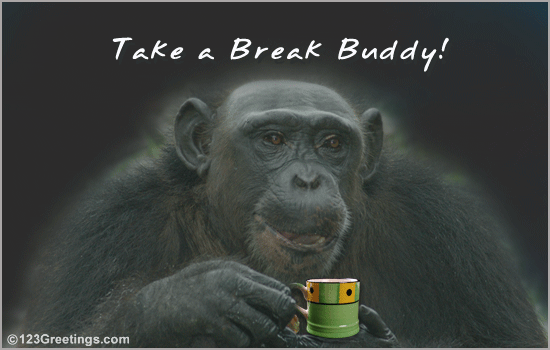
  2. When you fall sick, it is the universe’s way of saying – “Dude, take a break.”

I seem to think of these two pieces of advice nearly every time I don’t feel 100%. Years of paying attention to our bodies teach us a lot and I felt something was just not right this morning and it was better to get to it rather than push through and try to behave like nothing happened.

The agenda for today is Tylenol, rest and lots of TV, a.k.a, “dude, take a break” day. I am looking forward.

health adviceImage Source