The baldness game – The 200 words project

Six year old Emma had been undergoing therapy for cancer. The day after her head was shaved, she walked into class to find her classmates making fun of her. Emma dreaded going to school the next day.

When their teacher walked in the next day and greeted the kids in her usual cheerful way, she took off her scarf and showed off her bald head. The kids were all taken aback and, that evening, every one of them asked their parents to shave their heads bald.
The teacher saw opportunity in the little girl’s first day of suffering. She wore her bald head like a fashion statement and saw it as an opportunity to increase bonds, create solidarity, and most importantly, have fun. So, she created a game and everyone wanted to play.

Whenever we face a situation that creates winners and losers, it is probably worth reminding ourselves that we always have a choice to create a win-win game. The possibilities always exist.

Many circumstances that seem to block us in our daily lives may only appear to do so based on a framework of assumptions we carry with us. Draw a different frame around the same set of circumstances and new pathways come into view. – Ben and Roz Zander, The Art of Possibility

baldnessImage Source


Source and thanks to: The Art of Possibility by Ben and Roz Zander

Interviewing Seth

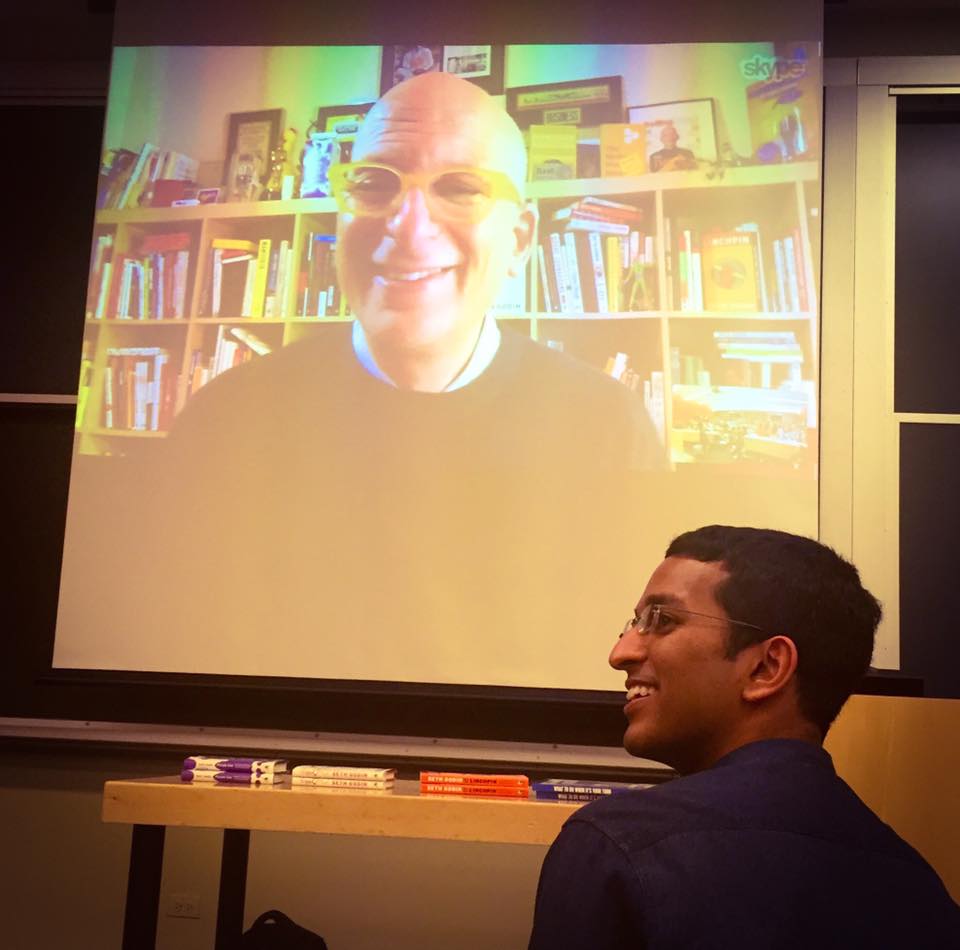
I had been looking forward to a Skype interview with Seth at school for many months. It took me a few months before I was sure the technology would work. I promised him a good experience and I definitely felt a bit of the pressure of the promise in the days leading up to it. It all worked well (thank you to KIS – our tech team!) and the interview was a real treat.

Unfortunately, though, the video recording was not the best. So, I’m afraid I’m unable to share that with you. Seth has very kindly offered an audio interview for this blog in the future. I won’t be taking him up on it anytime soon as he was so generous with his time and perspective. But, I look forward to doing so in a year or two.

Until then, I am pleased to share my notes. These are paraphrased and “I” refers to Seth.

Thank you so much, Seth. I intended to have a cliff notes version of the talk. But, there were SO many pieces that resonated.


On general and specific. There’s a difference between a wandering generality and a meaningful specific.

On how we’re measured. Today, we are measured on the change we make on other people.

On daily blogging. It is malpractice to not have a daily blog. Because, if you write something in public every single for 50 years, you will be better. You will be happier, you will be smarter and more connected.
When you look back on your posts, what you are going to see is your intellectual development. Doing it in public is much better because you can’t lie to yourself and you can’t skip a day.

On whether there’s the pressure of writing one of the most read blogs on earth. I love the fact that I’m about to touch people. But, if someone doesn’t get it, that’s okay – for both of us, I hope. That’s the only way I can do the work – by saying this one’s only for the person who gets it.

On productivity and the MBA. (I asked Seth a question about productivity but he decided to talk about what he thought was more important. I am glad he did) In some ways, it is the best time in history to get an MBA. In some ways, it is the worst. It is the worst because there is more supply of people who did what MBA’s did than ever before. There are also less organizations who demand the blue chip stamp. And, then there are other organizations who are asking you to do things that aren’t necessarily things you want to do – they’re just paying more.

The reason this is the best moment is – if you choose to, you can see. You can see how the world works, you can see through the lens of behavioral economics, industrial history, social movements. You can see all of these pieces fit together – not from a technical point of how do I do this or that. None of the technical stuff is going to matter 4 years from now. What’s going to matter 4 years from now or 20 years from now is – are you the person in the room who sees the world as it is and cares enough to change it? There are very few people are privileged who can do both of those things. I think that is 10,000 times more important than your productivity. What we know is that it doesn’t take an enormous amount of sleepless nights to do those 2 things. What it takes is the bravery to do something that might not work.

On mentors and heroes. There aren’t enough mentors for every mentee. Heroism scales. If you decide to be a long term investor, you can ask – what does Warren do? And, you can read his book or the Berkshire Hathaway annual report. Heroes don’t have to be rich or famous. They just have to be on a path that you hope to go on one day. The magic of that is that you can inculcate their beliefs and act as if. And, sometimes, you can get really good at it and do it better than they did because you are starting with a bigger head start.  (So, you can read my 7,000 posts and go farther than I ever did. I’m just trying to be a compass.)

On being right. Being right about the strategy is irrelevant if your audience isn’t enrolled. You’ve been trained to be right. It has taken me a long time to train myself that being right isn’t all that important. The people who are daring and are doing it out of generosity make WAY more impact. If you look at the list of products that Apple and Microsoft have made over the last 25 years, it will stun you. It just goes on and on with one wrong product after another. You can be wrong a lot of times and make the iPhone and you will be fine.

On Trust. Trust comes from making promises and then keeping them. The goal is to not just be consistent but to make bigger and more generous promises.

On career choices. Acceleration is a change in velocity. I picked a job after school based on two things – was it in an industry that was growing fast? and who was going to be my boss?

I’ve done projects all my life. With projects. you realize that you don’t have to hit home runs ever. Singles are better than a home run. People who talk to me about regrets after business school bought safety when they left. They started wanting to do that for 4 years. But, what they don’t do when they get there is share an apartment and eat brown rice and white beans everyday. Instead, they buy a BMW (since they have a miserable job) and the next thing you know, they get a promotion and stock options. Then, they worry about losing the stock options – haven’t you guys gone to your sunk cost class? :-)

Trade safety for acceleration and freedom.

On being “on duty.” If you can be the person you choose to be when you are being judged, you can be that person all the time. Then, your life becomes way simpler. You don’t have to worry about who’s watching. Just be that person in your private life and you’re going to do great. The mistake is to let the person in private be the person you are all the time. Then, you are going to disappoint us.

On management and leadership. Management is getting people to do what they did yesterday, but faster and cheaper. Leadership is helping people go where they want to go. Leadership is about getting people signed up to do what all of us want.

On the AltMBA. The goal is to transform into people who see the world as it is, to understand how to use words and images to cause other people to change their mind, and how to make better decisions. If we can help people do those 3 things, sky is the limit.

Everyone of you, even those with appropriately sized egos, is more powerful than you imagine. The challenge we face is – given that power, what are you going to do with it?

On creative process. As I get older, I get better at my creative process and get less creative. Because I don’t think those two things go together. There is no such thing as a creative process. Creativity is the work you do when you are not afraid. And, whatever method you can find to stop being paralyzed by your fear – because you can’t make it go away – but, so that you can dance with it is good. People who have something to show for their creativity have it because they decided it was important and cared enough to live with the fear.

Every one of you is an artist who has been pushed to fit in. The hard part now is to care enough to fail, to care enough to say – “Here, I made this.” And, when the person says – “I don’t like this, I don’t like you, you are a fraud”, you can say – “Oh, it must not be for you.” Then, offer it to somebody else.

You get to be the best in the world by not running away from the hard work that makes you the best in the world.

On quitting. Quit before you start if you are not prepared to stick it out to the end.

On parenting. Every kid is home-schooled between 3 o clock to 11 o clock at night. Even if you are not at home, they are home-schooled. You’re going be asked to trade-off time with your family for metrics of money or notoriety. I hope you’ll choose to trade some of it, maybe even a lot of it.. because they are counting on you.

On difficulty. I’ve been bounding out of bed every morning for 38 years. It is a choice. I’ve been to places where any of us would do almost anything to not have to live in that village with no electricity. And, I remind myself on a regular basis – this is not hard work. This might be difficult but it is not hard work. Hard work involves helping someone with leprosy, burying someone you grew up with. This is the safest human beings have been in our history, more powerful. What a privilege.

On infinite games. As the industrial age ends, information is not finite. Either we keep playing finite games and blow ourselves up, we will adopt a different mindset and just keep playing. We won’t pass it forward because we will win. We pass it forward because we can.


Seth, Kellogg

Waiting for passion

There are a lot of people on the planet waiting for passion. That is a bit like a person walking around waiting for bird poop to land on their head. Someone they met told them that bird poop is a lucky charm that will change their life and that they knew of a couple of other folks whose lives transformed when they had bird poop land on their heads.
So, this person roams around feeling certain that it’ll show up. And, when it does, they believe they will be on the path to success.

passion, waiting, choose

Jack Welch’s famous people evaluation systems at General Electric had a large weight for passion. But, passion for what? It turns out that it didn’t really matter. As he said, passionate people are passionate about everything. It didn’t matter if it is their kid’s softball team, their musical instrument or their not-for-profit, people who choose to be passionate will be just that, passionate.

Cal Newport wrote a whole (very good) book debunking the idea that finding your passion is bad advice. His thesis was that you work your way into getting good at something and that’ll lead you to passion. Starting with an attempt to find passion will take you nowhere. Instead, get good, become awesome, and you will likely find passion. It is an approach that is almost guaranteed to work.

My only addition to that would be – “Choose to become passionate.” Passion isn’t something you need to wait for. At some point, you just need to choose to give a sh*t, to care about what you do and who you spend time with. You can start anywhere you want – it doesn’t matter. You just need to care enough to sweat the small stuff.

The moment you do that, you will find that once you are passionate about something, you will care and be passionate about everything.

And, yes, you will be transformed.

What you are doing vs. who you are being

Of late, I’ve been pondering the difference between two ideas – what you are doing and who you are being. On the one hand, they seem closely related. One might imagine that what you do generally flows from who you are. But, that assumes you walk what you talk and vice versa.

Whenever there is a gap between what you are doing and who you are being, you come across as inauthentic. We’ve all experienced this with people we’ve met – that feeling of dissonance, that sense that something isn’t right.

And, on the flip-side, we’ve likely been on the receiving end of someone’s mistake. But, given we know how much they care (or who they are), we’ve been happy to forgive them.

In an age where there’s media everywhere around us that lionizes people who succeed, it has become more important than ever before to understand if what we do is aligned with who we want to be. We might do many of the “right” things, but if they aren’t consistent to who we are being, then it isn’t going to work.

After all, people don’t remember what we said or did. They remember how we made them feel.

Image Source

Living in day-tight compartments

In a rather dark phase during my university days, I remember reading Dale Carnegie’s book – “How to Stop Worrying and Start Living.” It was one of those classic self help books written in the post depression era.

I don’t remember much from the book beyond one idea that stuck was – live life in day-tight compartments. The idea here is that it helps to localize the effects of a bad day. If yesterday was a bad day, it is tempting to let it spill over into today. Instead, Carnegie recommended we practice taking life 24 hours at a time.

I was thinking about it over the last few weeks as I was watching episodes of The West Wing (which, by the way, has to be the greatest TV series ever made if you geek out about teams and leadership). The show, for the most part, takes us through momentous days in the lives of the team of White House staffers. And, every once a while, when they’ve had a good day, the President calls it out by saying something to the tune of – “You’ve had a good day. Go get rest and I’ll see you tomorrow.” And, typically, after a series of bad days, it is something to the tune of – “Break’s over.”

Here’s what we know – fluctuations are a part of life. A run of good days or, for that matter, a run of bad days will never last. If it is a good day, call it out, get rest and get started early the next day. If it is a bad day, call it out, get to bed quicker and get started early the next day.

The more we can keep perspective, the better. And, a nice way to do that is to live in day tight compartments.

day-tightImage Source

Disentangling situation from mood

One of the implicit assumptions most humans make in conversations is that mood has to be directly linked to current situation. Most conversations that involve a non-rhetorical “how are you?” go something like this – “All is well, so I am well” or “That bad thing happens, so I am not feeling great.”

This thought process is both flawed and weak. Yes, our environment has an effect on us. But, WE get to choose the response. The first step to discovering this super power is to disentangle what is going on with how we feel. These don’t need to be in sync. You could be walking through hell and high water professionally and could still be in a great mood. That is the difference between feelings and states. The state of happiness acknowledges that there will be minor ups and downs while keeping the perspective that things, overall, are just fine.

There is space between the situation and our response and it is entirely up to us to use it. As humans, we tend to crave a certain stability. When we learn to disentangle situation from mood, we realize very quickly that we don’t have to look outside to find that stability. It is within us.

And, what’s more, it has always been there…

mood

Re-frame to let go

I found myself irritated by an exchange recently where I felt I was being unfairly judged for the second consecutive time without good reason.

After letting it sink in for a few minutes, I moved onto other things. However, the irritation was still at the back of my mind. I don’t like the feeling of irritation and I have come to think of anger as a weak reaction. So, feeling that irritation made me wonder about how to let go completely.

After sleeping on the thought, I realized that the issue was the way I had framed the situation. In thinking about the situation, I had implicitly assigned blame on the other person. In my language – “They had judged me.” And, to add to it, the solution, in my own language, was – “I wish they were upfront about what they expected.”

I switched the frame to think about what I could have done and what I had learnt from it. And, voilà, it all became clear. I should have done a much better job setting expectations upfront. I didn’t this time. But, I’ve learnt my lesson and it is time to move on. Letting go was so much easier once I’d accepted responsibility.

It is very hard to let go of things you don’t feel you influence. You can, thus, take control by re-framing the situation and focusing was in your control. Once you do that, you acknowledge the mis-step, accept responsibility, learn and move on.

Re-frame. Then, let go.

re-frameImage Source

Rule number 6 – The 200 words project

Two prime ministers were sitting in a room discussing affairs of state. Suddenly, one of the aides walked in and began furiously explaining something that had gone wrong.
The resident prime minister admonished him gently – “Peter,” he said, “kindly remember Rule Number 6.” On hearing this, Peter calmed down, apologized, and withdrew.

The politicians returned to their conversation but found themselves interrupted by another hysterical staffer. Again the prime minister said – “Marie, please remember Rule Number 6.” Complete calm descended once more and she, too, withdrew with an apology.

When this scene repeated again, the visiting prime minister said: “My dear friend, I’ve seen many things in my life, but never anything as remarkable as this. Would you be willing to share with me the secret of this Rule Number 6?”

“Very simple,” replied the resident prime minister. “Rule Number 6 is ‘Don’t take yourself so damn seriously.'”

“Ah! That is a fine rule.” After a moment of pondering, he inquired, “And what, may I ask, are the other rules?”

“There aren’t any.”

When we follow Rule number 6 and lighten up over our childish demands and entitlements, we are instantly transported into a remarkable universe. The new universe is cooperative in nature, and pulls for the realization of all our cooperative desires. – Ben and Roz Zander


Source and thanks to: The Art of Possibility by Ben and Roz Zander

rule number 6

Actions unmask intent

In the short run, you might be able to act your way out of showing your true intent. You could pretend to care even if you don’t. You could pretend to be trustworthy even if you aren’t. You can pretend to be curious even if your intent is only to self promote. And, you can pretend to only want to influence when your intent is to manipulate and engage in politics.

Great actors can do all of this in the short run. They can outshine those who really care.

In the long run, however, your intent will show. It is impossible for the actor to cover all bases over a long trail of actions. Company A might have the best customer service ad campaign of all time but if its staff consistently brush customers away, the ad campaign’s effects will come to naught and may even result in negativity.

Actions, over time, unmask intent.

So much better, then, to just be upfront about what you care about and be consistent all around.

Because I said so

“Please don’t do that.”
“Why?”
“Because I said so/am the boss/am the leader/am your parent.”

This is about the worst thing you can say if you ever plan on gaining someone’s respect.

It is okay if it needs to be said in a hurry and is explained later. Sometimes, in a crunch, it is tough to take time to explain the “why” behind things when you are in-charge. In those situations, you just follow on trust.

There is a good chance that your team disagrees with your rationale when you get to explaining it. It matters, however, that there is a rationale and, more importantly, that it is explained.

But, if that is meant to be the answer with no further explanation, then some changes are in order.