
There are few things that I find as grueling as a job search process. For most of us, I find that it brings out the worst insecurities within us as it continuously seems to tease that one question – “Am I good enough?”
The truth, of course, is that any job search process is a crap shoot. Interviews are rarely great indicators of a candidate’s performance on the job. And, it can all seem and be arbitrary. However, in a world where there are few things you can control, I’ve learnt to focus on the one thing we do control – our process. And, that’s what this post is about – the 3 phases of the job search process. This is a long post but I figured it’d be easier to put this all in one place rather than break it up into multiple posts. Also, while the overall framework applies to all kinds of interviews, this has a lot more information about the business side versus the technical side.
There are 3 phases to finding a job –
I. Figuring out where you want to apply
II. Getting an interview
III. Doing well in the interview.
I. Figuring out where you want to apply
Phase I has 3 broad steps –
1. Get information. First, get as much information as you possibly can about the possible options you’d like to pursue. Speak to people you respect, connect with friends who are knowledgeable and get out of your comfort zone and have a few conversations with friends of friends in companies/industries/roles that interest you.
2. Reflect and decide what your priorities are. Once you gather all the information, it falls on you to decide which paths make sense. If it helps, there are just five career priorities that you normally struggle with. It helps to sit with these, struggle with them and prioritize.
3. Do a quick reality check on the final list. Finally, when you make your shortlist of companies and roles, it is helpful to do a quick aspirations vs. reality check. To take a somewhat outlandish example, NASA may be high on your list of employers. But, have they hired people with your background? The more you find people with your background and experiences, the more realistic it is (LinkedIn should be able to help you with this). Now, that doesn’t mean you shouldn’t have NASA on your list – you could definitely break ground. But, it is best to work with risk as a portfolio and mix some very aspirational places with places that you know would be interested in speaking to you.
II. Getting an interview
There tend to be 2 ways to do this –
1. Traditional or resume drop. This means following the standard process. This can work very well if your background is a perfect fit. But, I am not a fan of the odds in this process.
The only exception might be if you are part of a standard university recruiting process. Even then, you have plenty of competition from your classmates and from peers in other schools. In that case, it is worth asking yourself how you could visibly show interest (without being too eager). If available, company visits are generally a good way of doing this.
2. Get an internal referral. Most places have internal referral systems. There’s plenty of evidence to show that this is the best way to get your resume seen. If you can get one of these, you are almost certainly likely to be on the top of the pile. It is important to navigate this well – try to plant trees long before you need the fruit. For students, this means it is best to stay away from desperate calls to alumni when you need a job. It is okay every once a while (assuming you have enough positive karma going around) – just be thoughtful when you do it.. But, it works so much better if you ask people who’ve worked with you for help.
Important thing to remember – this is the phase when things are least in your control.
III. Doing well in the interview
Assuming you’ve got through phases I and II, this is the section where things get most in your control. So, this is a section where we’ll spend plenty of time.
Overall framework: Warmth vs. competence
Doing well in interviews comes down to this fundamental question – do you have the right mix of warmth and competence? I say the right mix because different company cultures prefer different levels of warmth. Hence, the term “fit.”
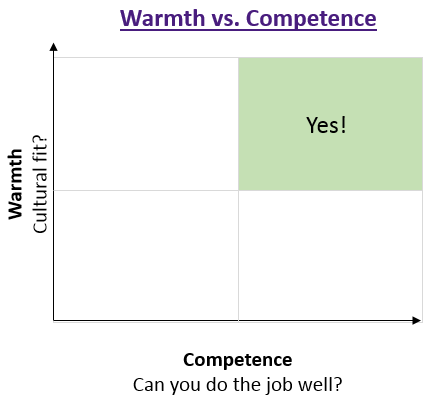
So, how do we break this down when it comes to preparation? I think it comes down to 4 key questions –
i. Why industry?
If you are switching within your industry, you can skip this and move on. This becomes more important depending on how radical a switch you are attempting to make. The goal of this section is to dig deeper than the usual “I am very passionate about X” to find if your passion has translated to any real action. For example, do you understand how things really work in your industry? Do you have a point of view on trends? Do you keep up with what is going on?
If I had just 3 days to prepare for an interview, I wouldn’t focus on this. This is typically what differentiates a very good candidate from a stand out candidate. But, assuming you have longer to prepare, I think there are a few tried-and-tested ways to get good. I am going to use technology as the example as I made that switch. And, here are the 4 steps I would suggest –
1. Configure your information diet. Subscribe to technology news, good blogs and analysis. In my case, I subscribe to Venture Beat for news, to Benedict Evans and Ben Thompson’s Stratechery (paid) for analysis, and to a collection of venture capitalist blogs. All of this means I have a good sense of what is going on.
2. Do a think week and write down your thesis. My single best tactic for getting smart on an industry is to take a few days (i.e. “think week”) where you aim to read a ton of material and synthesize what you are learning. In my case, I queued up a year of posts from Ben Evans and Ben Thompson. I then read, took notes, and read some more. A couple of days in, I had a lot of notes and a point of view on multiple topics would emerge. Then, I put together massive essay. I did this during winter break during both my years in school (2015, 2014). I think I took about 3 days to put this together. It is among the best investments I have made in understanding my industry.
3. Read good books. For those interested in technology for example, 2 books that I’d strongly recommend are The Innovators by Walter Isaacson (a nicely compiled history of technology) and “The Inevitable” by Kevin Kelly (a preview into the future). They’ll give you a solid ground of what has happened so far and what might happen.
4. Share this learning. In both my years of graduate school, I gave an hour’s presentation about Tech trends that involved compiling all this learning. It was a very useful experience. You can choose to create a learning group with folks who share similar interests. Either way, take the time to synthesize and share.
This is an investment that matters less for the interview but is worth a ton once you get on the job. Also, it is my belief that good interviewers will test this to make sure you have a point of view. But, then again, not everyone does.
ii. Why company?
This is critical. There are 2 things that are typically tested –
1. The “hard stuff” – business model, numbers, competitors, etc:
Must dos to help get on top of this are
1. Investor filings. Read the latest 10k and 10Q documents and understand the basics about the company – key strategic priorities, revenue and profit numbers. Make sure you understand how the company makes money, what the big revenue and cost drivers are. Investor presentations and analyst call transcripts help a ton too.
2. News. Do a quick Google News search to make sure you know what is going on with the company.
3. Analyst report or internal view. If you have access to an analyst report on the company, reading that is highly recommended as you get a great view on the future growth prospects of the company. If you are unable to do that, it is worth looking for someone on the inside to understand the internal view on growth prospects, key competitors, etc.
Optional – Industry reports. Reports from places like Forrester, Gartner, etc., can be useful. But, they aren’t a “must do” in my book.
2. The “soft stuff” – vision, mission, culture, values:
1. Website and HR presentations. Read the website and any presentations or videos from HR. Understand the vision, mission, values, cultural tenets, etc.
2. Speak to people who either work there or have worked there. There is nothing like the insider’s view on this. You realize that some values or cultural tenets are more important than the others. You learn what the culture is really like. All this is very important information.
So, how do you put all this together? I think there is the heavy version and the light version.
a) The heavy version. I liked putting together a snapshot for the companies I was very serious about. Here is an example snapshot created in preparation for my interviews at LinkedIn from 2 years ago. On the back, I used to have notes about my interviewers and other insights I’d gleaned from speaking with people at LinkedIn.
2. The light version. Just keep a document or One Note file where you are consistently synthesizing what you learn. The most important thing is to feel comfortable about your own preparation.
If there’s ever a principle with prep, it is to not just take notes. Synthesis is key.
iii. Why role?
This is probably the most important of the 4 questions and is typically the area where interviews are won or lost. This assumes you are switching into a new function. If you know exactly what you are getting into, great. You can skip this.
There are 2 kinds of questions you should be prepared for –
a) The executive question – This involves demonstrating an understanding of the big picture in your role or function. These are typically discussion questions that are around the theme of – “What is the Global Head of your team worrying about?”
b) The role question – This involves demonstrating an understanding of what it takes to do the job well. This varies from role-to-role but the typical format is to go through a “case” question or a simulation of sorts. For sales role, this might involve a role play. For engineering roles, this might involve writing some code for a typical problem. And, for most other roles, it would involve working through a business case. For example, a case for a marketing role might be – “What is your favorite product and how would you analyze its marketing?” This type of question is guaranteed – and likely will be asked by multiple interviewers. And, a key step to preparing for these is to really understand what a day in your role at x company really means.
To understand how to tackle these questions, we need to go back to first principles. The 3 requisites to answering any question in an interview is –
1. Content. You should know what you are talking about
2. Structure. You should be able to frame it in a way that is easy to understand
3. Delivery. You will hopefully enjoy the process of solving these problems
The biggest challenge here is structure. So, let’s tackle that. There are 2 steps to developing an ability to structure problems –
i) Understand simple frameworks that help solve problems in your role. For example, most Marketing problems are contained if you understand how marketing plans are built – understand business objective, then marketing objective, then segment-> target -> position and then execute by focusing on product, price, place and promotion. Then, evaluate.
Strategy problems typically fall into 3 categories – decisions (cost/benefit analysis of both quantitative and qualitative criteria), profitability (break down into revenues, costs and their components) and market sizing (typically by triangulating using a “top down” approach, a “bottom up” approach and a quick gut check).
Product problems, similarly, involve analyzing products within the product management process which is some version of – Problem -> User -> Performance -> Prioritization -> Execution.
Depending on your function, there are plenty of great books that will help with the process.
2. Develop your own frameworks. As you work through problems, you will be able to improvize, simplify and develop your own frameworks. That’s a key part of the process. Telling an interviewer – “I am going to use the 4Ps” – is rather lame. :)
IV. Why You?
And, now, the final piece. This is tested by asking you all sorts of behavioral questions that ask you about how you behaved in various situations.
I have a detailed post about preparing for behavioral interviews – so I won’t spend as much time on this. Instead, I’ll focus on the overall strategy.
1. Use the “Tell me about yourself / Walk me through your resume” question to set the tone. This is an important question and one that is typically asked at the start of most behavioral interviews. Once you’ve taken the time to write down all your key stories and answered the “why’ questions, a clear pattern on your main themes should emerge.
I am a big fan of thinking about the one thing you’d want the interviewer to remember about you. Then, think about three things. Structure your “Tell me about yourself” around these 3 things rather than a simple chronological order. This question is important because you can already lead in to the why company/role questions if done well. Really take the time to get this right – the final product needs to be succinct and it definitely needs to reflect YOU. Practice and feedback goes a long way with this question.
A successful tell me about yourself question would tell me –
a) 3 things I must know about you or your themes
b) Why you made the career transitions you made
c) why you think you’d be a fit for this company and role
d) the stories i should probe you more for..
2. Match your themes with what the role requires. Read the role description, understand what it is really about and ensuring you are highlighting how you fit. A bonus would be to make sure your stories emphasize the key values and cultural tenets of the company in question. The goal is to not necessarily have a story for every value.. but to at least have a few strong matches or things that resonate.
The Day
We all have our preferred “match day” routines. I tried to do 3 things –
1. Have a pre-interview routine. This involved lots of rest, good food and a couple of peppy songs before the interview.
2. Thank the interviewer and recruiter after the interview.
3. Debrief with yourself. Take notes on what you thought about your performance and what you learnt. This is likely not the last interview you will do.
Whew, this was a #long-read. And, it definitely sounds like (and is) a lot of work.
But, it is fitting. The job search process is hard. There’s a ton of luck involved in the process and you can’t control for that. The only thing you can do is to make sure your process was solid and that you did everything possible to be the best you could be. In the long run, good results follow good processes.
Regardless of how things turn out, the final step would be to say thank you to everyone who helped you along the way.
And, of course, as someone once wisely told me, all it takes is for one to work out.
I hope this helps. And, may the force be with you!

 A Learning a Day