Speed, velocity, tasks, and priorities

The difference between speed and velocity is a great parallel for the distinction between activity and productivity. Speed, like activity, concerns itself with movement. Velocity and productivity, on the other hand, care both about movement and direction. Velocity is moving toward an objective – speed isn’t.

Thanks Shane, from The Farnam Street Blog, for the visual

An easy trick to identify whether we’re moving at speed or at velocity is to ask if we’re task focused or priority focused. A task focus entails working our way down a task list (this can be an actual task list or take its more popular form – an email inbox). These task lists are never ending as it is easy for others to add to it. There is also never a lack of urgent things to be done and being task focused means walking out at the end of day feeling dissatisfied despite having been busy throughout.

A priority list, on the other hand, defines the 1-3 most important things you’d like to get done by the end of the day. This flows from a top 1-3 priority list for the week and contains the most important things you’d like to get done for the week to be successful.

Convert speed to velocity. It is only a worthwhile hustle if it counts toward something that moves the needle.

Managing perception and leading with it

“Perception becomes reality” – is one of the marketing’s cardinal principles. Taken to its extreme, it could mean working away at improving our perception, i.e. “our brand,” at the expense of everything else. In this race to improve perception, it is easy to forget that…

… companies renowned for good customer service start by providing great customer service.
… we get better at leadership by caring more about people, processes, and results than the next person.
… a person’s network is directly proportional to a person’s net worth – valued either by money or by character – sometimes both.
… and so on.

Perception undoubtedly matters. But, building a brand on perception is akin to vaporware. A select few manage to use the fuel from vaporware to build great products. Most don’t.

The most reliable way to build brands – organizational and personal – is by actually doing/building good things that create value and/or impact people in positive ways. Once you work on improving reality, it is critical to manage perception.

But, beware leading with it.

How we were sold tobacco, bacon and the ideal of thin women

Edward Bernays is one of the most influential persons in the 20th century. He is considered the father of “Public Relations” and changed how we think of mass marketing and advertising at scale. And, yet, it is likely you’ve never heard of him.

Despite his enduring impact on the world, there are many reasons for this lack of popularity. However, chief among them is a reluctance among the folks in his industry to talk about his work. So, you don’t hear Marketing professors or advertising executives mention him or his work. Not doing so denies some fascinating lessons that might shape how we think about the attention economy.

Edward Bernays and Propaganda
Edward Bernays was an Austrian American whose family moved to the United States in the 1890s. He spent the early part of his career as a Medical Editor and Press Agent. In both these roles, he showcased an ability to take strong positions on certain causes and successfully solicit support from the public — among them elite figures like the Rockefellers and the Roosevelts.

After the US entered World War I, he was recruited by the US Government’s “Commission on Public Information” to build support for the war domestically. Since a large portion of Americans had just fled Europe, this didn’t make much sense. But, Bernays coined a phrase — “Make the World Safe for Democracy” that became the meme President Woodrow Wilson needed. It gave the senseless war a higher purpose. And, Bernays began referring to his work as “psychological warfare.”

Bernays also added significant artillery to his propoganda techniques. He did this by incorporating the lessons from a then-infamous psychologist uncle who’d published work about how individuals are driven by unconscious needs, desires, and fears. Sigmund Freud, until then, was a relative unknown as he had been scorned by European society. But, his nephew, Edward Bernays, made him and his work famous in the United States and ensured he attained fame and prestige. Bernays applied his uncle’s insights to great effect by manipulating public opinion through mass media. As he became the world’s foremost expert in propaganda, he realized it was as powerful a tool in peacetime as it was during war.

So, after the war, he moved to New York and decided to counsel companies in propoganda. However, since the word propoganda was controversial and since its alternate “advertising” was too mundane, he decided to rename it “Public Relations.”

Why tobacco and bacon are great for you
Sadly, Bernays’ counsel was sold to anyone who cared to pay him well for it. And, chief among his clients were the tobacco companies and the pork industry. In his work with them, he demonstrated his skills as a master campaign strategist.

For example, he staged the “Torches of Freedom” event during the 1929 Easter Day Parade as a means of conflating smoking and women’s rights. Tens of millions of women threw off their shackles to claim their right to smoke in public.

His media strategy involved persuading women to smoke cigarettes instead of eating. He began by promoting the ideal of thin women by using photographers and artists in newspapers and magazines to promote their “special beauty.” He, then, had medical authorities promote the cigarettes over sweets.

Bernays also pioneered the covert use of third parties. For instance, he conviced a doctor to write to 5,000 physicians asking them to confirm that they’d recommend heavy breakfasts. 4,500 physicians wrote back and agreed. He arranged for these findings to be published in every newspaper across the country while stating that “bacon and eggs should be a central part of breakfast.” Sales of bacon went up.


The Engineering of Consent
Bernays called his brand of mass manipulation the “engineering of consent.” He worked with every major political power during his day to help provide the tools to non-coercive control of the mind. In 1928, he crystallized some of his lessons in his book “Propoganda.” Here’s a passage that describes his thought process about the importance of his work in society —

“The conscious and intelligent manipulation of the organized habits and opinions of the masses is an important element in democratic society. Those who manipulate this unseen mechanism of society constitute an invisible government which is the true ruling power of our country. …We are governed, our minds are molded, our tastes formed, our ideas suggested, largely by men we have never heard of. This is a logical result of the way in which our democratic society is organized. Vast numbers of human beings must cooperate in this manner if they are to live together as a smoothly functioning society. …In almost every act of our daily lives, whether in the sphere of politics or business, in our social conduct or our ethical thinking, we are dominated by the relatively small number of persons…who understand the mental processes and social patterns of the masses. It is they who pull the wires which control the public mind.”

Enid Blyton and Bernay’s popularity
When I was growing up in India, books from “Enid Blyton” (a British children’s authors) were recommended reading for all kids. I was a huge Enid Blyton fan myself. One of the enduring memories I have of her storytelling is her focus on food and her insistence — via various characters in the book — that “bacon and eggs was the best breakfast in the world.” As I grew up and learnt more about bacon, I couldn’t understand why she said that.

Now I do.

Edward Bernays held the masses in contempt. That’s why we don’t know much about Bernays. He simply didn’t care about popularity in the eyes of those who he held in contempt. As is evident from the Enid Blyton story, the impact of his techniques on society are undeniable. Every marketing and PR campaign since has used his techniques to shape our minds. We study his work in every case on mass marketing — without ever referring to him.

The incredible jump in the proportion of British workers who voted “leave” in the 2 months before the EU referendum would not have been possible if it wasn’t for Bernays techniques.


3 notes to ponder 

(1) Many column inches in the past year have been devoted to the role ads and social media have played in the tumultous political climate in the past couple of years. Here’s what scares me — a large proportion of the population is responding by consuming and discussing events on private messaging tools like Whatsapp. The Reuters Insititute confirms this trend among younger Americans. If you think polarized social news feeds can be propoganda carriers, you haven’t experienced the power of Whatsapp in spreading lies (see this and this).

(2) How would we go about learning marketing and public relations if we studied the life and work of Edward Bernays? I understand why professors and executives don’t want to talk about Bernays. Discussing his beliefs and techniques can seem akin to touting the power of the dark arts. But, every useful tool has its dark sides. And, the founding story of the PR industry is a great example of that. It is not an example we should avoid. Instead, it is a story we must learn from. It’ll make us all better marketers and, perhaps, better human beings.

(3) I was one among many who was surprised by the size of the impact of social media tools on the global politics. In retrospect, there were many warning signs. But, hindsight is always 20:20. That said, I don’t think I’d have been anywhere as surprised if I’d read the Edward Bernays story. The story of the propoganda maestro from a hundred years ago, it turns out, is very relevant today.

History doesn’t repeat itself — but it rhymes. It is why any attempt to understand the present and predict the future is futile if it isn’t preceded by an understanding of history.


Links for additional reading

The World Cup

I’m not watching the world cup yet. But, I am enjoying following it and I look forward to catching a few of the games toward the end. There have already been exciting moments, upsets, and fascinating stories. For example, defending champions Germany just prevented elimination after their second game witha goal in the 5th minute of extra time. There are going to be many more such moments.

But, it isn’t just the thrills and spills that makes the world cup special. The magic of the world cup lies in its ability to capture our collective imaginations and remind us that, despite the many obvious differences between all of us on display, we can collectively enjoy twenty two strangers trying to kick a ball into a net.

It is absurd. It is human. It is fun.

Lord knows we need more of that…

Hacking shopping – and productivity

The best way to save money while shopping doesn’t involve scouring every coupon deal available and then using all or most of them. It doesn’t matter how efficient we are in the coupon use process. It just turns out that the best way to save money while shopping is to buy the few things that we actually need.

Productivity isn’t any different. The most powerful productivity hack we have at our disposal is the choice to be thoughtful and clear about what we decide to spend our time on. Hacking things we shouldn’t be doing isn’t helpful.

Or, as Peter Drucker masterfully put it –“There is nothing so useless as doing efficiently that which should not be done at all.” 

Choosing what we do is a more important decision than how we do it. Effectiveness > Efficiency.

Removing stress and worry

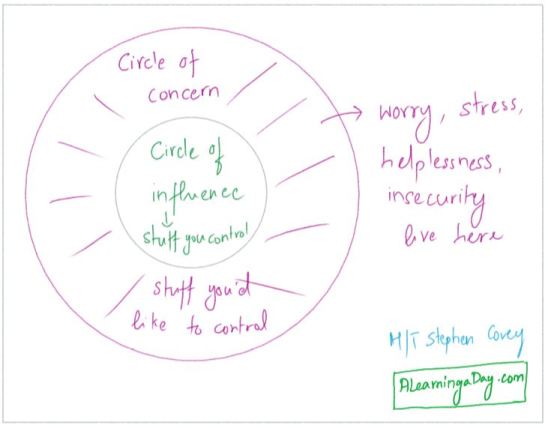
The best strategy we have on our hands to remove stress and worry from our lives is to have a near ridiculous obsession with focusing on what we control.

While removing worry, stress, helplessness, insecurity, and the like is pretty wonderful, the circle of influence has another incredible feature. It expands proportional to the time we spend within it.

Abraham Wald

As Allied Planes in World War II were being shot down at a devastating rate,  the US Air Force wanted to reinforce the planes with armor. However, every pound of extra armor took away the attack capacity of the planes. The person tasked with solving the problem was Abraham Wald, a Romanian Jew who’d fled the Nazis to become a Professor at Columbia University. He was recruited in the US Army efforts in World War II as part of the Statistical Research Group.

The Air Force supplied Wald with the data available – number of bullet holes grouped by their location on all the planes that returned to base. Most bullets were around the tail gunner and the wings. So, the army suggested reinforcing these regions with armor.

In what has become a legendary piece of analysis, Wald disagreed. He noted that the fact that the planes had survived despite these injuries suggested these areas needed no reinforcement. All the other planes had likely been struck elsewhere – the engine and the cockpit for example. Those were the areas that needed to be armored.

Wald gave us survivorship bias. In simpler words, he reminded us to look for insight by being very mindful of the data that isn’t in the room. And, as I think of a recent error that rose from jumping to a conclusion with available data, I realize I must spend more time channeling Abraham Wald.

Stepping out of the frame

Author Salman Rushdie once quipped – “The only people who see the whole picture are the ones who step out of the frame.”

Our ability to step out of ourselves and observe ourselves from the wall or ceiling is core to our ability to be human. That ability to see ourselves from another point of view gives us instant perspective and the ability to separate stimulus from response.

The question, then, is how often do we step out of the frame in the course of a day or week? How often do we trigger reflection and perspective? For most of us, sleep, meditation, a walk in the outdoors, writing in a journal, taking deep breaths, running, among others, are ways to do so.

Doing most or all of these well over the course of a day aren’t an optional add on at the end of a work day. They result in step changes in productivity as perspective inspires a focus on what actually matters.

And, perhaps more important for our life and relationships, they enable us to be more in touch with our humanity.

Macro patience, micro speed

“Macro patience, micro speed,” “Strategically patient, tactically impatient,” “Impatience with actions, patience with outcomes,” are variants of the same powerful idea expressed in different ways.

They run counter to how organizations and people operate. Most folks, for example, set ambitious 1, 3, or 5 year goals that involve promotions and net worth targets. But, they don’t focus on maximizing their productivity in the here and now. Or, they expect to have a flourishing family in 5 years but don’t take the time to invest in their relationships in the present. Organizations repeat the same pattern with ambitious five year goals but questionable quarterly planning.

Hence, these maxims that are equally applicable to building an organization for the long term (think: Amazon) and our own careers. Take the time to orient around a longer term direction built on principles / things that will not change. Resolve to be very patient over the next 10-20 years as you move toward that direction.

And, then, execute with speed and impatience to maximize your learn rate in the short term. Waste little time, experiment a lot, reflect, and learn fast.

We don’t have much control over our journey in the next 20 years. But, we can choose to be all over the next 7 days.

In the long run, how we approach these weeks is all that matters.

(H/T: Gary Vee, Jeff Bezos)

3 steps to making that big career transition

When we make career transitions, we typically change one or more of the following – (1) Company, (2) Role, (3) Industry, and (4) Location. These are ordered in ascending order of difficulty with changes in location – for the majority of the folks on the planet who do not possess rich country passports – being the hardest by a distance. Most importantly, combining these factors does not simply mean adding up the difficulty – the change gets exponentially harder.

Thus, career transitions can be very hard to make. While there is something be said about experimenting in the early stages of our careers, there are benefits to being in the right (for you) location, industry, and role early. Career transitions are also hard because they require dealing with all the feelings of insecurity and inadequacy that accompanies job hunting. This is heightened if you are an immigrant as you are doing it with the weight of uncertainty about how your change will work given your immigration status.

The result, for many folks, is multiple cold inMails and connection requests to folks they find on LinkedIn searches to ask for referrals or mentorship. This is understandable. Attempting to make a career transition is stressful and any help is appreciated. Sadly, cold inMails to strangers turns out to be the least effective approach.

Over the past five years, I’ve been fortunate to make a transition that involved changing all 4 factors. As with most things, it took a combination of intention, work, dumb luck, and accumulated privilege. We’re still working through visa challenges – so the location change is far from final. Nevertheless, I thought I’d share a 3 step approach toward making big career transitions. To ensure broad relevance, I’ve focused on the key principles while also adding color based on my experiences.

(1) Construct plans A-F: The first and most important assumption I’ll make is that you know exactly what you want to do (if you don’t, please see the resources section below). Once you do so, construct plans A-F. This means having at least 6 routes to the destination. I think the word “destination” is particularly applicable if you are trying to make a cross-country switch as it is worth tackling that head on.

I say plans A-F because it is highly unlikely your plan A will work. And, as you cycle through them, it’ll become easier to move past F to other alphabets. :-) For example, I learnt about the Bay Area and tech while working on a student job portal start-up (that eventually failed) through university. That’s when the idea of working in tech in the Bay Area took hold. But, as I mentioned above, location switches are the hardest kind to make if you don’t have the right passport. In the next 4 years, I cycled through plans A-F before finally finding a graduate school in the US that took a chance on me. (Graduate school is a staple in the immigrant playbook to switch locations)

The next step was to make an company + industry switch – i.e. find a tech company that would take a chance on me – and then a role switch – I’d learned about product management and believed I’d found my functional home. But, how do you get a start when everyone wanted folks with relevant experience?

Below is an image with the 6 questions I’d suggest asking.
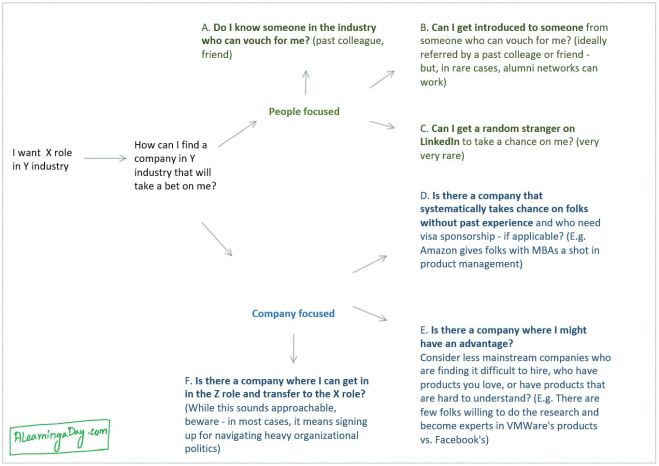
Next, my suggestion would be to build your plans by attacking as many of these options. For example, here’s how I approached it  –
A: Was connected to a role thanks to a past colleague.

B: Was connected to a few folks by the same past colleague (he’s a good samaritan) – one of these folks worked at LinkedIn. Also got a referral into someone from my graduate school alumni network. She helped with an interview call.

C: Didn’t attempt connections with strangers on LinkedIn as I wasn’t sure how I’d do so in a thoughtful manner.

D: I signed up for interviews with most companies that took a shot on MBA students without visa sponsorship for Product Management positions.

E – I thought highly of LinkedIn’s product and the vision and felt I’d fit in well. But, LinkedIn was also very mainstream. So, I was also focused on a company like VMWare that was focused on solving solutions with a high level of technical complexity. I figured thorough prep on server virtualization would be a competitive advantage – since few folks would actually do it.

F – I ended up betting on an internal transfer to move into Product Management at LinkedIn. These sorts of transfers are painful in most places. So, this wouldn’t have been my dominant strategy had it not been for an intersection with an opportunity to work with someone I liked and respected, a company whose mission resonated deeply and because of immigration considerations.

All in all, once I’d managed the location move, I attempted all options except emailing a random stranger because the chances of that working are minimal at best. If you are keeping count, I was well into plans M and N by this point.

(2) Understand base rates, preferred demographics and stereotypes: This step is designed to accomplish two objectives – i) Add a dose of realism to your search, and ii) Aide your preparation for an interview which you hopefully will land.

Step (1) was all about mapping your path to what you believe is a dream role. However, it helps to get a sense of the odds. Here, there are 3 questions that might help –
A. Base rates: Are there folks “like you” (similar education, work experiences) who are in those roles in companies you want to be?
B. Preferred demographics: Are you in the demographic that companies are hiring for right now?
C. Stereotype: Do you fit the stereotype that recruiters/hiring managers love?

I understand these may sound like controversial sounding questions. But, just because no one likes talking about them doesn’t mean they aren’t a key part of the hiring process.

In my case, the base rates were encouraging. There were folks with similar education, experiences in roles in tech. However, I wasn’t doing good on B. No one was jumping out of bed excited to add another Indian guy who needed visa sponsorship – which was getting more and more problematic – to their team. And, my stereotype was a mixed bag. The consultant + MBA combination was appreciated by some and despised by some. Now, you might say – “Hey, but what I did in the past doesn’t/shouldn’t define me.” Yes, it shouldn’t. But, given our human need to make quick decisions and label people, it does. So, we might as well learn to overcome it.

While you can’t do much about base rates and preferred demographics, it is important to note that you can do something about stereotypes – especially if you don’t believe you are the typical specimen. – by working on your story in your interviews. I didn’t think I was. I also had spent 3 years in a start-up and worked on plenty of side projects. I hoped to weave that into my story.

I had 2 key takeaways from my own inventory check –
1) This change was possible but was not going to be easy as the field was very competitive.
2) I’d have to find a way to make any interview calls I receive really count. I didn’t have experiences at a big name brand pre-graduate school. This generally means fewer interview shots since fewer folks are willing to take a chance on you. That, in turn, meant I needed to over index on interview readiness as I’d need to have a higher conversion rate.

(3) Take a really long term view. Do you care enough about your career switch to work on it for 5 years? If you do, that is good news. Here are 3 reasons why a long time horizon helps –

1) You will learn and grow through the process of attempting to make a switch. All these experiences will make you a better candidate – if you are willing to persist.

2) It is easier to change fewer variables at a time. For example, a change of location and role or location and industry are easier switches than attempting to change company, industry, role and location. This is particularly the case if you are immigrant – getting your location via visa sponsorship will likely be your dominant strategy.

3) You will have the time to convert random strangers and acquaintances to friends and well wishers. This is really really important. A big part of making transitions is building a network of relationships who will support you through it. And, it is very hard to build this network if you want immediate results. You can’t plant trees the day you want fruits.

I have a couple of stories to make my point. In my case, one of my failed early plans to move involved a final round interview that didn’t go well. However, I stayed in touch with the friend of a friend I’d mentioned above. We ended up meeting in person a couple of times and, thanks in no small part to the help I received, I ended up working on their team a full two years after we connected. Second time lucky.

Another related story – I was connected to someone by an acquaintance. This person stayed in touch via my blog with email exchanges over three years. That led to an in person meeting, then another one, and then a few calls. A full four years later, I was thrilled to help this person find a role where I work.

I could share a few more such stories to continue hammering this point home. But, I’ll stop. The key takeaway – our career journeys are long and full of surprising and random twists and turns. You never really know who will open a door for you some day in the future and you definitely don’t know if a good/bad day is so. It is futile to connect dots forward. So, a better approach is to make commitments on directional plans in the long term, be kind and thoughtful, and keep plugging away.

If this post is reaching you in the midst of a tough time, I’m sorry to hear that. It is surprisingly common on such journeys as the odds are always stacked against you. But, I’ve come to believe that the arc of success and opportunity bends toward merit in the long run. It helps to approach the whole journey as a mixture of scientist and student. Start with hypotheses, run experiments, test, learn, and iterate.

As the wonderful saying goes – “Things work out fine in the end. If it’s not fine, it is not the end.”

I hope this is helpful. Wishing you all the best on your journey.


Additional resources: Here are 5 resources that might help.

(1) The 3 phases of a job search process: This is a companion long read that dives into the details of the job search – figuring out where to apply, getting interviews, and doing well:

(2) 3 principles of asking for favors

(3) How to ask for help from people you don’t know and related – Ask advice better by replacing the generic question with a hypothesis

(4) How to ask for a cold call

(5) The 3 laws of privilege: Slightly off topic – but important. :-)