Optimizing roadmaps for breadth vs. depth – Peacetime and Wartime

In talking about successful leadership styles, venture Capitalist Ben Horowitz makes the distinction between peacetime leaders and wartime leaders. He explains the distinction as follows –

In peacetime, leaders must maximize and broaden the current opportunity. As a result, peacetime leaders employ techniques to encourage broad-based creativity and contribution across a diverse set of possible objectives. In wartime, by contrast, the company typically has a single bullet in the chamber and must, at all costs, hit the target. The company’s survival in wartime depends upon strict adherence and alignment to the mission. 

I’ve found the analogy of peacetime vs. wartime to be very useful in thinking about how we think about optimizing our product roadmaps and focus at work.

When everything we work on is looking healthy and growing, optimizing for breadth makes a lot of sense. We can take on a couple of venture bets and keep a portfolio of projects humming along.

But, when the weather changes and we find issues with one of our core projects, we must, just as quickly, be ready to hunker down and focus. That’s the time to shelve any extraneous work and focus on the pieces we know will drive impact – at the expense of others if necessary.

Effective leadership of organizations/teams/products/self involves understanding when to optimize for breadth vs. depth. And, the peacetime-wartime analogy is a great way to put the current situation in context and tailor our response.

Jim Loehr on Stress and intervals

Jim Loehr is a performance psychologist and author who has worked with some of the world’s top athletes. Loehr’s philosophy is that one’s success is proportional to the strength of one’s character. And, he believes that character strength can be built the same way we build strength in our muscles – a powerful idea. In Tim Ferriss’ book “Tribe of Mentors,” Loehr says the following about stress –

“Another piece of bad advice: “Protect yourself from stress and your life will be better.” Protection from stress serves only to erode my capacity [to handle it]. Stress exposure is the stimulus for all growth, and growth actually occurs during episodes of recovery. Avoiding stress, I have learned, will never provide the capacity that life demands of me. For me, balancing episodes of stress with equivalent doses of recovery is the answer. Playing tennis, working out, meditation, and journaling provide rich mental and emotional recovery. Adhering to my optimal sleep, nutritional, and exercise routines during stressful times is critical. Seeking stress in one dimension of my life surprisingly brings recovery in another. Avoiding stress simply takes me out of the game and makes me weaker. In a real sense, to grow in life, I must be a seeker of stress.”

His notes on stress and recovery resonated deeply. As stress tends to have a negative connotation, I use the word “stretch” instead and have come to observe that intervals between stretch and recovery are a wonderful combination for growth.

TLDR: Be intentional about what you are looking to learn, seek challenges and work intensely when you are working. Then, switch off completely to reflect and recharge when you are not.

At least it won’t be for a lack of

Despite our best efforts, there is no guarantee results will go our way. But, focusing on process and letting go of the results is generally easier in theory than practice.

A practice I’ve found helpful is to commit to what I expect from myself as part of doing my best. And, the phrase that helps me make that commitment is “At least it won’t be for a lack of…”

For example, I approach most difficult situations with – “At least it won’t be for a lack of positivity, thoughtfulness, and a focus on learning.” Or, as a parent, “At least it won’t be for a lack of thought, kisses, and dancing.”

Framing it in this manner takes a lot of the pressure off the inevitable mistakes. It helps define simple cultural norms that in turn define how we approach what we do – i.e. our process. As long as we are thoughtful and learning focused, it will only take a while before our process becomes a good process.

And, in the long run, good results follow good processes.

What we want to do vs. who we want to be

Most early career advice revolves around finding what we want to do. While picking that mix of industry and function is important, it matters that we also invest in understanding who we want to be.

We may occasionally find a role that is perfect for us at a given period of time. But, if we don’t do the work to understand our motives, values, and long term life priorities, it gets harder to make the sort of career decisions that help us shape both our careers and our lives.

Work is an important part of our lives – but, for most folks, it isn’t life. So, fitting life decisions based on career choices instead of the opposite is an approach that has it backwards. Anyone who has tried it knows that any success you experience will feel incomplete. And, the most predictable outcome of this approach is burn-out at work and unhappiness at home.

This isn’t an either-or choice. We can’t have who we want to be figured out when we are 21 and then start on a career that is a perfect fit. Instead, it is a constant, iterative, process that we need to invest in parallel. With intentional investment, thought, and time, these paths will begin to converge.

And, when it does, the juice will feel well worth the squeeze.

Good fences

In “Skin in the Game,” Nassim Taleb spends time on the Robert Frost quote – “Good fences make good neighbors.”  He makes the point that it is easier for people to like each other as neighbors than roommates.

Thus, interventionists who keep trying to get people to not act sectarian are sure to fail because being sectarian is in our nature. Instead, we’re better off using these sectarian tendencies to keep groups as they are and, instead, design systems that encourage us to work with each other.

Powerful.

Working in our job vs. working on our job

We spend a majority of our days working in our job. This involves doing what we are, at least on the surface, hired to do. For many of us who have the privilege to work in offices, it is some mix of problem finding and problem solving, bringing people together to solve those problems, and selling – lots of selling.

Working on our jobs, on the other hand, is all about taking the time to get direction right. Are we investing in the right products? Are we developing the right skills to operate in our workplaces, build and sell these products? Are we set up to work on the stuff that matters? Are we building the relationships that help us working “in” our job better? Are we making directional progress in our careers?

Working in our jobs vs. working on our jobs is analogous to efficiency vs. effectiveness and managing vs. leading. Our natural bias tends to favor a focus on activity, busy-ness, and efficiency. That’s why it matters that we force ourselves to carve out time every week to ask ourselves the effectiveness questions.

As Peter Drucker wisely reminded us, there is nothing as useless as doing efficiently that which should not be done at all.

Worrying about what we should say or said

It is natural to worry about what we should say or should have said. We have been conditioned to improve our presentation style, be assertive, add value in conversation, etc. So, it is natural to want to over prepare and try to do it right.

Except – it is impossible to do it right all the time. We say a lot during the course of a day and there is no end to worrying about whether we said the right things.

A better approach might be to shift this focus from our words to our actions. Many talk, few do. And, more often than not, our actions speak louder and clearer than the words we speak. The colleague who follows up to your request when she didn’t need to and the manager who didn’t make any changes to your role despite your unhappiness said plenty without saying a single word.

In the long run, we are, on average, better off spending our energies on being better doers than we are better talkers.

PS: The best part about this approach is that the focus on doing makes us much better speakers with relatively minimal effort by simply taking all the pressure of the speaking.

Love the Plateau

The late swimming coach Terry Laughlin had a powerful note on the plateau as he summarized his lessons learnt from George Leonard’s book on Mastery.

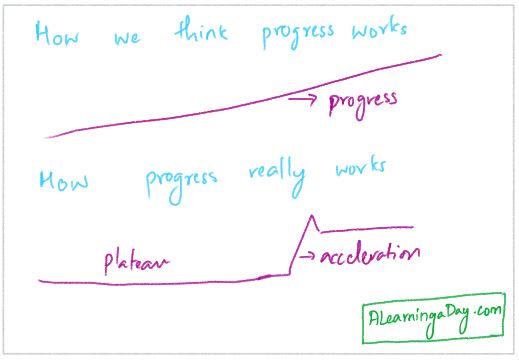
“Love the Plateau. All worthwhile progress occurs through brief, thrilling leaps forward followed by long stretches during which you feel you’re going nowhere. Though it seems as if you’re making no progress, learning continues at the cellular level. If you follow good practice principles, you are turning new behaviors into habits.”

Progress is lumpy. We experience short periods of acceleration when we go through an intense experience, crystallize important learning, or, every once a while, experience a good outcome. But, between these periods of acceleration, we go through long periods of time (i.e. the plateau) when we’re just working away in relative silence.

Channeling Terry Laughlin, keep working away purposefully. Love the plateau – love is a verb.

Managing expenses on Google Spreadsheets – follow up

I wrote about managing expenses on Google spreadsheets earlier this week and offered to share a template. I was admittedly blown away at the response. Unlike other posts where I tend to hear from a few folks I’ve come to know well, long time readers sprang out of nowhere asking about the template (read: it was a delight meeting you all). It is no wonder good blogs on personal finance build up large and engaging readerships. Anyway, I digress.

As promised to those of you wrote in, please find the template here. You should just be able to download the Google sheet as an excel file on your computer or copy the Google sheet. Below are a few notes that might help.

First, I’ve added a few notes on the Google sheet to make the flow of sheets intelligible. The main principle at play is consciousness. We consciously enter every expense on the sheet using the “Sheets” app by Google. We also ensure we track all our subscriptions in one place so we’re being intentional about shutting subscriptions we don’t use. The yearly math sheet just ensures we have a macro view of what’s going on.

Second, we don’t use a budget anymore. The 2012 version had budgets – but, we shelved them a few years back. We realized that we don’t make frivolous spending decisions if we’re conscious about our expenses. So, we didn’t see benefit of the overhead involved with setting and maintaining a budget. That doesn’t mean we haven’t made dumb or and the occasional expense we’ve regretted. But, thanks to this sheet, we discuss it and aim to learn from it. Our biggest lesson from these reflections is to simply pause 24 hours before making a large expense.

Third, while there’s a tab for investments, we don’t use this sheet to manage it. We are fans of the app “Personal Capital” and use the free version to get an overview of how things are going. An important complementary document is a living document called the “Finance Thesis Sheet” that I’ve written about before. I’d co-created a “learnographic” a few years back that synthesizes lessons learnt on personal finance and investing – those principles, for the most part, inform our approach to investments.

Fourth, the paycheck sheet is a very lightweight version of the finance thesis sheet. We’ve tried to maintain conscious boundaries about how we think about our money. The key here is to assume we earn far less than we do, not increase our expenses as our income increases, and to make sure most money goes to longer term investment accounts.

Fifth, as you can tell, this is all (relatively) low tech. We’ve been recommended many fancier apps from time to time. But, the key feature of all these apps is that they do the work for us. And, that’s a problem where we’re concerned. We spend a few mins every week going through our accounts, talk about any anomalies, and look at trends annually to see how we’re doing. Doing the work to understand how we’re spending our money is a feature for us – not a bug.

Hope you find this useful. Look forward to hearing your notes and lessons learnt.