Hopes and dreams – realized

Every once a while, it is worth taking stock of all the aspects of our lives that were hopes and dreams a few years back. These may be the little things – owning this or that, going for a vacation here or there – or the big things – how much we’ve learnt and grown, what we get to do everyday, the place we call home, where we work, our family.

There are always three things I find fascinating about this exercise.

First, the longer our look back window, the more we’re likely to find transformation. It is quite amazing how much we can get done in a decade.

Second, the more time passes, the faster we take realized hopes and dreams for granted. That is a shame because a hope or a dream taken for granted is a hope or a dream wasted. Happiness follows gratitude and not the other way around.

And, finally, the more we take stock of these, the more mindful we become of the strokes of luck we’ve had thanks to the privilege we’ve accumulated. With great privilege should come great responsibility and humility – so, here’s to more of that and here’s to using it well.

Wrong lessons from the Marshmellow test?

For decades, the marshmellow test occupied the popular imagination in demonstrating the effect of delayed gratification in our lives. The lesson was simple as it was powerful – more willpower = more success in every aspect of our lives.

But, perhaps we got it wrong?

Researchers from the University of Rochester ran a variation of the test with 28 children in 2012 that involved a first step in which half the kids were exposed to an adult who promised to bring them supplies for an activity and didn’t. When this half was exposed to the marshmellow test, they did far worse.

The research hypothesis was that a child’s ability to wait wasn’t just about the amount of willpower they were born with. It was also about how much they trusted the word of the adults who said they’d come back and give them more. Willpower is still important in enabling kids to be successful. But, it is likely more important for kids to grow up in an environment where they trust the adults around them.

While the test was conducted with a a small sample, the conclusion is thought provoking.

The meta learning, one that Nassim Taleb vocally advocates, is to carefully consider the results of the latest and greatest social science experiment. Far too often, factors outside the lab affect the behavior of the subjects in the lab.

The future of automation and work

Michael Osborne, a Professor at Oxford, has a great 45 slide deck on the future of automation and work. Here are a few of the notes I’m thinking about –

“If a typical person can do a task with less than one second of thought, we can probably automate it using AI either now or the near future.” | Andrew Ng

Quantity of available work: Well defined portions of retail, service jobs, accounting, auditing, and logistics – some of the highest employed jobs – are automatable. These jobs involve physical and motor skills. On the other hand, jobs that require more cognitive skills are not. However, it is the former that accounts of high employment numbers.

Quality of available work: So, what about the fact that large sections of the population moved away from challenging, industrial work to become iOS developers, Yoga instructors, and so on? To that, Osborne has a powerful stat – it took ~60 years for the English revolution to improve the life of workers. 

The 60 year stat is powerful and important. On the one hand, it signals the importance of walking into this machine learning driven workplace paradigm with caution. We don’t need sentient AI to disrupt our lives – just take the machine learning techniques available to us today and apply it universally.

Second, there isn’t a reason we won’t be able to find a way forward and adjust to the new reality. The question is – how can we work together to do it faster?

Creating content on the internet – 3 notes to self

1. The world does not need your content. But, if you do want to create it and share it, you should.

2. The chances that your content will make you famous, popular, lead to future jobs, untold opportunities and wealth etc., is low. We pay disproportionate attention to the few for whom it works out – better to assume you won’t hit the lottery.

That said, the chances are high that writing regularly will change your perspective and make you better. On a personal level, discipline in synthesizing and writing is one of those wonderful things that doesn’t seem to pay off for the longest time… until it does.

3. A useful mental model to aide your efforts in building that discipline is to write for two people. Write for yourself and one other person you can picture reading it (hi mom!). Once you internalize this, you won’t fret about optimizing every post, analyzing your followers, etc. An additional happiness tip – if you post on social media, check notifications once a day and never check your blog stats.

This is not to say you won’t look around from time to time and wonder what you need to do to build your “brand.” When you do, however, this mental model will remind you of what actually matters – your long term growth – and bring you back home.

(H/T Hunter Walk and Matt Mullenweg for inspiring #1 and #3)

Developing kindness with awareness

Awareness is the gift of competence. When we become an expert tennis player, we develop heightened awareness of every move on the court. When we’re expert presenters, we observe the subtleties of the room and the audience better than others. And, when we’re good at life, we are intensely aware of reality and our ability to shape it.

But, while we all work hard on developing the increased awareness that comes with competence, we don’t often realize that the increased awareness needs to be accompanied with a bigger capacity for kindness. When we lose that ability to be considerate and generous, we develop a fixed mindset and react to any perceived incompetence with arrogance, annoyance, and frustration.

However, if we err on the side of ensuring we always have more kindness for every ounce of awareness, we develop the ability to help others grow.

Of course, what makes this all very interesting is that this needn’t be viewed with the lens of “others.” Kindness starts within. And, our ability to develop a growth mindset, thus, requires us to learn to be kind to ourselves. When we’re able to be that person for ourselves, we’re able to help ourselves grow while also being that person for others.

That is why it is more important to be kind than clever.

Yelp Review notes

I was looking at Yelp reviews recently for two businesses that are close to my heart.

The first is Earthbaby – a compostable diaper service that we love. They pick up dirty diapers once a week and convert them to compost. Diapers are a massive source of non biodegradable landfill waste and Earthbaby turns this bad outcome into something incredibly positive. It is a great example of a well run small business dedicated to a wonderful cause. If Earthbaby isn’t keen on global expansion, I’m hopeful Earthbaby’s copycats spring up everywhere.

Earthbaby’s Yelp reviews are a testament to how they run their business. Their customer service is superb and it is no surprise that every one of their 131 reviews are 5 star reviews. Yelp represents Earthbaby well.

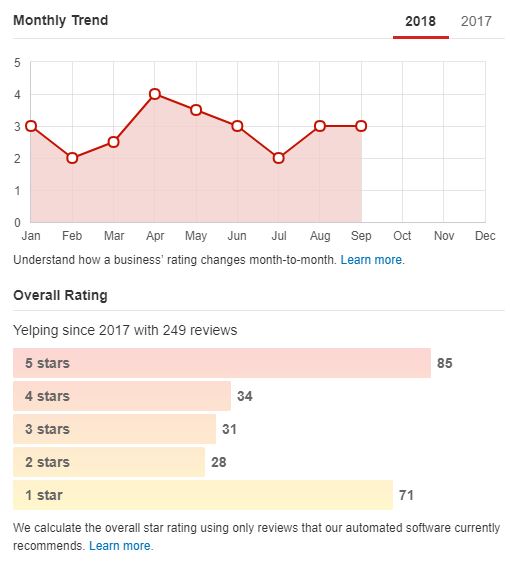
On the other hand, I was looking at one for a South Indian restaurant that I love called “Dindigul Thalappakatti” (the name’s a mouthful). When Indian restaurateurs take their brands abroad, they change their spice levels and flavor. It makes sense to tailor food to the average customer’s palate. However, this restaurant doesn’t. They are un-apologetically spicy and flavorful. They also happen to be more expensive than their competition. But, to folks like me, it is worth paying the price to be reminded of home.

That, then, results in an average rating of 3 stars and a rating distribution that looks like this.

I took away two interesting lessons from looking at these reviews.

First, when building products and business, it is important to be conscious about what kind of product/business you’d like to be. Universal popularity is alluring and can work for some products (e.g. Earthbaby). But, for everyone else, you’ll have to start with clarity around who you are looking to serve/please.

Second, don’t just look at the average rating when evaluating restaurants on Yelp. If everyone rates a restaurant 3 stars, stay away. But, if you see a polarized distribution, read the reviews and see if you’re the sort of person who’d give it five stars. If you are that person, such places turn out to be the hidden gems.

Jim Loehr on Daily Journaling

I shared a note from performance psychologist Jim Loehr on stress and intervals earlier this week from Tim Ferriss’ Tribe of Mentors (a fun read). When asked about a habit in the past 5 years that has most improved his life, he had this to say  –

“The practice of daily journaling has been a remarkable tool in helping me navigate the storms of life and be my best self through it all. The daily ritual of self-reflected writing has produced priceless personal insights in my life.

For me, daily writing heightens my personal awareness in a nearly magical way. I see, feel, and experience things so much more vividly as a consequence of the writing. The hectic pace of life becomes more balanced and manageable when I intentionally set aside time for self-reflection. I am able to be more in the present in everything I do and, for whatever reason, more accepting of my flaws.”

As you can imagine, his notes resonated – deeply.

Wishing you a great weekend.

The 3 laws of effective breaks

The 3 laws of effective breaks –

1. The effectiveness of a break is directly proportional to the presence of natural objects (trees, natural food, even people we like) and inversely proportional to the presence of to man-made objects (laptops, phones, tall buildings).

2. The more effective the break, the more productive the rebound. Put differently, the more we disconnect today, the more productive we’ll be tomorrow.

3. The relationship between work and breaks/rest is best represented by a fractal – they need to work together at every level to be effective. (H/T Dustin Moskovitz)

Uncertainty on Continuations

Albert Wenger, a venture capitalist at Union Square Ventures, authors one of my favorite blogs – Continuations. Yesterday’s post was about a new series on uncertainty –

I intend to write a bit about just how much of our lives is impacted by uncertainty (hint: all of it) despite us largely not acknowledging this reality. Then I plan to look at examples that illustrate how poor our intuitions are when it comes to dealing with uncertainty. With that in place, I will share the answers I have arrived at for myself for how to live with uncertainty.

He goes on to share three examples from his own life that involved major shifts that were far from certain.

I am excited about this series because a version of one of these stories inspired a classic ALearningaDay lesson – “You never know if a good day is a good day.” It has been five or six years since I first heard that idea from Albert and it is still one of those ideas that I think about every few weeks and write about every few months. For someone who struggled to learn how to keep perspective, that story was a game changer.

Repetition is a key part of learning. And, I love thinking about the topics I’m repeatedly re-framing and writing about – those lessons are the ones I clearly want to learn. At some point in the future, I hope to take on a project where I share some of the core principles I end up writing about every day.

One thing is for certain – when I do, the principle inspired by Albert’s story on the inherent uncertainty of our lives that reminds us of keeping things in perspective and plugging away will be key among them.

Discipline equals freedom

Former Navy Seal Jocko Willink has a great note on Discipline = Freedom.


“Discipline equals freedom.” Everyone wants freedom. We want to be physically free and mentally free. We want to be financially free and we want more free time. But where does that freedom come from? How do we get it?

The answer is the opposite of freedom. The answer is discipline.

You want more free time? Follow a more disciplined time-management system.

You want financial freedom? Implement long-term financial discipline in your life.

Do you want to be physically free to move how you want, and to be free from many health issues caused by poor lifestyle choices? Then you have to have the discipline to eat healthy food and consistently work out.

We all want freedom. Discipline is the only way to get it.”


This is one of those powerful insights that often takes time for us to internalize. The idea that a great time management system is what we need to enjoy more free time is one that seems to not make sense until we experience it. And, all happy careers, lives, and relationships take years of disciplined work to make happen and survive.

There is a transitory kind of freedom that comes with shirking discipline and responsibilities. But, if we desire the kind of freedom that stays with us, discipline is our best friend.

(H/T Tribe of Mentors by Tim Ferriss for the Jocko Willink note)