The FIRE movement – tactics versus principles

In case you missed it, there’s been a lot of recent press about the “Financially Independent, Retire Early” or FIRE movement. The news is a mixed bag with many strong criticisms about the idea. Amidst all this varying sentiment is a lesson for all of us on taking the time to separate tactics from principles as we communicate ideas.

While the “retire early” part of the name is provocative (and seems to be drawing most ire), the central principle behind the FIRE movement is to become financially independent by being conscious about our financial well being.

Financial independence doesn’t mean not working – it just means being able to build a career and life without worrying about money. This is done with a strategy based on 3 simple tenets – i) Save more by living simply and cutting costs, ii) Invest aggressively in low cost index funds, and iii) Increase your income.

Would anybody argue against these principles? I’d posit that we should all be part of this movement.

The deeper learning here is that it is human nature to lose sight of the principles as we get caught up in the details. So, as we work to communicate our ideas every day, it is on us to obsess about sharing principles versus tactics.

Is right vs. looks right

Shane Parrish, author of the generally excellent Farnam Street blog, had a great post this morning about defensive decision making – the type of decision making that focuses on what “looks right” vs. what “is right.”

Defensive decision making is the “IBM” option. Since “no one got fired for buying an IBM,” it is intended to protect the decision maker. Organizations can often create a massive decision-consequence asymmetry in that they become so risk averse that most decisions come with small upside if they go well and large downside if something goes wrong (e.g. get fired).

So, the natural incentive is to just make the “default” decision. There is no risk to one’s reputation and it is always defensible.

This points to why so many cultures talk about “thinking out of the box” but never actually do so. It also speaks to why cultural change is very hard.

And, finally, it is a great reminder that approaching building products and services for customers with first principles thinking and hypothesis isn’t just about hiring the right people.

It involves building a culture that incentivizes attempting decisions that are right instead of rewarding those that look right.

Cleaning and insecurities

Does cleaning ever get done?

It doesn’t matter how beautifully we vacuum our home this week. We will still need to vacuum next week.

Of course, it helps that we don’t expect to ever be “done” with cleaning or washing vessels or exercising. We understand that our commitment to being clean will be tested every day of every week. It is on us to recommit, take action, reflect, and keep improving how we take action.

It turns out that dealing with our insecurities works the same way. Our trysts with imposter syndrome, our deepest insecurities, and most powerful demons never go away. They are ever present and part of who we are.

And, we must deal with them like we deal with dirt or unwashed vessels every day. Re-commit to acting from wholeness instead of our wounds, take action, reflect, and iterate.

Familial

I recently had to take our two year old to the Emergency Room. She was having breathing difficulties due to a viral infection. I had many reflections from the experience and I’m guessing a few will trickle down as part of “Parenting Saturdays” (the unofficial name of this series :-)) in the coming weeks. But, one concept I was struck by was familial responsibility.

But, before I go there, a quick public service announcement. One of our biggest lessons from the incident was to waste no time when children have breathing difficulties. Children move from “normal” to unconscious with surprising speed. Our nurse explained that delays tend to have serious consequences. We were lucky we didn’t have to deal with that.

Now, back to notes on familial responsibility. As part of her breathing difficulties combined with the strong retching reflex that kids have, she projectile vomited her day’s food in 4 spurts. 3 of them were when I was carrying her.

But, as we didn’t have a change of clothes or time, I just went with it for the next 3 hours.

Somewhat disgusting details aside, this is no big deal of course. Most parents/people will go through a lot worse for their kids/family.

That precise thought gave me pause.

Isn’t it amazing how much we’re willing to compromise, sacrifice, and endure for someone we consider family?

Why doesn’t more of that extend to the many human beings we encounter over the course of our lives?

And, perhaps more importantly, what if it did?

The HQ3 fiasco

I’ve shared a lot of nuggets from Jeff Bezos over the years on this blog. His notes on the importance of being open to changing your mind, on strategic patience and tactical impatience, on using long form memos for business decisions, to name just a few, have all had a big impact on how I think and operate.

As someone who admires much of his thought process and approach to things, I found Amazon’s and Bezos’ approach to their second (and now apparently third) HQ deeply disappointing.

NYU Professor Scott Galloway outlined the many issues with this fiasco in his weekly note today. 2 excerpts –

Amazon’s HQ2 search was not a contest but a con. Amazon will soon have 3 HQs. And guess what? The Bezos family owns homes in all 3 cities. And, you’ll never believe it, the new HQs (if you can call them that) will be within a bike ride, or quick Uber, from Bezos’s homes in DC and NYC. The middle finger on Amazon’s other hand came into full view when they announced they were awarding their HQ to not one, but two cities. So, really, the search, and hyped media topic, should have been called “Two More Offices.” Only that’s not compelling and doesn’t sell. Would that story have become a news obsession for the last 14 months, garnering Amazon hundreds of millions in unearned media?

We are not only witnessing the 1% pull further away from the 99% in our hunger games economy, but certain metros begin to pull away from the rest. Of more than 400 metros in the US, five account for over 20% of the growth. And, you guessed it, two of those five are DC and NYC. This is not Amazon’s problem, but this was an opportunity to do something extraordinary. Locating HQ2 in Detroit would have been transformative.

Scott Galloway’s conclusion is withering in its assessment of this move that displayed canny PR and negotiation and a disappointing display of capitalism taken to its extreme all at once.

I keep going back to a note from Seth Godin on capitalism – capitalism exists to maximize civilization and not the other way around.

This was a classic case of the other way around.

Written selling

Most non-sales job descriptions underemphasize the amount of selling required as part of our jobs. And, of all the selling we do, the ability to do “written selling” is, ironically, under-sold.

Written selling is all the writing we do on a daily basis – via long form documents, emails, and messaging conversations – to persuade others on the merits of whatever it is we’re selling.

We could be selling belief in a vision in a long form doc, the fact that we’re on top of the crisis-of-the-day in an email exchange, and that the task at hand is the best use of our teammate’s time over a message exchange.

When we picture selling, we picture the verbal version. But, in today’s workplace, our ability to write persuasively is a high leverage skill.

Lessons on change from making yoghurt

Our family is from a part of India where plain yoghurt is a key part of the diet. Yoghurt is a great counter to the heat and, thus, a staple. So, I grew up a big yoghurt fan and that continues to this day.

As a result, I “make” yoghurt 2-3 times a week. I put make in quotes because it makes itself. But, there’s still a lightweight process involved. And, that requires me to heat the milk till it almost boils over, allow it to cool down a bit, pour a bit of existing yoghurt, and leave it to do its thing over the next day or so.

This process turns out to be very instructive in driving change in ourselves –
1. It helps to face the heat and be under a bit of pressure that pushes us to recognize the importance of change (too much heat causes other spillover effects).

2. Next, we must give ourselves a bit of time to partially recover from the period of intensity and use that time to reflect on the kind of change we’d like to drive.

3. Then, it helps to find a role model for that change – either a person who embodies the behavior or a book or a course that teaches us the way – and spend mental time with that role model.

4. Finally, give it time.

Lots to learn from yoghurt, we have.

Bad manager

In a conversation with a leader of an organization recently, I learnt that her list of the three most impactful people in her life features a bad manager – the worst manager she’s ever had.

She said the experience was so bad that she still woke up from bed many years later determined to create the opposite experience for anyone who worked for her. She is known for her ability to lead and manage people now – so, the experience clearly worked out in the long run. :-)

But, it speaks to the interesting thing about bad experiences. Understanding them always involves holding two truths together. On the one hand, it is natural to work to avoid the ones that are avoidable. On the other hand, their presence can both be instructive and provide the sort of perspective that helps us appreciate good experiences.

Perhaps the best way to approach tough situations lies in embracing this contradiction. Do your best to ensure good outcomes – but, don’t beat yourself up if they don’t turn out as you’d expected. If you take the time to reflect and learn from the pain, it more than pays off in the long run.

Learning systems

Our ability to be continuous learners is directly proportional to the quality of learning systems we put in place in our lives.

Our learning is proportional to our ability to synthesize i) our own experiences, ii) conversations with people, and iii) information from books and courses. And, good learning systems enable us to do all 3 of these. For example, a learning system to improve on our communication skills might look something like this –

1. Get a great book on communication or sign up for an online course. Then, spend a minimum of 15 minutes every day reading the books / listening to the course – followed by 5 minutes of synthesis.

2. Practice every morning on our drive or walk.

3. Ask to spend time on a regular cadence with the best communicators we know discussing communication.

4. At the end of every work day,  write down a 1-2 line reflection on how we communicated before we shut our laptop. Do it again on the weekend and revisit our learning system for the week.

5. Teach what we are learning every week or every month to anyone who will listen or read. Our dog, baby, roommate, or mom, are all viable candidates for this. :-)

Each of these mini-systems, on their own, will accelerate our learning. But, piece them all together and learning compounds very quickly.

The beauty about taking the effort to set up a learning system is that we can replace communication with graphic design tomorrow. With a few tweaks, a good system will adapt to aiding our efforts to work on skills that involve other people too.

If we care about improving our ability to learn, consider building a system, we must.

What does a product manager do?

A quick note for the new subscribers: I just started doing a bi-weekly series on my notes on technology product management (this is what I do for a living). As I write to learn, you’ll notice posts on the topics I spend most of my time thinking about on weekends. Thus, it is technology/product management on Sundays and parenting on Saturdays. :)

We kicked this series off with an attempt at answering the the most common question about problem management – “What is the day in the life of?” In doing so, we looked at the 4 core skills of an individual contributor Product Manager – problem finding, problem solving, selling, and building effective teams.

Today, we’ll tackle the other common question – “What does a product manager actually do?” As with the last post, this is focused on the individual contributor Product Manager vs. a manager/leader of product managers. We’ll build up to the latter later in the series.

So, what does a product manager do?: A product manager brings a team of cross functional stakeholders together to build a product that is valuable, usable, feasible.

This definition builds on Marty Cagan’s articulation of product management by explicitly calling out the role of the product manager in bringing a team together. I’m aware that there is definition out there that explains what the product manager does by describing a person who spends time at the intersection of technology, design, and user experience. While there are many problems with that definition, the most important is that it is output focused vs. outcome focused. The outcome that matters is a product that is valuable, usable, and feasible.

Inevitably, this discussion on what a product manager does takes us back to the 4 core skills of a product manager. Each of the 4 contributes to our definition –

1. Bringing together a team of cross functional stakeholders effectively requires us to build effective teams.

2. Building a product that is valuable requires problem finding and selling.

3. And, solving for usability and feasibility requires plenty of problem solving supported by selling.

Who are these cross functional stakeholders?: The typical list of functions a product manager works with is proportional to the size of the company and is dependent on the type of product. In smaller companies, multiple members of the team likely wear more than one hat. And, B2B products, for example, tend to have more cross functional involvement due to the concerted go-to-market efforts required. All that said, a list of the stakeholders who combine to become the product team would look something like this –
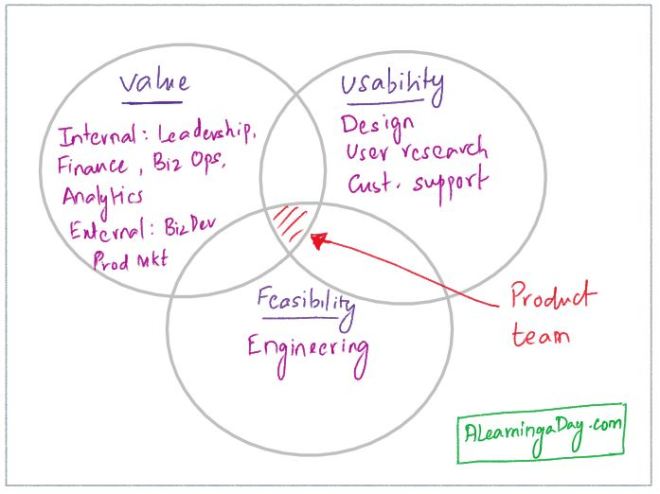
product-team

I have a long list of cross functional stakeholders listed in the “value” part because that is most challenging part of product management. Getting the “value” part right means finding that ever elusive product-market fit.

At this point, it is important to understand why a lot of the writing around product management tends to focus on the process of building products that are usable and feasible. That is a function of the fact that a large number of product managers are working on established products that have already found product-market fit – i.e., the survivors.

In such situations, building effective teams and problem solving through usability and feasibility issues tend to be the skills in demand. Established products do still go through the process of problem definition – every new feature still needs a problem statement and hypothesis. But, it is much easier to do this when you’re building on a successful product.

If, however, you’re tasked to build something new for an existing audience or target a new audience altogether, problem definition becomes the single most important skill (the ability to sell comes second). If you’re not building something that is of value to customers/users and that fits within the company’s strategic vision, the most beautifully designed/engineered product is useless.

What exactly is good problem definition?: Since I’ve spent a lot of time in both posts on the importance of good problem definition, I’d like to do a quick outline of what “good” looks like (detailed version to follow in another post). The two key steps in defining a problem well are generating a good problem statement and hypothesis.

Problem statement – Good problem statements clearly articulate i) the audience, ii) their unsolved need, and iii) the importance of meeting that need.

Hypothesis – A good hypothesis is a proposal for meeting the audience’s need articulated in the problem statement that can be validated/tested through experimentation or analysis of existing data. A hypothesis generally takes the form of a collection of assumptions that can be tested.

Getting the problem statement and hypothesis right are the first and most important steps of the product creation process.

Conclusion and a preview: This post was focused on defining what an IC Product Manager does – bringing a team of cross functional stakeholders together to build a product that is valuable, usable, feasible. As we explored this, we touched on cross functional stakeholders and problem definition. Understanding how to craft a good problem statement and hypothesis helps explain why product creation is less about “minimum viable products” and more about “riskiest assumption tests” – an idea we’ll spend time on in future posts.

At this point, it is also worth taking a step back and asking why we didn’t begin this series with this post. Why not start with what product managers do and then follow it up with the skills required for the job? I think that flow gets to what is generally broken about hiring and PM hiring is no exception. Most hiring focuses on past experiences over skills and, thus, inadvertently prioritizes intercept over slope. There’s an opportunity in there for all of us – for those who are looking to hire great teammates and for those who are seeking to move into product management.

More to come on all of this.
