
When a person’s reaction to a particular stimulus feels disproportional in its intensity, it is either a result of a want of a basic need (sleep or food) or a perceived attack on something they consider to be part of their identity.
Best shop practice
“I am not particularly anxious for the men to remember what someone else has tried to do in the past, for then we might quickly accumulate far too many things that could not be done … Hardly a week passes without some improvement being made somewhere in machine or process, and sometimes this is made in defiance of what is called “the best shop practice.” | Henry Ford
Every once a while, organizational memory can be problematic.
The key lies in not just documenting successes and failures but making the effort to establish causal understanding.
The more we attempt to understand cause and effect, the better our experiments become.
Process, outcomes, goals, systems
I’ve thought about the tension between processes and outcomes a lot over the years. On the one hand, outcomes are lagging indicators while processes are leading indicators. That naturally lends itself to advice along the lines of “focus on the process.”
But while the process is a leading indicator, a focus on the process alone doesn’t guarantee we’re headed in the right direction.
That leaves us with a conclusion that holds for most good things in life – when in doubt, replace the “or” with an “and.”
Combine a focus on process by keeping our eye on an outcome that helps us understand if the process is working.
Combine a focus on creating a good system with a goal that help us understand if we’re making progress.

We dissolve the tension by embracing it.
H/T Melodie for the illustration
Open book
Thanks to our experiences with examinations in school early in our life, we sometimes think of life as a series of closed book tests.
In truth, however, it is more similar to a series of open book tests with fewer and fewer questions. It is less about remembering things and a lot more about knowing where to look and whom to ask.
And, over time, it is developing a child-like curiosity to keep asking questions… and then learning to ask better ones.
The license saga
I lost a wallet recently and needed to replace my driving license.
I got my temporary license and was told my card would arrive in 2-3 weeks. I called the DMV 4 weeks later. After a long wait, I was told that it had been mailed to an older address. Not clear why. But, as it still had mail forwarding enabled since I’m still within a year of moving, it wasn’t clear why this would be a problem.
The kind person on the phone explained she had no idea what happened. But I could call error processing and ask them to resend it.
I did. After an hour’s wait, I was told that I couldn’t apply for error processing yet as I was on day 24 since the card was mailed. I needed to call them back after day 30.
Could I request them to just send it on day 30? Nope. Process.
I called them back a couple days after day 30. After the customary 1 hour wait (after 2 days of attempts to get on the wait queue), the person on the phone realized I was on a visa. The right department wasn’t error processing, it was legal presence.
So I called legal presence. 1 hour later, I was finally connected to someone who could help. She said she’d processed it. “If all went well”, I’d receive it in 2-3 weeks.
It was a fascinating experience. 4 hours of waiting could easily have been shortened with better instructions and possibly avoided with slightly better process.
But the incentives involved here mean the optimization function isn’t a good user experience.
A good reminder of the primacy of incentives in shaping our experiences. That and the futility of getting annoyed at such experiences.
Focus on what you control.
The “Breaking down a” series
Lindsay Brownell and Zach Frechette had a fascinating article on The Collaborative Fund’s blog titled “Breaking Down A Tesla.”
They started with 2 questions:
(1) Automakers around the world are trying to catch up with Tesla. But are Tesla’s cars actually “good” in their stated mission to accelerate the world’s transition to renewable energy?
(2) What are Tesla’s cars actually made of and are those materials better than their gas guzzling competitors?
They follow up with a detailed breakdown of the many parts of a Tesla.
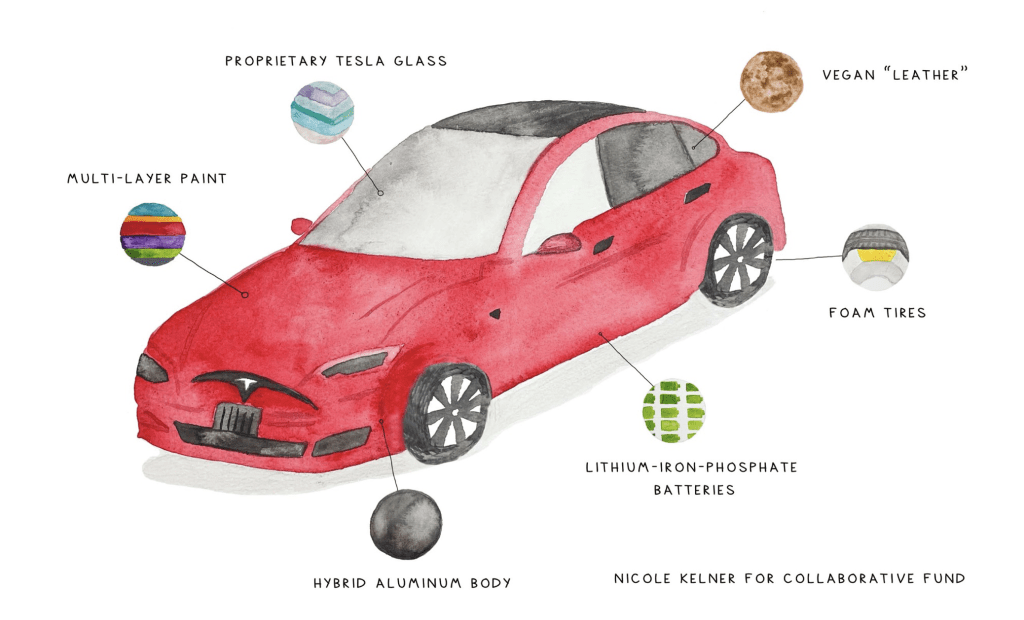
This detailed analysis reveals that Tesla’s decisions do demonstrate a commitment to sustainability. These choices are, in fact, good for the environment.
My fascination for their post is less about this specific breakdown. Instead, as I read this post, I began thinking about the many items we use in our lives and how they’d fare in such a thoughtful analysis.
Luckily, the Collaborative Fund team are thinking along the same lines and have promised a series of follow up posts breaking down other everyday objects.
I can’t wait to see what I’ll learn in these upcoming posts.
Much gratitude, team. Great work.
Self-confidence and paranoia
Sustained high performance requires us to both find self-confidence within to weather challenges while also making space for the kind of regular paranoia that ensures we’re driven to push ourselves in the lull between them.
An ankle knock and 2 truths
I picked up a knock on my ankle during a game of soccer 3 weeks ago. I think I was caught between attempting to defend a ball at pace and pulling my leg away to just let the ball go through. The save definitely wasn’t worth it and I think I subconsciously knew that. I just didn’t react fast enough. :-)
It was tender during the first week and has been steadily getting better. But it still isn’t fully recovered 3 weeks later.
It is a helpful reminder of two truths:
(1) It is very easy to take good health and a functional body for granted.
(2) It takes time, patience, and effort to fix a problem with our health. It is a lot easier to ruin than it is to build.
In our health and in our lives.
Constructiveness ratio
I saw this tweet wishing for “An Anti-Acknowledgments section of a research paper for the people who tried to stop your progress.”
It got me thinking about a hypothetical constructiveness ratio.
Our constructive ratio = (No. of projects we engaged with where we’d make the acknowledgments list) / (No. of projects we engaged with where we’d make the anti-acknowledgments list)
Higher the better.
Reframing the elevator problem
I came across this example in an interesting article on problem reframing on HBR.
Imagine this: You are the owner of an office building, and your tenants are complaining about the elevator. It’s old and slow, and they have to wait a lot. Several tenants are threatening to break their leases if you don’t fix the problem.
When asked, most people quickly identify some solutions: replace the lift, install a stronger motor, or perhaps upgrade the algorithm that runs the lift. These suggestions fall into what I call a solution space: a cluster of solutions that share assumptions about what the problem is—in this case, that the elevator is slow. This framing is illustrated below.

However, when the problem is presented to building managers, they suggest a much more elegant solution: Put up mirrors next to the elevator. This simple measure has proved wonderfully effective in reducing complaints, because people tend to lose track of time when given something utterly fascinating to look at—namely, themselves.
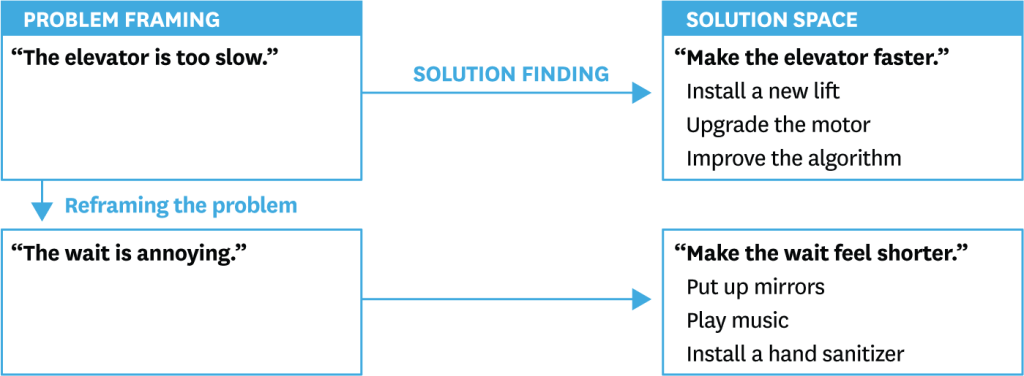
The mirror solution is particularly interesting because in fact it is not a solution to the stated problem: It doesn’t make the elevator faster. Instead it proposes a different understanding of the problem.
I was guilty of missing an opportunity to define a problem right recently. The challenge with skipping past this step – even in cases when it feels like the problem might be obvious – is that we lose the opportunity to reframe the problem.
That in turn means we miss a bevy of possible solutions – like putting up mirrors! – we’d never consider otherwise.

