The Pratfall Effect – The 200 words project

Here’s this week’s 200 word idea from Give and Take by Adam Grant

In an experiment where people were asked to listen to candidates make an argument over the phone, they typically listened more carefully to the superior candidates over the average candidates. This wasn’t surprising of course.

But, when each candidate was asked to say – “Gosh, I spilt some coffee on my suit,” the persuasiveness of the superstar candidates increased while that of the average candidates decreased. The researchers call this “the Pratfall effect” – where a top candidate is liked when they feel more human.

Hence, superstar performers in fields that require them to work with and move people are those who give themselves completely to their teams/audience and are thus willing to be vulnerable and human. People who are too obsessed either with being perfect or with getting something from the people they work with forget that it is necessary to be a prat.

PS: don’t try this if you are average! :-)

The-Pratfall-Effect

Source and thanks to: www.EBSketchin.com

‘Everybody is scared of looking silly or looking like they don’t quite know. The truth is that we don’t mind if someone doesn’t have the perfect answer if they’re natural and honest. Much more important than getting it right is being real.’ | Patricia Ryan Madson
Study groups and learning – The 200 words project

Here’s this week’s 200 word idea thanks to TheBuildNetwork.com and our RealLeaders.tv interview with Mark Suster.

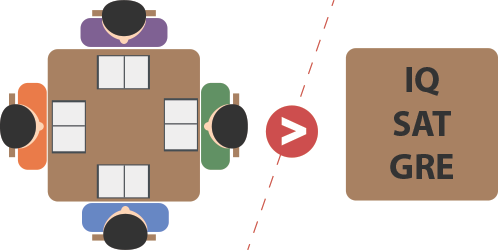
In 1986, the Harvard university president wanted to know if there was a way to predict whether a particular student would succeed or fail in college. What was different about kids who succeeded as undergrads?

The subsequent study revealed the single best predictor of college success – it’s all about with whom rather than how you learn, i.e., it wasn’t GPA or SAT scores or a number of any kind. It was a student’s ability to either create or join a study group. Students who studied in groups, even only once a week, were more engaged in their studies, better prepared for class, and learned significantly more than students who worked on their own.

Venture capitalist Mark Suster applied this in his own career by creating peer learning groups of fellow CEO’s when he ran his own start-up and of venture capitalists when he started his career in venture capital in Los Angeles.

Perhaps it is time for us to create our own peer learning group.

Study-groups-and-learning

Source and thanks to: www.EBSketchin.com

‘I felt that when I was being open and willing to talk to other people about what my issues were and then tried to solicit from them, that the table actually discussed things. You can do that. Anyone can do that.’ | Mark Suster

Ooch before you leap – The 200 words project

.Here’s this week’s 200 word idea from Decisive by Chip Heath and Dan Heath.

 In 2006, John Hanks, an executive at “National instruments,” was thinking about making a bet on wireless sensors. The technology had a lot of promise but it needed to be understood if it would survive tough environments like mines and oil rigs.

So, Hanks did what National Instruments usually does – “Ooch.” An ooch is a small experiment to test a hypothesis. He worked with Electrical engineers at UCLA to install wireless sensors in a jungle in Costa Rica for an experiment to understand changes in carbon dioxide in the forest. If they were to work, they would have to not only be accurate but resistant to heavy rainfall and other elements of nature.

They worked. After a few more ooches, John and team began developing wireless sensors with $3M investment and that business has been a key part of National Instruments offering since.

This is common practice in some professions, e.g., designers call it prototyping. If it is not normal practice in what we do, perhaps we should consider an “ooch” before we make major decisions e.g. spend two weeks in a new place before we make a permanent shift.

Ooch before you leap

Source and thanks to: www.EBSketchin.com

‘The best way to show that a stick is crooked is not to argue about it or to spend time denouncing it, but to lay a straight stick alongside it’ | D.L.Moody

The value of doing nothing – The 200 words project

Here’s this week’s 200 word idea from this Morningstar article on the value of doing nothing.

Michael Bar-Eli et al analyzed 286 penalty kicks in top soccer leagues and championships worldwide. As the ball takes approximately 0.2 seconds to reach the goal, the keeper has to decide whether to jump about the same time as the kicker chooses where to direct the ball. The researchers found that the goalkeeper almost always jumped left or right as they typically choose action over inaction. But, interestingly, the data revealed that the optimal strategy for the goalkeeper was to stay in the centre of the goal.

Just like the goalkeeper, investment professionals too feel compelled to play every trade that is out there in the market. The median holding period of the top 100 stocks by market capitalisation in the U.S. has shrunk to a third from about 600 days to 200 days over the last two decades.

As far as investing goes, there is high value in doing nothing. After all, as Warren Buffett says, benign neglect, bordering on sloth, remains the hallmark of his investment process.

Value of doing nothing

Source and thanks to: www.EBSketchin.com
Related source for all interested in personal finance and investing – Our learnographic on personal finance

‘”Do nothing” are the two most powerful – and underused – words in investing. The urge to act has transferred an inconceivable amount of wealth from investors to brokers.’ | Morgan Housel

Happiness will not be downloaded – The 200 words project

Here’s this week’s 200 word idea from Steve Faktor’s articles (12) on the Harvard Business Review

When the National Organization for Research at the University of Chicago asked which jobs made people happiest, most of the top-10 occupations involved creating a product, engaging the senses, or helping others.

10 most loved jobs - Steve Faktor

The ten most hated jobs, on the other hand, had a significant proportion of people stuck on a laptop.

In his article “How office dwellers can become doers,” Steve Faktor argues that we need to improve happiness at workplaces by enabling people to do all of this.

For product companies, engage employees more in the product building – send them to factories, keep prototypes and samples lying around, and allow for “building projects” like decorating the office.

Engaging the senses can be done by livening up work spaces, introducing more plants, having 15-minute stand up meetings and standing desks, and killing unnecessary document preparation. Allow for more employee interaction and mutual help with office sports leagues and team cook-offs.

As Steve points out, happiness at work cannot be downloaded. We need to make it happen.

‘My last traditional office job was leading growth and innovation at a Fortune 100 company. From the outside, you might think my job was a cauldron of experimentation that at any moment could produce a cure for cancer or The Incredible Hulk. No such luck. Most days were a potpourri of emails, meetings, and sensory dead-ends.’ | Steve Faktor

Kind and clever – The 200 words project

Here’s this week’s 200 word idea from The Everything Store by Brad Stone and Jeff Bezos’ talk @ Princeton.

Even as a 10-year-old boy, Jeff Bezos (founder and CEO of Amazon.com) had a passion for crunching numbers. During a summer road trip with his grandparents, young Jeff got fed up with his grandmother’s smoking in the car. He recalled an ad campaign about smoking and calculated how many cigarettes per day his grandmother smoked, how many puffs she took per cigarette, the health risk of each puff, and then tapped her on her shoulder and proudly proclaimed “You’ve taken nine years off your life!”

 Bezos expected to be applauded for his arithmetic skills. Instead, his grandmother burst into tears. His grandfather pulled the car off to the side of the road and asked him to step out. And then his grandfather taught a lesson that this now-billionaire decided to share with the  Princeton graduating class of 2010: “My grandfather looked at me, and after a bit of silence, he gently and calmly said, ‘Jeff, one day you’ll understand that it’s harder to be kind than clever.’”

kindandclever
Source and thanks to: www.EBSketchin.com

‘Be kind. The world will roll on without you.’  | Dave Crowley

Pixar frame – The 200 words project

Here’s this week’s 200 word idea from To Sell is Human by Dan Pink

While one might imagine Pixar story writers conjuring up amazing stories without constraints, every Pixar story is tested with and uses the following frame –Once upon a time… (there lived a fish called Nemo with his widowed father)
Every day… (his widowed father warned him about dangers in the sea)
And then one day… (Nemo swam out and got lost)
Because of that…(he was captured..)
And because of that… (Dad went to search for Nemo)
Until one day.. (they found each other and realized..)

This simple framework ensures the stories has the requisite twists and turns to be a successful film. If a story lacks any of these elements, the framework will call it into focus and help the team fix it.

Perhaps we should work on creating simple frames for our pitches, presentations and meetings (e.g. current state, planned future state, plans to bridge the gap).

PixarFrameSource and thanks to: www.EBSketchin.com

‘Shakespeare wrote his sonnets within a strict discipline, fourteen lines of iambic pentameter, rhyming in three quatrains and couplet. Were his sonnets dull? Mozart wrote his sonatas within an equally rigid discipline: exposition, development, and recapitulation. Were they dull?’ | David Oligvy

Red and green buttons – The 200 words project

Here’s this week’s 200 word idea from Seth’s blog

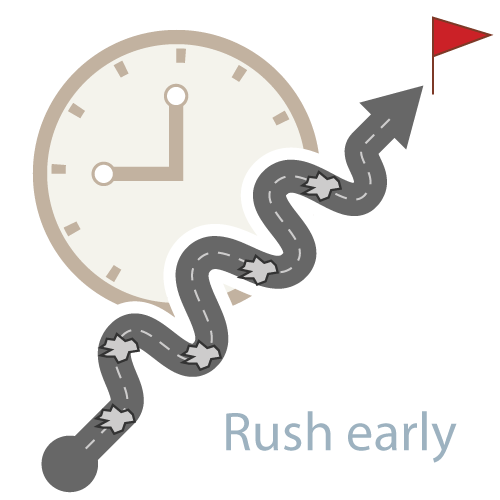
Seth Godin was leading a team of forty people building a complex series of products which had to ship before Christmas. The stakes were high – if they missed by even one day, the entire company was going to fold. They approached it by doing an analysis of the “critical path” and quickly realized that it was a relay race and right now, there was one team carrying the baton.

So, Seth went out and got some buttons – green and red. The deal was simple: if you were on the critical path, you wore a green button. Everyone else wore red. When a red button met a green button, a simple question was asked, “how can I help?” The President would get coffee for the illustrator if it saved the illustrator three minutes. In other words, the red button people never (ever) get to pull rank or interrupt a green button person.

 An understanding of the critical path and an early urgency ensured they made it. As Seth says – “Rush early, not late. It’s cheaper that way, and better for your peace of mind, too.”

Rush

Source and thanks to: www.EBSketchin.com

‘Once you’re aware of who’s on the path, you understand the following: delaying the critical path by one hour at the beginning of the project is the very same thing as delaying the entire project by an hour at the very end. ‘ | Seth Godin

Quaker teenagers – The 200 words project

Here’s this week’s 200 word idea from Decisive by Chip Heath and Dan Heath..

An analysis of teenager decision making showed –
– 30% of teenager decisions were just statements or “yes-and-yes” decisions. E.g. “I am going to go to that party,” “I am not going to smoke.”
– Another 35% were “whether-or-not” decisions. E.g. “Should I go to that party or not?”

In other words, teens are very binary. They don’t consider any options and instead spend a lot of time mulling over one option.

In an analysis of 168 decisions made by companies across industries, researcher Paul Nutt found that only 29% of the decisions made by companies had options => companies were worse than teenagers in making decisions.

In fact, large acquisition decisions were often a result of a “yes and yes” decision. The CEO decided a company was worth acquiring and everyone else worked hard to prove him right. A famous example is Quaker’s failed acquisition of Snapple for $1.7 Billion. Ex-Quaker CEO, William Smithburg, later admitted that the acquisition had no one within the company challenging it. Think about that – the largest acquisition in the company’s history had no one challenging it.

Do we consider options when we make big decisions within our teams?

clip_image001
Source and thanks to: www.EBSketchin.com

‘There was so much excitement about bringing in a new brand, a brand with legs. We should have had a couple of people arguing the ‘no’ side of the evaluation.’ | William Smithburg reflecting on the Snapple debacle

William Seward – The 200 words project

Here’s this week’s 200 word idea from Allgroanup.com.

A man met with a serious accident on a carriage ride – he broke multiple bones and only a large metal splint held his jaw together. Hearing this, Abraham Lincoln rushed to visit his most trusted confidant, Secretary of State William Seward. Lincoln shared that the Civil War was sure to be over in days. They had finally done it.

Nine days later, Lincoln was assassinated. An assassin came for Seward as well and struck him with a knife till he was sure he was dead. But defying all odds, he was not – the large metal splint from his broken jaw had somehow shielded his face.

Seward recovered, re-took his position as Secretary of State, supported President Andrew Johnson’s plans of reconciliation with the South, and then went on to make what was considered one of the greatest mistakes of the time – buying a piece of land called Alaska for $7.2 million from Russia.

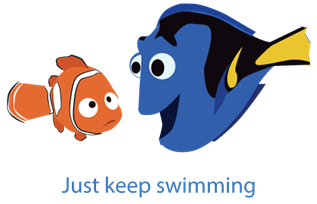
Many things in life won’t turn out like we planned. Some things will even inexplicably take turns down dark roads. But, as Seward’s story shows, we never know what amazing gift lies around the next corner if we are willing to keep going.

clip_image001
Source and thanks to: www.EBSketchin.com

‘The most miserable moments of our lives have the potential for the greatest redemption.’