Partitioned cookies – The 200 words project

Here’s this week’s 200 word idea thanks to Decisive by Chip Heath and Dan Heath.

Participants volunteered to help with a cookie tasting study (that must have been a tough decision) that was actually a test on how partitions affected decision making. They were to report back once they finished their cookie jar with 24 cookies each. Participants took 6 days on average.
However, in boxes where each cookie was individually wrapped, participants took 24 days to finish the cookies!

Similarly, participants gambled less when their funds were divided into different envelopes. Day wage workers managed their finances better when they split their wages in different envelopes. And, venture capitalists made better overall decisions when they split their investments in different rounds.

Partitions like these make sure we set boundaries so we don’t just escalate our commitment to existing choices. These boundaries ensure we make conscious decisions (do I really want another cookie?). Chip and Dan Heath suggest setting up more partitions in our day for conscious decisions – e.g. a call from the family at 5pm to check in on our productivity and ensure we head home in time for dinner.
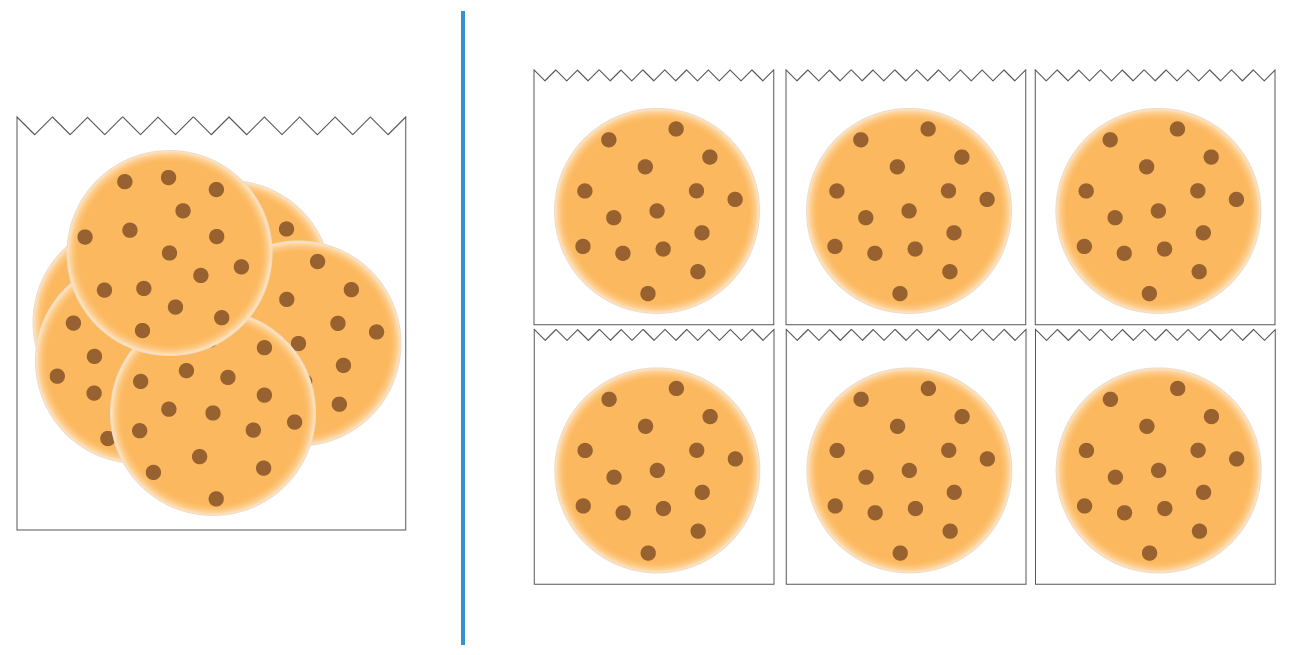
Partition Cookies

Source and thanks to: www.EBSketchin.com

‘My approach to living with purpose has always been to create the life I want, one conscious decision at a time.’ | Oprah Winfrey


Selection bias and winners – The 200 words project

Here’s this week’s 200 word idea thanks to TimHarford.com, Lifehacker.com and Professors David Dranove and Brett Saraniti at Kellogg.

In 1943, the American statistician Abraham Wald was asked to advise the US air force on how to reinforce their planes. Only a limited weight of armor plating was feasible, and the proposal on the table was to reinforce the wings, the center of the fuselage, and the tail. Why? Because bombers were returning from missions riddled with bullet holes in those areas.

Wald explained that this would be a mistake. What the air force had discovered was that when planes were hit in the wings, tail or central fuselage, they made it home. Where, asked Wald, were the planes that had been hit in other areas?They never returned. Wald suggested reinforcing the planes wherever the surviving planes had been unscathed instead.

As blogger Tim Harford points out, this makes for a classic example of selection bias and also a great life lesson. It is natural to look at successes. But, if we don’t examine our failures, we may end up putting our time, money, attention or even armor plating in entirely the wrong place.

Abraham Wald planesSource and thanks to: Digitalroam.typedpad.com

‘The data that isn’t present may tell as important a story as the data that is.’

The Matt Damon method of finding help – The 200 words project

Here’s this week’s 200 word idea (and the first of the new year!) thanks to 99u.com, Nathan Kontny’s blog.

On his blog, startup founder Nathan Kontny explains that the best way to find help is to first become the person you seek. He observed that he regularly bumped into people seeking help from others in their projects or careers – like business people looking for technical co-founders or people looking for someone else to write a press release about them.

Kontny, instead, believes actor Matt Damon had it right. Instead of looking for some writer to give him a starring role, he just became the writer and wrote the script for Oscar winner ‘Good Will Hunting’.

So, Kontny’s advice is – if you’re a “business guy” stuck because you can’t find a technical co-founder, go become the technical co-founder. Go to some classes, conferences, meet-ups and read technical blogs and forums – do what you think a technical co-founder would do. And, you’ll be surprised that the action of trying to accomplish this actually puts you into the company of a great deal of people who would make… really great technical co-founders.

Matt Damon waySource and thanks to: www.EBSketchin.com

‘A funny thing happens when you do the work to become the thing you seek so much from others. You find it.’ | Nathan Kontny

You never know when you had a good day – The 200 words project

Today marks the 50th 200 word idea since the start of the year and the 325th weekly learning over the past 7 years. Today’s is from our interview with Albert Wenger on RealLeaders.tv. I thought today’s quote and story made for a great way to start reflecting on the year that’s gone by (thanks Albert!). I will be taking a two week holiday season break from these notes myself. :-) So, more 200 word notes to follow in the new year and here’s wishing you happy holidays!

Venture capitalist Albert Wenger shared a close friend’s wonderful saying, ‘You never know when you had a good day’. In his words –

“In my first startup, an internet healthcare startup, we brought in a very experienced management team. I thought that was a great day. Subsequently, it turned out that team, which was very experienced, made some decisions that ultimately led to the demise of the whole thing. It turned out not to be a good day. Conversely, when the deal to buy a software company fell apart, I thought I had a terrible day. I had worked intensely on something for 2 years and it fell apart. That, though, turned out to be one of the best things – I wouldn’t be here doing this with you if the deal had happened. I would be in Cleveland working with that company.

One of the things I have come to learn is that you shouldn’t get too depressed on the downside, or too excited on the upside – just keep plugging away. Eventually, good things happen.”

“You never know if a bad day is a bad day” – converse of the Albert saying to give us heart as we think of a bad day/phase

Hail the fail whale – The 200 words project

Here’s this week’s 200 word idea from Things a Little Bird Told Me by Biz Stone.

Since Twitter was born out of a two week hackathon, the architecture of the site wasn’t built to handle its exploding growth and the service regularly went down.

Biz Stone, the voice of Twitter to its users, believed in being absolutely honest about the issues and the work being carried out by the Twitter team. While companies worked hard to convey a “perfect” image, his belief was that vulnerability is always rewarded with goodwill. So, the Twitter team created the now-famous “fail whale” – a humorous communication of the service’s outage.

He realized his approach was working just a few months in. When the Twitter team was working late at night before the Apple developer’s conference where an iPhone was rumored to be released, pizzas arrived at the office followed by a tweet from a few users asking if they’d received it. Their users didn’t think of Twitter as automated bots who caused them pain. Instead, they saw them as people working hard to make the service work. The fail whale went on to inspire many fan clubs and even a conference(!).

Here’s to vulnerability over attempts to look perfect.

Fail whaleSource and thanks to: www.EBSketchin.com

‘Perhaps the history of the errors of mankind, all things considered, is more valuable and interesting than that of their discoveries.’ | Biz Stone

Lead bullets – The 200 words project

Here’s this week’s 200 word idea..

When Ben Horowitz was working for the web server team at Netscape, Microsoft created a rival web server product that was 5 times as fast as Netscape’s and gave it to customers for free. So, Ben began working hard on potential acquisition targets that could help Netscape overcome this problem.

When he shared the idea with his engineering counterpart, Bill Turpin, Bill listened and said – “Ben, those silver bullets that you are looking for are all fine. But, our server is FIVE times slower. There is no silver bullet that is going to fix that. We’re going to have to use a lot of ‘lead bullets.'”
So, the engineering team focused hard on the performance issues. And, Netscape soon beat Microsoft’s performance and grew web servers to a 400 million dollar business.

Later, as CEO of Opsware, when he found competitor BladeLogic consistently beating them on big deals, Ben had colleagues who suggested silver bullets like other acquisitions and pivots. But, he had learnt his lesson – they had to build a better product. No silver bullets, only lead bullets. That’s how they built a 1.6 billion dollar company.
Source and thanks to: The Hard Thing about Hard Things by Ben Horowitz

Lead Bullets

Source and thanks to: www.EBSketchin.com

‘There comes a time in every company’s life where it must fight for its life. If you find yourself running when you should be fighting, you need to ask yourself: “If our company isn’t good enough to win, then do we need to exist at all?”‘ | Ben Horowitz

Toyota experiments and Intuit – The 200 words project

Here’s this week’s 200 word idea thanks to Fastcompany.com.

How can a loom maker located in the Kansas of Japan decide to go into the car business after everyone else and become better than GM and Mercedes in the core business of making cars? Why is it that when Nissan sells a hybrid, it’s got Toyota parts in it?

Even as a student, Intuit founder Scott Cook was fascinated by Toyota. Along with his professors at Harvard, he went to the Toyota factories and observed Toyota’s approach to manufacturing. And, one of his professors pointed out that Toyota ran itself as a massive series of experiments from the production line worker to the CEO. They had the line supervisor teach 70 or 80 people how to run experiments with their team – little scientific single variable experiments to try out their ideas on how to improve production. He later saw the same dynamic repeat itself at Google.

Scott Cook concluded that the reason big companies with insanely smart people made bad decisions was because they relied on the 3 P’s of politics, persuasion and PowerPoint instead of experimentation. He was so inspired by Toyota that “leadership by experimentation” became at the center of his leadership style at Intuit

Leadership by experimentationSource and thanks to: www.EBSketchin.com

‘We got beat because Google runs itself as a series of experiments run by its engineers. They are constantly trying new things at a ferocious rate. A Google chief scientist says they run 3,000 to 5,000 experiments a year. If you use Google in a week, you’re likely to be in three experiments. You don’t know you are, because they are experiments.’ | A Yahoo engineer on Google

Happiness and balloons – The 200 words project

As it is Thanksgiving season here, we have a “happiness” edition on this week’s 200 word idea from, well, the internet. Try as I might, I wasn’t able to find a source for this story. So, my conclusion is that this is probably a made up story used by trainers. A good one, nevertheless.. :-)

A speaker at a seminar conducted a group activity. He gave each person a balloon. The attendees were then asked to write their name on it using a marker pen. Then all the balloons were collected and put in another room.

The attendees were then let into that room and asked to find the balloon with their name written on it within 5 minutes. That descended into chaos – everyone began frantically searching for their name, colliding with each other, and pushing each other around. Very few found their balloon.

Then, the speaker asked each person to randomly collect a balloon and give it to the person whose name was written on it. Within minutes, everyone had their own balloon.

The speaker then shared the lesson, “This is happening in our lives. Everyone is frantically looking for happiness all around, not knowing where it is. Our happiness lies in the happiness of other people. Give them their happiness and you will find your own. And this is the purpose of human life…the pursuit of happiness.”

Happiness - give and getSource and thanks to: www.EBSketchin.com

‘Thousands of candles can be lit from a single candle and the life of a candle will not be shortened. Happiness never decreases from being shared.’ | The Buddha

10-10-10 rule – The 200 words project

Here’s this week’s 200 word idea from Decisive by Chip Heath and Dan Heath.

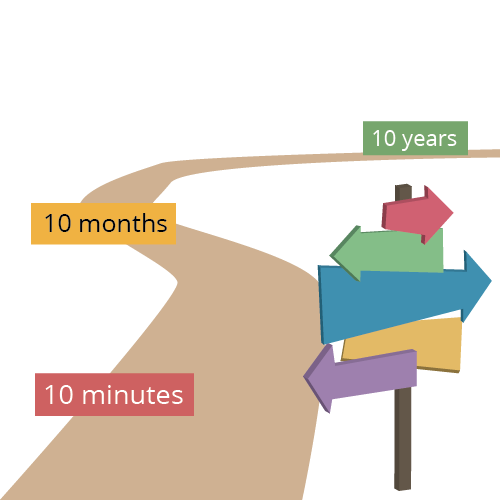
Imagine you are deciding whether or not to avoid a difficult conversation with a teammate. An idea suggested by author Suzy Welch to help make the decision is to conduct the 10-10-10 analysis. Consider how you would feel about the decision –
– 10 minutes from now (anxious)
– 10 months from now (probably glad you had the conversation)
– 10 years from now (most likely, it won’t matter)

Similarly, if you are chasing a hot-shot to hire in your company, perhaps the 10-10-10 analysis will warn you not to offer too high a pay package that you may regret 10 months from now. Besides, the hot shot may probably not even stick around for 10 years.

The purpose of the 10-10-10 analysis isn’t to negate short term emotions. What we feel now tends to be strong and heavy and it exists to ensure that short term isn’t the only voice on the table.
10-10-10-rule
Source and thanks to: www.EBSketchin.com

‘Knowing your priorities may help you with the 10-10-10 process, but the great thing is that it can also help you discover them.’ | Suzy Welch’s response (paraphrased) to a student who pointed out that 10-10-10 works best if you know your long term priorities.

Opportunity is manufactured – The 200 words project

Here’s this week’s 200 word idea from Things a Little Bird Told Me by Biz Stone.

When 11 year old Biz Stone (co-founder of Twitter) wanted to join a sports team at school, he hit upon a problem. He had spent the last 4 years as a part of a boy rangers organization and was far behind his class on sports like baseball and football. He barely understood the rules. But, he really wanted to play in a sports team and expand his circle of friends.

So, he hit upon an idea – if he could find a sport no one else in the class had played, he wouldn’t be the newbie anymore. After a bit of research, he found lacrosse and asked the school if they’d permit a lacrosse team if he found interested boys and a coach. Voila! Problem solved. Biz turned out to be a decent lacrosse player and ended up having a great set of friends.

The lesson from this for Biz? The world conditions us to believe that opportunity comes from a perfectly aligned set of circumstances. But, in truth, we can go out and create those circumstances. Opportunity can be manufactured.

Opportunity manufacturedSource and thanks to: www.EBSketchin.com

‘If you make the opportunity. you’ll be the first in the position to take advantage of it.’ | Biz Stone