Notes on responses

16 notes on responses –

1. An immediate response to a situation is a reaction. A response, on the other hand, is a reaction after some thought and consideration. This ability to find space between a situation and a response is what Stephen Covey described as “being proactive.” It is an important part of what makes us human. We have the freedom to choose.

2. Anything that affects us is our problem. And, if it is our problem, it is our responsibility to choose a response.

3. Is there ever a right response to a problem? I don’t think so. There is, however, a “best case” response to a problem for a particular person. Different situations affect people in different ways. I have been in situations where others’ responses made no sense to me. But, I’ve been in just as many situations where I could see that my response to a situation made no sense to others. Our past experiences play a big role in our reactions. So, it is often hard to predict the results of the reaction unless you’ve seen someone (or yourself) react to something similar before.

4. More often than not,  a “best case” response involves proper deliberation and a measured, non-attached response.

5. A non-attached response isn’t the same as one without emotion. Non-attachment involves emotion involved in the process – in dealing with the situation, weighing the process and picking what feels like the best outcome. It just means we don’t attach any emotion on the result of our actions.

6. There is no point judging our responses to a situation. Asking “why do I feel this way?” or saying “I should not be feeling this way” are just ways of denying how we feel. The first step to solving any problem is to accept it. And, denial of any sort gets in the way of acceptance.

7. The DABDA framework for dealing with our emotions is pretty powerful. DABDA describes the 5 stages of coping with something difficult – denial, anger, bargaining with ourselves, depression, acceptance. It has its issues. For example, any response could be described as denial. But, limitations aside, it does a good job on walking us through the process.

8. As humans, we care about resolving situations. Uncertainty messes with our psyche. That’s why learning to respond in a measured manner involves learning some very powerful life lessons. It teaches us to be patient by demanding it of us.

9. Emotional reactions to tough situations can work. But, they rarely do. There is a lot of power in controlled emotion. But, the key word there is controlled.

10. A fantastic response that I’ve seen work in most situations is to find humor in them – especially the kind that involves taking yourself less seriously. In the book “The Art of Possibility,” the authors call it “Rule No.6 – Don’t take yourself so damn seriously.” That said, humor only comes naturally to few people. For the rest of us, it is hard work. :)

11. There are alternate ways to diffuse the tension of course. Another is to simply treat every system as a game and to focus on simply gaming the system. This is less about humor and more about making solving problems fun. Having difficulty getting your kid to eat vegetables? See if you can make it into a game where you try multiple approaches until you solve the problem.

12. The other side of all this is to pick a very small list of things that you seek to maximize. Of course, this is easier said than done and it comes a lot easier to some than others. The important thing isn’t the method. There is enough choice out there for us to pick one that suits our style. The important thing is to pick.

13. Related to not judging ourselves, the worst thing we can do is be harsh to ourselves when we are experiencing emotions. This generally leads to a bad cycle of guilt and shame that lead absolutely nowhere. Reflecting on our reactions generally sucks. We always learn something less flattering about ourselves. We have to learn to reflect without judgment. And, the way to do that is to focus on what we are learning about ourselves and our quirks.

14. The hardest thing about responding well to situation is keeping perspective. If you are reading this, it is likely that most problems you face are variants of first world problems. That doesn’t mean they need to be discounted. Anything that effects us is a problem after all. We just need to remember that we have far fewer excuses to be unhappy. We don’t really know what difficult is.

15. There is no replacement for thoughtfulness. This isn’t limited to responses alone, of course. Also, a tool to aid thought is writing. When in difficulty, write things down. It helps clarify our thinking.

16. Watching ourselves respond to situations is a fantastic learning experience. I had a recent situation where I definitely was making a mountain out a molehill. And, I soon realized that the problem was the not the situation but my reaction to it. And, being upset with myself wasn’t going to solve. Instead, I learnt that the intensity of my reaction was a reflection of how much I cared. Now, I just needed to design a thoughtful, constructive response. And, I was glad for the ability to put all this thought about responses into a tiny situation. So much better to do it in practice versus attempting to learn it at a situation equivalent to a world cup final.

Finally and most importantly, it got me to think about 16 lessons about responses. And, for that I am grateful.

First thing

What is the first thing that gets thrown out of the window when things get busy or difficult?

In my life, it used to be either sleep or exercise a few years ago. I know folk who would point to a good diet or reading good books. And, then there are others who would probably point to time with family.

The first thing thrown out of the window is very instructive because it generally points to the thing we take for granted. If we take our health for granted, we’d probably throw sleep, exercise or food. If we take our growth for granted, we’d probably throw books or learning. And, if we take our relationships for granted, we’d ignore them while we are busy.

All of these are the easy choices. That’s why we let go of them so easily when push comes to shove. But, more often than not, easy is a good proxy for wrong.

Every one of these falls under the “important and not urgent” bucket. And, we’ll never get to the important investments if all we do is fight fires every day. Furthermore, the challenge with many of these investments is that, unlike the urgent stuff, it doesn’t feel like our effort is paying off for the longest time.

Until it does.

Confusion matrix

A confusion matrix is a simple and powerful tool to understand the effectiveness of a classification system. We see classification systems all around us. These are simply systems that classify things or people into two categories. Health screenings for diseases, baggage and X-ray systems at the airport and even our gut reaction to people we like or dislike are all classification systems.

The confusion matrix is a representation of the performance of our classification system. There are four outcomes of a classification system.

Let’s say our baggage screening system flags a bag, there can be two outcomes – safe or dangerous. A “True Positive” is when the system correctly flags a dangerous bag. A “False Positive” is when the system falsely flags a safe bag. False positives are called “Type I” errors.

Next, a “False Negative” is when the system doesn’t flag a dangerous bag. The terminology gets a bit confusing here. The simple translation of a false negative is that the negative predicted was false. These are called “Type II” errors. Finally, a “True Negative” is a correctly predicted safe bag.

Source and thanks to: Codeproject.com

Based on these 4 metrics, we can now construct a good picture of the quality of the classification system. Some of the common metrics are –

1. Prevalence – how often in our sample do we find a yes? (True Positives + False Negatives) / Total of all 4
2. Accuracy – how often is the classifier correct? = (True Positives + True Negatives) / Total of all 4
3. False positive rate – when it is actually no, how often does it predict yes? = False Positives / (False Positives + True Negatives)
4. True Positive rate or Recall – when it is actually yes, how often does it predict yes? = True Positives / (True Positives + False Negatives)
5. Precision – when it predicts yes, how often is it correct? = True Positives / (True Positives + False Positives)

These metrics typically give us the health of a classification system. There isn’t one “standard” for what the health should be. Ideally, you want as small a false positive and false negative rate as possible. But, building hyper accurate systems is very expensive – especially in cases where the prevalence is low. So, it comes down to what trade offs we are willing to make. For example, a cancer test that has a high false positive rate is problematic since it unnecessarily jeopardizes the health and happiness of someone falsely flagged. However, all cancer tests need to have very low false negative rates. This is why healthcare systems often set up less accurate preliminary screenings before moving us over to advanced expensive screenings that have higher accuracy.

If you’re ever wondering if a classifier is working well, just plot the confusion matrix. And, more importantly, when you take important medical tests, understand the False Positive and True Positive rates.

PS: It takes a repeated, intentional study of the Confusion matrix to feel comfortable with it. It is called the “Confusion” matrix for a reason.

Helped me out list

We all work on projects – both personal and professional. The most common projects are searching for a job or applying to university or graduate school. But, we work on other personal development projects too. During these projects, we connect with people for help and support. Some of these are people we know and some tend to be random strangers who help. My suggestion – make a “Helped me out list.”

It doesn’t matter if the person helped you a lot or a little bit – put them all on the “Helped me out list.” And, at the end of the project, regardless of how it turns out, reach out to every one of these folk and let them know how it went. Nothing fancy required. A short update will do. A thank you will be a wonderful addition.

First, people who take the time to respond to others, especially people they’ve never met, love hearing about the outcome of that conversation. Second, from personal experience, you only hear back once every hundred or so times. So, every follow up conversation is very memorable. Finally and most importantly, if you’ve reached out to a person for help once, there is a non zero chance that you will reach out to them again.

Besides, it is horrible practice to only reach out to people when you need something from them. I can think of two situations in the past year where I felt on either side of that table. In one case, I only seemed to be reaching out to this person asking for help. And, on the other, I seemed to only be hearing from someone when they needed my help. I was acutely aware of both and it just felt bad.

There are two principles at work here. First, plant more trees than whose fruit you’ll ever need. Second, plant them long before you need the fruit. This is hard to do right. You will definitely get a few wrong and they will feel painful. I certainly have gotten a few wrong over the years. But, over time, your percentages will get better.

A “Helped me out” list is a great way to improve those percentages.

Choice vs Tension

Choice is the act of selecting or making a decision when faced with two or more possibilities. Tension is the state of being stretched tight. In a decision making context, this stretch is often between two ideas seemingly in conflict. A sign of great decision making is the ability to distinguish between choice vs tension.

There are many time when we need to choose between options. Picking a restaurant, credit card or car require us to choose. However, there aren’t as many situations where we need to choose as we think there are. Most decisions, especially difficult ones, require us to embrace tension rather than a choice.

Should we be push ourselves or be content?
Must we focus or should we diversify?
Should we build toward the long term or the short term?
Must we create profits or value?
Should we pursue quality or quantity?

Every one of these tough questions (and many more) is a false choice. They look like straight-forward A or B questions. But, they aren’t. Each of these are examples of natural tensions. We can’t do one of these at the expense of the other. We have to do both. So, how do we tell the difference?

A wise friend once shared – “Whenever I am faced with such a dilemma, I ask myself [very deeply] what it would take to replace OR with AND.”

We must embrace the tension.

HWMYL

All decisions implicitly ask us one big question – HWMYL? Or How will you measure your life?

I think of HYMYL as that is the short form for Clay Christensen’s excellent book with the same name. The interesting thing about this question is that it is a feature of every decision. It is just less obvious with the small decisions.

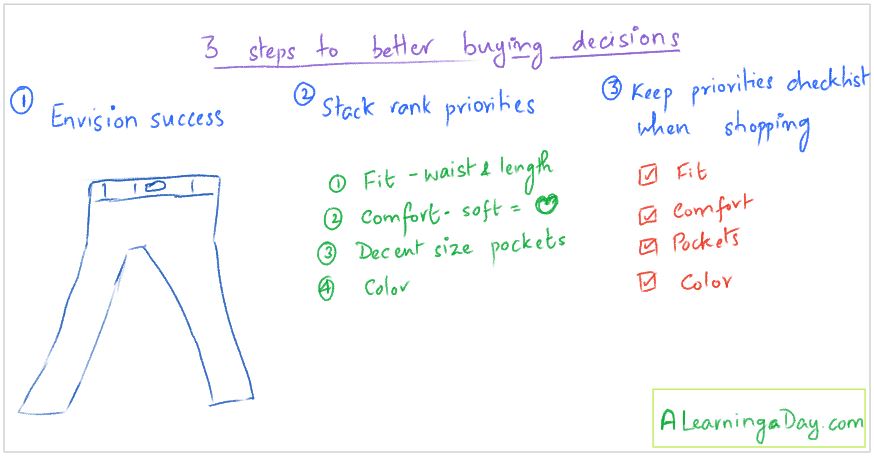
For example, deciding how you will spend the next hour or next day doesn’t scream a big life question. But, how we spend our time is and should be a by product of our priorities. What clothes to buy, where to go for a dinner, and what gifts we purchase are all manifestations of our answers to this big question.

When we move to bigger decisions – do we take that big job, do we get married now, do we move to a different place – the decision is just a manifestation of what matters most to us.

2 things make these decisions easier –

1. Have an answer to the HWMYL question. Take a stab at what you think matters to you. A simple approach is to take a trip to the future to your funeral. What are the people saying about you? What would you like them to say? There are more elaborate approaches, too. Just boil it down into a couple of words in prioritized order. I think of mine as “people, learning, and impact” – if it is helpful.

2. Expect to learn more about what matters to you as you make these decisions. Even if you’ve spent a lot of time thinking about how you will measure your life, you will often learn a ton from how you make these big decisions. You may find out that some things matters to you a lot more than you thought. That’s important too.

The beauty about the HWMYL question is that the answers may change with time – and that’s okay. As we grow in wisdom, what matters to us might change.

But, the beauty of the question is the fact that it is a question. That is, the answer matters far less than simply asking the question.

Elevate

Masterchef is a cooking competition. But, Gordon Ramsay’s presence, energy and artistry elevates it to be more than that. It inspires the contestants to elevate their performance. And, it entertains and inspires viewers all over the world as they watch these home cooks transform into artistic chefs.

The Pike place fish market is one of Seattle’s popular tourist spots. It is a fish market which has huge difficulty dealing with the volume of applications of people who want to be part of its staff. A fish market with a different sort of recruitment problem! Growing up in India, we were taught to associate fish markets with chaos, dirt and smell. When John Yokohama (reluctantly) took over ownership in 1965, it was still just a fish market with most of those associations. He decided he would elevate it into something much more than that. And he did.

Soccer or, football outside the US, is just a game played by a bunch of people kicking a ball around. It is unlikely that the folks who first created a game out of kicking a ball around would have imagined the sort of following soccer inspires. Thanks to the artistry of generations of players and a legion of smart entrepreneurs, the game became much more than a game.

All three of these are mass market examples. Most people have heard of soccer. Many have heard of Masterchef. Fewer have heard of Pike place fish market. There are many examples of people and organizations in our communities that have taken something seemingly commonplace and made it much more than that.

Every time I come across one of these examples, I am reminded of the fact that things are never what they seem to us on first glance. They can always be a lot more than that. We just have to learn to look at things and people with an eye for their potential. When we find something that looks devoid of inspiration, we can choose to elevate it. It doesn’t come easy. It often requires us to swim upstream. But, choosing to do so consistently not only changes us for the better, but it also transforms those who engage with it.

This isn’t about doing the big things. This is about doing the small things with extraordinary love.

Small moments

There are so many magical small moments in a day.

Waking up in the middle of the night and realizing you’ve still got a couple of hours of sleep left.

Snoozing that alarm once to get a precious few extra minutes of sleep.

Managing to squeeze that little bit of toothbrush from the tube.

Seeing more green traffic lights than red ones on the way to work.

Walking out of a good meeting.

Making a colleague smile.

Smelling great food.

Feeling alive as you enjoy sweating on a run outdoors.

Reading a passage from a book that strikes a cord.

Enjoying a breath of fresh air as you take a walk.

Telling someone you love that you love them.

Being there for someone who needs you.

We love the big moments. The award ceremony, the big promotion, the raise, the graduation, and the signing of the paperwork.

But, the big moments are so few and far between that life can feel like an endless pursuit, an endless treadmill. It is when we learn to appreciate the small moments that we learn to appreciate the pursuit, that we realize that the pursuit is all there is.

As we live and appreciate these small moments, we live our days. And, as we live our days, so we live our lives.

To daily heroes

We saw “The Piano Guys” live in a small and beautiful concert a few weeks back. Regulars here know how much I love their music. It turns out that their personalities are as wonderful as their music and it came through as they spoke to us between songs. I took away two powerful messages from my time with them. I thought I’d share the first today – an ode to daily heroes.

Steven Sharp Nelson, the talented Cellist, took to the mic to dedicate this song to the daily heroes. We all know who these heroes are.

The moms and dads who give everything to make sure their children are learning.

The partner who’s got your back.

The teachers who never give up.

The manager who simply cares a tremendous amount for her team.

The friend who you know you can rely on.

The guy at the restaurant who always shows up with a smile.

The janitor who does her job incredibly well, every day.

And to every one else who made a difference to your life.

The Piano Guys dedicated their rendition of “The Fight Song” to these daily heroes. After they did, we heard someone at the back talk about how Rachel Platten, the person who sung the song, spoke about it at the very same venue. She had been struggling for years as a waitress when she wrote that song as a message to herself to keep giving it her all. Fitting.

[embedyt] http://www.youtube.com/watch?v=mOO5qRjVFLw%5B/embedyt%5D

Thank you to all my daily heroes. It is you who make life the blessing it is.

PS: I listen to this just as I get into work on most days. The Cello at 1:23 is stunning. Thank you, Piano Guys.

PPS: Thanks to one of you, I just realized that my email feed has been down over the last couple of days. My apologies to the email subscribers. Hopefully the bug has been fixed.

Amazon experience

We went down to a physical retail store to buy stuff for the home the other day. Right then, I realized how much we missed the Amazon experience. We missed two aspects in particular.

1. Reviews. I felt lost as I looked at products in the aisle. Were these the ones that came highly recommended? On what basis were they on the aisle?

2. Unlimited selection. We were looking for a specific product we’d seen online. But, it was “out of stock.” Out of stock? What is that? :-)

Three reflections –

First, reviews and unlimited selection make the Amazon experience vastly much superior to most physical retail stores. I could immediately see a future application for augmented reality. I would imagine us wearing AR glasses to see reviews superposed on top off products in physical retail stores. We’d be able to instantly compare attributes and prices across retailers as well. Pushing this further, I’d imagine retailers would already know what I intend to buy by having their staff wear AR glasses of their own. After all, I was probably logged into their website when I was searching. They’d be able to help me as soon as they saw me walk in.

Second, hybrid approaches often tend to be powerful. Maybe retailers could do better with having computers onsite that would help us browse their online inventory. At least, they could convert our intent to a sale by helping us make a purchase and have it delivered to our homes rather than have us go back and order it on Amazon. On the other hand, Amazon retail stores would be very helpful. They could just have all their best selling merchandise in one place.

Finally, it is impossible to roll technology back. Such experiences repeatedly underline how naive discussions around bringing jobs back to “x country” are. The Amazon experience is better for customers with far lesser people employed per dollar of revenue. Even the folks who are employed in their warehouses are slowly being replaced by robots with a few human supervisors. Technology innovation is going to keep moving forward.

It is up to us to keep pace with it.