Lessons learnt from the 200 words project

For 8 years since June 2009, I used to share a story or idea from a book with folks I’d met over the years via a mailing list. It turned out to be a wonderful way to stay in touch and share learning from books.

Over the past 3 years, that project came to be known as the 200 word project. And, I used to share these notes every Sunday. I decided to close that project last weekend. Below was my note.


Aside from the many lessons shared, I reflected on the 2 biggest lessons I learnt from the process of putting these notes together –

1. Feeling comfortable shipping. This list is a collection of colleagues, managers, and clients from over the years. So, pressing the send button was a bit nerve wracking for a long time. Over time, I learnt to say “this might not work.. and that’s okay” as I kept the faith that the good and bad ones would average out over time. :)

2. Learning how to read a book. Thanks to this project, I pause every 5-10 minutes when I read and synthesize what I’ve learnt. It has been game changing.

Looking forward – Notes by Ada. But, like all good things, the time had come on this project. Post having a baby, time is more at a premium than ever before and I realized I’d like to spend my time learning more about technology – by sharing more, of course.

The Notes by Ada project is inspired by Lady Ada Lovelace. She was the first to visualize and write about the computer as a “general purpose machine” in a paper she aptly titled “Notes.” We’re living at a time when tech has far outgrown tech and my goal is to bring together weekly narratives around a theme every week. It is 11 editions old and includes notes on augmented reality, the unbundling of retail, and bitcoin among others. But, mostly, inspired by Ada Lovelace, it is really all about thinking about the future.


I still haven’t made up my mind about whether I want to share weekly posts from the “Notes by Ada” project here as I also share them on Medium and LinkedIn. I guess we’ll play that one by ear.

And, while I don’t plan to share stories in the 200 word project format, sharing lessons from what I read is key to my learning. So, more to follow on that for sure.

Onward.

Time with trees

Trees never cease to inspire me.

They add so much to the landscape around them. They can be approachable, beautiful and majestic all at once. They outdo themselves in the value they add to us with shade, fruits, fresh oxygen and wood.

And, beauty and utility aside, there’s so much a tree stands for in our lives. There are many great metaphors around what the combination of roots, trunks and leaves stand for. And, rightly so. Trees beautifully demonstrate the greatness of this planet and of nature. They encapsulate the power of impact without needing to make a sound.

As a human waster who wastes so much and gives so little in the grand scheme of things, trees are reminders of how much we have to do to leave this planet a little better than we found it.

We are the average of the 5 living beings we spend time with. Today, I plan to spend time with trees and be inspired by them.

I hope you consider doing that too.

Think big, act small, and plug away

“Think big, act small and plug away” is the thoughtful doer’s credo.

We need big thinking – now more than ever. The big issues – the effects of climate change, the effect of robots on the future of work – aren’t going away anytime soon. There’s an unprecedented urgency for us to believe in our ability to come together as humans and to care.

But, there’s also little point in spending all our time worrying about things we don’t control. Instead, we must keep acting small, focusing on what we control, making it count and earning our right to influence things on a larger scale.

Along the way, we’ll have good days and bad days. It is hard to tell which is which in the moment. So, it is in our interest to not care about which is which and, instead, keep plugging away.

So, if we’re feeling stuck, disheartened or in doubt, let’s remember to go back to the credo – think big, act small and plug away.

Done consistently, it is how things of value get built.

Limitations of Maps

If you read maps, it helps to understand that they come with 3 limitations –

  1. Perspective: To show us the information we see, maps trade off a lot of potentially useful information.
  2. The Cartographer’s bias: A map tends reflect the reality it wants to show. As an example, for the longest time, the maps of both India and Pakistan showed both countries possess disputed territory.
  3. The territory: One map rarely does justice to the territory.

So, how do we become better map readers? First, be aware of the biases involved. And, second, get multiple maps and triangulate to get the best understanding of the lay of the land.

Of course, this post isn’t just about reading maps of places.

When we walk into organizations and communities, we effectively look at maps of these groups from the eyes of the people we choose to meet and to follow. We follow our managers, community leaders and parents and see the world from their maps until we learn to build our own.

And, this is a reminder to follow the best practices of a map reader. But, also, as a cartographer who offers maps to others, it is on us to call out our biases and provide multiple perspectives to those who count on us.

H/T The Farnam Street Blog for the limitations of maps.

Couldn’t and didn’t

Florence Foster Jenkins, the movie, is a fascinating story about a socialite and music lover in 1940s New York. Oblivious to her own lack of musical ability, she (i.e. Meryl Streep) tried performing as an amateur soprano.

Her loved ones kept her shielded from any real feedback for a long time. But, she eventually found out that she was mocked for her performances in the press. While obviously disheartened, in the closing scenes of the movie she said something that stuck with me – “People may say I couldn’t sing, but no one can ever say I didn’t sing.”

She was unequivocally right. Her failure wasn’t for a lack of effort.

How many of us can say that for things that matter to us?

Plans and planning

Planning is an activity that has been proven to help us become effective. Plans are an outcome of planning.

The challenge both people and organizations face with planning is that it is easy to become wedded to the plans that emerge from the planning process. So, they refuse to change course and block progress if it comes down to it.

The reason? A plan is stationary and stationary objects bring a false sense of certainty along with them. That false sense of certainty is all we need to refuse change and the tension that accompanies progress.

The act of planning, on the other hand, serves a different function. It is, very simply, a proxy for thoughtfulness. A well run planning process asks us to be aware of the nature of our environment and to intentionally pick which direction we’d like to move toward. Of course, when the nature of the environment changes, we’ll need to change as well.

Thus, planning shares two characteristics that great processes share – it is dynamic and the process matters far greater than the outcome.

In the long run, our plans don’t matter. The habit of planning, however, makes all the difference.

Manager and underling – gender issues at home

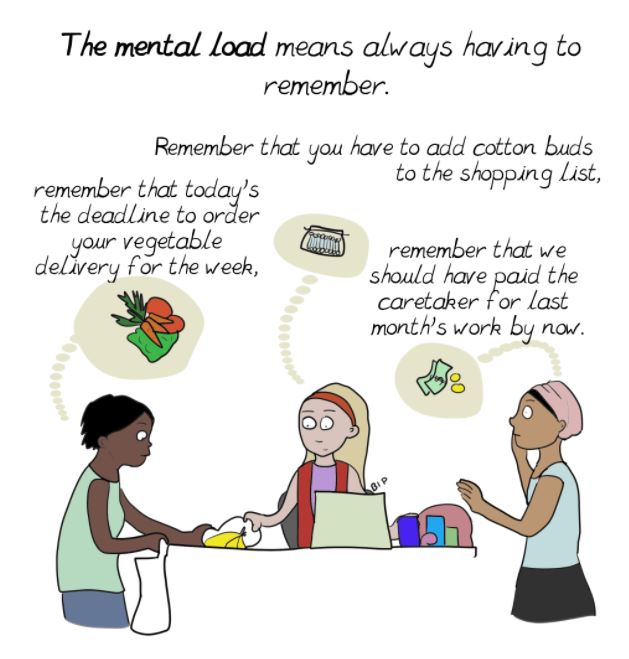
The Guardian has a fantastic comic titled “You Should’ve Asked.” It beautifully shares the frustrations of a working mom at home.

I picked out my 3 favorite pieces pieces from the comic.

These 3 were my favorite because they resonated deeply. I’ve definitely been guilty of the manager-underling behavior. I also constantly marvel at how my wife manages to process so much about stuff at home – evidently without shouldering enough of the mental load. And, I know for a fact that boys aren’t born with an utter disinterest for things lying around because I’ve seen my attitude toward that change completely.

I’ve become more conscious about these inherent differences over the years. Some of the research that’s gone into the amount of unpaid work women do has been eye opening. And, comics like this go a long way in further increasing that awareness.

Awareness is a necessary first step for change.

I hope to do better.

Helping thyself

I’ve read many self help books over the years. Good self help books are books on psychology at their core.

The logic is straightforward – changing ourselves requires us to change how we think. And, it is hard to change how you think if you don’t understand why we think a certain way in the first place.

There’s been a huge influx of really good self help/happiness/psychology books over the years. It isn’t enough to read one of them to inspire change – repetition definitely helps. But, after a point, they do begin to share the same principles packaged in slightly different ways. And, in the past six months, I’ve found myself consciously resisting the newer titles I purchased.

I’ve generally mixed different kinds of books – the odd autobiography, the book on history or technology. But, I’ve always had a self help book in the mix. I think that is no longer going to be the case – at least for a while. I will, of course, always be one of those who strongly believes self help books have an undeserved bad reputation. These books have changed my life and, if you haven’t yet, I hope you’ll give them a shot.

What is interesting is that my takeaway after a decade of reading these books is – just aim to live the 7 Habits. That should be no surprise to folks who’ve been reading these notes over the years. But, it is amazing that I’ve come right back to where I started 8 years or so ago.

As T.S.Elliot might have said – “We shall not cease from exploration, and the end of all our exploring will be to arrive where we started and know the place for the first time.” 

Onward.

Carbon Dating and Clock of the Long Now

Marie Curie discovered that radiation was emitted from the decay of an atom over time. Then, Marie and Pierre Curie found the half life of carbon resulting in “Carbon dating.” Radiometric dating has been key to scientific advances showing that mythical stories about the earth being 6000 years old are just stories – not facts.

Thanks to Carbon dating, we’ve learnt about our past and the movement of Homo sapiens. This is thanks to a story written by the charcoal in our ancestor’s bones that we could only understand once we understood atomic physics.

On the flip side, our many technological advances have shrunk time in a way we’d never have imagined. We live in a time when everything is expected to happen instantly or in “real time.” The same advances have led to a group of entrepreneurs to fund a 10,000 year clock or the “Clock of the Long Now.” The builders of this clock intend this to be a nod to longer term thinking.

Will we take the long term perspective or let the short term triumph? Will we be high frequency traders or good ancestors?

Only time will tell.

“This is the paradox of our age. On the one hand, we have short attention spans and an ability to measure time in minuscule increments. But, on the other, we are able to trace human actions back to thousands of years and also have an appreciation for the fact that this advance was 500 years in the making.” | Steven Johnson

—
Source and thanks to: How we got to now by Steven Johnson

Designed for consumption

The most beautiful pieces of technology we use are generally geared toward consumption. Whether it is your 40 inch flat screen LED TV, that gorgeous iPad or can’t-fit-in-the-pocket phone, these screens have been created to keep us in consumption mode.

Why?

Success in consumer technology products is generally measured by usage. Attention is a scarce commodity. So, the more we spend it on our devices, the more valuable they become.

Next, these products provide us many avenues to consume content produced by studios in Hollywood. Most of these studios make money running advertising.

So, as users, there are a couple of things worth remembering. First, there’s very little incentive for technology product creators to build products that encourage us to smell the roses. And, incentives govern human behavior. So, it is on us to create incentives to limit our time with technology geared for consumption.

Second, a disproportionate portion of our happiness and fulfillment comes from creating things. So, it is on us to stop measuring how many TV shows and movies we’ve watched and counting how many things we’ve built and shipped.

Again, the devices that surround us are not designed to encourage these behaviors. This is on us.