
When we make career transitions, we typically change one or more of the following – (1) Company, (2) Role, (3) Industry, and (4) Location. These are ordered in ascending order of difficulty with changes in location – for the majority of the folks on the planet who do not possess rich country passports – being the hardest by a distance. Most importantly, combining these factors does not simply mean adding up the difficulty – the change gets exponentially harder.
Thus, career transitions can be very hard to make. While there is something be said about experimenting in the early stages of our careers, there are benefits to being in the right (for you) location, industry, and role early. Career transitions are also hard because they require dealing with all the feelings of insecurity and inadequacy that accompanies job hunting. This is heightened if you are an immigrant as you are doing it with the weight of uncertainty about how your change will work given your immigration status.
The result, for many folks, is multiple cold inMails and connection requests to folks they find on LinkedIn searches to ask for referrals or mentorship. This is understandable. Attempting to make a career transition is stressful and any help is appreciated. Sadly, cold inMails to strangers turns out to be the least effective approach.
Over the past five years, I’ve been fortunate to make a transition that involved changing all 4 factors. As with most things, it took a combination of intention, work, dumb luck, and accumulated privilege. We’re still working through visa challenges – so the location change is far from final. Nevertheless, I thought I’d share a 3 step approach toward making big career transitions. To ensure broad relevance, I’ve focused on the key principles while also adding color based on my experiences.
(1) Construct plans A-F: The first and most important assumption I’ll make is that you know exactly what you want to do (if you don’t, please see the resources section below). Once you do so, construct plans A-F. This means having at least 6 routes to the destination. I think the word “destination” is particularly applicable if you are trying to make a cross-country switch as it is worth tackling that head on.
I say plans A-F because it is highly unlikely your plan A will work. And, as you cycle through them, it’ll become easier to move past F to other alphabets. :-) For example, I learnt about the Bay Area and tech while working on a student job portal start-up (that eventually failed) through university. That’s when the idea of working in tech in the Bay Area took hold. But, as I mentioned above, location switches are the hardest kind to make if you don’t have the right passport. In the next 4 years, I cycled through plans A-F before finally finding a graduate school in the US that took a chance on me. (Graduate school is a staple in the immigrant playbook to switch locations)
The next step was to make an company + industry switch – i.e. find a tech company that would take a chance on me – and then a role switch – I’d learned about product management and believed I’d found my functional home. But, how do you get a start when everyone wanted folks with relevant experience?
Below is an image with the 6 questions I’d suggest asking.
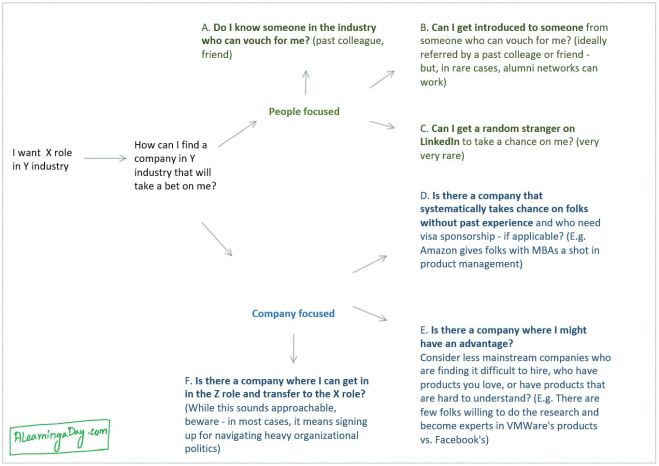
Next, my suggestion would be to build your plans by attacking as many of these options. For example, here’s how I approached it –
A: Was connected to a role thanks to a past colleague.
B: Was connected to a few folks by the same past colleague (he’s a good samaritan) – one of these folks worked at LinkedIn. Also got a referral into someone from my graduate school alumni network. She helped with an interview call.
C: Didn’t attempt connections with strangers on LinkedIn as I wasn’t sure how I’d do so in a thoughtful manner.
D: I signed up for interviews with most companies that took a shot on MBA students without visa sponsorship for Product Management positions.
E – I thought highly of LinkedIn’s product and the vision and felt I’d fit in well. But, LinkedIn was also very mainstream. So, I was also focused on a company like VMWare that was focused on solving solutions with a high level of technical complexity. I figured thorough prep on server virtualization would be a competitive advantage – since few folks would actually do it.
F – I ended up betting on an internal transfer to move into Product Management at LinkedIn. These sorts of transfers are painful in most places. So, this wouldn’t have been my dominant strategy had it not been for an intersection with an opportunity to work with someone I liked and respected, a company whose mission resonated deeply and because of immigration considerations.
All in all, once I’d managed the location move, I attempted all options except emailing a random stranger because the chances of that working are minimal at best. If you are keeping count, I was well into plans M and N by this point.
(2) Understand base rates, preferred demographics and stereotypes: This step is designed to accomplish two objectives – i) Add a dose of realism to your search, and ii) Aide your preparation for an interview which you hopefully will land.
Step (1) was all about mapping your path to what you believe is a dream role. However, it helps to get a sense of the odds. Here, there are 3 questions that might help –
A. Base rates: Are there folks “like you” (similar education, work experiences) who are in those roles in companies you want to be?
B. Preferred demographics: Are you in the demographic that companies are hiring for right now?
C. Stereotype: Do you fit the stereotype that recruiters/hiring managers love?
I understand these may sound like controversial sounding questions. But, just because no one likes talking about them doesn’t mean they aren’t a key part of the hiring process.
In my case, the base rates were encouraging. There were folks with similar education, experiences in roles in tech. However, I wasn’t doing good on B. No one was jumping out of bed excited to add another Indian guy who needed visa sponsorship – which was getting more and more problematic – to their team. And, my stereotype was a mixed bag. The consultant + MBA combination was appreciated by some and despised by some. Now, you might say – “Hey, but what I did in the past doesn’t/shouldn’t define me.” Yes, it shouldn’t. But, given our human need to make quick decisions and label people, it does. So, we might as well learn to overcome it.
While you can’t do much about base rates and preferred demographics, it is important to note that you can do something about stereotypes – especially if you don’t believe you are the typical specimen. – by working on your story in your interviews. I didn’t think I was. I also had spent 3 years in a start-up and worked on plenty of side projects. I hoped to weave that into my story.
I had 2 key takeaways from my own inventory check –
1) This change was possible but was not going to be easy as the field was very competitive.
2) I’d have to find a way to make any interview calls I receive really count. I didn’t have experiences at a big name brand pre-graduate school. This generally means fewer interview shots since fewer folks are willing to take a chance on you. That, in turn, meant I needed to over index on interview readiness as I’d need to have a higher conversion rate.
(3) Take a really long term view. Do you care enough about your career switch to work on it for 5 years? If you do, that is good news. Here are 3 reasons why a long time horizon helps –
1) You will learn and grow through the process of attempting to make a switch. All these experiences will make you a better candidate – if you are willing to persist.
2) It is easier to change fewer variables at a time. For example, a change of location and role or location and industry are easier switches than attempting to change company, industry, role and location. This is particularly the case if you are immigrant – getting your location via visa sponsorship will likely be your dominant strategy.
3) You will have the time to convert random strangers and acquaintances to friends and well wishers. This is really really important. A big part of making transitions is building a network of relationships who will support you through it. And, it is very hard to build this network if you want immediate results. You can’t plant trees the day you want fruits.
I have a couple of stories to make my point. In my case, one of my failed early plans to move involved a final round interview that didn’t go well. However, I stayed in touch with the friend of a friend I’d mentioned above. We ended up meeting in person a couple of times and, thanks in no small part to the help I received, I ended up working on their team a full two years after we connected. Second time lucky.
Another related story – I was connected to someone by an acquaintance. This person stayed in touch via my blog with email exchanges over three years. That led to an in person meeting, then another one, and then a few calls. A full four years later, I was thrilled to help this person find a role where I work.
I could share a few more such stories to continue hammering this point home. But, I’ll stop. The key takeaway – our career journeys are long and full of surprising and random twists and turns. You never really know who will open a door for you some day in the future and you definitely don’t know if a good/bad day is so. It is futile to connect dots forward. So, a better approach is to make commitments on directional plans in the long term, be kind and thoughtful, and keep plugging away.
If this post is reaching you in the midst of a tough time, I’m sorry to hear that. It is surprisingly common on such journeys as the odds are always stacked against you. But, I’ve come to believe that the arc of success and opportunity bends toward merit in the long run. It helps to approach the whole journey as a mixture of scientist and student. Start with hypotheses, run experiments, test, learn, and iterate.
As the wonderful saying goes – “Things work out fine in the end. If it’s not fine, it is not the end.”
I hope this is helpful. Wishing you all the best on your journey.
Additional resources: Here are 5 resources that might help.
(1) The 3 phases of a job search process: This is a companion long read that dives into the details of the job search – figuring out where to apply, getting interviews, and doing well:
(2) 3 principles of asking for favors
(3) How to ask for help from people you don’t know and related – Ask advice better by replacing the generic question with a hypothesis
(4) How to ask for a cold call
(5) The 3 laws of privilege: Slightly off topic – but important. :-)


