The millionaire who wanted to get involved

The college admissions bribery scandal reminded me of a story I once heard from someone who had exposure to the inner workings at prestigious universities. They shared that top administrators were (re-)introduced from time-to-time to multi-millionaire alumni who wanted to get “involved.”

And, whenever this happened, the odds were high that this alumnus had a kid who was 16 years old – in perfect time to influence admissions a year later when it would be illegal to do so. Of course, at top universities, 2 million wouldn’t get you in. It would just mean you get the marginal decision in your favor.

And, as the New York Times lays out, you can guarantee you are in the playing field by shelling out another 1.5 million for a 5 year package from “Ivy Coach.”  The Ivy Coach program guides kids from the 8th grade on the best ways to stand out via extracurriculars while also coaching them intensively on SATs.

Of course, bribery takes all this to a new, amusing or dark (depending on your point of view), level. The SB Nation article I linked to had a few powerful quotes. My favorite was –

When talking about the case, Andrew Lelling, the US attorney for the District of Massachusetts, said, “We’re not talking about donating a building … we’re talking about fraud,” a statement that validates one way that rich people openly game the admissions system. What makes the acts fraudulent, apparently, is that the defendants tried to buy admissions in a way that is not allowed, not that they tried to buy admissions in the first place.

Privilege is powerful.

3 free subscriptions of LinkedIn Premium for 6 months

I work at LinkedIn. Our vision is to provide economic opportunity for every member of the global workforce. One of our initiatives in 2019 is called the #plusonepledge where every member of the LinkedIn team helps someone in their network with finding economic opportunity – finding a new job, a new contract, a new client, and so on.

As part of that initiative, I now have access to gift 6 months of free LinkedIn Premium Careers subscription to 3 folks who are actively seeking a new opportunity. LinkedIn Premium is particularly helpful for job seekers who’d like more custom insights on how their experiences fit toward a job and who’d like the ability to get in touch (selectively) with recruiters and hiring managers of jobs they believe they are a fit for.

So, I thought I’d write in to check if there are members of the ALearningaDay community who’d find this useful. If you are in the midst of a job search, please just reply to this email or send me a note on rohan at rohanrajiv dot com with how you think Premium might help your search. I’ll follow up via email.

Thanks.

(Update: these are no longer available. I’ve completely run out of mine + those of 20 generous colleagues who shared theirs :))

People problems are generally system problems

Consider a few situations that we’ve all likely been through.

a) A few folks on your broader product team seem to frequently spend their time chasing crazy ideas with no result to show for them.

b) You are working on an initiative with folks across multiple teams and find yourself constantly dealing with issues related to miscommunication.

c) You have a cross-functional partner who can’t seem to stop sending you new requests.

d) Your sales team just doesn’t seem to be cooperating.

In each of these situations, it is tempting to think you are dealing with people problems and that the solution is to simply isolate the characters involved and “deal with them.”

In truth, however, each of these could either be partially or completely fixed with better process/systems. a) The product team would spend their time better if the planning process was more rigorous, b) the multi-team initiative needs regular alignment meetings where the issues are consistently surfaced, c) the cross-functional partner needs to be made aware of your priorities (a shared doc?) and could benefit from a light-weight requests process, and d) the sales team likely needs better incentives to cooperate better.

Good management – whether within your team or in your project – is less about dealing with individual people and their preferences and a lot more about thinking in systems that will solve the people problems you face.

And, the first step to being that systems thinker is to be able to say – show me the people problem and I’ll show you the system problem that is the actual root cause.

Filler words – 2019 edition

Self-improvement projects that require us to break old habits are hard. Such projects aren’t settled in a few weeks – instead, I think of them as 3 year construction projects.

One of the many gifts I’ve received from writing everyday here for ~11 years is the ability to work on a few such 3 year construction projects. Writing here forces a level of accountability that I’d otherwise not have. But, while I’ve made visible progress on many self improvement projects, an area where I’ve repeatedly failed is in eliminating filler words.

I was in a conversation recently where I thought I used more filler words – “kinda” and “I think” – than actual words. It was disappointing to hear myself stammer and stutter in my attempts to make a point.

As I reflected on that conversation this weekend, I was reminded of a post on the topic from Seth’s blog that inspired me to revisit this habit a few years back. A few of my favorite bits from the post –

“For a million years, people have been judging each other based on voice. Not just on what we say, but on how we say it.

I heard a Pulitzer-prize winning author interviewed on a local radio show. The tension of the interview caused an “um” eruption—your words and your approach sell your ideas, and at least on this interview, nothing much got sold.”

“Persuade yourself that the person you’re talking to will give you the floor, that he won’t jump in the moment you hesitate. You actually don’t have to keep making sounds in order to keep your turn as the speaker. The fastest speaker is not the speaker who is heard best or even most.

Next step: First on your own, eventually practicing with friends, replace the “um” with nothing. With silence.”

“Talk as slowly as you need to. Every time you want to insert a podium-holding stall-for-time word, say nothing instead. Merely pause.”

“You’re not teaching yourself to get rid of “um.” You’re replacing the um with silence. You’re going slow enough that this isn’t an issue.”

“Our default assumption is that people who choose their words carefully are quite smart. Like you.”

Communicating constructively and with clarity is one of my 2019 themes. Unlike in past attempts, I intend to stick with the filler words this time till it gets solved.

Fourth time’s a charm, I hope.

See you in 2022.

Collective notification log

NYT reporter Katie Rosman shared a screenshot she found of a teacher who had her students turn up their phone volumes in class and create a collective record of notifications they received.

I wonder what this chart would look like if we, as co-workers and family members, did this exercise at important meetings and family meals.

And, perhaps more importantly, what if we made it a point to do it periodically?

(H/T: Greg’s “Cofounder Weekly” newsletter that brings together a collection of interesting/fun tweets on tech/entrepreneurship)

Mailing in the last bit

I recently bought two pairs of jeans. That’s a once-in-eighteen-or-twenty-four-months event in our household. So, we planned a morning trip over the holidays to an outlet store (we’re fans of 7 for all Mankind if you’re looking for comfortable daily wear jeans :)) 40 minutes away, tried a bunch, and wrapped it up.

Of course, there was the small matter of alterations remaining. So, I picked a store that was open and relied on them to get it right. It would have helped to show up there with an existing pair of jeans so we could ensure they got the length right. But, I didn’t. I figured altering these jeans should be simple enough.

It turns out it wasn’t.

Despite explicitly requesting them not to cut the extra cloth away, they did. And, after I made my third visit today, I’m beginning to realize this purchase might just be wasted.

Every once a while, we do a lot of hard work on a project to get it to 90%. But, just as we’re about to get to the last bit, a new shiny project pops up. And, since our 90% project is, well, 90% of the way, why not just mail in the last bit?

In one word, don’t.

Skills, traits, and values in hiring

We were in conversation with Lea Hickman, a former VP of Product at Adobe and Invision, yesterday and asked her about her reflections on hiring over the past three decades. She said the biggest change was moving from hiring for past experience/hard skill fit to hiring entirely for folks who enjoyed collaborating, exhibited an appetite for continuous learning, and demonstrated grit.

This was fascinating for 2 reasons. I found it interesting that her hiring criteria evolved from a focus on “intercept” to a focus on “slope.”

And, second, it reminded me of Ray Dalio’s insistence that most conventional hiring managers have their priorities backward because they insist on testing skills instead of understanding how the candidate’s abilities and values fit with the role.

The value of inspirational leadership

In a post just before Christmas, I’d written about the importance of working with managers who believe in us. The impetus for that post was watching the highlights of a Manchester United game under the new interim manager which saw the team hit 5 goals for the first time in 5 years.

That match, it turned out, was a watershed moment. Under the leadership of the interim manager, Ole Gunnar Solskjaer, Manchester United went on an impressive winning streak – 7 consecutive games, 8 consecutive away games, and victories against top rivals. Through this process, we learnt that Solskjaer wasn’t just a club legend brought in to tide the team through the rest of the season. He was an astute manager and an inspirational leader.

While he’s exceeded all expectations so far, he faced the biggest challenge of his reign yesterday. His only defeat thus far came in the European Champions League against heavyweights Paris Saint Germain. He lost two of his best players to injuries in the first half and the team lost 2-0 in the first leg.

So, he headed to the second leg facing a task that had eluded 106 other teams who lost 2-0 in the first leg in the knock out stages. In the world’s elite football tournament, no one made their way back at 2-0. But, that was not all. He also had 10 senior players out of his 22 member squad injured. So, he fielded a make-shift team with 4 teenage substitutes – all of whom had never played a game in the Champions League for Manchester United. And, to top it off, he’d lost his talisman – midfielder Paul Pogba – as he was suspended after two yellow card fouls in the first leg.

Against all odds, the team won 3-1 and are through to the quarter finals. They rode their luck, they took their chances, and they made it.

This victory was a great reminder of the value of inspirational leadership to me. United were given a 6.7% chance by the bookmakers at the start of the game. But, Solskjaer got every member of the team to believe in their own capabilities, to keep faith in each other, and to dig deep and find that extra bit of energy and resolve when they most needed it.

When that happens, individuals and teams are capable of overcoming absurd odds.

Self made and some fascinating research on privilege

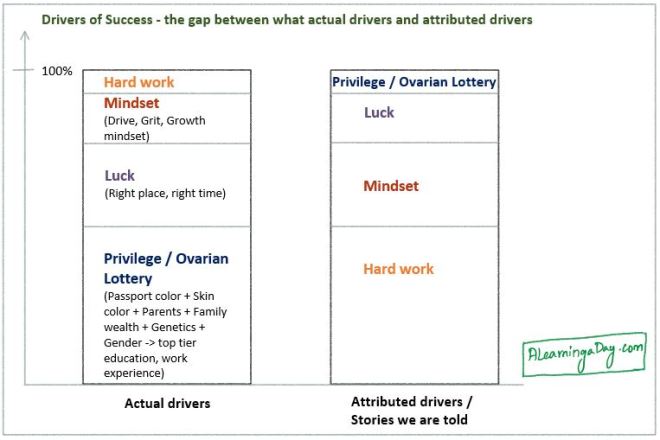
There’s been a fair bit of media outcry (in the United States) on all sides of the aisle around wealth of late. The issue at the heart of most of the outcry is that it seems wealthy folks, with few exceptions, want to be termed self made. And, no one (again – with few exceptions) wants to acknowledge the role privilege played in their success.

Amidst all this noise, The Atlantic shared an important interview with two British researchers who decided to immerse themselves in the cultures of workplaces in four settings – a TV-broadcasting company, a multinational accounting firm, an architecture firm, and the world of self-employed actors. Here are two ways in which they found privilege to show up.

First, financial cushion enabled actors to take low paying jobs to get their start while also enabling others to take important unpaid internships or to live in a city like London where there are more opportunities. Imagine attempting to do any of this with the pressure of having to support a family or pay back debt.

Second, at work, they found it easier to find sponsors who found themselves reminded of themselves while also finding it easier to understand the unwritten norms that folks who are relatively unexposed struggled with.

Of course, this won’t make for a popular media story. Forbes, for example, has a category in their billionaire lists called “Self made who got a head start from wealthy parents and moneyed background.”

But, this research is a start. In time, I’m hopeful we’ll begin to see a lot more data that points to the massive role privilege plays in success. We need to stop downplaying its role so as to build systems that result in broader equity and access.

It will take time. But, I’m optimistic we’ll get there.

PS: I haven’t read this yet – but the authors mentioned above have written a book called “The Class Ceiling: Why it Pays to be Privileged”

PPS: A reminder on how I think about privilege and success.

Trading problems and progress

Difficult problems presented by life don’t go away when we make a big decision or two. Instead, our decisions just enable us to trade one set of problems for another.

Progress, then, is all about trading problems we don’t like working on with problems we don’t mind (or even enjoy) working on.

No problems isn’t an option. Better problems is.