
In response to a recent post, Theo shared – “Maybe thanks to – and not due to – the Coronavirus, we will all be a bit closer to our loved ones.”
Thanks to – and not due to – is a powerful way of reframing any challenging situation.
It resonated.
In response to a recent post, Theo shared – “Maybe thanks to – and not due to – the Coronavirus, we will all be a bit closer to our loved ones.”
Thanks to – and not due to – is a powerful way of reframing any challenging situation.
It resonated.
A note for new subscribers: This post is part of a monthly series on my notes on technology product management (this is what I do for a living). You might notice that these posts often link to older posts in the series on LinkedIn even though they are all available on this blog. That is intended for folks who only want to follow future product management related posts. Finally, for all those of you who don’t build tech products for a living, I believe many of these notes have broader applicability. And, I hope you find that to be the case as well…
A quick overview of what we’ve covered on “Notes on Product Management” so far –
In our last post on Notes on Product Management, we covered how we’ll build our strategy. Thanks to the experience of going through the strategy creation process, you and the product team understand where you need to focus. The next step is to translate that into a product roadmap.
A product roadmap is a high level summary of what we will build to execute on our strategy. I’ve laid out the 5 steps that I’ve found helpful below.
Unlike prior posts, this post will very tactical and, thus, long. I’m going to do my best to share rationale – but, in many cases, there’s a lot of learning from various iterations (read: stumbles and missteps) baked into these notes. So, please feel free to ask questions in the comments and I hope you find it helpful.
Step 1 – The Roadmap brainstorm: The first step to building the team’s roadmap is a brainstorm with the entire product team.
The best scenario is when every person on the product team is present in-person. Co-location is very powerful. Even in the case of a largely remote product team, it is worth waiting to have everyone together as part of a team event to do one of these. A good brainstorm session can take anywhere between 2 hours to 4 hours. These can be shorter – but it is generally worth the time. (If you’re wondering about the remote version of this given the circumstances, don’t worry – I’ve got you covered below)
For details on this step, I’m going to get very tactical (forgive me):
i) Invite everyone on the team – below is a snapshot of the folks who may be on your invite list

ii) Book an airy room with a view – It is worth booking the best room in your building well in advance. You may even want to consider taking the team offsite to do this (you will just need a white board).
iii) Agenda –
a) Objective: This meeting will be successful if…. a) we get to know each other, b) align on context – strategy, data, and user feedback, and c) brainstorm product ideas to execute on our strategy. I also share that my success metric for this meeting is “% of shut laptops.”
b) Fun intros: Invest in doing something beyond having folks introduce themselves. Fun facts, 2 truths and a lie, interesting questions, cross introductions, etc., are ways to make this fun. Time invested in getting to know each other is always well invested.
c) Context:
i. Strategy: Remind everyone of the strategy.
ii. User research/feedback: Request the “Voice of user” team to share a 1 slide synthesis of user research/feedback
iii. Data: Similarly, request the “Voice of data” team to share a 1 slide synthesis of data
d) Brainstorm:
i. Prompt: Share the prompt – What are 3 features you would prioritize for us to successfully execute on our strategy?
ii. Brain-writing: Give everyone 5 minutes to write their individual ideas down on post its – this will ensure every member of your team (especially the quiet ones) have time to think
iii. (optional) Group brainstorming: Split folks into teams of 3 or 4 and ask them to discuss for another 5 minutes and further hone their ideas
iv. Summarize ideas: Go to a whiteboard and ask every person to share their ideas with their reasoning – as they share their ideas, cluster similar ideas in groups as themes will inevitably emerge
v. Prioritized vote: Next, and most important, ask every member to vote for their top 2 across all ideas and tally the top themes. Inevitably, 3-4 high priority areas will emerge.
It is impossible to over state the importance of the prioritized vote. It is the step that separates a successful brainstorm from a failed one. Failed brainstorms have organizers take back sheets or photographs of un-prioritized ideas. In successful brainstorms, the entire team walks out with a shared understanding of the few things that matter.
e) Next steps: Promise to synthesize the results of the brainstorm in a roadmap sheet that you will share with the team.
An outcome I’ve observed over the years – a team with shared context always converges on the right set of big ticket items that matter. This is the most magical part of well run brainstorms. You don’t need to pre-alignment meetings to get alignment within your team. Setting context will do.
And, if you are remote, there’s a way to do this remotely too. You just need to set up a spreadsheet where everyone can vote. Below is a screenshot and click here for a sample spreadsheet.

Step 2 – Organize your plan to ensure you are taking a portfolio view: The next step is to go through your plan and organize your bet into a portfolio view. The 4 buckets I’ve found helpful to use are –
3 common questions that come up when discussing these buckets.
i) Is there a correct allocation between the buckets?: No. This is entirely situation dependent. If you are going through a massive technical migration, you will have a large allocation on “Foundations.” If you are under urgent revenue pressure, your “Core” bucket may be heavily stacked. So, use your judgment.

If there is a mistake to avoid, it is over-indexing on “Core” to optimize for short term metric wins. I’ve personally found a ~20%-40%-40% balance between Foundational, Strategic, and Core to be optimal as it ensures we’re making progress across the board. I don’t generally make allocations for venture bets because those allocations are best made at the level of a business unit vs. in an IC PMs portfolio.
2. Where do you allocate time for fixing bugs?: There are two kinds of bugs – blockers/criticals and everything else. All blocker and critical bugs need to be triaged, by definition, immediately.
Other bugs that fall into “everything else” bucket require judgment. Often times, non-critical bugs point to workflows that need to be re-engineered – these can be incorporated in the “strategic” bucket. The rest is up to you. Different folks have different philosophies on it and these also need to vary between enterprise products and consumer products. I don’t know if there is a right one – the only thing that matters is picking the philosophy that works for you, your team, and your product.
3. What is the best tool to use to create this roadmap?: I don’t know. Maybe there is one – then again, there may not be. I’ve found spreadsheets to be wonderful personally. But, I also tend to be a minimalist when it comes to tools. So, feel free to experiment… just remember again that there is no right answer. Find one that works for you and your team.
Step 3 – Figure out if you can accelerate progress via partnership or M&A: Building a product internally is just one way to achieve your goals with a positive RoI. You can also accelerate your progress via two other strategic options – partnerships and, every once in a rare while, M&A.

If you believe there is an M&A target or two worth considering, build a strong working relationship with your investment/Corp Dev team to build out the investment case. In such cases, make sure your investment/Corp Dev team members have full visibility of your strategy and roadmap (invite them to that brainstorm!).
M&A aside, more often than not, you will likely find ways to partner. There are again two ways to do this –
Step 4 – Share a high level visual in your strategy doc: Bring this back to your strategy doc with a high level visual that breaks your roadmap either in quarters or 6-months/halves. Enterprise roadmaps can go as long as two or three years. But, if it is a consumer roadmap, 18 months is about as long as it probably makes sense (it is unlikely you’ll go 6 months before changing it again :-)).
Use this visual to check if everyone is bought in and if the timelines makes sense – this is especially important if you are running an enterprise product with go-to-market commitments. Below is an illustrative visual – it tends to be helpful to bring cluster features within initiatives that seek to help us execute on our strategy and drive toward metrics that matter. These strategy pillars and metrics, in turn, hopefully map straight to the user/customer problems we set out seeking to solve.

5) Set expectations both externally and internally: Once the team is aligned, the final step is to set expectations.
a) External: Your GTM partners will now use the roadmap to create the customer/user education plan. This may involve previews, presentations, updates to client decks, and the like.
b) Internal: The more tricky part is setting internal executive expectations. This is especially important if you are planning strategic bets or key infrastructure upgrades that may impact your metric forecasts. This is the biggest area where I’ve seen folks make mistakes – and it is definitely the area where I have some painful war stories myself.
The key here is to take the time to work through the first and second order effects of your planned roadmap. Ask yourself – what will be the impact to metrics that matter for each initiative? Then, think through what happens when all the initiatives roll out together – will there be any compound effects? Finally, think about initiatives partner teams are planning to undertake – do any of them impact your strategy?
When you go through that exercise, you will likely realize that there are a few curve balls that you need to further flesh out. If you are managing a business with revenue expectations, work through these steps diligently with your Finance and Ops partners so you know what to expect. Once you know what to expect, communicate and get exec support.
The better your own understanding of what lies ahead and the better you set expectations, the more freedom you’ll have to execute on your vision. Fail to do that and your roadmap will just be a spreadsheet full of ideas that never saw the light.
Building good roadmaps is a core aspect of an IC PM’s job. But, how these roadmaps get built is often misunderstood. It is the PM’s job to facilitate the conversion within the product team and use the team’s collective brainpower, insight, and perspective to create this roadmap. As a result, we can’t just walk into a new team and build a roadmap. Those kinds of roadmaps result in poor products.
Instead, we need to take the time to get to an understanding of the core problems, articulate them in clear problem statements, define a strategy with the team, and then build the roadmap. When we walk into a new team, we often have to do this in parallel with executing on an existing roadmap.
The outcome of a well run process is a team that is aligned and rowing in the same direction. And, a test of this is when they refer to the roadmap as “our roadmap” instead of “the PM’s roadmap” or “your roadmap.”
When that begins to happen (and it often takes time and a lot of reinforcement), good products and happy users/customers generally follow.
The next time we find ourselves dealing with irrational anger, here’s a quote by Thich Nhat Hanh that might give us some perspective – “Three hundred years from now, where will you be and where shall I be?”
(H/T Claudia Dawson on Recommendo)
PS: A second and final PS on the Premium subscription gifts – I heard from someone who hadn’t received the original email I sent with the gift + next steps. If this is you, please just let me know on rohan at rohanrajiv dot com. I have gifts for everyone who asked for one via the form on the post (and a couple extra in case you missed it).
Update since I wrote the note below on Friday evening: This turned out to be a false dawn. In fact, it turned out to be a calm before a storm – we followed a low of 7 as today’s report had 68 new cases.
As I’ve been writing a post a week over the past few weeks, I’ve been reflecting on the lessons I’ve learnt so far. And, the biggest one is that there is no “normal” for this sort of thing.
All leaders can do is act quickly, decisively, and clearly (Tomas Pueyo continues to make an important case for decisive action). But, it is important to remember that there’s no playbook for this sort of thing. All we can do is pay attention to the signs and data, act as early as possible, and hope for a bit of luck.
Here’s to that. Stay safe, stay optimistic. We’re living through a period that is undoubtedly going to be an important point in our history as a species. And, we’ll get through this.
While it is very helpful from a productivity standpoint to avoid news websites/Twitter (see Seth’s powerful post on the topic) save for a few mins every day, one Twitter stream I’ve been monitoring at least twice everyday has been from our local county.
Every day, county officials – who’ve been working tirelessly to help those in need while implementing a strong and important cross-county shelter-at-home directive – share an update on the number of cases.
While I wish we had more data and transparency around total numbers tested, the early signs from efforts to flatten the curve are encouraging. As you can see from this graph, the number of new cases has been trending downward over the past 3 days.

As symptoms only show after 5-7 days, this is hopefully a result of major companies enforcing work-from-home 2 weeks ago. And, if so, this underscores why the tougher shelter-in-place/school closures were important steps to take this week.
The true test, again in the absence of testing data, will be if the change in the new case rate continues to remain at these levels (or decreases) in a week as we’ll see the full impact of the shut down.
If these trends continue, it would be really really really positive and will hopefully help further underscore the importance of acting early. Fingers crossed.
Scientific American has a fascinating, albeit geeky, article with a story that lives up to the title – “No one can explain why planes stay up in the air.”
There are two classical theories that attempt to explain why planes stay up in the air. But, they each have their drawbacks and don’t provide complete explanations.

Even with multiple modern attempts, scientists acknowledge we don’t yet have a one line answer that does justice.
I found myself chuckling as I read the article as I was reminded of a Rory Sutherland idea from Alchemy – Just because it makes sense doesn’t mean it should work. And, just because it works doesn’t mean it makes sense. :-)
Science is fascinating.
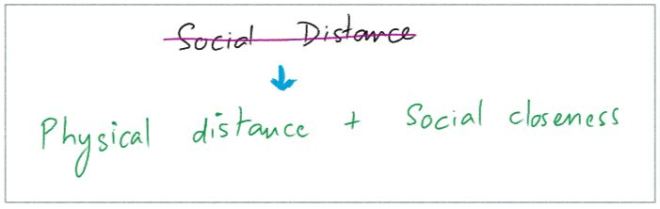
Let’s replace “social distance” with “physical distance and social closeness.”
Adam Gazzaley, a Professor of Neurology and Psychiatry at UCSF, made a great point about replacing “social distance” with the more accurate “physical distance” as our go to term for our efforts to flatten the Coronavirus curve.
At a time when feelings of loneliness and a lack of community have spiked – especially among the elderly – we need to combine physical distance with social closeness more than ever before.
What this means for us: make the time to give friends who’re working by themselves a call from time to time, send a quick check in text to anyone who crosses our mind, send lots of positive notes to our teams, and over communicate.
In times like this, all of us have plenty of reasons to be wrapped up in our own problems. So, it is also okay if we don’t have the time. But, perhaps, every time we hear the word “social distance,” we can begin to flip that to “physical distance and social closeness” in our mind.
Powerful things happen when we change language.
The word I’m thinking most about right now as I release version 31 is focus.
I hesitate to call it a learning because it isn’t yet a part of how I operate – at least not to the degree I’d like for it to be. And, since to know and not to do is not to learn, I still think of my notes on focus as reminders to myself.
As the years pass, I’ve become more aware of the fact that the time and energy I have on this planet are finite. And, with that awareness comes the real need to thoughtfully spend time on the things that matter. That’s where learning to focus is a game changer – by pushing me to be aware of the priorities at any given moment, it elevates the signal and dulls the noise.
The second word I’m thinking about is gratitude. In this very disruptive and turbulent time, my heart goes out to the many many incredible people who are on the front lines in hospitals and grocery stores risking illness to ensure we’re able to deal effectively with a global pandemic.
Many of these folks are forced to do so because the lack of pay check would affect their sustenance.
Thanks to large doses of luck at critical moments and a lot of privilege, I am able to spend time on my work and family without worrying about my health, getting food on the table, or having money in the bank. Instead, I get to deal with all sorts of first world problems while working in a job that was the stuff of dreams not too long ago.
I also have the privilege of writing on this blog – and sharing in this journey with you.
A friend asked me recently as to who I speak to when I need a pep talk.
“I write” – I wrote back.
That’s not entirely true. Thanks to you, these notes often become conversations. And, as I’ve gotten to exchange notes with many of you over the course of many years, there’s a sense of friendship and community that comes with many association of writing here.
So, I just want to say thank you. For being there. I hope you are staying safe.. and well.
I also want to express my gratitude to the many many people who helped me learn, grow, love, and laugh over the years. And, also to the universe for working its magic along the way.
In sum, much to do – with more focus. :-) Much to be grateful for.
Here’s to making it meaningful, making it count.
To the extent possible, stay focused on what you control.
I’ve observed only two leading indicators of someone developing and then mastering a skill –
i) Obsession: Obsession is driven by a combination of a) an intrinsic desire to get better at the craft and b) commitment. I’ve found intrinsic aptitude to be highly correlated to obsession and that obsession makes it easy to put in the hours required to hone our skills. Long hours don’t feel long when you are obsessed about something.
ii) A willingness to adapt based on quality feedback: The quicker the response to quality feedback, the steeper the learning curve.
Applies to developing our skills in building products, playing a sport, or even parenting kids.
I woke up yesterday to a weather forecast that predicted rain for most of the next week.
Great, I thought. The one outlet I was relying on during the Coronavirus lockdown was to go out on hikes over the weekend. This is going to suck.
And it did – in my head at least.
My attitude through most of the day would have received a C. I plodded through the day, reacted to a few things, and made my way to the end.
What we see is what we get.
Luckily for our kids, they have another parent who embodied exemplary attitude and managed to see the situation as a puzzle that could be solved with some creativity and thoughtfulness.
I could have chosen to see what she saw, of course. I could have also chosen to see so many other things I took for granted – good health, shelter, reliable electricity and water, job security, and so many other gifts that I’ve been bestowed with.
If I’d seen all of that, I would have earned a day full of gratitude and opportunity.
What we see is what we get.
It wasn’t to be.
But, I have an opportunity to start afresh today.
So, here’s to that.

