The economics of building a coal plant

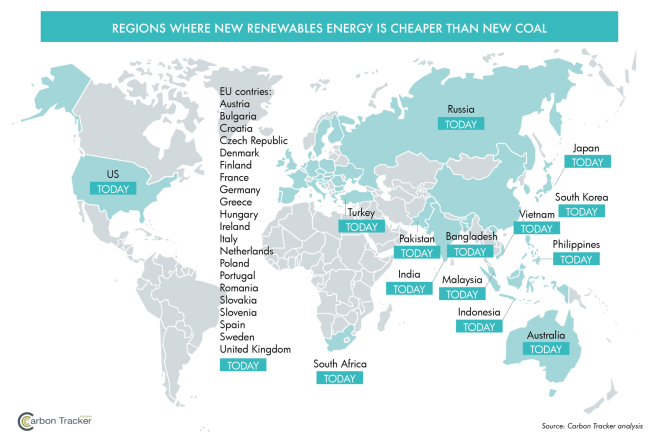
Carbon Tracker, a UK based website I’ve been following of late, shared a useful graphic about the costs of coal versus renewable energy.

Coal has always been considered the cheapest source of power generation. And, as a result, the debate about whether to regulate coal plants has involved a lot of political back and forth in the past decade.

But, as the Carbon Tracker team points out, over half of the coal power plants today cost more to run than building a new renewable power plant. At the rate at which this progress is being made, low-cost renewable energy generation is expected to be cheaper than coal everywhere in a decade.

There are no incentives more powerful than monetary ones in shifting behavior.

Two seemingly contradictory truths

I think there are 2 seemingly contradictory truths to internalize –

1. Everyone around us is hurting from this epidemic. They may be hurting in different ways and to different degrees – but, they’re hurting nevertheless. While it is tempting to compare our pain versus theirs – cut by age of kids, marital status, introversion/extraversion, etc., – the truth is that these are all just marginal differences in the big scheme of things.

2. The real chasm this epidemic exacerbates is that between the haves and the have nots. If we have a) savings in the bank to see us through the next 6 months and/or b) a steady paycheck (likely from a job that can be done remotely), we are firmly in the have category.

This isn’t to trivialize any pain we’re going through. First world problems are still problems and it is impossible to serve others if we don’t take care of ourselves. And, we’ll undoubtedly be better served if we learn to be kind to ourselves and others while also continuing to maintain that combination of physical distance and social connection.

Once we do that, however, it is on us to ask the question – what can we do to help those whose needs are far greater than ours?

Reflecting on reflections and the three crises

Over the past few days, I’ve been reflecting on my reflections here (very meta :-)). And, it’s been quite an experience to look at the impact the Covid pandemic has had on what I’m thinking about. I’ve been writing every day for nearly twelve years now and I’ve never experienced anything like this.

Venture capitalist Brad Feld had a thoughtful post on an idea I found helpful in attempting to make sense of this experience. He makes the case that we are going through three crises all at once – 1) a pandemic, 2) a financial crisis, and 3) a looming mental health crisis from the isolation/disruptive shift.

In addition, these are happening at various levels – local/community, state, nation-wide, and global.

Of course, this may not be the case for everyone – e.g. for folks in communities where the effects may be minimal. But, even if so, there’s more complexity than the plain vanilla (in relative terms) financial crisis or public health scare. And, as the complexity of such events is never linear, the compound effect of so many things happening at once means that there really is a lot to think about.

So, if you’re working through a similar realization of how all-consuming these past weeks have been, I hope Brad’s articulation is helpful.

PS: There’s like a fourth crisis around a lack of time for parents with young kids who’ve also been attempting to be pre-school teachers during the day that also squeezes out available bandwidth to process everything.

5 personal finance notes – volatile economy edition

I share notes on personal finance every few months. Given recent events, I thought I’d share a few notes that are top of mind.

1) A penny saved > a penny earned. Best to tighten up and watch those expenses extra carefully at this time. Also, it is likely a good time to defer any major planned purchases for a while.

2) Ensure you have an emergency fund that enables you to sleep peacefully at night. Most investment advisors will say you should lock in 6 months worth of expenses in cash as an emergency fund. If you’re able to manage that, that’s great. If you think you need more than that, that’s also fine. Whatever it takes to sleep peacefully.

3) Beware selling stocks. If you own stocks, beware selling them unless you desperately need the money in the next 6 months.

4) Consider buying into the market more. Is now the best time to buy? Nobody has a clue. What we do know is that today is a better time to buy in than 2 months ago when prices were sky high. So, if you’ve been consistently been investing in the markets, now may be a good time to bump up your monthly contributions with your savings (see 1).

5) If you’re comfortable and have enough to get by, consider keeping an eye out for small (or large) ways to help folks who need. Even small things such as being a regular patron at your favorite restaurant can go a long way.

PS: For folks graduating in the class of 2020 and for anyone else looking for a job right now, it is hard to keep track of which companies are freezing hiring and which aren’t. Here’s a great live resource from the Candor team for job seekers to understand which companies have announced hiring freezes.

Weather and experiences

We’ve had rainy weather pretty often these past weeks. And, I’ve observed that my mood and energy get a significant lift when the weather is sunny.

In normal times, this happened less often because of the number of experiences that were possible even on a rainy day – people, places, books, etc.

But, as life has predominantly revolved around family, the computer screen on work days, a few rooms at home, and a few mile radius around home (again, weather permitting), the weather has become a key determinant of what the day’s experience might turn out to be.

It has made me more aware of how much we are shaped by the weather around us – consciously and unconsciously. The weather around us makes certain kinds of activities and ways of life possible.

There’s a saying that we are just the average of the five people we spend our time with.

What if all five of these people are shaped by the weather? :-)

COVID-19 #5: Mar 27 notes

Every once in a while, I write something fervently hoping it won’t come true.

That is just false hope of course. The truth doesn’t care about hope.

Over the past few years, such posts have been about the climate crisis. More recently, the post was about the Coronavirus. I wrote 3 things in that post that gave me pause –

i) We don’t understand exponential growth.

ii) The most dangerous places with COVID-19 on the planet today – particularly if you are over 50 years – are places which are neither acting early nor ramping up on testing. Given the lack of understanding around exponential growth, the US administration’s attempts to compare COVID-19 to the flu and downplaying its risks would have lethal consequences.

iii)  The only way out is drastic action – both lockdowns and significantly increased testing. The best action is the kind that looks overly cautious in hindsight.

At the time of writing, I think the number of cases of Coronavirus in the US were around 1000 or 2000. 15 days later, we have already crossed 100,000 cases with no signs of a slowdown as yet. As we’ve finally gotten to drastic measures and lockdowns in many states, I’m hopeful we will begin to flatten the curve in 4-6 weeks depending on how drastic the lockdown is.

It is hard to make an accurate prediction without widespread testing. So, there’s a lot of missing data and that makes it hard to understand what is actually happening. The cost of delay and dithering is significant and real. But, at least, we’re on the path.

I am conscious of the fact that the tenor of my notes in the past weeks have been grimmer than usual. I’m sorry about that. What I write about reflects what is on my mind. And, it has been frustrating to see slow action on a problem that was clearly going to get out of control – especially one that has real impact on lives and livelihoods.

There are no marks in life for cramming the night before the test. On challenging tests, it hardly ever ends well.

If there is one thing you take away from this post, it is that physical distancing is more important than ever – no matter where you are on the planet and no matter what your local authorities are telling you. Even if there are just a few cases where you are right now, it is best to exercise caution.

This is likely the most significant global event since World War II. It is a different kind of war – one that will be fought from the confines of our homes.

It is also a marathon – not a sprint. So, I hope stay safe, find peace amidst the chaos, and find ways to keep your spirit up. Also, let’s continue to replace social distance with physical distance and social connection.

Wishing you well. :-)

Previous posts: #1#2, #3, #4

It is okay if it feels like everything sucks

Outside of the news, there’s a lot of positive/inspirational/educational/heart warming content on feeds everywhere. More than ever, folks are making an effort to share some love and make the best of this unique situation. That is great.

Amidst all this, it is worth reminding ourselves that it is okay if we’re feeling none of that.

It is okay if we’re feeling (one or more of) – lonely, sad about being cooped up, dispirited about talking to people on a screen, annoyed with ourselves about wanting some time away from our kids, anxious about barely holding it together in our jobs, missing the office, hopeless, worried about our finances and/or our jobs, frustrated about misguided projects taking up our limited bandwidth, and guilty about not doing enough for others.

In sum, it is totally okay if it feels as if everything sucks and all we want to do is to play victim for a while.

There’s no way out of a funk without acknowledging that we’re in a funk in the first place. We have to meet ourselves where are.

Progress – especially mental and emotional – is not linear. Every once a while, we have to take a few steps sideways or even backward to eventually make our way forward.

The habit casualty list

I was thinking about habits that have fallen into the casualty list due to (and not thanks to in this case :-)) the lockdown.

I was reflecting on the habits I miss the most at the current moment and there were two that came to mind. The first is the ability to switch off from attempting to get things done (not necessarily work). And, the second is the steep fall in the number of minutes I’ve listened to books on Audible.

The inability to switch off is a fact that most parents with young kids have to deal with. I don’t think there is any way out when you are attempting to keep young kids occupied through the day while getting work done and, somehow, keeping the household clean with dishes washed and clothes laundered. No complaints. We’re all in it together. And, there’s much to be grateful for.

The Audible habit, on the other hand, is one I miss more than I realized. As weekdays, weekends, and any such time compartments have blurred, I realize I miss content stimulating content that pushes me to think about things outside of getting things done at work/home and/or the lockdown/pandemic.

So, here’s to reviving that habit in the coming days.

Understanding data and the one metric that matters

There is a lot written about the Coronavirus every day. However, as the volume of content goes up, so does the amount of unhelpful data thrown into what is written. As a result, it is challenging to find answers all the questions that might be on our minds – are local officials panicking?, are they reacting fast enough?, is that total case number too high?, etc.

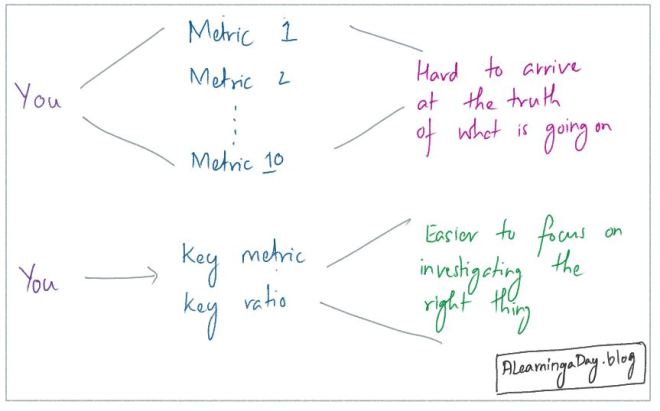
A better approach to understanding the data is to focus on one or two ratios/metrics that matter. In this case, I think we’d be better served if we ignored the news and just looked for change in one ratio – Total number of cases / Total number of new cases yesterday.

The result is the number of days it takes for cases to double. If that number is =<7, then the strictest of lock downs are called for as cases doubling every week will overwhelm the healthcare system and result in more fatalities. If that number is >10 or 15 and increasing, it means the strict measures are working.

Of course, this applies just as well to any business or product we work on. While there may be any number of possible metrics or pieces of data to react to, boiling things down to one or two ratios/metrics that speak to the fundamentals of our business/product help us quickly discern the signal from the noise.