Good weekends

I’ve asked myself what makes a good weekend for many years.

A few weeks back, I finally had an epiphany. I realized that my definition of a good weekend involves four actions in order or priority – rest, connect, learn something and building something.

Rest means getting to sleep in for one of the two days and watching a game of football/soccer whenever possible. Connect involves spending quality time with the framily – ideally with some time outdoors.  But, a good weekend doesn’t feel complete until I feel I’ve learnt something and attempted to build something.

The best part about these four priorities is that I recognize they are a luxury. There are many on the planet who don’t get to take the weekend off.

So, these two days are a wonderful weekly reminder of the enormous amount of privilege in my life and, as a result, of how much I owe.

Maybe acknowledging our privilege with gratitude is what weekends are all about. We get to define what “good” is. And, in the process of doing so, we are reminded that there is so much to be grateful for.

Introducing The Notes by Ada Project | 5 things you need to know about technology every week

Tech, as we know it, has long outgrown “tech.” Technology is everywhere and is becoming fundamental to everything. There are many places you can go to to understand what’s going on in tech. Some of these places do news, a few do analysis and fewer synthesize.

I’d love to take a crack at synthesizing the 5 most important things you need to know about tech during the week in 1 email. These 5 things will likely be a mix of important news or compilations of key pieces of news into narratives. If that sounds interesting to you, do subscribe on NotesbyAda.com.

Why “Notes by Ada?”

It is my tribute to one of the greatest tech visionaries of all time. Ada Lovelace was the first to ever see the potential of analytical machines to go beyond calculating and number crunching. She did this when she translated the work of Italian military Engineer Luigi Menabrea on the analytical engine. And, she simply called them “Notes.” Oh, and “Notes” also contained the first ever algorithm.

That speaks to exactly what I’d like to do. I’d like to take pieces of news, add my notes to them and hopefully envision what’s coming ahead. And, if I emulate Ada in a small way, I think I’d be doing a good job.

Thanks Ada! | NotesbyAda.com

Ending extreme poverty

The “Our World in Data” team has a great blog post on the cost of ending extreme poverty. It is highly recommended. Here are 5 things I took away from the post.

1. Simplifying the economics, the post asks one question – How much money would we need then to lift the incomes of all poor people up to the global poverty line of $1.90 a day?  

The answer is $90B US dollars. To put that number in perspective, the US defence spending is $600B. This number is probably the lower bound as the process will be inefficient. But, even at close to 2x, we’re looking at around a quarter of the defence budget.

I think the comparison to the defence budget is useful because I wonder how much lesser terrorism (30%?) we might have if some parts of the world were better off.

2. It is also less than all of global foreign aid flows. I’m guessing foreign aid goes to fight numerous other problems.

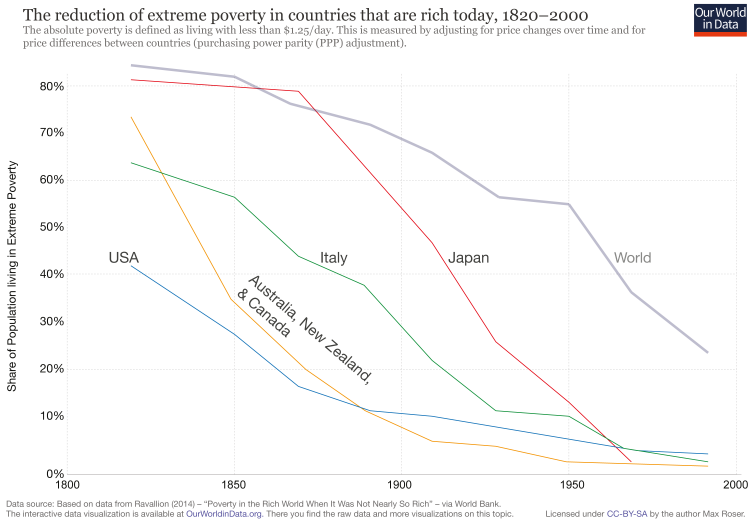
3. The good news is that the yearly cost of closing the poverty gap has gone down. This is because, despite the polarization of incomes, the world has become a less poor place overall.

4. This is true even in rich countries.

5. What can we take away from this? I love this paragraph –

90 billion market dollars is also not a huge number when compared to the net worth of billionaires. Chandy et al. compare the value of national poverty gaps to the net worth of billionaires in each country, and conclude that “In each of three countries – Colombia, Georgia, and Swaziland – a single individual’s act of philanthropy could be sufficient to end extreme poverty with immediate effect.”

We may not be billionaires ourselves but small efforts from many of us can go a long way in helping reduce extreme poverty. In economic terms, these acts have huge positive “externalities.” Areas with lesser poverty have better health, better sanitation and lesser crime.

Of course, if you know a billionaire friend or two, do send them this blog post. :)

You and future you

For the longest time, you didn’t have too much of a say in crafting the “future you.”

Even two decades ago, those who worked “above” you in your organization had a big say in what opportunities you got to work on. Want to make that big career switch? Or, want in on that exciting new project? You just had to wait to get picked by the powers that be.

But, that’s changed.

Now, you have access to an incredible set of media tools to shape “future you.” You could demonstrate your penchant for coming up with ground breaking insights about the industry you want to work in on your blog or on LinkedIn. Facebook or Instagram can be incredible platforms to show off your artistic abilities. And, Twitter is a great place to build a following around your comedic wit or knack for pithy dialogue.

Like all good things in life, these tools are entirely what you make of them. You can use them to consume an endless stream of sticky content. Or not. If you decide to do so, these tools can be your customized digital garage to work on projects that would open up opportunities for “future you.”

Here are 3 simple questions to help craft your approach toward social media –
1. What sort of projects would you like to work on in the future?
2. What do you need to learn and ship to get access to those opportunities?
3. Which 1-2 social media tools could you use to build that body of work? If you really love the consumption, pick one other tool to consume (guilty pleasure allowance) and nix the rest.

You could choose to unconsciously engage in social media in ways that simply benefit their parent companies and hurt you.

Or, you can harness the tremendous power these bring and pick yourself to do work that matters.

Open apps

“How many apps are open right now?” – I asked myself as I decided to close apps running in the background on my phone.

I guessed 4 or 5 apps. But, there were close to 20 apps open and running in the background.

This happens nearly every time I decide to close apps. I underestimate how easily app baggage accumulates.

It struck me that mental and physical baggage accumulates just the same way – silently and continuously.

So, it is our responsibility to create a regular de-cluttering routine to clear enough space to enable us to be conscious and engaged. This could be regular reflection, meditation, a walk in the woods or a shower. It doesn’t matter which approach we choose.

It just matters that we choose one.

Why your garage matters

A garage has had a symbolic role in innovation. We think of startups founded in garages – even if they hardly ever are.

As Steve Johnson writes in “How We Got To Now,” most innovations occur in the “adjacent possible.” And, a few make seemingly impossible leaps.

While the popular theory for innovation is that it is the work of a genius, there are plenty of high IQ individuals at any given time. If there is a common thread, it is that inventors worked at the intersection of multiple fields. Ada Lovelace could see the future of computers as she lived at the edge of science and art. Steve Jobs and Elon Musk are modern day examples of cross disciplinary mastery.

Staying within the boundaries of a discipline can enable incremental improvements – which are critical to progress. But, to make leaps, we have to travel across borders – sometimes geographical. These time travelers often have hobbies and interests in varied fields. And, this is one of the reason garages have such a symbolic role in innovation. After all, garages are peripheral spaces where hobbies are worked on.

So, what does this mean for you and me?

Pick a side project. Any side project will do. Work on something you care about and get better at it. It may seem like it has nothing to do with what you do to earn your paycheck. But, it’ll surprise you. When this one runs its due course, it’ll lead you to the next one. And, so on. Very soon, you’ll have a body of work that speaks volumes about who you are and what you care about.

These side projects serve as differentiation in our career – in ways we’d never have imagined. They also give us energy and cross-disciplinary ideas that we would never have dreamed of.

And, most importantly, our side projects are how we walk toward our future selves.

We build ourselves into who we want to be, in time.

And, all that tinkering in our garage plays a big role in that process.

Ikea Retail Therapy

Swedish agency Åkestam Holst spent 2016 using Ikea ads to explore family dynamics in all shades. Then, they came up with an ad that was a masterclass in how to rethink advertising.

With “Retail Therapy,” Ikea’s website renamed products to match common Google searches in Sweden. Here are a couple of examples –
“My daughter is out all night” – a disco ball
“My partner annoys me” – a double-desk separated by a cubby wall
“He can’t say he loves me” – A magnetic writing board :)

Additionally, this campaign was also smart because high volume searches for terms like “He can’t say he loves me” lifted Ikea’s product ads to the top of the Google Adwords pile. AdWeek accurately called it “a visibility coup so maniacally clever that it’s hard to hold a grudge.”

We don’t sell products. Instead, we sell solutions to problems. Ikea’s ad campaign was a wonderful illustration of that idea. Well played, Ikea.

“Whether it’s a snoring husband, a never-ending gaming son or any other relationship problem you have, Ikea can come to the rescue … or at least put a smile on your face while you keep Googling for an answer.” – Ikea Retail therapy


Source and thanks to: Adweek, The Retail Theory ad spot (1 min, 36 seconds)

We are lent into each other’s keeping

Tom Tunguz had a beautiful post on his excellent blog – “We are lent into each other’s keeping.”


(Cal Fussman, Esquire author and interviewer, and Muhammad Ali must catch a plane, but they are running late.)

Later in his life, Ali suffered from Parkinson’s disease, which slowed him significantly. Fussman is worried about missing the plane, and is trying to hurry them through security.

Just then, a woman pulls a camera from her purse to take a photo with Ali. Ali stops, walks towards her and takes several photographs with her, before continuing on.

When Fussman asks Ali why he did it, Ali replies, “That was likely the only opportunity she would have to take a photograph with me. I wanted to make sure she had the one she wanted.”

Certainly, the experience gave Ali some satisfaction, but as Fussman relates in the interview, the empathy Ali showed impressed him the most.

Fussman confesses in the podcast that he respected and admired Ali more after having met him – something that doesn’t happen with many heroes.

The entire story reminded me of an old friend who often tells me, “We are lent into each other’s keeping.” Our time with each other is borrowed, it’s duration is unknown, and that uncertainty make it precious.

Ali recognizes this uncertainty, and finds a moment to show empathy, understanding and be kind.

Fussman ends the interview with Ali asking him for words of wisdom. When Fussman asks, “How you define evil?”, Ali replies, “Unfriendliness.”

As I’m rushing through my days, trying to make a plane or get to the next meeting, I think about Ali, hobbled by Parkinson’s, the best known celebrity of his generation, dancing through the airport, still taking the time to be kind to a stranger.

We are lent into each other’s keeping.


Something about this story made me choke up for a few seconds. I guess it just resonates beautifully with my experiences and my why.

There is always the opportunity to get caught up in the latest human foible of the day – someone was rude and maybe someone was playing unnecessary politics and work. Life can pass us by if we pay too much attention this stuff.

I am frequently reminded of a line I read from someone on his advice to his 20 year old self. He said – “Be kind, life will roll on with you.”

True. We are indeed lent into each other’s keeping. Thank you, Tom, for a beautiful story.

Learn as we go

Of course we’ll learn as we go. We don’t really have a choice if we want to live our lives with a semblance of consciousness.

But, foregoing an opportunity to prepare when we have the chance is irresponsible and, generally, foolish. In nearly every kind of work, a little bit of extra thought and preparation go a long way. We’ve all been there – that supplier who came well prepared, the interview candidate who demonstrated her thoughtfulness and the spouse who showed she cared.

There are more humans on the planet than we’d like who don’t have the luxury to take the time to prepare. So, preparation is both an opportunity and a great privilege.

And, with great privilege comes great responsibility.

Preparation is how we do small things with extraordinary love. And, that extraordinary love and care is what makes the world a better place for all of us.

3 scheduling tips for meetings with people you don’t know

Many of us reach out to people we don’t know every once a while. It could be for advice, for potential opportunities or for help of some sort. Here are 3 tips I’ve learnt from scheduling meetings on both sides of that table.

1. Be open to an email exchange. There are folks who prefer email if it is a simple ask. The best way to solve for this is to outline your ask clearly in the email. That way, if it just means investing 5 minutes into typing a detailed email, it is almost always preferred to the overhead of scheduling a call.

Related, the clarity of the ask matters a lot as it clearly illustrates the difference between those who are prepared and not.

2. Asker’s responsibility. If you ask for time, it is your responsibility to find times that work. My sense is that there is a three strikes rule of sorts here. I would try to avoid more than three emails going back-and-forth to find a time. And, as an asker, you can do that by being flexible.

3. Make it easy for them to say yes/no or propose a new time. When you have permission to find time on their schedule, draft a detailed email that outlines all the times you might be available in the next week. Assuming you are located in different time zones, a simple way to show thoughtfulness is to send times in their timezone instead of yours.

There’s a new trend of sending people links to online calendars. I think online calendars are great. However, I don’t think sending these is the best idea if you are asking someone else for help. There’s too much friction – clicking a link, finding a time that suits you, etc. That doesn’t mean they don’t or can’t work. I just think adding friction is not the best idea if you have no relationship.

A bonus tip – the best calls are those where you’ve made a good enough impression that the person on the other side is happy to take another call. Your preparation for the call will always come through. And, your follow up will go a long way as well. Always send a thank you note – ideally with what you learnt and what you plan to do next. And, if possible, stay in touch by giving them updates on your progress.

Cold calls are a wonderful way to build connections that might lead to relationships. Very few of them go great – that’s subject to chemistry. But, preparation can ensure none of them go badly. And, that’s a worthy outcome to work toward.