2017 Themes

I had 3 “look back” posts in the past ten days or so that all built up to my annual review. After all that looking back, the time has now come to look forward. I don’t like new years resolutions as I’m not a fan of “goals” based thinking. Instead, I prefer thinking in terms of direction and process. So, I prefer thinking of the new year in terms of themes.

My theme for the new year is engagement. I believe engagement is the answer to the debates around managing energy versus managing time. As with most important things, it isn’t an either/or. And, I also believe engagement is a principle that a good life is anchored around. And, as with all life principles, it is very hard to consistently live it. Also, I think of engagement and consciousness (the ability to be aware and to choose) as sister concepts. They share the same core.

While engagement is the high level theme, my audit and reading pointed to 3 sub themes.

The first theme is – “Seek to understand and then to be understood” – from my holiday re-read of “The 7 Habits.” I am way too impatient and, as a result, interrupt far too much than I’d like. I’d like to do better, a lot better. This isn’t something that’s easy to measure. So, I intend to just check in with myself every day for starters as I build my instincts around this.

The second theme is health. As I grow older, the idea of being very fit grows increasingly more appealing. I haven’t done as bad a job at this so far. But, there’s plenty of room for improvement. I used Mr Money Mustache’s excellent post on “Staying fit with no gym in sight” to reflect on this and piece together my health plan. The first part of this plan is to moderate my diet better – my diet is still pretty carbohydrate heavy (I love rice!). And, having just discovered the benefits of doing a full body work out during the week, I’ll aim to keep that going through this year.

The final theme is information. Again, there are two pieces. First, I’ve been working on streamlining my information diet over the past couple of weeks. I massively cut down on my news consumption and went through a review of every source I regularly consume on Feedly. I also took a good look at my work email flow and consumption habits and have made a few changes. The idea here is to be a lot more conscious about this as I still check my email and feeds far more than I’d like. The second piece of this theme is doubling down on reading books. I have a reading list that I cannot wait to get to. And, I’d like to spend more time on deep book reading over shallower sources.

I expect to see a step change in my level of engagement/consciousness if I work through these sub themes. But, as with all good processes, the journey is sure to be filled with learning. While seeking to understand will help me improve on my interactions with others, I see my approach to health and information as crucial. The better my health and information diets, the more energy I expect to have to be engaged through the day.

Lots of work to do. Onward.

PS: Peter Koehler, a reader, has done a nice job co-creating “The New Years Reader” – to be read aloud and shared with your close friends and family. Hope you enjoy reading it as much as I did. I contributed a thought to it as well. The theme should look familiar to you. :)

“We are a by-product of our questions. Perhaps we stop asking ourselves about how we can be better/best at something this year and, instead, ask ourselves – “How can I be engaged every day? How can I make sure I am being conscious about my decisions?”

All this would take is a commitment to spend 3 minutes to ask yourselves these questions at the start of your day, every day. And, a calendar reminder to re-commit to this habit every weekend.

Wishing you more engaged, more conscious days this new year. As we live our days, so we live our lives…”

Private victories, public victories

Segmentation is one of the basic marketing tenets. If you build a product, target a segment that will love its strengths and ignore its shortcomings. Similarly, if you want to build a blog that becomes massive (assuming you aren’t someone famous already), you are better off focusing on some niche. Examples of such niches are productivity, personal finance, minimalism, health, etc. Going after learning in as broad a sense as this blog does isn’t a winning strategy. For those of you manage to stick on despite this very broad focus, I try every once a while to explain what this blog is about. An idea that will help frame this is – private victories precede public victories.

I am re-reading the 7 Habits very slowly. And, it was nice to be reminded of the logic behind Covey’s structure – focus first on private victories and, only then, will public victories follow. This is the basis of the character ethic that Covey describes. It is about bringing a certain sustainability into life and happiness by being effective. So, what does that even mean?

I’ll go back to my concentric priorities image. If we think of the world as a series of priorities – you, your people, your work and your community – private victories are focused on you, your people/relationships and parts of your work.

The principle is straight forward – you will be able to lead others only once you lead yourself. And, to lead yourself, you have to first understand how to be proactive, to think long term while focusing on what you control and learn to prioritize.

The first time I read Covey’s book, I spent all my time attempting to put the “private victories” portion in action. I had such a long way to go. However, as I read it now, I feel more comfortable with this portion of the book. I am still giving it plenty of thought but I find myself thinking about optimizing existing approaches versus building them from scratch. This process has taken 7 years. And, I’m sure it’ll be a few more years before I spend more of my time attempting to live part II.

How does this relate to this blog? I write about what I most need to learn. And, this blog is and has been shamelessly self focused over the past 8 and a half years. That will likely change with a time. But, for now, it is me teaching myself how to develop a perspective that is both effective and kind. That is why this blog is some parts happiness and other parts productivity, minimalism, some finance, health etc. It isn’t the most effective marketing strategy and is certainly not a case study in segmentation. But, I don’t intend this to be any of that.

This is about growing into character – one learning at a time, over a very long time. It is hard work. But, it is also an awesome process. As is evident in the sheer number of topics I write about, there isn’t any prescribed way to go about this process. Sure, there are a few principles that help. But, for the most part, you are on your own. It is just a journey that requires consciousness and engagement.

And, mostly, it is a journey.

PS: “For those of you manage to stick on despite this very broad focus, I try every once a while to explain what this blog is about.” – if you’ve stuck around for a while, you probably don’t need an explanation. So, you probably guessed this – this is more a reminder of the “why” for me than it is for you. Thank you for your attention. :)

Audit

An audit is an inspection of an organization’s processes typically conducted by a third party. I love the idea of an annual audit and I think I’ve become more conscious about the process over time. And, this year, I am thinking about the various parts of my life as I aim to commit to a few practices for the coming year.

For starters, I tend to take a concentric circle view when I think of my priorities.

This builds on a simple principle – you can’t take care of others until you take care of yourself. However, the prioritization that follows is personal. I think of my people, my work and my community (service) as the priorities that follow – in that order. So, here are some questions I’m asking myself. This isn’t an exhaustive list of the question I should be asking as I’m focused on areas I most want to improve.

Me
How can I eat healthier?
How can I be fitter?
What is my information diet looking like? How can it be less, but better?

My people
How can I be more conscious in my relationships?

My career
How can I organize my workday better to make sure I’m tapping maximum productivity?
Post kid, how do I embrace more flexibility in terms of when I work without letting it affect my engagement at home?
How can I take the time to synthesize what is going in tech?
How can we manage our finances better?

My community/service
How do I define service?

I’ll aim to write about the results of these questions over the next few days.

What’s the point

The path we implicitly sign up for in a professional career is one with continuous movement upward. A sign of progress is having fancier possessions and fancier titles every few years. With it comes an implicit promise of bigger impact. So, every once a while, I find it helpful to ask “what’s the point?”

Most of life’s pleasures are cheap or free. Sure, it is nice to splurge on a nice vacation every once a while. And, maybe some nice additions to our home would make life more convenient. But, for most of us, we probably have all the fundamental parts of Maslow’s hierarchy in place. Earning a lot more money isn’t going to step change our happiness. It might make things easier. But, since when has easy been better?

Furthermore, we learn, time and time again, that few things matter more than the people in our lives. And, again, for most of us, we don’t presumably make friends based on someone’s title. We make friends because they’re people we appreciate, learn from and enjoy spending time with. I have met with enough fancy titled folk over the years to realize there is absolutely no correlation between someone’s career accomplishments and my appreciation for them. The folks I’ve come to love are those who don’t care about any such race. They just deeply care about everyone around them, strive to grow through the daily struggle and work hard to make an impact.

So, what’s the point? If our fundamental assumption around progress is in question, where does that leave us?

My hypothesis is that asking this question can be incredibly liberating. We are surrounded by so much noise – none of which moves the needle in our happiness and fulfillment. And, most of this noise is surrounded with obsessing about our path forward.

So, here’s where I end up – never mind the future. Just understand which direction you are heading. Look at the map, but not too much. Look behind to learn from what happened – but, not too much. Enjoy the company of those who’re around you. Look them in the eye, smile and help them grow through the journey. Help those along the way who are less fortunate. And, critically, enjoy the now yourself.

In the final analysis, it is the happiness and impact you make during the journey that will matter. They aren’t waiting at a future stop.

Do our absolute best

Much of our lives lies outside our control. People respond to this fact differently. Some like to believe they control everything while others like to believe it is all predetermined. Maybe one of those is the right view, we’ll never know. My preferred approach is to simply acknowledge that large portions of our lives lie outside our control. Once we acknowledge that, the onus is on us to also acknowledge the flip side – there are portions, occasionally significant, that are in our control. And, for those portions, we can choose to do our absolute best.

The context to which we wake up in the morning may be outside of our control. How we choose to live our day today, however, isn’t. And, by living our day well today, we can improve our context tomorrow. This can go on until our context changes again – for no apparent reason. That’s part of the unpredictability and beauty of this life. It can rain when we least expect it. What matters is that we learn to dance with it.

As I thought about the week that had passed by, I wondered if I could have done a little bit more. But, I also remembered to ask – did I do my absolute best? Did I be my absolute best?

Contentment and drive are false choices. There’s a tension between them (and many other false choices) that makes life beautiful. Asking ourselves if we did our absolute best is an example of a question that embraces both. We did the best we could as we knew it. Now, that we know better, we’ll do better.

I’ve learnt that there’s not much more we can expect from ourselves in every analysis. I’ve also learnt that there are few goals that are more worthy of aspiration. So, as I start this week, I tell myself that, at the end of it, I will reflect and ask myself – did I do my absolute best? Did I try to be the best version of myself?

I will likely have made mistakes and mis-steps this week. But, if the answers to those two questions were yes, it will have been a good week.

Behind the curtain

1: A wise friend’s friend and ex-colleague, an accomplished entrepreneur, was once in a room with one of the richest, most successful businessmen of our time (let’s call him Mr.Forbes). They were discussing a potential business initiative and Mr.Forbes seemed to be behaving somewhat difficult through the discussions. He seemed to be putting an undue amount of pressure on himself to make absolutely sure the venture would be a big success. After the meeting, this friend asked one of Mr.Forbes’ close friends and associates about the behavior. “Yes” – the friend acknowledged, “he’s just very hard on himself because he’s worried people think of him as a one trick pony.”

2: David Heinemeier Hansson, the co-founder of Basecamp, has a fantastic post in 37 Signals blog about “The day I became a millionaire.” In the post, he shares what many of us know deep in our hearts. After a certain point, money doesn’t make you any happier. Of his realization, he says –

If anything, I began to appreciate even more intently that flow and tranquility were the true sources of happiness for me all along. It was like I had pulled back the curtain on that millionaire’s dream and found, to my surprise, that most of the things on the other side were things I already had. Equal parts shock and awe, but ultimately deeply reassuring.

He adds –

I can only speak to the experience I did have. The one I do share with millions of people who have the basics taken care of, but who still yearn for the treasure perceived to be behind the curtain. For those who might contemplate giving up all manners of integrity, dignity, or even humanity to pull it back.

3: In a conversation with a couple of close friends recently, one of them pointed out that my point of view on someone’s behavior is likely because of “negative goggles.” It was a comment that made me pause and ask myself a couple of questions – “Am I aware of an unconscious bias in my judgment of the situation?”, “Am I being judgmental when it isn’t necessary?”, and “Am I giving with expectations?” It didn’t take me long to answer these questions. I cleared myself of the unconscious bias and I believed I was applying judgment only when concerned with the specific discussion. But, I did feel I’d given something in this situation with certain expectations. The nature of the situation was such that I felt myself entangled in it and I hadn’t let go. That wasn’t something I’d intended to do and the conversation helped me take a simple step that helped me resolve it.

These stories and a certain friend’s recent experiences have exposed me two truths –

1. When you don’t have your basics, i.e. shelter, food and security (or the lower ends of Maslow’s hierarchy of needs), taken care of, life is a fight for survival and making ends need. This happens to us occasionally during times of adversity. In such cases, our life has little do with our sense of self. If you are the daily wage laborer who has to work 16 hours to make ends meet, you don’t have time for much reflection. Even if it might make your life better, your priorities are different – it is about earning your bread and notching up a win for the day. Similarly, if your kid is very sick, your own well being is put on hold as you care for your kid. Again, during such times, it isn’t about you.

behind the curtain, life, needs, self

2. Once you do have your basics taken care of, life, in many ways, is everything you do with your sense of self. Notice how the upper pyramids have to do with love/belonging, esteem and self-actualization. For example, to be loved, you have to be, and feel, lovable. This is what lies “behind the curtain” of most human beings you and I know.

It is this struggle that explains Mr.Forbes’ behavior. It is this struggle that David Hansson refers to. And, it is this struggle that I went through this morning. The quality of our lives has everything to do with how we feel about ourselves. It doesn’t matter how much wealth or material success we have. If we don’t feel good, life isn’t going to be good.

So, how do we feel good or love ourselves? Here, I will go back to Scott Peck’s definition of love – “The will to extend ourselves for our own or another’s spiritual growth.” Or, to put it simply, to love, we must grow. And, to grow, we must love. Growth doesn’t come easy, of course. Self-growth is a constant cycle of learning, reflection, control and awareness. It is a cycle of – self-control -> deliberate action -> reflection or self evaluation -> self knowledge -> self awareness. It is easier to not complete the loop. Self evaluation is painful. I have been working over these years to give without expectations. And, yet, when I caught myself doing so this morning, it pained me. But, ignoring it isn’t going to solve the problem. Response is. And, now that I know this happens, I can be more aware and exercise better self control next time. It is an incredible loop. But, it is hard work. You can avoid this loop for a while (for years, in case of some people), but the pain felt as you grow is nothing compared to the pain felt when you don’t.

It is always better to do the work.

As Scott Peck says –

Life is difficult.
This is a great truth, one of the greatest truths. It is a great truth because once we truly see this truth, we transcend it. Once we truly know that life is difficult-once we truly understand and accept it-then life is no longer difficult. Because once it is accepted, the fact that life is difficult no longer matters.

It doesn’t matter who you are. The fact that life is difficult remains unchanged. If you, like me, are blessed to be free of worries around your basics, maybe this ought to be a reminder that our life is ours alone and we make of it what we will. It is best spent when we stop wondering what is behind the curtain of other people’s lives (especially those who’re more wealthy or more successful by some measure or other) and become better at loving ourselves.

So, it all comes down to this – we’ve been dealt a hand of cards. It isn’t easy to play it right. But, choose to grow, and we have the opportunity to make it meaningful, to make it count.

It truly is a wonderful life.

Career and life lessons from a business class upgrade

I was upgraded to business class on Emirates Airlines last month for a 4 hour leg of a 17 hour journey. It was funny how I immediately found myself wishing I had been upgraded for the longer leg. Ha. Human nature. It had been a while since I traveled business on a good airline and what I observed had some interesting implications on thinking about careers and life.

To begin with, I perceived a change in behavior from the staff the moment I got my upgrade at the counter. I felt I was suddenly treated with more respect and felt special. Of course, the comforts were great – a full recline bed on which you can sleep comfortably and a table on which you can get work done without feeling squished. But, what struck me was the visible difference in the way I was treated. This disappeared the moment I stepped back into Economy for the longer leg.

The principle here is signaling. I was treated as someone with perceived higher value simply because of my accidental/serendipitous business class tag. It is powerful because we, as humans, are always categorizing people and things. And, signaling, one way or the other, determines which buckets we fall into.

So, when it comes to planning careers, my thought process and advice are really boring – work hard, get into the best school you can get into, then work hard and get good grades (or do something really cool in the risk-free zone that is school), then get into the best job you can get into, do very well and you’ll find yourself with more options over time. The reason for this boring advice is that it reduces downside. Yes, we love talking about entrepreneurs who made billions by taking crazy risks. That is largely media fueled nonsense. Most smart entrepreneurs are actually masterful de-riskers – they only take the next risk when they feel they’ve minimized chances of failures. And, as far as drop outs who made billions go, the most storied of the lot – Bill Gates, Larry Page and Sergey Brin, and Mark Zuckerberg – dropped out of Harvard and Stanford. I daresay they would have done fine even if things hadn’t worked out at Microsoft, Google and Facebook.

Fivethirtyeight had a sobering article titled “Rich Kids Stay Rich, Poor Kids Stay Poor” presenting results from a research study on how growing up in poverty affects kids. One of the charts in the article was –

career, wealth

Most charts told a similar story – folks who grew up in wealthy families remained wealthy as adults.The article underlines just how hard social mobility is. And, if these were the results in the US (the land of opportunity), I can only imagine what similar studies would unearth elsewhere.

My hypothesis is that the principle that underlies all of this is, again, signaling. Do well early and you reduce downside for the rest of your careers. Once you’ve reduced that downside, you are well placed to take risks to increase upside. That isn’t to say your chances are low otherwise. But, it is also no coincidence that you have an absurd number of risk takers in places like the Silicon Valley. The truth is that places like the Silicon Valley both place a premium on failure and encourage risk taking once you’ve had a stint at a successful tech firm. So, in some ways, you’re probably only increasing your career capital. Sure, you will always be able to point to many who “made it” without following this principle. But, I could say with a good degree of confidence that the many are a small proportion of the “many others” who fell by the wayside without a Fortune cover story.

The article and data also goes to show how fortunate you are if you won the genetic lottery and were born into the right family. If you are in those top percentiles, maybe this data ought to be a wake up call to stop complaining about all the things that go wrong and to use all that privilege you have to leave the world better than you found it.

A deep life

Cal Newport’s new book “Deep Work” is just out as of this week. I love Cal’s work and downloaded it the morning it came out on Audible and am looking forward to getting through it in the next two weeks.

deep work,

I don’t expect the book’s insights to surprise me – Cal’s thought process generally resonates with my philosophy and he also shares his thought process via his excellent blog. (My framework for doing work that matters is – focus x intensity x hard work – and the book focuses on the intensity portion.)

That said, I am excited about the book because I expect him to bring together all this learning, help condense it into a thesis and also help me think through actions to increase the percentage of time I spend in deep work mode. More depth = more mindfulness after all.

So, I am looking forward to obsessing about “deep work” in the next 2 weeks. After all, as Cal nicely puts it, “a deep life is a good life.”

Here’s to that.

16 life principles

Over the past weeks, I’ve been thinking of “principles” – ideas serves as fundamental truths. So, I decided to attempt to boil all my life related learning into 10 principles or ideas. While I couldn’t manage to boil them all down to 10 (maybe that’ll happen in another 20 years :)), here is my list of 16 –

1. There are 2 forces that shape our lives – our circumstances and our decisions. Our circumstances play a massive role in determining our impact on the world. If we’re blessed to have had the privilege of good circumstances (and, if you are reading this, the chances are high that that is true), we ought to treat that privilege with utmost humility and do our best to make it count.

2. We make decisions all the time and the nature of our decisions are shaped by our mindset. At any given moment, we can either choose to adopt a judging mindset (why am I so dumb? Why are they so stupid? What’s wrong with me?) or a learning mindset (what can I learn? What are my options?). The latter results in a much happier path.

3. Insecurity is the most powerful force on the planet. Our insecurities are the source of our drive, ego and any sort of desire to prove ourselves. Our ego is just our attempt at a shield that masks our insecurities. Every one of us has insecurities. The question that remains is whether we stay in the driving seat or let them drive us. Again, they could drive us to enormous wealth and power but it is very unlikely they will bring happiness.

4. Happiness is a by-product of a life where what we do is aligned with what we value and where we’ve learnt to keep perspective through life’s ups and downs. Perspective brings gratitude and that, in turn, brings happiness. Happiness, as a result, can’t be pursued and isn’t guaranteed on our birth certificate. It ensues from an approach to life that is deserving of it. And, it is also why the alignment of values, thoughts and actions are a thing of beauty.

5. If there was ever a secret to finding what we want, it is to simply strive to become deserving of it. To find a great job, be a great worker. To find great friendship, be a great friend. That is, of course, just one side of the puzzle. But, most importantly, it, “the process,” is the only part of the puzzle we control. In the long run, great processes lead to great results. All we can do, however, is give it our best shot and then let go.

6. Even with our best efforts, things (relationships, jobs, deals) may not work out, however – that’s because it still takes two hands to clap. Things work out when there is fit. Over time, we attract people and, thus, circumstances based on who we are. We demonstrate who we are by what we do. And, when we pursue relationships and engagements that fit with who we are, it is quite magical.
(A note on attracting people: in the long run, it is futile to attract people by attempting to be liked. Universal popularity is an oxymoron. All we can do is hope to be deserving of respect. Liking may follow.)

7. Fit underlines an important principle – our life is an exercise in picking people. At any point, our health, wealth, and happiness are likely to be the average of the 5 people we associate with. That is why it is vital we learn to pick people based on alignment with core values rather than other superficial traits – people who are similar on superficial traits will never challenge our thinking. Picking people requires us to continually hone our people judgment. And, once we get good at picking people, we have to then get good at keeping them – that requires character.

8. If there is one word that best describes people of character, it is, in my opinion, integrity. Integrity comes from the word integer – which means whole. To be whole as a human being requires us to be consistent – in our words and actions. Character, at the end of the day, comes down to one thing – our ability to make and keep commitments to ourselves and others. The integrative nature of character illustrates why dividing life into buckets such as work, personal, social, etc., is futile. How we approach one thing is how we approach everything.

9. It isn’t enough to make and keep commitments, though. Over time, we have to learn to pick the right commitments. Our ability to do that while keeping focused on our priorities is what defines our productivity. When we take actions that move us toward our priorities, we are productive. The rest is just activity. To be consistently productive, we need to combine focus (consistent prioritization or your “strategy”), intensity (what we commonly call focus or “tactics”) and hard work (execution). Good strategy, as a result, is simply making the best possible decision by being aware of the trade-offs involved.

10. If we do manage to do all of this, we become worthy leaders – of ourselves. Do more and we become worthy of leading other people. Leadership is simply caring more than the next person. And, leadership matters because great things are achieved by groups of people – teams. Learning to lead and manage teams, as a result, is as high value a skill as they come.

11. To be able to lead, i.e., care for the people around us, we must demonstrate ability to care for ourselves. We must sleep well, eat well, exercise well and nourish our minds with books and ideas. All of these help us maintain our willpower reserves, which, in turn, help us make good decisions. It is easy to lose track of these priorities in the daily grind. That’s why we need great habits.

12. Habits are life’s infrastructure. The better our habits, the easier it is to be effective. Again, the better our habits, the more we have access to our limited supply of willpower for the tough decisions that matter. Willpower matter so much because self-control is single highest determinant of the quality of our life.
Habits are built by developing a systems driven mindset that ignores short term goals. A 10 pound weight loss diet is a goal, exercising 3 times a week is a system.

13. Systems can only be developed with a willingness to embrace experimentation. Building habits that last the trials of time are hard. It requires us to test various approaches and, eventually, arrive at something that works for us. Failure is an essential part of experimentation. And, experimentation requires us to internalize the idea that “this might not work.”

14. Confidence is built on the idea of “this might not work” as it requires us to shun the easy, safe path. Confidence isn’t built on the belief that everything will work. It is built on the understanding that things will likely not work out and that will be just fine. Confidence requires an acceptance of this truth, the truth. As a result, the first true sign of confidence is vulnerability.

15. Vulnerability is difficult because it requires us to be comfortable with our fallibility. We are all, by default, a bundle of contradictions. That’s because every one of our strengths mirrors a weakness that can derail us. It is only with self-awareness can we understand this, accept this, and proceed to build a meaningful life. This building process requires us to constantly hone our self-control muscles because building a meaningful life requires us to consistently postpone immediate gratification and do what’s right for the long term. By definition, meaningful isn’t easy. But, it is worth it.

16. So, what does all this mean for our lives today? The best way we can bring this all together is that we must approach life as students of life. As students of life, we must take responsibility to design a life that’ll maximize our shot at leaving this place a bit better than we found it. Some days will be better than others. It is hard to tell which as we never really know if a good day is a good day. All we can do is be the best version of ourselves today, plan to be better tomorrow and ten years from now, and yet, listen to, hug, and celebrate people while we can today. We can live either nothing is a miracle or as if everything is a miracle – it is our choice.So, if we can go to bed every night knowing we gave it our best shot and being thankful for everything we have been given, we will have given ourselves and the world the most beautiful of gifts – a day well lived.

And, as we live our days, so we live our lives.
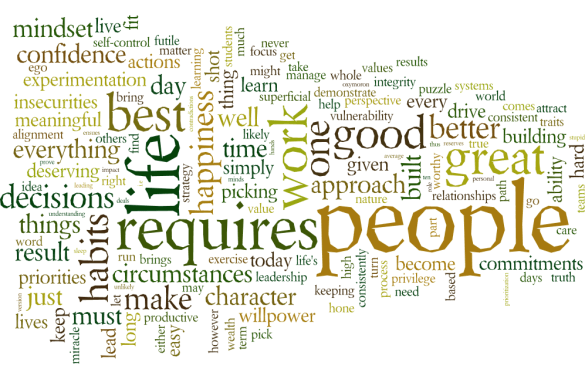
wordle

(a tag cloud of all the words in the post above courtesy Wordle.net – fitting that “people” takes top billing)

Doing it wrong, relentlessly

Every once a while, I am reminded of  a post from Seth Godin in 2012 – “Doing it wrong, relentlessly.”


Doing it wrong, relentlessly

According to this post by Neil Patel, I blog incorrectly–missing on at least 7 of his twelve rules.

On purpose.

I’m not writing to maximize my SEO or conversion or even my readership. I’m writing to do justice to the things I notice, to the ideas in my head and to the people who choose to read my work.

The interesting lesson: One way to work the system is to work the system. The other way is to refuse to work it.


I remember wading into the comments of the original post and had many thanking Neil for the great advice. After all, as a couple of the comments pointed out – “that’s easy for Seth to say. He has a blog with a few hundred thousand followers after all.”

I’ve reflected on this post a few times. Among the things it has taught me, two stand out.

First, we need to understand what we’re optimizing for. A few years back, I experimented spending a bit more effort publicizing these posts and carefully looking at my page views and analytics. These efforts barely lasted a week. Every aspect of my being seemed to reject it. I learned quickly that I wasn’t interested in optimizing those things. Now, of course, the results would be great to have. :-) I would, of course, love it if these notes resonated with many more people. But, I wasn’t ready to try and maximize it by investing time into self promotion. It just wasn’t/isn’t me. Besides, time is scarce and I’d rather spend the extra time making sure my post for the day is clear and concise.

Second, there is a huge market for easy-to-implement advice. Easy-to-implement advice often assumes certain things about what you are trying to do. Seth’s blog is not remarkable because he writes a certain way or keeps his posts to a certain length. It is remarkable because he’s written, and shared, every single day for more than two decades. That isn’t easy advice as a receiver. It is much easier to be happy with advice that says there are just 12 things you need to do every time you post.

But, as I’ve come to realize, good things are always hidden among the hard things.

what comes easy won't last long and what lasts long won't come easy, blogging, doing it wrong