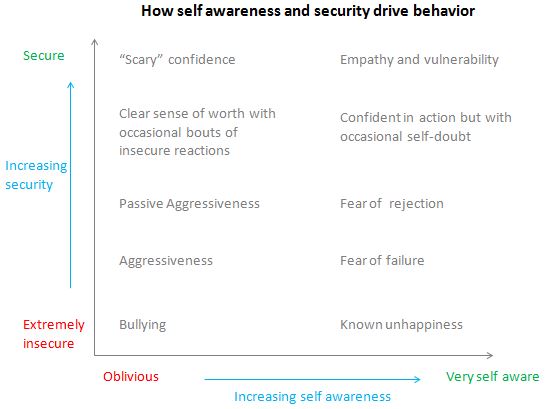
How self awareness and security drive behavior

Below is a 2 x 2 that describes how self awareness and security drive behavior. This isn’t a well researched graph. Instead, it is one that I’ve put together from observing myself and other people.

Before we dive in, I’d like to quickly describe the axes –

X Axis: Self awareness – Oblivious stands for an inability to be self aware.
Y Axis: Security – Secure doesn’t mean the person has no insecurities. Secure just means that, on average, the person is a lot more driven by security than insecurity. Every one of us have our insecurities but some choose not to be driven by them. Another possibility here is that, sometimes, environment plays a role in increasing the insecurity level.
Self awareness and security 2x2

I can’t say I am happy with every data point I’ve described on the graph. I recognize the ones I have experienced well. I have also not marked many interesting points in the middle which is probably where we spend most of our time. However, I think this should work for all practical purposes. Over to the takeaways –

1. Aggressive behavior always arises from insecurity. Vulnerability can only rise from confidence. The causes of these two behaviors are often swapped. Vulnerability, the ability to ask for for help, the ability to be kind, etc., can only come from a place of worthiness.

2. I find it very helpful to think of my behavior within a particular situation on this chart and understand what drives it. For example, I was on a call yesterday when I started out behaving aggressive. The call was a first-of-a-kind discussion in my experience with 10 people via Google Hangout on a topic that would have really benefited from a face-to-face meeting. I had no idea if we’d even be able to facilitate such a discussion via a video call with it’s lags and disconnection. 5 minutes into the call, once I began to realize that there was no need to worry and that I should really calm down, I began to settle. Soon, I was back to normal behavior.

3. My idea of normal behavior has changed a lot over the years. From my limited experience, it is easier to move right before you move upwards. We can all work harder on our self awareness by setting aside more time for reflection and taking stock. It begins there. Insecurities are a harder beast to tackle. They are often so deep rooted that it takes a fair bit of self awareness to even realize that is the case.

4. I’ve deliberately stayed away from the concept of “ego.” I’ve observed large egos when you feel insecure and manageable egos among the more secure folk. That said, I am always left with the feeling that there’s more to that word. So, I’ll come back to it when I feel I’ve understood it enough – maybe 4 years from now. :)

This graph is a culmination of observations over the last 4 years or so and is the first time I’ve been able to put these thoughts and ideas into a frame. These ideas have had a lot of influence in making me a happier and more secure person. And, if there is anything I have learnt, it is that we can all benefit from self reflection. Positive change almost always begins there.

The value of doing nothing – The 200 words project

Here’s this week’s 200 word idea from this Morningstar article on the value of doing nothing.

Michael Bar-Eli et al analyzed 286 penalty kicks in top soccer leagues and championships worldwide. As the ball takes approximately 0.2 seconds to reach the goal, the keeper has to decide whether to jump about the same time as the kicker chooses where to direct the ball. The researchers found that the goalkeeper almost always jumped left or right as they typically choose action over inaction. But, interestingly, the data revealed that the optimal strategy for the goalkeeper was to stay in the centre of the goal.

Just like the goalkeeper, investment professionals too feel compelled to play every trade that is out there in the market. The median holding period of the top 100 stocks by market capitalisation in the U.S. has shrunk to a third from about 600 days to 200 days over the last two decades.

As far as investing goes, there is high value in doing nothing. After all, as Warren Buffett says, benign neglect, bordering on sloth, remains the hallmark of his investment process.

Value of doing nothing

Source and thanks to: www.EBSketchin.com
Related source for all interested in personal finance and investing – Our learnographic on personal finance

‘”Do nothing” are the two most powerful – and underused – words in investing. The urge to act has transferred an inconceivable amount of wealth from investors to brokers.’ | Morgan Housel

Fun Saturday: Best 20 chick flicks

When my wife and I got together, I didn’t like or watch chick flicks. But, then, since our taste in movies were two non intersecting circles, we both had to make a few compromises. One of them from my end was watching romantic comedies or “chick flicks.”

I am not a regular movie watcher but I think it’s fair to say that I’ve seen my fair share of chick flicks over the past 8 years. And, for all the reluctant boyfriends and husbands, I am happy to share that there are quite a few nice ones out there. When I mentioned this as a bunch of us gathered a couple of weekends a go, one of the group raised his eyebrows in disbelief and sent us a request for a favorites list the next day.

I thought I’d share that list. This is pretty much sorted in the order of priority that my wife and I agreed on. We may have missed a few but hoepfully this is a good starter list –

1. We Bought a Zoo: Matt Damon, Scarlett Johansson with kids and animals. Hard to go wrong but they actually did it pretty well.
2. Penelope: Great great movie. Must watch as it has a lovely message. And, as a bonus, it also has Peter Dinklage.
3. Sweet Home Alabama: Classic chick flick. We like it loads.
4. The Switch: We’re big fans of Jason Bateman.
5. The Proposal: Another classic.
6. Raising Helen: Nice move with a nice message.
7. No Reservations: See above and also has Catherine Zeta Jones
8. Notting hill: The chick flick of chick flicks
9. The Wedding Date: I can’t remember/this was my wife’s pick.
10. Definitely, Maybe: I liked this one.
11. Love happens: Nice message with Jennifer Aniston and Aaron Eckhart.
12. The Wedding Planner: I can’t remember/this was my wife’s pick.
13. How to lose a guy in 10 days: Classic
14. Pride and prejudice: The Keira Knightley version. I thought it was done well.
15. What to expect when you’re expecting: Funny in parts and touching in parts
16. Maid of honor: I can’t remember/this was my wife’s pick.
17. Couple’s retreat: REALLY lame but will inspire you to go to Bora Bora
18. The Change Up: Very lame but with some hilarious moments
19. Forgetting Sarah Marshall: Nice movie
20. The Notebook: This is a sob fest.

PS: If you guys have good recommendations, I’d love to hear them too!

Making the world better

Atrocities happen every day of the week on this planet. This was one of those that had me swearing out loud. A man felt it went against his family’s honor for his pregnant daughter to marry someone against his wishes but felt it was perfectly okay to murder her with his son and a few goons.

There is a lot wrong with the world. There is no doubt about that. There is a lot right too that goes unmentioned. It feels, as a result, that we have two principal duties to help make the world better. Focus on the right in our lives and do more of it. This is the only way to keep our spirits up without getting bogged down by everything that is wrong with the world.

At the same time, we must work hard on changing what is wrong. A lot of what is wrong with our attitude towards other races and women can be made much better. It starts within. We have to pledge to be open to differences ourselves and hopefully change the culture of our families and friends to reflect that. Change occurs in ripples. It begins with changing ourselves or, at the very least, teaching ourselves to think. There is a real dearth of people who can do that. Atrocities like the one above are typically committed by men (yes, it is always men) who are unthinkingly following some norm or order.

The world will never be perfect but it can become better, much better. In making ourselves better, we make it a bit better and I think that’s as worthwhile a cause as any.

Building Help2Grow.org – a series

When a few close friends and I met on a saturday evening last year, our discussion centred for a long time on the best way to give to those less privileged than us. We had all tried multiple methods – volunteering our time, giving to charities, and a fair bit of micro-lending. And, we were still discontented. I think it was because we felt we could do it better but didn’t know how. We were all intent to do this back in India as we had all grown up seeing the challenges the underprivileged face and we wanted to do our bit to make it better.

That conversation in early September last year was when Help2Grow.org was really founded in my opinion. Conversations can be truly momentous in retrospect.

A few weeks later, another friend shared some of the charitable volunteer work he did on a Whatsapp group that we all are part of and we jumped at the opportunity to further the discussion. “Why not start our own charity?” – we thought. And we did.

We had 2 challenges in the pre-formal-founding days that we never expected. The first was picking a name. We put all the pressure on our volunteer friend and shoved what must have been close to 200 possibilities  at him – again, over Whatsapp – technology really is amazing. After being stuck in the “we need a name” phase for a week, a couple of us decided we just had to hammer it down. So, the final name was picked and we were ready. Learning – many teams tell wonderful stories of how they spoke of a name and how it just “clicked.” We didn’t have any such luck. We were mentally and emotionally tired of the naming process and decided it was time to pick and focus our energies on making a difference. And, guess what, we love our name!

The next challenge involved getting the India wing of the team together for the formal registration. We wanted 3 team members to sign the trust deed and, somehow, one thing or the other seemed to come up in the last minute leading to a postponement. Initially, there were whispers of this being the universe’s way of telling us what the “right” time would be (or fate). After a month of dithering, we decided it was probably not fate but the resistance. So, we promptly got it done. Learning: Yes, there are times in life when, no matter what we do, life seems intent on executing other plans. However, that is not always the case. It is also up to us to keep pushing to test the limits.

We then navigated our way through the registration and began working towards our first meeting. We had 14 people interested, had registered a charitable trust, created a bank account, and were all set to go.

But, where?

That’s the story I’d like to share with you. It’s a story that is still being written and, most importantly, it’s a story that might not work. This isn’t a series about how to build a successful charitable trust – this is a series about our attempts at building a charitable trust that will last a 100 years. I’d like to take you through our process, failures, occasional successes and learning through the process. One of our core values is to “be transparent about why we do what we do” – so I’d also like to share our intent, dreams, and plans. Help2Grow.org is about giving to the community and there are many ways to give. We’re hopeful sharing these learnings will help too.


This blog post has also been posted on the Help2Grow.org blog.

Every market/client has problems and every market/client is special

There is a nice consulting truism that serves as a reminder from time to time – every market/client has problems and every market/client is special and, most importantly, no one really understands this (especially not those people sitting in headquarters).

I’ve seen this across clients and across country organizations within the same client. Every country organization says exactly the same thing when starting out on a discussion around change.

What they are really saying is – Take time to listen to and understand us. If we don’t feel listened to, we’re not going to listen to you.

They’re right in part. The listening helps us in understanding the nuances that will enable us to ask the right questions. The basic principles will still work (they are basic principles for a reason) – we just have to customize them to suit the needs of our clients.

But, first, you have to listen to be heard.

Staying in pretentious-stan

Social media has created a new country – Pretentious-stan. Here’s a prospectus –


Rent: Our rents are high – we require large amounts of your time and an unwavering attitude that is focused on serving our cause. Most of your thinking time should be devoted to making the stay of our other residents comfortable. This is not all about you, after all.

Note: Unholy ideas like opportunity cost are not to be considered

The ideal resident. Our ideal residents have 3 endearing qualities to our residents –
1. A constant need for approval
2. A willingness to share normally uninteresting details and/or gossip
3. A willingness to, well, be pretentious. This requires a bit of elaboration – we require our residents to invest in things that fall into our “Like-able list” – all moments they feel awesome and amazing, photographs of a coffee mugs and tea-cups at all stages from all angles (actually, most kinds of photographs), “check in” from every place that might draw likes – new countries, business class lounges at airports, and, in general, we love those who share pictures of themselves sharing into great landscapes.

(Fun fact: Unlike the Foursquare check in which was invented to create a directory that would create an online version of the yellow pages, we are proud to share that the Facebook check in was created purely for Pretentious-stan residents. That it has expanded to mainstream use is a sign of our the validity of our mission.)

Are you worried that you may not fit in? Don’t worry – even if you have none of these qualities but have a desire to fit in, we’ll make it work. We use state-of-the-art tools (Facebook and Instagram being on top of the list) to make sure you feel at home right from day one.

Word of caution:
1. We consider sharing things in our “un-like list” equivalent to treason – interesting ideas, stories about your failures (boo), things that moved you, long and well thought out prose. We share similar ethos with successful public speakers and just focus on making it entertaining. Real content is frowned upon and you can rest assured that NO pretentious-stan member will like or encourage such content by sharing it.

2. We also dislike the use of social media to, well, be social – e.g. stay in touch, create meet ups in real life, etc. We allow for occasional indiscretion but, on the whole, we prefer you spend time on your phones even when interacting with your family and friends. Thank you for your understanding.

We are sure you will like it here.

The ones who are most in need of love..

are often the ones who are hardest to love.

The same is true for most things we tend to long for (for good or for bad) – happiness, money, jobs, recognition, power, success. It always feels like the ones who have a lot of something are the ones who get more of it and vice versa.

I’ve learnt that it’s best to observe those to whom something comes easy and understand what they do or don’t do. For instance, since my interests lie in happiness and success in the form of making a positive difference on this world, two of my observations from people who seem to have it figured out are –

– Happy people have this unending ability to keep perspective, laugh at a situation and say – “C’mon, it could be much worse.”
– People who make a difference don’t do it with one large decisive action overnight. The big actions we see are the sum of a lifetime of consistent small actions.

There’s a lot to learn.

PS: I’ve also learnt that, sadly, there’s not much we can do for someone who refuses to learn these things. We’re better off surrounding ourselves with folks who are happy rather than attempt to turn around an unhappy person. We only go where want to go – others can help but only so much.

Happiness will not be downloaded – The 200 words project

Here’s this week’s 200 word idea from Steve Faktor’s articles (12) on the Harvard Business Review

When the National Organization for Research at the University of Chicago asked which jobs made people happiest, most of the top-10 occupations involved creating a product, engaging the senses, or helping others.

10 most loved jobs - Steve Faktor

The ten most hated jobs, on the other hand, had a significant proportion of people stuck on a laptop.

In his article “How office dwellers can become doers,” Steve Faktor argues that we need to improve happiness at workplaces by enabling people to do all of this.

For product companies, engage employees more in the product building – send them to factories, keep prototypes and samples lying around, and allow for “building projects” like decorating the office.

Engaging the senses can be done by livening up work spaces, introducing more plants, having 15-minute stand up meetings and standing desks, and killing unnecessary document preparation. Allow for more employee interaction and mutual help with office sports leagues and team cook-offs.

As Steve points out, happiness at work cannot be downloaded. We need to make it happen.

‘My last traditional office job was leading growth and innovation at a Fortune 100 company. From the outside, you might think my job was a cauldron of experimentation that at any moment could produce a cure for cancer or The Incredible Hulk. No such luck. Most days were a potpourri of emails, meetings, and sensory dead-ends.’ | Steve Faktor

The Personal Finance Learnographic

First up, the news – We, the Learnographics team, are back with a new learnographic. A learnographic, as you might have guessed, is a synthesis of learnings from a book (or a couple of books ona  topic). In the spirit of starting with “why,” I’d like to share our thesis on learnographics –

We believe that our progress as a species occurs when we find, build and share great ideas. We also believe in the power of learning, reflecting, and sharing ideas in living happy lives. Books are a big source of learning and ideas and we’ve embarked on a mission to spread ideas from our favourite books.

After our first learnographic on willpower last year, we took a bit of a break as we thought about how we wanted to make this process sustainable. Our promise for this year is release 4 learnographics by the end of the year – 2 in the first half and 2 in the second. Producing these is a real labor of love – it involves us reading a bunch of books, synthesizing them, picking a book or two that we think would make for an interesting topic, illustrating them so they are easy to follow, and then sharing them with you.

We picked personal finance as it is a topic that we believe ought to get all the attention it can get. In this case, the learnographic is a synthesis of 6 books, 3 interviews, and 1 blog post.

We really hope you find it useful. Please click on the image below to see the full learnographic.

banner-per-fin

And, if you like it, please do share and spread the love. :)