The Pratfall Effect – The 200 words project

Here’s this week’s 200 word idea from Give and Take by Adam Grant

In an experiment where people were asked to listen to candidates make an argument over the phone, they typically listened more carefully to the superior candidates over the average candidates. This wasn’t surprising of course.

But, when each candidate was asked to say – “Gosh, I spilt some coffee on my suit,” the persuasiveness of the superstar candidates increased while that of the average candidates decreased. The researchers call this “the Pratfall effect” – where a top candidate is liked when they feel more human.

Hence, superstar performers in fields that require them to work with and move people are those who give themselves completely to their teams/audience and are thus willing to be vulnerable and human. People who are too obsessed either with being perfect or with getting something from the people they work with forget that it is necessary to be a prat.

PS: don’t try this if you are average! :-)

The-Pratfall-Effect

Source and thanks to: www.EBSketchin.com

‘Everybody is scared of looking silly or looking like they don’t quite know. The truth is that we don’t mind if someone doesn’t have the perfect answer if they’re natural and honest. Much more important than getting it right is being real.’ | Patricia Ryan Madson

When the challenges are related to a goal you care about..

..stop and give thanks. Yes, stop what you are doing and take a moment to be grateful for those sorts of challenges.

The challenges will come anyway. If they’re related to your most important objectives, consider yourself very lucky. They’re inadvertently keeping you focused on the main thing – good for you. Overcome them. Win.

Uneasy feelings and the warrior state of mind

How do you think the warrior feels on the day of the battle?

I think the answer is that it doesn’t matter. He just better be at his best. He better be beyond feeling because it is a matter of life and death. The warrior has no time to deal with the resistance. He just banishes it. 

I felt a certain unease the other day as I was heading to lunch and found myself wondering why it was the case. I also wondered if the unease would lead to a less productive day.  So, as I began typing this thought out for a potential post on uneasy feelings, I thought of the warrior and realized that the feeling of unease didn’t matter in the big scheme of things. I wouldn’t remember my feelings on unease a month down the line but I’d remember not doing my job. I had a job to do for the rest of the day. I’d worry about the unease when I was back in my tent after the day’s battle if it still lingered.

It was an important small decision as it changed the way I looked at the day. I moved from feeling like a victim of the unease virus to feeling in full control about whether or not to let it affect me. As Eckhart Tolle would say, you are not your thoughts or feelings. You are the awareness within which you experience these thoughts and feelings. Be aware. Don’t react to everything. Respond instead. And, when you do decide to respond to feelings of unease when you need to get something done, summon the warrior state of mind.

Building Help2Grow.org: Getting to our mission and values

Help2Grow.org was registered in end January this year. As I’d shared in the first post of this series, it felt like the resistance did everything it could to stop this from happening. It felt like a big win.

But, now, we were into February and back where we started – we were a group of about 20 close friends and family who had expressed interest in the idea. 14 of us were serious about making Help2Grow.org a commitment. None of us had ever run or worked in a charity before but were keen to make a difference. We now had to convert this energy into a team that added value.

There were 3 interesting lessons from this period.

1. It is great to start afresh with no baggage. I am not going to make an argument against experience. This is just about a group of us who set out to change things with very little domain knowledge and a lot of desire . It was a clean slate and it felt great. Every once in a while, it is fun to engage in a project like this – new territory, new kinds of challenges, and complete freedom to define things the way we want. We often get caught up in the way things are. It is easy to forget that these things we take for granted in our world were created by human beings just like us.

2. Never assume alignment – take time to discuss what you want. The larger the group, the more important it is to never assume alignment. Yes, we had all started with discussions around the same idea but that didn’t mean much. We needed to take some time to align ourselves around the kind of organization we wanted to build. We all agreed that this could be an important piece of our life’s work. So, we wanted to approach it like a 100 year project and we wanted to do it right. Yes, the whole thing might not work. But, we wanted to give it our best shot. This was an important phase and took 4 weeks at a time when we might have been happier to hit the ground running with field work. Sometimes, however, it pays to go slow before you go fast.

3. Defining our mission, values and guiding principles. Our first 2 team calls defined many ground rules and ways of working that have stuck. But, the highlights were intense debates on a couple of topics – our mission, values and guiding principles. The end result of the debate was –


Mission:To support the underprivileged to sustainably work towards a better quality of life

Core Values:

  1. Integrity – Make and keep commitments
  2. Transparent about intentions – Be transparent, honest, and open about why we do what we do
  3. Respect and responsiveness – Respect everyone’s time, needs, and opinions

This was a messy process as it was a debate held on Google Hangouts with members of team calling in from across continents. We used Google spreadsheets to put down ideas, vote on them and then discuss them. We literally debated every word of this mission statement. Our focus has narrowed since we started and we might have to update it at some point but it has been very helpful in guiding us. The key word in this statement is “sustainable” – with this, we agreed that we wouldn’t do one time donations to any partner (e.g. a birthday lunch). We would engage with a partner for 2-5 years and contribute to them consistently and sustain-ably.

As far as our core values went, we picked those that resonated strongest with us. These are tough values to live by and we have our difficulties living them.. but that’s a topic for a different post.


This blog post was been posted on the Help2Grow.org blog.

5 guidelines for being constructive

Here are 5 guidelines I have developed for being constructive over the years –

1. Listen a LOT more than you talk. At least 3x more. I won’t go on about the benefits of listening – just do it. And, when you do, try not to do it the way I do it and give people time to finish what they want to say. (I’m working on doing it right)

2. Quantity never equals quality. When you spend time with people, make sure it is as constructive as it possibly can be. It’s okay if it is less – let it be good.

3. If you sense yourself in a non-constructive mood, stop. Get out. Get some space. This is a critical move if you’re an introvert who needs to recharge. The other way to judge this is when you are in a low willpower state – lack of food and sleep can do this to you.

4. Only give your opinion to those who really want to hear it. Opinions are like backsides. Everyone loves airing them but it’s perhaps best not to do so in public. What you think is only valuable to people when they want to hear it. This can be extremely different if you are generally outspoken / used to expressing yourself.


5. Don’t discuss what to think, discuss how-to-think. Speak about how you’d approach a problem rather than your proposed solution. This is always valuable as it enables a generally constructive discussion how to approach problems.

Being constructive is a lot about managing your style. From my experience, you learn more by making mistakes than by watching others do it right. Watch for whether your conversations end constructively and think about what went right or wrong over time. You’re not going to get a 100% constructive hit rate and that’s okay. But, we can get better. As always, a touch of awareness and a touch of reflection followed by action can help us work magic.

On relationships that didn’t work

It is easy to classify people we have known as those we liked and those we disliked based on whether our relationships remain positive or ended either negatively or with a sense of “good riddance.”

I find it helpful to add a third category – the ones that didn’t work – and separate them from the truly bad relationships. I tend to believe that 9 out of every 10 people we meet have good intentions and it’s just the chemistry that doesn’t work.

When I think if this third category of relationships, I think of many relationships that, well, didn’t work. In fact, just thinking of them this way takes out nearly every relationship that I’d previously written off as “bad.” In most cases, these were relationships that became that way as we grew, while, in other cases, it took us a while to realize things weren’t working. In some cases, I pulled the plug and, in other cases, either the relationship just drifted away or the other person pulled the plug. Some of these lasted many years with earnest attempts at making then work while others didn’t.

In every case, however, I learnt something about myself. I learnt about my core values, my chosen approach to life and about my own level of openness to different traits and value systems. These tend to be particularly instructive when I think about some professional relationships that didn’t work as differences in “approach” or “the how” features as a reason for it not working as much as the value system.

The beauty about thinking about what didn’t work is that we get much better at spotting doomed relationships. That, in turn, means we get better at picking future friends, project mates, partners and team members -> less time wasted and more happiness.

It is tempting to write off relationships that didn’t work as bad investments we ought to avoid thinking about. It’s much better if we remember the good times (and there generally are a few), understand why they didn’t work and apply what we understand in our life going forward.

We are never going to be perfect at this but we can get better..

The hard thing about self awareness

If you are completely oblivious, you wouldn’t know it.

So, how do you get better at self awareness? By surrounding yourself with people who are self aware and asking them to help you become less oblivious. The first step (ironically) is still awareness.

You can’t stop being the sucker on the table if you didn’t know you were the sucker in the first place.

Study groups and learning – The 200 words project

Here’s this week’s 200 word idea thanks to TheBuildNetwork.com and our RealLeaders.tv interview with Mark Suster.

In 1986, the Harvard university president wanted to know if there was a way to predict whether a particular student would succeed or fail in college. What was different about kids who succeeded as undergrads?

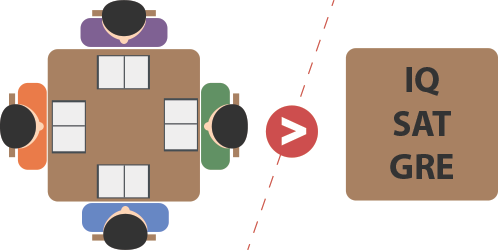
The subsequent study revealed the single best predictor of college success – it’s all about with whom rather than how you learn, i.e., it wasn’t GPA or SAT scores or a number of any kind. It was a student’s ability to either create or join a study group. Students who studied in groups, even only once a week, were more engaged in their studies, better prepared for class, and learned significantly more than students who worked on their own.

Venture capitalist Mark Suster applied this in his own career by creating peer learning groups of fellow CEO’s when he ran his own start-up and of venture capitalists when he started his career in venture capital in Los Angeles.

Perhaps it is time for us to create our own peer learning group.

Study-groups-and-learning

Source and thanks to: www.EBSketchin.com

‘I felt that when I was being open and willing to talk to other people about what my issues were and then tried to solicit from them, that the table actually discussed things. You can do that. Anyone can do that.’ | Mark Suster

Needing luck

When you follow a good process, you lessen the need for luck. It’s when you follow a bad process that you gravely need luck.

The last time I found myself fervently hoping for luck, I reminded myself that, if this didn’t work out, it was because I was paying the price for a bad process.

Hoping for luck is something I seek to eliminate – good skill trumps good luck in my book. Luck is always welcome, of course. But, skill is more reliable.

And, I’d take consistency over sporadic brilliance any day.

Lamborghinis and television ads

A friend recently shared – Lamborghini does not advertise on television because people who buy Lamborghini’s don’t watch television.

The idea applies to everything we do. For example, do we understand where the folks who read our blogs, use our web services hang out?

Perhaps even more pertinently, where do those who we’d like to hang around with, be like and learn from (i.e. our friends) hang out? Our closest friendships form during high school, university and graduate school because of this reason – we are surrounded by a group of people with similar ideas and dreams for an extended period of time.

This sort of environment becomes harder and harder to replicate as we move through life but it makes for great question to ask every once a while – where does my tribe exist and how can I find them?

The best part about this question is that begs a deeper set of questions – who am I?, why am I here?, and what tribes do I want to be part of or create?