A few thoughts on culture

As part of my annual review process at the end of every year, I ask myself – “Who/what were my biggest sources of inspiration this year?” It is a useful question as I think about all those people who’ve had a repeated positive impact on me. Inevitably, Seth Godin takes the top spot. I have been reading Seth’s blog for five years or more now, sharing his posts and thoughts here and, most importantly, revisiting his posts from time to time. Often, when I think of the topics he tends to write about, I realize that my definition of a particular idea came from one of his posts.

One such seminal post and idea is “change the culture, change the world.” This post boils culture down to one line – “This is what people like me do.” The first time I read this, I asked myself and all my friends (I think they got tired of hearing about this post within a week) – “What is it that people like us do?” And, we ended up attempting to coordinate a “Mastermind Group” across three continents to discuss various topics that mattered most to us. We decided our culture was one around having conversations that matter. The project didn’t work because of timezone issues but it is one that demonstrated to us how much we cared about having conversations that matter. I have continued to implement that idea ever since – at graduate school, I have time set aside every week for a conversation that matters with a group of friends.

I realize now that my answer to the question about my biggest source of inspiration was actually incomplete. There is one other person who has influenced me in a way similar to Seth – Clayton Christensen. While he doesn’t have a daily blog that I know of, his book “How Will You Measure Your Life?” got me started on a path that has gone on to help me define how I live. I listened to Clay’s TEDx talk and read his excellent article (which, unfortunately has been put behind a paywall by the folks at HBR) and I was again left thinking about culture. Clay’s insight was – “Ultimately, people don’t even think about whether their way of doing things yields success. They embrace priorities and follow procedures by instinct and assumption rather than by explicit decision—which means that they’ve created a culture.” Or, “this is what people like me do.”

I’ve written before about how you build culture in a team. Building culture and sharing the culture are two different things, though. While you might imagine any great culture would be automatically shared, it doesn’t work that way. As I have repeatedly learnt, “build it and they will come” is fundamentally flawed. Our culture is built around “best selling” or, in the case of the internet, “best sharing?”

I think the way culture is shared is by sharing stories. It is like the famous collection of Macy stories which talk about Macy’s employees who go to incredible lengths to please a customer. It is the Zappos person who was on the phone with a customer for many hours. Stories are powerful.

As I reflect on their power, I see the effect they have had on my life. In two days, I’ll be leading and participating an initiative called “The Good Life Sessions” in my final quarter in graduate school. The Good Life Sessions is a three part series of workshops that gets to the questions – “How will you measure your life?” through a series of other questions that help break that large question down. As you might imagine, there is a lot of Clay Christensen in the Good Life Sessions.

I also start these sessions and pretty much any initiative I lead by saying – “This might not work.” While I say this to myself every time before I take a leap, I say it in public generally to shocked reactions – “What do you mean? It should work. Do you lack confidence?” Those close to me understand it. Those who are getting to know me give me feedback about it and tell me I must stop saying it. And, folks listening either love it or hate it. This is one of those things where I choose to ignore all that is said and say – “This is the cost of me doing things. This is how I approach things and this is part of me being me.” “This might not work” is a Seth idea that embraces the fact that anything worth doing begins with an acceptance that it might not work.

As this example illustrates, Clay and Seth have shared their cultures with me and their cultures are an important part of my culture and how I operate. And, they’ve shared this without us ever meeting in person. Clay doesn’t even know I exist.

That is how I’ve come to learn that cultural change is incredibly powerful. It is a big part of what I have spent my time learning about and pushing for during my time in graduate school over the past year and a half – to encourage more reflection, more conversation, and more understanding. And, as you might imagine, a big part of this is just attempting to be all of this myself – because that’s what Clay and Seth have taught me. You have to be the change you wish to see.

And, most importantly, no one is going to pick you to make cultural change. You have to pick yourself.

culture

The Curry workout – The 200 words project

Stephen Curry, considered one of the greatest NBA shooters of all time, owes a lot of this success to a unique practice regimen devised by his trainer, Brandon Payne.

Payne’s philosophy is focused on improving “neuromuscular” efficiency – training the connection between mind and body. One such novel workout requires Curry to wear a pair of military-grade strobe glasses that strobe at different speeds, impairing vision, while Curry dribbles a basketball with one hand and catches a tennis ball with the other. Take away that stressor on the senses during the game and Curry’s reaction times are faster.
Overloading the brain and body during practice and then contrasting it in order to get immediate feelings of improvement are what Payne does in his skill work with Curry.

As Diamond Leung, a journalist, wrote about Curry’s regime, he realized that there was a lesson in all this for him and us. Thanks to all the stimulation from our devices, we are already wearing strobe glasses and are in the midst of a struggle to focus on any single activity long enough to carry it out with imagination, verve and precision.

The Curry workout is perhaps the ultimate call for mindfulness.

curry workout

When I’ve got something intricate to work on, I now tend to visit coffee shops with bad Wi-Fi. That forces me to keep working on the task at hand, even if I’m stuck for a little while. It also gives me a chance to peel back the project to first principles every now and then, and to do some sustained, free-form thinking about what I’m trying to accomplish… it’s hard to know when breakthroughs will happen. Getting rid of sensory overload doesn’t instantly guarantee success. But it improves the odds. – Diamond Leung

—
Source and thanks to: Mercury News article on Stephen Curry and Brandon Payne

The short straw

We were recently in passport control on our way back to the states. As we were in transit at the airport, we had transit passengers from various other flights and one of them seemed to be a flight heading back the UK. As per usual, passport control for non-citizens, non-ESTA countries (effectively Europe) was under staffed. We weren’t clear why the Brits weren’t on the ESTA queue. But, stuck in our queue, we heard one annoyed British accented voice after another complain about how preposterous the wait was. Some even called friends and family to tell them how ridiculous this was.

My wife and I found this all pretty amusing for two reasons. First, British passport control is actually among the most unfriendly to anyone who isn’t white skinned (even if the officers are a diverse mix). Often, they make you sorry for having taken a tourist trip to see their country. And, they take incredibly long, too. A below average wait at Heathrow if you are Asian/African is an hour. I once waited 3 hours at passport control after a 2.5 hour flight. That’s right – my travel time was shorter than my wait at passport control.

Second, none of the others on the queue yesterday had anything to say at the wait. It was just another day, just another flight. Wait 1 hour? No problem. At least it is not a pat down. Made to feel unwanted when visiting another country? That’s just business-as-usual.

The good news is that drawing the short straw every time for arbitrary reasons – i.e. birth and the color of your skin – helps you keep perspective when you face what should only be (for your own sanity at least) minor annoyances.

short straw

I know what I need to do

I know what I need to do. It is going to be painful, hard and, truth be told, the resistance is screaming in my ear asking me to figure out ways to avoid it.

There are definitely ways to avoid it.

I can choose to ask many people for their advice and choose to listen to someone who shines light on an easier path.

I can choose to make a list and just begin working on other projects – never mind their priorities.

I can choose to listen to the resistance, complain and find ingenious ways to procrastinate.

Or, I can just suck it up and do it. Like most times, when I listen carefully to myself, I know exactly what I need to do and how it needs to be done. Perhaps, instead of attempting to figure out escape routes, I should just realize that the high anticipated pain and the strength of the opposition from the resistance provide the strongest clue that this is exactly the obstacle that needs to be overcome.

The obstacle is, almost always, the way.

resistance

The Chief of Staff

A close friend recommended the TV show “The West Wing” to us. We’re twelve episodes in and are loving it. The show is incredibly well written (thanks Aaron sorkin) and keeps you entertained on story, screenplay and dialog alone.

An incredible scene at the end of a recent episode has the President in conversation with the Agricultural Secretary as he’s leaving for “The State of the Union” address. The Agricultural Secretary is the person who is chosen to take charge in case there’s a disaster. The President gives him two minutes of advice of what he should do in case the worst happens. Then, he asks –

“Have you got a best friend?”
“Yes, sir.”
“Is he smarter than you?”
“Yes, sir.”
“Would you trust him with your life?”
“Yes, sir”
“That’s your Chief of Staff.”

It is an incredible scene because you see a wonderfully deep relationship between the President and his Chief of Staff. And, this dialog brings it all together.

The Godfather made the adage – “It’s not personal, it’s just business” popular. I think that is a sad way to approach the work we do. We often spend more time with folks we work than we do with our own families. And, many of my closest friends have come from the teams I’ve worked on.

In reality, it is business AND it is personal.

No pie charts

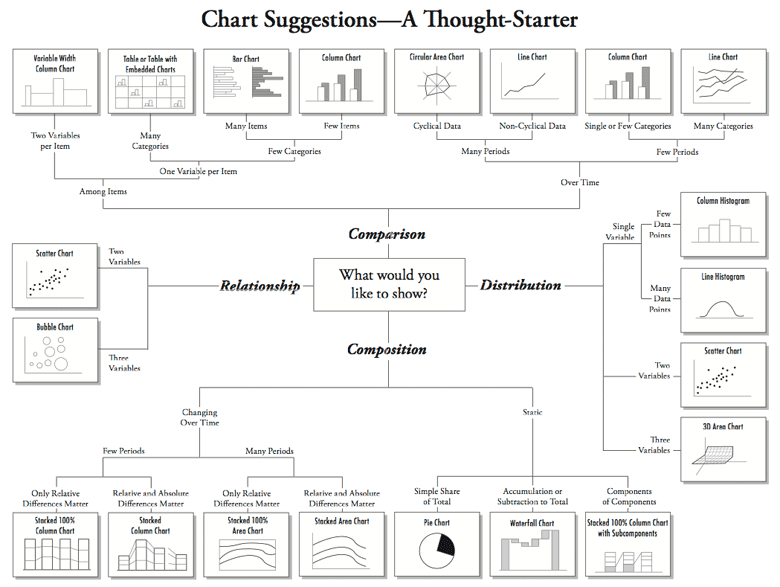
“Never use a pie chart.” – said one of my favorite senior consultants with a lot of passion. “For every case where you might want to use a pie chart, there is a better chart out there.”

With more data present than ever before, understanding how to visualize data is a useful skill. To that end, I thought I’d share a “chart suggestions thought starter” infographic. Most of it is common sense.

But, as you and I have likely experienced and been guilty of ourselves, common sense is not common practice.

chart-suggestions, data visualization, pie chartsThank you to the team at Extreme Presentation Method

Basic Income Guarantee

The reason hard real world problems are hard to solve is because the causes of real world problems are not simple to understand. What causes poverty, for example? If someone tells you there is one simple solution to the problem, you can be certain that person has gotten it wrong.

That said, with a bit of thought, we will likely be able to identify a few likely causes. But, identifying a lack of education as a cause for poverty only takes us so far. Bringing quality education to low income regions requires better infrastructure, better teachers and a general improvement in out-of-school lifestyle. Hard problems are hard for good reason.

Brussels was bombed thrice today – there is likely a strong link between these bombings and the attacks in Paris as the people behind the Paris attacks were known to have grown up in Brussels. Like poverty, a problem such as terrorism has multiple causes. We can be certain, however, that low household income is a cause. Poverty and crime tend to go together.

Over the past few years, we’ve been hearing increased agitation around the subject of income inequality. The various “occupy” protests from a few years back were a result of that agitation. These aren’t going away. Donald Trump owes much of his success so far to the pent up anger in American society around the unequal distribution of wealth. Thomas Pikkety’s famous book on economics effectively demonstrated that, left to a natural flow of events, inequality only gets worse in society. The reason previous centuries have escaped this problem is because of regular war (a costly escape but an escape nonetheless) – one of the best redistributors of wealth. However, in a society that is as peaceful, on average, as ours today, this problem is likely not going away soon.

Compounding these issues is the sheer speed at which technology is progressing. AlphaGo was supposed to have the capability of beating a top human Go player in ten years. This means jobs that we expected computers to replace 10 years from now will likely be replaced in five. A recent White House report to the US Congress estimated that there was an 83% chance that a worker earning less than $20 per hour will eventually lose their job to a machine. I think the probability is at a 100%.

All of this brings me to the central thesis of the post – there is a need for conversations to be had about the possibility of a “Basic Income Guarantee.” This scenario involves decoupling income from work and working toward redistributing wealth across society. Of course, the solution isn’t to approach this as the only solution. But, it is important to acknowledge that this is a possible solution and important that we at least begin to have discussions on conducting experiments in select geographies to see how it might work.

The combination of poverty, unequal distribution of wealth and technological progress will not make for pretty viewing in ten years. This is not a hard problem as much as it is a combination of many hard problems. As the article by Scott Santens that inspired this post nicely said, ignoring these problems will be tantamount to the laughable “duck and cover” strategies to avoiding nuclear blasts during the cold war.

Brevity isn’t all that important

The smartphone obsessed reader would have you believe that brevity is what defines good writing. More than a paragraph? You must really suck as a writer. One scroll is all the attention a reader will give you before they move to the next thing.

Here are five things I’d take over brevity –

1. Useful
2. Inspiring
3. Thoughtful
4. Memorable
5. Clear

Brevity matters, sure. I’d love for what is written to be as short as possible. However, if it means becoming less thoughtful or less useful, I’d prefer the long version – thank you very much.

—
Inspired by David Heinemeier Hansson’s excellent post – “Simple just isn’t that important.”

Bothered by limitations – 10x thinking – The 200 words project

Continuing last week’s thread on 10x, not 10% – 10x thinkers, Ken Norton observes, don’t surrender to limitations – they get bothered by them. They look for ways around them, or things they can do to blow through them.

Google’s “Project Loon” is an example of 10x thinking. Project Loon is attempting to use weather balloons to bring reliable internet connectivity to underserved populations around the world. Whether Project Loon succeeds or not remains to be seen, but they’re trying.

A wonderful example of blowing through limitations comes from the 1960s when faster cargo ships and containerization revolutionized international shipping. However, when freighters from Hawaii reached San Francisco harbor in days instead of weeks, they were still forced to wait for many days since their documents needed to clear customs after arriving via postal service. Adrian Dalsey, Larry Hillblom and Robert Lynn saw this as an opportunity – while ships were still being loaded in Hawaii, they drove from dock to dock picking paperwork. They, then, put them in their luggage, got on a flight to San Francisco and got the papers ready by the time the ships arrived.

Dalsey, Hillblom, Lynn => DHL.

It’s often easier to make something 10x better than it is to make it 10% better. – Astro Teller, Google[x]

10x

—
Source and thanks to: Ken Norton’s essay – 10x, not 10%

The 35k lesson

Every time I look back at a painful experience, I attempt to re-frame it by asking myself what lessons I learnt from that experience?

There was one such experience for which I paid what was effectively “tuition” of thirty five thousand dollars – a massive amount. For a long while, I was annoyed at what led to that experience. But, once I passed it through the re-framing filter, I realized that the most important lesson I’d learnt from that experience was one about emotional intelligence.

I was listening to “Mastery” by Robert Greene during that period and I distinctly remember the moment Greene spoke about emotional intelligence as (paraphrased) the ability to ignore what people say and, instead, to listen to what they do. In listening to what they do, he asked us to pay careful attention to their behavior when the chips were down, how they behaved when they thought no one was watching, their choice of partners, etc. It was one of those moments of clarity for me. I finally realized what I was meant to learn from thirty five thousand dollar experience.

A few days ago, I wrote about the idea that “falling is guaranteed.” The flip side of that idea is that, as you take bigger risks, some of those falls become rather painful. You might break a metaphorical bone and pay the tuition for that experience – this can be money, burnt relationships, dents in your confidence or a sense of discomfort when you think about it. As you pay this tuition, it is tempting to want to block this experience off entirely and not think about it. But, my experience has taught me that there is a lot to be gained from wading in within that discomfort and pain and really extracting the value from the tuition paid. My emotional intelligence fall came with scars. I live with them everyday. But, I look at them now not with disgust, but with gratitude for what they taught me.

The saying – “Success comes from good judgement. Good judgment comes experience. Experience comes from bad judgment” – holds absolutely true. The part that is missing is that the experience follows only after careful reflection and analysis of our errors in judgment.

That process is painful and uncomfortable, but worth it.

experience, lesson