Omitting privilege

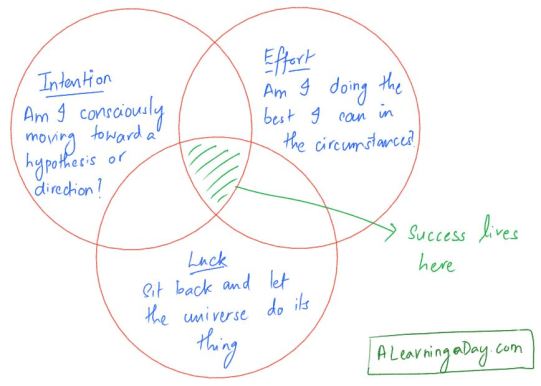
Last week, I shared a post on how intention, effort and luck combine to create successful projects. I realize now that I missed something important – privilege.

Privilege accumulated over the years determines the opportunities that are open to us. Once you are born into a family with means or are born in a place with lots of opportunity or are fortunate to get a good education or work experience at a top tier firm or two, you see opportunities that others never will. Privilege also shapes our intention, effort and the component of luck whose probability increases with thoughtful preparation.

This is easy to ignore and forget because you take this sort of privilege for granted.

I clearly did when I wrote about what makes projects successful last week. My updated sketch would look like the one below with privilege being the platform on which most success is built.

With privilege should come humility and responsibility. And, a first step to both is being aware of the presence of privilege in the first place.

Picking watermelons – a lesson in choices

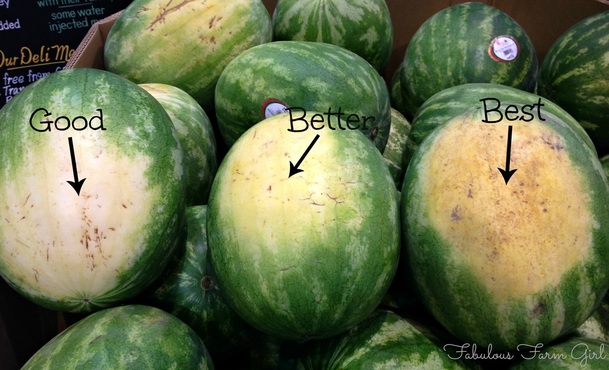
If you were picking watermelons for the first time, it makes sense that you’d pick one that looks like this.

The color is beautiful, the lines look great and it looks unblemished.

But, it turns out such watermelons aren’t the watermelons you should look for.

The best watermelons have ugly-looking bald spots. These tell us that the watermelon was picked after it ripened as watermelons don’t ripen once picked. White bald spots are good, yellow spots are better and orange spots are the best.


This is counter intuitive as the appearance could easily lead us to conclude that the watermelon is spoilt.

As humans, we rely on appearances to make quick judgments about objects and people. Our lizard brain uses these judgments to choose a fight, flight or freeze response.

However, these responses were designed for when we lived in forests as hunter gatherers. There was danger lurking all around and these quick responses increased our chances of staying alive.

That isn’t true anymore. Thanks to our pre-frontal cortex, we have the time to seek to understand, deliberate and make better decisions. We can override our lizard brain if we choose to and get over impulses that instinctively bucket things based on their first appearances. In Daniel Kahneman’s words, we have the opportunity to use our more logical “system 2″ to make better decisions.

And, of course, this applies as much to how we judge and pick people as it does to watermelons.

Writing about the same things

I was reflecting about yesterday’s post on the “Don’t Do” list. While that is a new experiment whose results, by definition, are uncertain, I wondered why I didn’t try it in earnest when I first wrote about it five years ago.

I realized it is because I haven’t written about it enough.

Ideas I really care about appear on this blog many times over the years. A search for “Circle of influence”  or “Focus on process” shows many posts over the years that explore the topic from various angles. I’m still not an expert in either. But, I certainly am much better by virtue of thinking about them often, experimenting, failing and changing my approach.

This idea is the key to any kind of personal change. We need to obsess about the change, commit to it, keep trying various approaches, and keep re-committing to it.

And, writing about it many times over is an obvious signal that I care enough to obsess over it.

Here’s to writing more about the same things.

Don’t do list

I first wrote about Don’t Do Lists 5 years ago when I was contemplating trying it out. But, somehow, the idea just didn’t stick. I think I was still trying to do “To do” lists well.

As of yesterday, however, I’ve decided to give a “Don’t Do” list a shot. I generally tend to have an improvement project or two in flight and I would love for a way to keep them top of mind. And, a list on my phone’s notes app felt like a good place to start.

The Don’t Do list on my phone currently reads –

1. Stop using filler words
2. Stop mindlessly checking email when you get downtime

I’ve attempted reducing filler words at least once every year in the past 3 years and failed each time. Looking forward to seeing if this strategy works better.

Obstacle agnostic

No path you take is going to be obstacle free.

In fact, the more the obstacles, the higher the likelihood you’re doing the right thing. Good things rarely come easy.

So, every moment you spend fretting or ranting or raving about obstacles is a moment wasted. Fretting or ranting or raving don’t make obstacles go away. We need focused, constructive action.

Maybe, today, we could aim to be obstacle agnostic instead.

Just for today, let’s expect obstacles and eat them for breakfast.

The high priest of perseverance

The Straits Times’ Rohit Brijnath wrote a beautiful piece about Rafael Nadal’s recent French Open victory. I’ve read Rohit Brijnath’s work from time to time since when I was a kid. As with great artists, he elevates his craft. That is definitely the case with this column – it is about Nadal and tennis on the surface.  But, really, it is about life.

Here are my 3 favorite excerpts.

Nadal is still the high priest of perseverance. He contests every single point as if it is a championship in itself. He pursues every single ball as if his life’s work hinges on this particular effort. He constructs bewildering shots because his inner voice can never convince him that a ball is unreachable. We’ve known this for years and still it’s staggering.

We learnt, on Sunday and in January, that Nadal and Federer don’t just win matches, they stretch the idea of excellence and test imaginations. An Australian Open for a 35-year-old four-kid father and a 10th French for a fellow with body parts whose warranty has run out? Had you forecast that a decade ago, you’d have made Nostradamus seem like an idle tea-leaf reader.

We learnt, again, that Nadal is whom you want to present to your son, or niece, or school team, as proof of the simple, durable qualities of sport. The ones about honesty, work ethic, patience. The ones about wearing defeat but not wilting, for before this year began his record at the previous six Slams were second round, third round, first round, third round, no show, fourth round. The ones about always improving, for he’s sharpened his serve and added iron to his backhand. Imagine at 31 the faith this took, the will it required.

There were two wonderful things that I learnt when I read this article thanks to an email from a longtime reader (thanks Shweta!).

First, I hadn’t even watched this game. And, yet, I knew exactly what Rohit Brijnath was talking about. I’ve been fortunate to watch a few Rafael Nadal games over the years and you know exactly what you are going to get from him. There is something so incredibly powerful and inspiring about consistency of effort. I still consider Roger Federer to be the greatest tennis player of all time. But, if it ever comes to picking the greatest role model, it would be Rafa – hands down.

Second, the act of reading it brought a tear to my eye. I think it was a combination of awe and appreciation for the sheer perseverance he’s shown despite his many injury troubles. Rohit Brijnath described him as the “high priest of perseverance. It is fitting.

I was once asked – “What would you like people to say about you when your time comes?” (a re-framed version of the “what would you like written on your tombstone?” question). It is a question that has stuck with me. And, the answer that has stuck is – “He cared. It showed.”

Maybe that’s why the idea of being the high priest of perseverance resonates so deeply. We are what we do. And, consistent effort and perseverance are among the truest demonstrations of care.

Thank you, Rafa and Rohit, for the inspiration.

A few thoughts on transitions

I’ve been working on a project that I thought would end a month or so ago. It’s been a long, bandwidth absorbing project and one where I’ve been waiting for some closure. I learnt a couple of days ago that closure is delayed by a few weeks at least. Since this means a few more weeks in transition, I thought I’d share a few thoughts on transitions –

1. Transitions are difficult because they involve uncertainty. Uncertainty goes against our instincts to feel in control of our lives. So, we often view transitions like we do dentist appointments. We want as few of them as possible. And, in the off chance we have to have one, we want it to be over as fast as possible.

2. The most challenging part about dealing with uncertainty is a reduction in bandwidth. It is hard to emphasize how much of a difference a feeling of control and stability makes to our mental make up.

3. A side note – this is why living in poverty isn’t just about dealing with a lack of cash. That lack of cash takes away valuable mental capacity on a daily basis. It is a double whammy.
Similarly, any kind of issue that threatens a person’s security – whether it is mental, financial, or emotional is a bandwidth killer.

4. Every one of us who is reading this blog post, however, is likely lucky to have escaped those extremes for the most part. Our transitions are, luckily, of a first world nature. The worst case, in our case, is not all that bad. That calls for a lot of gratitude and a responsibility to make the world better for those who don’t share that luck.

5. So, how do you deal with transitions? I break it down into three truths. First, the best way to deal with the uncertainty that affects a transition is to focus intensely on what you control and not worry about anything else.

Second, listen to myself. There are periods when “normal service” may not apply and that’s okay. For example, I love listening to audio books. But, there are weeks in the thick of a transition when I don’t feel like listening to anything but music. And, that’s okay. If I listen carefully, I know what I need.

Third, even this will pass. And, when it does, I will have learnt a ton.

6. The biggest learning opportunity during a period of transition revolves around the idea – what got you here won’t get you there. I’ve found transitions to be a great opportunity to re-evaluate my projects and processes. They are a great time to shelve things that aren’t working any more and find new ones. This process requires some commitment to being intentional as it feels counter-intuitive to change things at a period when you feel too much is changing.

But, there rarely is a better time.

7. Transitions are tests. They only really end when we’ve learnt to embrace them and live life as if they don’t exist. For the longest time through this transition, I wasn’t ready for that. I was seeking closure.

But, just yesterday, I realized that there’s no point waiting for closure. I have the opportunity to reflect, re-evaluate and learn. Transition or not, there’s a lot that I need to get on with. So, as of today, I intend to do just that. And, experience tells me that the more indifferent I feel about closure, the sooner it will arrive.

In case you are wondering, you can’t cheat your way into feeling indifferent. The universe is smart. :-)

8. Finally, we are never really done with transitions and neither should we ever want to be. There are periods of respite following big transitions. But, only for a short while. Transitions are the zones that test us, push us to grow and become better human beings.

We need more of these, not less. And, it is worthwhile remembering that it is better to use opportunities to reinvent ourselves rather than having circumstance force it on us.

9. Whenever I think of transitions, I think of the lyrics of a song I’ve shared here a few times by the same name. I’ve shared it below. Enjoy.


Sometimes I feel that my life is a series of trapeze swings.

I’m either hanging on to a trapeze bar swinging along or,

for a few moments in my life, I’m hurtling across space in between trapeze bars.Most of the time, I spend my life hanging on for dear life to my trapeze-bar-of-the-moment.

It carries me along a certain steady rate of swing
And I have the feeling that I’m in control of my life.
I know most of the right questions and even some of the right answers.
But once in a while, as I’m merrily (or not so merrily) swinging along,
I look ahead of me into the distance, and what do I see?
I see another trapeze bar swinging toward me.
It’s empty,
and I know, in that place that knows, that this new trapeze bar has my name on it.
It is my next step,
my growth,
my aliveness going to get me.
In my heart-of-hearts I know that for me to grow,

I must release my grip on the present, well known bar to move to the new one.Each time it happens to me, I hope (no, I pray) that I won’t have to grab the new one.

But in my knowing place I know that I must totally release my grasp on my old bar,
and for some moment in time hurtle across space before I can grab onto the new bar.
Each time I am filled with terror.
It doesn’t matter that in all my previous hurtles across the void of unknowing,
I have always made it.
Each time I am afraid I will miss,
that I will be crushed on the unseen rocks in the bottomless chasm between the bars.
But I do it anyway.
Perhaps this is the essence of what the mystics call the faith experience.
No guarantees, no net, no insurance policy,
but you do it anyway because somehow, to keep hanging onto that old bar is no longer on the list of alternatives.
And so for an eternity that can last a microsecond or a thousand lifetimes,
I soar across the dark void of “the past is gone, the future is not yet here.”
It’s called transition.
I have come to believe that it is the only place that real change occurs.
I mean real change, not the pseudo-change that only lasts until the next time my old buttons get punched.
I have noticed that, in our culture, this transition zone is looked upon as a “no-thing”,
a no-place between places.
Sure the old trapeze-bar was real, and that new one coming towards me,
I hope that’s real too.
But the void in between?
That’s just a scary, confusing, disorienting “nowhere” that must be gotten through as fast as unconsciously as possible.
What a waste!
I have a sneaking suspicion that the transition zone is the only real thing,
and the bars are illusions we dream up to avoid, where the real change,
the real growth occurs for us.
Whether or not my hunch is true,
it remains that the transition zones in our lives are incredibly rich places.
They should be honored, even savored.
Yes, with all the pain and fear and feelings of being out-of-control that can (but not necessarily) accompany transitions,

they are still the most alive, most growth-filled, passionate, expansive moments in our lives.And so, transformation of fear may have nothing to do with making fear go away,

but rather with giving ourselves permission to “hang- out” in the transition between trapeze bars.
Transforming our need to grab that new bar, any bar, is allowing ourselves to dwell in the only place where change really happens.
It can be terrifying.
It can also be enlightening, in the true sense of the word.
Hurtling across the void, we just may learn how to fly.

Terrorism and lone gunmen

I saw a small snippet of Trevor Noah’s latest stand up piece where he took apart how we think about terrorism. His observations were as follows –

  • If a Middle Eastern person committed a crime, it was definitely an act of terrorism.
  • If a black person was shot or killed, it was “suspected gang violence.”
  • And, if a white person killed people, it was a “lone gunman” suspected of being mentally disturbed.

I’ve been the US over the past 3 years and I hadn’t notice the terrorist versus “lone gunman” narrative until now.

A search for terrorism defines it as “the unlawful use of violence and intimidation, especially against civilians, in the pursuit of political aims.”

As Trevor Noah puts it, terrorism is about acts of violence and isn’t about the people perpetrating it. A lot of this comes down to how we tell stories because the stories we tell have these in-built biases all over them.

Perhaps we should be a lot more careful about passing these biases along. Ever time we do, some innocent person from a marginalized group suffers just a bit more.

Thanks for the lesson, Trevor.

I + E + L = Success

Success is a combination of Intention, Effort and Luck.

Intention is ensuring you’re consciously working toward a direction, hypothesis or goal.

Effort is simply giving it your best shot given all the constraints.

And, luck is the universe’s cooperation in your efforts from time to time. It helps to also think about two kinds of luck. The first kind of luck is “dumb luck” – this strikes from time to time and is impossible to influence. The second kind, however, is the kind of luck whose probability increases with thoughtful preparation (i.e. Intention + Effort).

So, in everything you do, focus on the two questions that drive intention and effort – am I consciously moving toward a direction or hypothesis? And, am I doing the best I can in the circumstances?

Then, take a deep breath and let the universe do its thing.

Priority list proximity

A big challenge when things get busy is keeping focus on the things that matter.

One way to accomplish this is increase the proximity of your priority list as things get busier. For example, in normal times, my priority list is on OneNote on my computer. But, when push comes to shove, I’ll write a short version on my phone so I always have it with me. So, before I respond to the new new thing, I check in with my priority list and double check importance and urgency.

When there is a high volume of activity, it becomes harder to separate the signal from the noise. That, in turn, means more time spent reacting to what’s happening instead of responding.

So, when things get busier, just take your priority list everywhere with you.

The main thing is to keep the main thing the main thing.