$299 learning

6 years or so ago, I discovered Lumosity. Lumosity is an online program full of games that claim to improve memory and problem solving. I tried the service for a month and enjoyed playing those games. And, in one impulsive moment, I decided to buy a lifetime offer that showed up on the payment page.

Why spend every month when I can have membership for a lifetime?

Of course, I stopped using the service a few days later.

Ever since, I’ve instituted a 24 hour rule for a big unexpected purchase. If I suddenly see an offer for something I didn’t intend to buy, I sleep over it. (Or, better yet, I also ask my wife for her opinion during that time)

The rule has saved me a lot of money and spared a ton of unnecessary buyers remorse over the years. It is amazing how quickly something that seems incredibly tempting feels unnecessary once you give it a bit of thought.

The 24 hour rule works beautifully to deal with other such impulses too – acting out in anger, responding with frustration, among others.

Time is a powerful decision aide.

Ask why, not what

A wise friend shared a hiring tip – “When interviewing someone, don’t ask them what they’ve done. Instead, ask them why they did what they did. Why did they go to college? What about the first job? Why did they leave? That will tell you more about them than a list of what they did.”

It turns out that this piece of advice is very applicable when getting to know people as well. Conversations that are all about “what do you do” rarely go anywhere.

The best conversations move to the “why.” But, since “why” is a daunting question, there are others that serve the same purpose. What’s the dream? What drives you? What would you be doing if you didn’t have to worry about money?

People judgment is among the top few skills we need to lead effective lives. And, people judgment involves understanding what drives people and whether that aligns with our values and motives in limited time.

Great questions go a long way in helping us with this.

Things we generally take for granted

Air conditioning

Home cooked food

The ability to commute

A catch up call

Functioning senses

The shade of a tree

Fresh air

Almost anything our family does :)

Having the means to buy an ice cream

Breeze

GPS

A comfortable bed

Wifi

A colleague who cares

Our paycheck

Access to drinking water

A tight hug

Bowels

Instant messaging

Hands and legs that just work

A friend

What if we took the time to appreciate just one of these every day?

Joe and Tetsuro Toyoda

There’s a legendary story from when Tetsuro Toyoda visited the NUMMI factory in Fremont after their joint venture with General Motors. The NUMMI factory was one of GM’s worst factories and Toyota sought to overhaul the culture as part of the joint venture.

A key part of the Toyota Production System or TPS involved pulling the “andon cord” when a worker saw a problem. The “andon cord” was an emergency cord that stopped the entire production line. While it was very expensive to stop the entire line, Toyota had learnt it was far better to fix existing problems early than to ship defective cars.

Source

A month after NUMMI opened, Tetsuro Toyoda (President of Toyota), paid a visit to the new factory. While going through one of the production lines he noticed an employee struggling to install some rear lights on a vehicle. Mr. Toyoda approached the employee, looked at his badge, and said “Joe, please pull the andon cord.“

Joe looked at Mr. Toyoda (and the entire factory executive team behind him) and replied, “I can fix it, sir.”
‘Please Joe.” – Mr Toyoda replied
“I can fix it sir.”

After watching Joe struggle some more while refusing to pull the cord, Mr. Toyoda reached, took Joe’s hand and, together, they pulled the andon cord. A yellow light began to flash and Joe (with his hand shaking) continued to work on the car. Once the car reached the end of Joe’s work area, the production line stopped. Joe finished his work and pulled the andon cord again – the production line return to normal work.

Mr. Toyoda bowed to Joe and began to speak in Japanese. “Joe,” he said, “please forgive me! I’ve done a bad job of communicating to your managers the importance of the andon cord. Only you can make the best cars. I’ll do everything in my power to make sure that I don’t let you down again.”

By noon, the entire factory had heard about it. The Andon cord was reportedly pulled over ten times the next day and an average of 100 per day a month after Mr. Toyoda’s visit. Two years later, NUMMI was producing cars at a quality level on par with Toyota factories in Japan. Absenteeism decreased from 45% to 3% and it became GM’s most productive plant.

I love this story. It beautifully encapsulates lessons on building great products, leadership and culture all at once. It is always better to be obsessive about fixing problems early. We are better off building cultures and organizations where people feel safe admitting and fixing mistakes. And, leaders are the ultimate example of a team’s culture – people watch what they do.

Finally, stories like this go on to inspire a generation of future builders and leaders. Cultures spread through stories like this.

A quick post script note on NUMMI – GM didn’t succeed in replicating NUMMI’s cultural transformation in plants across the company. The joint venture was eventually abandoned in 2010. But, fittingly, it was bought by a South African born entrepreneur who dreamed of building great cars.

Today, the former NUMMI plant is the Tesla factory at Fremont.

Stinking of curry

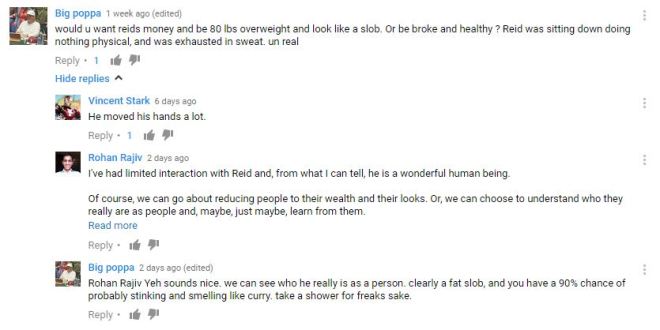
I was on a YouTube link with an interview of Marc Andreessen and Reid Hoffman the other day. I decided to punt watching the interview but noticed a comment that accused Reid of looking “like a slob.”

I don’t know why I felt the need to defend Reid. I’m sure life as a celebrity entails worse abuse than that. But, nevertheless, I’d seen Reid in action a couple of times during my time at LinkedIn and thought highly of him. So, I did. It wasn’t long before I regretted it.

“Big poppa” told me I was probably stinking and smelling of curry. So, I ought to take a shower for freak’s sake.

I was torn for a minute to write a sarcastic response back. But, I was reminded of the difference between stimulus and response. And, I decided to let it go and, instead, find humor in it. I was left with a few questions though –

  1. Can you build a nice community without asking people for real names? There is little chance “Big poppa” would have said this on LinkedIn. But, on YouTube, it’s all fair game.
  2. How much of this is influenced by the current political discourse in the United States? It is always hard to tell. But, I do wonder if folks like this have been emboldened.
  3. Why is it always men?

The good news is that there is a gap between stimulus and response – confirmed. :) I’m glad I didn’t go back and respond. Instead, it did get me to pause and reflect about how you build civil communities (it isn’t easy), politics and gender.

And, finally, small incidents like me make me feel grateful for the folks I’ve been fortunate to surround myself with as my exposure to racial slurs has been few and far between.

All in all, plenty to be thankful for.

Good questions

I experienced two situations recently when a simple question changed an entire situation.

A good friend was mulling about a decision and we discussed the idea of running the decision by the – “Is this a hell yeah?” filter. If it isn’t a “hell yeah,” it ought to be a no. (HT Derek Sivers) Suddenly, the decision making process was greatly simplified. It worked much better than a long diatribe about decision making frameworks.

Then, a casual conversation was changed into an engaging, thoughtful and personal one when we all just asked each other – “What is the dream?” Our dreams offer wonderful insight into what drives us and the conversation took a fascinating turn.

We all know good questions are powerful. I do too, somewhere deep inside. But, situations like this remind me that I could spend more time thinking about good questions versus thinking about what to say or mulling answers to things.

The obvious question, then, is how do you ask good questions? My sense is that good questions and good judgment go together. So, good questions come from experience. And, experience, in turn, comes from bad questions.

We should just ask away till we get better. And, we will.

Challenging, difficult and hard

An idea that helps me keep perspective is the difference between challenging, difficult and hard.

Regardless of who we are, life challenges us. We always have problems to solve and ups and downs to deal with. That’s just life. Challenges make life interesting, fun even.

Every once a while, life gets difficult. These are typically times when we are pushed to our limits, overwhelmed and/or clueless. Difficulty is generally due to the effect day-to-day living has on our minds. In the words of Scott Peck, the best antidote to dealing with this difficulty is accepting that life is difficult. For, once we truly accept something is difficult, it ceases to be so.

Finally, for everyone who is reading this, it is likely that life is never hard. Hard is when you have to struggle for the basics, toil in the sun to get food on the table or hope for someone’s generosity to fill your stomach for the day. Everyone reading this has luckily escaped hard. In fact, it is on folks like us to remove “hard” from those who experience it.

And, the first step to doing that is to make sure we don’t lose perspective ourselves.

Great jobs are point-of-time references

A friend said something wise to me the other day – “Great jobs are point-of-time references.”

A great job is generally a combination of a few things –

  1. A location that you love
  2. An industry that might be thriving
  3. A company with a great culture and environment
  4. A role whose scope is appealing
  5. People who you work with who are inspiring

While dynamics around location and industry rarely change all of a sudden, a lot can change around the company, role and people. Senior leadership may change, the scope of the role could shrink and folks who you love working with could leave.

There are two lessons in here.

First, understand which of the 5 priorities (location, industry, company, role, people) matter most at any given point. That helps optimize for them.

Second, we rarely really know what we’re really signing up for. The best we can do is sign up for change and embrace it when it inevitably happens.

Lessons learnt from the 200 words project

For 8 years since June 2009, I used to share a story or idea from a book with folks I’d met over the years via a mailing list. It turned out to be a wonderful way to stay in touch and share learning from books.

Over the past 3 years, that project came to be known as the 200 word project. And, I used to share these notes every Sunday. I decided to close that project last weekend. Below was my note.


Aside from the many lessons shared, I reflected on the 2 biggest lessons I learnt from the process of putting these notes together –

1. Feeling comfortable shipping. This list is a collection of colleagues, managers, and clients from over the years. So, pressing the send button was a bit nerve wracking for a long time. Over time, I learnt to say “this might not work.. and that’s okay” as I kept the faith that the good and bad ones would average out over time. :)

2. Learning how to read a book. Thanks to this project, I pause every 5-10 minutes when I read and synthesize what I’ve learnt. It has been game changing.

Looking forward – Notes by Ada. But, like all good things, the time had come on this project. Post having a baby, time is more at a premium than ever before and I realized I’d like to spend my time learning more about technology – by sharing more, of course.

The Notes by Ada project is inspired by Lady Ada Lovelace. She was the first to visualize and write about the computer as a “general purpose machine” in a paper she aptly titled “Notes.” We’re living at a time when tech has far outgrown tech and my goal is to bring together weekly narratives around a theme every week. It is 11 editions old and includes notes on augmented reality, the unbundling of retail, and bitcoin among others. But, mostly, inspired by Ada Lovelace, it is really all about thinking about the future.


I still haven’t made up my mind about whether I want to share weekly posts from the “Notes by Ada” project here as I also share them on Medium and LinkedIn. I guess we’ll play that one by ear.

And, while I don’t plan to share stories in the 200 word project format, sharing lessons from what I read is key to my learning. So, more to follow on that for sure.

Onward.

Time with trees

Trees never cease to inspire me.

They add so much to the landscape around them. They can be approachable, beautiful and majestic all at once. They outdo themselves in the value they add to us with shade, fruits, fresh oxygen and wood.

And, beauty and utility aside, there’s so much a tree stands for in our lives. There are many great metaphors around what the combination of roots, trunks and leaves stand for. And, rightly so. Trees beautifully demonstrate the greatness of this planet and of nature. They encapsulate the power of impact without needing to make a sound.

As a human waster who wastes so much and gives so little in the grand scheme of things, trees are reminders of how much we have to do to leave this planet a little better than we found it.

We are the average of the 5 living beings we spend time with. Today, I plan to spend time with trees and be inspired by them.

I hope you consider doing that too.