Observation and Evaluation

“The ability to observe without evaluating is the highest form of intelligence.” | J Krishnamurthi.

Our natural instincts tend to have us overdo evaluation and under-do observation. They also push us to conflate both by attempting to do both at the same time.

There’s a time to observe and a time to evaluate. And, learning to keep observation and evaluation separate in our thinking and communication is a superpower because it enables us to have consistently productive and constructive conversations.

Next step for myself: Learn how to better separate the two. :-)

(H/T Non Violent Communication by Marshall Rosenberg)

The problem with expecting to learn more from failure

“We learn more from failure” is one of those problematic pieces of common knowledge we hear from time to time. It is problematic because it is a self fulfilling prophecy. We expect to learn more failure and, so, we do.

We don’t learn more from failure because failure has some magical teaching quality. We learn because we take the time to reflect on it, understand what happened, and learn lessons that drive change in how we approach our work/life.

If we deconstructed success and obsessed about its causes the same way we do with failure, we could learn just as much from it. But, that doesn’t happen because common knowledge tells us to celebrate success instead of learning from it.

We can change that.

Behind every effortless display of skill

Behind every effortless display of skill lies thousands of hours of effortful deliberate practice.

I recently had the opportunity to ask a fantastic communicator about his journey to effortless public speaking. He shared two nuggets.

First, he talked about the commitment he made when he decided to become a great communicator. He realized it mattered to him and wanted to get really good. So, he committed to doing 50 speaking events in the next twelve months. 10 speaking events would be a lot for most people. But, he started with a talk at the local library and went on to complete 50 in about 18 months.

Now that he had established a level of comfort and expertise, the next step was continuous improvement. Before every talk, he asks a friend/colleague to look out for 1-2 things he can do better. By making a specific request, he ensures there’s no cop out “you did great!” answer. He then follows up after the talk on the feedback and incorporates it for the next one. He’s been doing this for a decade.

It is worth repeating again then – behind every effortless display of skill lies thousands of hours of effortful deliberate practice.

Letting your art be art

Every once a while, we see a lot of buzz about monetizing weekend projects. It comes and goes in cycles. The basic thesis is – start a blog or podcast or newsletter, build an audience, and make some money on the side. What’s the downside?

The downside, in my mind, is that pursuing weekend/side projects with the pressure to monetize (or to meet some lofty engagement goal) converts art to work. You have to find an audience that’s willing to give you their attention and build for them. That is very different from painting for fun.

It also changes the focus of the exercise from you to your audience. Your growth and what interests you matters a lot less than generating content that appeals to your audience. There are two exceptions to this – existing celebrities and the rare creator who manages to engage a large audience based solely on what interests her/him.

If you are planning on a weekend/side project, consider letting your art be your art. Perhaps it could be something you do for fun and be the kind of thing you’d do even if no one paid attention. If you can just celebrate having an audience >=1, these fun projects almost always contribute to our long term learning and growth. And, if we keep at them long enough, they provide many opportunities for us to connect with and perhaps even have a positive impact on others on a similar journey.

Let your art be art.

Understanding and expressing

It is fascinating to listen to kids who’ve just expanded their vocabulary to say “I love you” express love.

It is a fascinating dichotomy. On the one hand, they don’t really understand the meaning of the phrase and what it entails (few do). And, yet, on the other hand, there are few who mean it more wholeheartedly.

The quote – “People may not remember exactly what you did, or what you said, but they will always remember how you made them feel” – is repeated often for good reason. When we spend time with others, we often pay a lot of attention to things that appeal to our head (the logic of their words or actions for instance) when human connection is often a function of the heart.

When we really mean something, the intent tends to shine through.

Notes on Product Management | Day in the Life of

Writing on this blog every day is all about sharing my learning journey. As a result, this has meant sharing lessons learnt on starting (and quitting) a non profit, on life in graduate business school, and, more recently, Saturday posts on parenting. So, I’m excited to commit to writing more regularly – I’m shooting for bi-weekly – about what I do at work as a Product Manager at LinkedIn.

While I expect to delve into topics unique to product management about half the time, I expect the other half to be about lessons learnt on approaching work better – running better meetings, managing managers, and so on. I hope you find it interesting/useful.

Today’s post tackles the “What is a day in the life a Product Manager” question.


“What is a day in the life of <insert role you’d like to learn more about>?” is a common question when you’re looking to learn more about a role in a particular company. It is a surprisingly powerful question as you aren’t expecting the person on the other side to open their calendar and rattle out their schedule for the day.

Instead, the question behind the question often tends to be – “What are the skills required to do what you do?” That turns out to be a difficult question to answer because the skills required to a job well are rarely covered on the job description. And, my journey to understanding the skills required for my job as an IC/individual contributor Product Manager involved drawing extensively on the 3 sources of learning – books/synthesized information, conversations with other product managers, and my own experiences – to map out the product creation machine and the skills required for each phase.

This is the “clean version” of that machine.
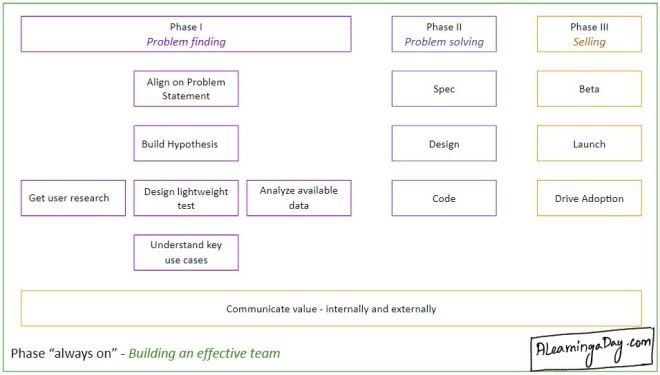
I say “clean version” because the reality looks something like this.

All this takes us back to where we began – “What are the skills required to be an IC Product Manager?” While the nature of their application varies depending on the type of product (B2B vs. B2C for instance), I think there are 4 core skills –

1) Problem finding: This is arguably both the most challenging and most important skill. We are educated in systems that teach us to solve problems, not find them. So, it takes time to unlearn our natural instinct to “dive in” and, instead, take a step back and really understand what problem we’re trying to solve and for whom.

2) Problem solving: Iterative problem solving is at the heard of the building process. This is when we aim to balance value with usability and feasibility. We always have fewer resources than we’d like and this skill helps us make the trade-offs necessary to get a product out of the door.

3) Selling: I’ve intentionally chosen to use the word “selling” instead of the more common “influencing” because selling is a massive part of the job. We are always selling the value of our product – internally, externally, upward, downward, and sideways. Realizing this was a game changer for me. The other powerful learning that accompanied this was realizing how much of the selling I did was written.

4) Building effective teams: Great products are built by teams. Great products aren’t always built by great teams. But, great teams are always at the heart of great product building experiences. We don’t always get to build great products (they require luck and timing among other factors) – but we can choose to always create great building experiences.

More on all of this to follow on future posts in the series.

Great book experiences and oh shit moments

The best leading indicator of a great non fiction book experience is not the source of the recommendation or its average rating on Amazon. It is the “oh shit – I really need to learn that” moment that precedes searching for it. The intensity of that desire to learn what the book is about is the best indicator I’ve found.

That is not how we normally look for books – the common approach I’ve observed is to ask externally and then check in internally to narrow the list down. For example, we might 1) ask around to see what folks we know recommend or skim some successful person’s reading list and 2) ask ourselves which of the books recommended sounds most interesting.

But, we get much better results when we flip the order. As is the case with many of life’s best experiences, the journey needs to start with an understanding of what we want to learn.

And, when the student is ready, the teacher appears.

PS: I came across a great articulation of this by Naval Ravikant – “just in time” vs. just in case.”

The Exec Q&A communication Jedi progression

Most folks respond to questions from an executive or folks who’ve got a higher ratio of impactful things to do/time than we do in the course of their work week. Handling Q&A, verbal or written, is a skill and I’ve become mindful of the following progression as I work on my own abilities to do so. Each stage builds on the other.

(1) Padawan learner: We are prompt. We answer questions promptly but tend to bury the answer in a blur of detail in our attempts to be complete.

(2) Jedi Knight: We deliver clarity over completeness. We answer the question first and provide just the amount of extra detail required for clarity.

(3) Jedi Master: We anticipate follow up questions. By putting ourselves in the shoes of the asker, our extra detail minimizes follow up questions and back-and-forth.

(4) Jedi Council: We see and answer the question behind the question. Awareness is the gift of competence and, at this level, we go beyond the question to the interests of the asker and, thus, to the question behind the question.

(5) Grandmaster: We become the one asking the questions. :-)

While this post has been focused on responding to executives/folks busier than us, I’ve come to appreciate the value this skill adds in life. Learning to listen for the interests of the asker, answer the question behind the question, and do so with clarity over completeness are very useful skills – both at work and at home.

Fast risks and slow risks

Albert Wenger, a venture capitalist and all around wonderful person, had a great post about fast risks and slow risks.

“People worry about many risks, but generally about the wrong ones. We tend to be obsessed with personal and societal risk that is “fast.” What will the Fed Reserve announce next? Should I trust Tesla’s auto steering? These are risks where outcomes are realized quickly. That’s why I call them fast risks. As it turns out though some of the biggest risks today are slow. Outcomes will not be realized for decades or longer. The impact of nutrition and exercise on health is an example of a slow risk. The mother of all slow risks is climate change.” 

I hadn’t thought of risks this way and now see this fast risk-slow risk dichotomy everywhere. It is fascinating to think of fast and slow risks from the perspective of our careers. Fast risks are the next big presentation, evaluation, interview or promotion cycle. But, a slow risk on the other hand is any deceleration of our rate of learning.

Albert goes on to observe – “I continue to be amazed by how much fear and anxiety people are experiencing daily based on fast risk. Will I get a good grade on my exam? Will this investment succeed or fail? These risks completely pale compared to the climate change risk of global upheaval of life as we know it, with the potential for tens of millions of human deaths.”

Powerful observation. It begs the question – how can we do a better job putting fast risks in perspective and ensure we’re working toward a better response to that “mother of all slow risks” – climate change?