Misusing the word feel

What percentage of our use of “I feel” is actually followed by a feeling?

When we use phrases like “I feel that” or “I feel like,” we communicate thoughts and judgments instead of feelings. The appropriate use of “I feel” would be to say “I feel hurt” or “I feel frustrated.” Even saying “I feel misunderstood” communicates a judgment.

There is great power in communicating feelings and needs because they enable us to focus on the issue at hand while ensuring we move past passing judgments about others. But, channeling that power requires us to use language the way it was intended.

And, the first step to that is to pay attention to the language we use.. and misuse.

My biggest reflection from this idea is the importance of clarity in our bid to communicate constructively. When I wrote out my theme – “Communicate constructively and with clarity” – I thought of these as two separate goals. But, they’re likely more related than I initially thought.

(H/T: Nonviolent Communication by Marshall Rosenberg)

Themes for 2019

I’ve seen many flavors of new year resolutions over the years – goals, systems, mantras, words. They’re all various implementations of the same principle and it is lovely to see the diversity. My chosen flavor over the past few years has been to pick 3 themes for the year.

In keeping with that, my 3 themes for 2019 are –

(1) Invest in my health: I didn’t have a personal health item in the last two years or so – but, the best time to fix the roof is when the sun is shining. So, I’ve identified two areas where I’d like to invest. The first is to work with a fitness trainer. The system goal here would be to get one physical training session in during every working week of the year.

The second is to continue investing in removing shallow interactions with technology – e.g. pointless checking of email, mindless surfing. I identified this as an area to work on in 2017, experimented plenty in 2018, and plan to continue to do so in 2019.

(2) Be a better partner: We have 2 young kids and have faced a few immigration related challenges in the past year and a half. While we’re hopeful for some light at the end of the tunnel in 2018, my wife has shouldered the bulk of the burden.

But, I foresee more opportunities to help shoulder more of the load in 2019. And I am looking forward to doing that.

(3) Communicate constructively and with clarity: I’ve written about the impact “Nonviolent Communication” (I wonder if “Constructive Communication” might have been a better name) had on me. I’ve also written a bunch about the impact of “The Pyramid Principle” on my writing at work over the past six months. I expect to re-read both books this month and hope to do a better job internalizing the lessons from them as I communicate this year.

As you can tell from my notes on these themes, they don’t always have a specific system goal or follow up action. The only commitment I make is to be deliberately re-commit every weekend. That act alone inspires plenty of incremental follow up action over the year.

So, here’s to plenty of incremental progress. And, here’s wishing you a lovely start to 2019.

Making the most of the opportunity to reset

The magic of the new year is that it is an opportunity for us to reset. As with other opportunities to reset, this is a magical opportunity filled with possibilities.

And, yet, we often muck it up. After a possibility filled January, we inevitably hit the trough of disappointment in February and let it stay that way till January the following year. We do this to ourselves by attempting to change too much too soon.

Instead of picking 1-3 things we deeply want to change and focusing on creating realistic systems to move the needle, we set transformational goals. Incremental change, after all, is not nearly as glamorous.

And, yet, if all we do is commit to 2 small changes starting January 1 that we stick to till December 31, we’ll actually achieve the transformation we seek.

Incremental change, it turns out, is incremental for the longest time… until it becomes life changing.

Paying attention

In his book, “The Geography of Bliss,” Eric Weiner had two lovely paragraphs on attention.

“Attention’ is an underrated word. It doesn’t get the… well, the attention it deserves. We pay homage to love, and happiness, and, God knows, productivity, but rarely do we have anything good to say about attention. We’re too busy, I suspect. Yet our lives are empty and meaningless without attention.

My two-year-old daughter fusses at my feet as I type these words. What does she want? My love? Yes, in a way, but what she really wants is my attention. Pure, undiluted attention. Children are expert at recognizing counterfeit attention. Perhaps love and attention are really the same thing. One can’t exist without the other.”

Doing one thing at a time is said to be the essence of Zen. When we use the phrase “pay attention,” we inadvertently remind ourselves of this idea and the fact that our attention is probably our most valuable resource.

As with any such valuable resource, it is on us to spend it wisely and well. There aren’t many better gifts we can give ourselves in the new year.

Spending time with the why and the how

As you can tell, we’re in the midst of a series of end of year tradition posts. Today’s tradition is one that accompanies the annual review – spending time with my why and how.

This exercise involves revisiting how I define my why/purpose/mission, how that translates into my values, my culture, my approach/strategy, and the 3 most important principles I live my life by.

I have two reflections from this iteration. First, while most of it is consistent to the first version from 5 years ago, every tweak reminds me of the fact that this is a “living document” that I need to re-commit to.

The second reflection is a reminder of the power of deliberate iteration. Each iteration pushes me to articulate this better by making it flow more logically and simply. And, the more logical and simple it is, the more easier it is to live by.

v2018 is now below and on the “About” page.


My personal mission/“why”/“purpose”/what I care about: Build active relationships with framily (close friends and family), learn, and contribute positively to the world.

Thus, my simplified 3 word version articulation of what I value is – people, learning, contribution

My culture or the norms with which I make decisions flows from what I value. I aspire to show up every day by being thoughtful about how my actions impact the people around me, learning focused, and hungry to contribute. Again, in 3 words that would be – thoughtful, learning focused, hungry.

I approach my days by aiming to do my best in my 4 roles – I think of this as my strategy or my “how.” :-) These roles are sorted in priority order:
1. Leader of self
2. A caring member of my framily
3. A learning focused teammate
4. A responsible contributor to my community, i.e., the world

3 principles that I attempt to live my life by are:
1. Integrity: Integrity is making and keep commitments. This means walking what I talk and talking what I walk.

2. Love/Growth: Love is the will to extend oneself for one’s own or another’s spiritual/mental growth. This means committing to to doing small things with extraordinary love and investing in continuous growth.

3. Half-scientist, half student: I aspire to live my life as a mix of scientist and student. This means engaging with life to consciously take the time to define problems, build hypotheses, experiment, and then learn. Life, after all, is simply a series of experiments and learning opportunities. 

The 10 question annual review – 2018 edition

The 10 question annual review is a end-of-year ALearningaDay tradition. Here’s how it works in 3 steps –

1. We carve an hour out over the next few days to “look back and look forward.” If we have past versions of the annual review, a recommended approach is to start the hour with a quick skim of past versions.

2. We work with 10 questions – with a suggested split of 4-6 between looking back and looking forward. 10 questions helps ensure we get to the depth required for insight while ensuring it doesn’t feel daunting. In case it helps, I have shared the 10 questions I use below and have a Google doc version if you’d like to download, edit, or print.

3. We archive our notes for next year – if we write out answers to the 10 questions, then we keep the sheets in a place we will be able to access next year. If we type it, we just need to make sure it is stored on Dropbox/G Drive or some place it will never get lost.

This annual review hour is one of my favorite parts of the year. I have annual reviews with responses to a version of these 10 questions from 2010 and looking back is an exercise that inspires humility, gratitude, and many a broad grin.

And, of course, doing this can be even more fun if you decide to share some of your notes with folks you care about/those who featured in your review.

I hope you’re able to try it this year and I look forward to hearing how it goes.


Part I – Look back

1. The Theme or peak moment – One word/line descriptions:
a) 2018 was the year of
b) 2019 will be the year of

Runners Up Theme or peak moment
a) 2018 was also the year of
b) 2019 will also be the year of

2. What were my 3 greatest successes/memories from 2018?

3. What were my 3 biggest lessons learnt from 2018?

4. How did 2018 fit in to the big picture/contribute to the big dreams in my life? (i.e. did any dots connect?)

Part II – Look forward

5. What are 3 themes I am thinking about for 2019? Are there any “process goals” I want to commit to?

6. What skills do I want to develop in 2019 (personal and professional)? What actions am I going to take to develop them?

7. Who/what were my biggest sources of inspiration/learning/energy this year? Are they high on my priority list to engage with (if they are people) or to do (if they were actions) for 2019?

8. Who were my personal/professional board of directors/advisors/sponsors this year? How do I plan to engage with them in 2019?

9. What have I got planned in 2019 to prioritize rest and renewal (e.g. holiday plans, weekend activities, hobbies)?

10. What are my 3 most important core beliefs or principles? And, are my goals for 2019 aligned with these core beliefs?

Declutter day

More than a decade ago, I listened to an audio book called “Stop Clutter from Stealing Your Life.” It was straight out of the “self help” play book and was the story of an obsessive hoarder’s struggle with the emotions that accompany decluttering.

I vividly remember pausing and looking around my room – a tiny student dorm room – and realizing that I had found a way to fill every nook and cranny with stuff. So, I put the book on loudspeaker and began decluttering.

In the next two or so hours, I removed about half of my stuff. Gone. Forever.

It felt fantastic.

Decluttering has since become a yearly ritual (half-yearly in good years :-)) that has impacted my life in a very positive way. Declutter day has since evolved to become a day to donate clothes / items I haven’t used in the last year.

While this exercise inspires gratitude, the beauty about regular decluttering is that it forces a higher awareness on what we purchase. Over time, we become better at identifying items that will, in all likelihood, end up in next year’s declutter pile. As a result, the number of items that are part of this decluttering ritual have gone down over time.

From experiencing the emotions of a hoarder a decade ago, I am grateful for the joys of relative minimalism. And, most importantly, I am grateful to David Elias and Mike Nelson for writing about their journey.

PS: In case you are considering reading the book, the suggestions in the book are likely pretty outdated (I vaguely remember old software programs being suggested) – but, the principles are evergreen.

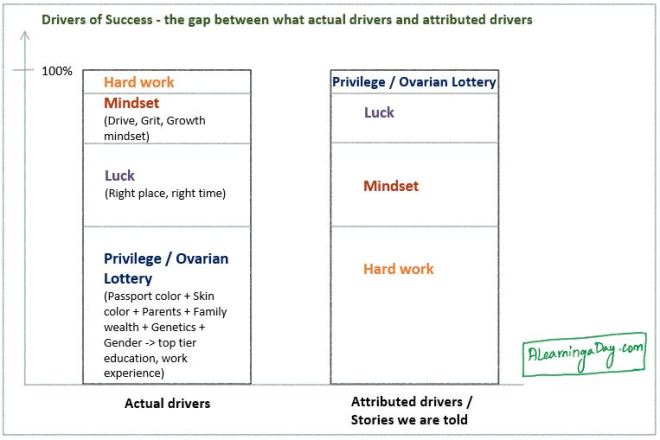
Drivers of success – the gap between actual drivers and what we read about

It is always amusing to see the gap between actual drivers of extrinsic success / wealth and attributed drivers. We have a need to believe in romantic stories of hard work and heroic mindset and are painted these pictures in the stories we are told.

In reality, however, the biggest driver of extrinsic success / wealth is privilege by a long shot. Luck and mindset matter – but, privilege is the platform on which it is built.

Acknowledging the real drivers is the first step to building systems that provide better access to opportunity to those who don’t have it.

Source/Note: This image is a working hypothesis/theory after years of obsessing about this topic, studying success, and writing about it..

The impact of “at this moment” in our self-talk

Fixed mindset self-talk: “This is who I am and this is what I am capable of.”

Growth mindset self-talk: “This is who I am and this is what I am capable of at this moment.”

(Feel free to replace “I am” with “you are”)

It often amazes me how habitually adding or removing a few words from our self-talk can have a lasting impact on how we view the world and respond to it.

Ready Player One

I finally got to reading “Ready Player One” over the last few days. It was a fascinating read – one for anyone who wants to geek out on some fun science fiction. I had two takeaways from the experience of reading the book.

The first was a quote from the creator of the virtual universe in the book – “I created the OASIS because I never felt at home in the real world. I didn’t know how to connect with the people there. I was afraid, for all my life. Right up until I knew it was ending. That was when I realized, as terrifying and painful as reality can be, it’s also the only place where you can find true happiness. Because reality is real.”

It was a reminder on the importance of thinking through the second and third order effects of technology we build. Ready Player One is set in a dystopian post climate change, post virtual reality world. Humans spend most of their lives attached to their VR devices – an idea that can’t be dismissed as improbable given what we’re seeing with device addiction today.

The second was a nudge to read more fiction in 2019. I hope to make that happen. And, I’m also in the market for recommendations – so, if you have a favorite fiction work of fiction you’d recommend, I’d love to hear it (rohan at rohanrajiv dot com).