
Frederic Tudor and Ice

Frederic Tudor, a young man from a rich family in Boston, once visited the Carribean (estd year – 1800). He was then seized by an idea – how about shipping New England ice to the Carribean?

After many attempts of shipping ice over and gradually overcoming challenges of transportation and storage (blocks of ice melt slowly so it was possible to move them even without too many innovations), he slowly began to stir up some demand. People in the Caribbean began developing an appetite for iced drinks. While Tudor nearly went bankrupt through the process, his fortunes changed by the end and he ended up a multi-millionaire.

But, this started a unique shift as all previous global trade had been about moving materials from warm places (abundant solar energy) to colder ones – spices, food, etc. The ice trade became very successful and the ice barons of New England became rich.

It is this ice that led to the growth of Chicago. While Chicago became a transportation hub thanks to some excellent engineering and building of railroads, it became the hub of the meat industry due to refrigerated meat. How that happened is coming up next week…

A man who has drank his drinks cold at the same expense for one week can never be presented with them warm again. – Frederick Tudor :)


Source and thanks to: How we got to now by Steven Johnson

(This story and quote is part of “The 200 words project.” I aim to synthesize a story from a book (and, occasionally a blog or article) I’ve read within 200 words consecutive Sundays for around 45 weeks of the year.)
Paradigm shifts

All was peaceful one Sunday morning on a subway in New York until a man and his children entered. The children were yelling back and forth, throwing things, even grabbing people’s papers. The, however, man simply sat down and closed his eyes. Irritated and after unusual patience and restraint, Stephen Covey finally turned to the man and said – “Sir, your children are really disturbing a lot of people. I wonder if you couldn’t control them a little more?”

The man lifted his gaze, suddenly conscious, and said softly, ‘Oh, you’re right. I guess I should do something about it. We just came from the hospital where their mother died about an hour ago. I don’t know what to think, and I guess they don’t know how to handle it either.’

We can all imagine how Stephen felt that moment – his paradigm shifted. He felt the man’s pain and saw everything differently.

It felt like an appropriate story for the new year – we might be able to make small changes in our life by shifting our attitudes and behaviors. But, if we want to make significant leaps, we need to shift our paradigms or how we see the world.

In the words of Thoreau, ‘For every thousand hacking at the leaves of evil, there is one striking at the root.’ We can only achieve quantum improvements in our lives as we quit hacking at the leaves of attitude and behavior and get to work on the root, the paradigms from which our attitudes and behaviors flow. – Stephen Covey


Source and thanks to: The 7 Habits of Highly Effective People by Stephen Covey

(This story and quote is part of “The 200 words project.” I aim to synthesize a story from a book/blog/article I’ve read within 200 words consecutive Sundays for around 45 weeks of the year.)

Mentorship and grit – The 200 words project

Venture capitalist and blogger Tom Tunguz nicely summarized Robert Greene’s book “Mastery” by identifying two common paths to mastery – mentorship and grit.

Leonardo da Vinci’s story captures both ideas. Leonardo was born out of wedlock and was prohibited from attending school. His father, a notary, had access to a large supply of paper which was a rare commodity at the time. So, Leonardo would walk through the forests of Vinci and draw. Over time, he built an excellent body of work that led to Andrea Del Verrochio to hire him as an apprentice. Leonardo would go on to learn many different sciences under his mentor and become a master artist.

As he was still scorned because of his birth, Leonardo demonstrated grit as he pursued hundreds of inventions including helicopters, parachutes, and a giant crossbow. This combination of an education from a leading expert and grit led Leonardo da Vinci to greatness.

Tying it into his work with entrepreneurs, Tom observed – “I suspect all great founders and CEOs are supported by a network of great mentors. Most of these mentorship relationships are hidden in the shadows, not often mentioned. But that lack of visibility belies their critical importance.”

A few times in my life, I have been privileged to have amazing mentors and all of those experiences share something in common. Those people helped me learn something about myself that I couldn’t have without them: they pushed me to start a business, they challenged me to carry a quota, they offered me an opportunity in venture capital. – Tom Tunguz


Source and thanks to: Tom Tunguz’s blog, Mastery by Robert Greene

Laundry Love – The 200 words project

Ventura is a beautiful beach city just north of Los Angeles and home to Greg Russinger.  Greg was very passionate about engaging people in his city to bring relief to those in need. One day while walking with T-Bone, one of his many friends from the street, Greg asked him, “Is there anything I can do to help you with your daily needs?” The response was instant, “clean clothes”.

Clean clothes would remove barriers to human interaction and increase self-esteem, he explained. So, Greg approached a local Laundromat and requested permission to allow him and a group of friends to come in and sponsor washes for those living under the poverty line. Thus, Laundry Love was born.

Laundry love soon gained momentum in Ventura and has now touched over 450,000 people. All of this happened because Greg asked T-Bone what would help instead of assuming what might be useful. There is something powerful about spending time in the environment of the people you hope to reach with your product or service and listening to the ones you hope to serve.

If I had clean clothes I think people would treat me like a human being. – T-Bone


Source and thanks to: Good Idea, Now What? By Charles Lee

(The 200 words project involves sharing a story from a book/blog/article I’ve read within 200 words)

Peak – a synthesis – The 200 words project

(continued from parts 1, 2, 3, 4, 5, 6) – This is a synthesis of the series of posts from the book “Peak” by Anders Ericsson.

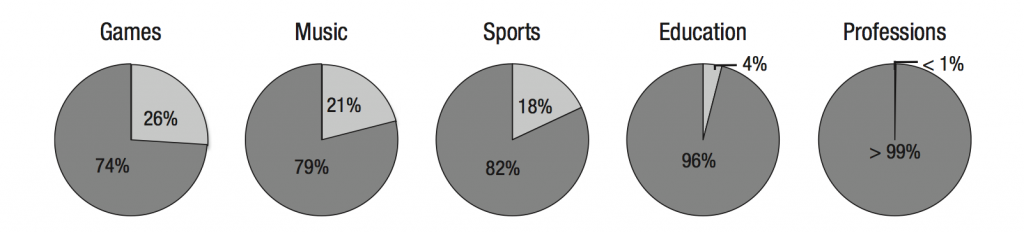
Brooke Macnamara, David Hambrick, and Frederick Oswald reviewed a large number of studies since Anders Ericsson’s seminal 1993 paper. They found that a sheer amount of deliberate practice does not explain all variation in expert performance. They also found that it varies by context – more applicable for more predictable activities like games and sports.

deliberate-practice-variation(light gray = explained variation, dark gray = unexplained)

While this can seem discouraging, it ties into an intuitive idea – deliberate practice alone doesn’t explain all expert performance. There are many other personal and environment factors that interact with each other in making experts. However, “innate talent” is not one such factor.

What does this all mean for us? First, stop using innate talent as an excuse. Second, where possible, actively find ways to integrate the principles of deliberate practice into how we teach and learn – take the help of a coach and push ourselves beyond our comfort zone. For example, we could use regular meetings to try out new ideas and practice taking initiative or test our presentation skills.

At its core, deliberate practice is about learning how to learn and to approach what we do as enthusiastic and committed students. So, here’s to that.

This is not a pie chart (above) of talent vs. practice. All traits, including the ability to deliberately practice, involve a mix of nature and nurture. In fact, there is no such thing as innate talent. That’s a myth that is constantly perpetuated, despite the fact that most psychologists recognize that all skills require practice and support for their development– even though there are certainly genetic influences. – Scott Barry Kaufmann


Source and thanks to: Peak by Anders Ericsson, Practice alone does not make perfect – Scientific American

(The 200 words project involves sharing a story from a book/blog/article I’ve read within 200 words)

Ineffective Lectures – The 200 words project

(continued from parts 1, 2, 3, 4, 5)
Anders Ericsson’s research on deliberate practice has been extensively in training elite athletes and musicians. But, what about in universities?

Nobel prize winning Physicist Carl Weiman from Stanford university collaborated with a Post Doc and a Graduate student from the University of British Columbia to experiment with redesigning a Physics course. Weiman believed that Professor centered lectures in universities have been ineffective for centuries and he has been on a quest to make things better.

For this course, Weiman and team focused on teaching skills versus disseminating knowledge. So, they redesigned the class to mimic a fast-paced athletic training session centered around the students. They broke a lecture down into various concepts. Each concept had a series of multiple choice questions that students answered in groups using clickers. They got immediate feedback followed by a short instructor led debrief and then moved to the next concept. The results? A 20 point improvement in attendance and a 15 point improvement in scores.

Weiman conducted the experimented both in UBC and the University of Boulder and both universities have begun redesigning courses to offer this format. How can we apply this in how we teach and learn?

Cognitive scientists have found that learning only happens when you have this intense engagement. It’s almost certainly the case that lectures have been ineffective for centuries. But now we’ve figured out a better way to teach” that makes students an active participant in the process. – Prof Carl Weiman


Source and thanks to: Peak by Anders Ericsson, Carl Weiman’s paper on the experiment, ScienceMag’s article
We’ve spent 6 weeks with Prof Ericsson’s work on deliberate practice. Next week will involve a final post providing what might seem like a counter point to his work (but isn’t – spoiler).. And what we might take away from all of this.

The dangers of innate talent – The 200 words project

(continued from parts 1, 2, 3, 4).
In the many examples mentioned in past weeks, we’ve seen that “talent” is developed by deliberate practice. If you were wondering if it applied to sports, Malcolm Gladwell’s book “Outliers” starts with an interesting insight into how sports talent is picked. Gladwell analyzed data on professional athletes to show that the overwhelming majority are born in the second half of the year. Since this means they fall in the older half of the class, they tend to be physically better developed in their age group when they are young. This gets them selected for intensive practice and the rest is history.

Ericsson’s research supports this – for some sports, one could speculate about some minimum talent requirements – e.g. height and body size. Beyond that, however, practice seems to trump everything else. We also have strong reason to believe that early practice shapes our physical and mental attributes. So, we might be born with a preference for music over sports, for example. But, that counts for little if we don’t practice it.

And, therein lies the dark side of the innate talent hypothesis – believing in innate talent, we tend to write kids off before they have a chance to practice.

Nobody questions that Mozart’s achievements were extraordinary compared with those of his contemporaries. What’s often forgotten, however, is that his development was equally exceptional for his time. His musical tutelage started before he was four years old, and his father, also a skilled composer, was a famous music teacher and had written one of the first books on violin instruction. Like other world-class performers, Mozart was not born an expert—he became one. – Anders Ericsson


Source and thanks to: Peak by Anders Ericsson

The case against innate talent – The 200 words project

(continued from parts 1, 2, 3).
Researcher K Anders Ericsson has researched expert performance for the past 30+ years. In every case, his analysis has revealed one thread – every innate talent/prodigy story can be deconstructed to reveal “deliberate practice.”

Deliberate practice is practice that is typically guided by a coach that has specific goals, involves continuous stretching of the body and mind and, by nature, is hard. If you’ve felt the challenge when learning a new skill (whether it is a tennis swing or the guitar) from a coach, you’ve tasted deliberate practice. And, behind every great prodigy such as a Mozart or a Tiger Woods, there was typically a coach (in their case, dad) who developed their skills early. These practice techniques have been refined over time to the delight of competitive parents globally. Search for “child prodigy” on YouTube and you’ll notice the increase in the number of child prodigies over the years.

Often, kids with innate talent – be it IQ’s in mental tasks or better physical attributes in physical tasks – may get a head start. But, it doesn’t count for much without deliberate practice.

If innate talent isn’t everything we thought, what are the dangers of the belief?

While there is a huge benefit to starting young, it is only too late if the field doesn’t allow for participation based on age. Today’s octogenarian athletes are fitter than ever before. In 2015, Don Pellman became the first 100 year old to run a 100 meters in less than 27 seconds. – Anders Ericsson paraphrased


Source and thanks to: Peak by Anders Ericsson, The deliberate practice research paper

(The 200 words project involves sharing a story from a book/blog/article I’ve read within 200 words)

Deliberate practice minus the 10,000 hour rule – The 200 words project

(continued from parts 1, 2).
The Outliers by Malcolm Gladwell popularized the idea of 10,000 hours required to become an expert . There were, however, two issues with the 10,000 hour rule.

First, there is no magic number for the number of hours required to become an expert. It varies by field. 10,000 hours could be a good approximation but nothing more than that. Second and more important, experience does not result in expertise. Spending thousands of hours “practicing” golf by yourself will not make you an expert. Spending all those hours in “deliberate practice” under an expert coach is what you will need. It isn’t about the time you spend – it is about what you do with it.

This, then, leads us back to innate talent. Ericsson conducted years of research with expert violin players in Germany only to find that there was no visible link between innate talent and the performance of the best violinists. Instead, the two predictors were (you guessed it) – hours and intensity of practice.

If this is the case, perhaps there is a case to be made against the idea of innate talent?

People always said I had a natural swing. They thought I wasn’t a hard worker. But when I was young, I’d play and practice all day, then practice more at night by my car’s headlights. My hands bled. Nobody worked harder at golf than I did. – Sam Snead – once called “the best natural player ever” from Anders’ article on HBR


Source and thanks to: Peak by Anders Ericsson

(The 200 words project involves sharing a story from a book/blog/article I’ve read within 200 words)

Testing for a relationship between innate talent and expertise – The 200 words project

(continued from part 1)
We measure innate talent in the mind with “IQ”. IQ had no relation with the London taxi drivers who passed the qualification test.

While the average IQ of scientists is higher than the average person, there is no correlation between IQ and scientific productivity either. Richard Feynman, one of the most brilliant physicists of all time, didn’t make it to the top 5%. Researchers have suggested that the minimum requirements for performing capably as a scientist is around 110 (top 25%). Beyond that, there is little or no additional benefit.

Similarly, dental students’ early success was found to be related to their existing level of visuospatial ability. But again, this trend disappeared with residents.

And, a study of 91 fifth grade students who were given piano instruction for 6 months found that students with higher IQs performed better at the end of the 6 months. However, as years of study increased, the correlation between IQ and music performance got smaller and smaller.This finding is similar to other studies of this nature.

If there isn’t an observable link between “innate talent” and expertise, do we explain expertise with the 10,000 hour rule?

Coming up next week.

It is unclear if the IQ requirement in research is for one to succeed as a scientist or to do the writing and admission tests required to get a PhD. – Anders Ericsson


Source and thanks to: Peak by Anders Ericsson and Robert Pool

(The 200 words project involves sharing a story from a book/blog/article I’ve read within 200 words)