Eddie Vedder’s typewriters – The 200 words project

Here’s this week’s 200 word idea thanks to Twofeetthick.com, Lifehacker.com, Seth’s blog.

Computers are obviously the most popular way to write, but star Pearl Jam singer and songwriter Eddie Vedder still prefers to use a typewriter.

As Vedder notes – “I like them because you can write on them late at night, depending on what you’re fortifying yourself with, and the next morning you can still figure what you wrote. There are times where I would keep three typewriters on a table, and I’d have three complete thoughts going. With computers, you make folders, files – I don’t know about those things… And a typewriter keeps your hands strong for guitar playing.”

As Seth Godin notes, Isaac Asimov wrote more than 400 books, on a manual typewriter, with no access to modern productivity tools. Would they would have helped him write 400 more?

Too often, we get so caught up in maximizing the benefits of technology that we lose sight of what already works for us. There’s nothing stopping Vedder from learning about computers, but he recognizes that it’s not important; his core task of writing a song is done well enough on a typewriter. So he sticks with it.
Source and thanks to:

Eddie Vedder ToolsSource and thanks to: www.EBSketchin.com

‘I wonder how much productivity comes from new techniques, and how much comes from merely getting sick of non-productivity and deciding to do something that matters, right now.’ | Seth Godin
The first book he finished – The 200 words project

Here’s this week’s 200 word idea thanks to 99u.com, James Clear on Entrepreneur.com.

Steven Pressfield’s most famous work, The Legend of Bagger Vance, was a best-selling novel that became a motion picture starring Matt Damon, Will Smith, and Charlize Theron. But, if you ask Pressfield, he will say that his most important book was one that you never heard of: the first book he finished.

“I never did find a buyer for the book. Or the next one, either. It was ten years before I got the first check for something I had written and ten more before The Legend of Bagger Vance was actually published. But that moment when I first hit the keys to spell out THE END was so epochal. I remember rolling the last page out and adding it to the stack that was the finished manuscript. Nobody knew I was done. Nobody cared. But I knew. I felt like a dragon I’d been fighting all my life had just dropped dead at my feet and gasped out its last sulfuric breath.”

Here’s to finishing what we start..

The first book he finishedSource and thanks to: www.EBSketchin.com

‘Finish something. Anything. Stop researching, planning, and preparing to do the work and just do the work. You don’t need to set the world on fire with your first try. You just need to prove to yourself that you have what it takes to produce something.’ | James Clear

Staples’ caution and optimism – The 200 words project

Here’s this week’s 200 word idea from Decisive by Chip Heath and Dan Heath..

Researchers studied companies and their moves in 3 big recessions – 1980-1982, 1990-91, 2000-02. Their moves were broadly focused either on “prevention” (e.g. job cuts) or “promotion” (e.g. investment in new products). They found that neither approach, when used too much, was successful. While prevention focused companies were pessimistic, promotion focused companies were regularly naive and steeped in denial of the gravity of the crisis.

The most successful companies were “multi-trackers” or companies that combined both approaches. For example, in 2000, Staples closed under-performing stores but hired 10% new employees to roll out a new high end service for customers. Office Depot, on the other hand, just cut 6% of workforce and made no comparable investments. 3 years later, Staples was 20% more profitable. It had cut out costs to become efficient but still invested.

AND, not OR, turned out to be good corporate strategy. When faced with cutting 5% off a budget, better to consider cutting 8% in unnecessary areas and spending 3% on future investments.

This applies just as well to our lives, of course – we make our best decisions when we combine caution with optimism.

Optimism CautionSource and thanks to: www.EBSketchin.com

‘A study by Kathy Eisenhardt at Stanford University found that the Silicon Valley firms that were the quickest to respond to strategic changes — and respond with a strategy that addressed the changes in their industry — were firms where top leaders considered multiple alternatives at the same time.’ | Chip Heath and Dan Heath 

The Freaky Friday management technique – The 200 words project

Here’s this week’s 200 word idea from The Hard Thing about Hard Things by Ben Horowitz..

At Opsware, Ben Horowitz’s Sales Engineering department constantly complained that the Customer Support didn’t reply to issues on time. The Customer Support department, on the other hand, said Sales Engineering didn’t qualify bugs and gave every bug top priority making it impossible to prioritize. The two functions hated each other.

Inspired by the movie “Freaky Friday” where a mother and daughter find their minds switched and begin to understand each other’s point of view, Ben Horowitz called up the two department heads and informed them that he was switching their roles.

At first, they reacted in shock and annoyance. But, within a week, they diagnosed the set of core issues and implemented a set of processes that enabled the teams to work well with each other. Until the 1.6 billion dollar sale to HP, Ben observed that the best two divisions that worked with each other were sales engineering and customer support – all thanks to Freaky Friday.

Freaky Friday management techniqueSource and thanks to: www.EBSketchin.com

‘Before you criticize someone, you should walk a mile in their shoes. That way when you criticize them, you are a mile away from them and you have their shoes.’ | Jack Handey :-D

Passwords, cues, and a changed life – The 200 words project

Here’s this week’s 200 word idea thanks Mauricio Estrella’s great post on Medium..

A few months after a bad divorce, depressed designer Mauricio found himself frustrated by his Microsoft Exchange server which required him to change his password every 30 days. He then stumbled on a simple idea – he would use these passwords as cues to change his life.

So, his first password became – Forgive@h3r. One month later, it became Quit@smoking4ever. The daily act of typing his password in resulted in him quitting smoking. Next month, it was Save4trip@thailand. 3 months later, he was in Thailand.

A couple of small mis-steps aside, he was soon on a roll – his passwords went from Sleep@before12, Facetime2mom@sunday to Ask@her4date, MovE@togeth3r and Save4@ring. In 2 years, he turned his life around, and happily announced his “Save4@ring” password worked too. She said yes.

Small cues -> Big changes. Thanks for sharing the inspiration, Mauricio.

PS: On a related note, while you are thinking about passwords, please do consider two factor authentication. More here.

She said yes“She said yes” – Mauricio Estrella

‘I still await very anxiously each month so I can change my password into a phrase that motivates me to focus on something that I need to get done.’ | Mauricio Estrella

The Endymion – The 200 words project

Here’s this week’s 200 word idea from the Mastery by Robert Greene..

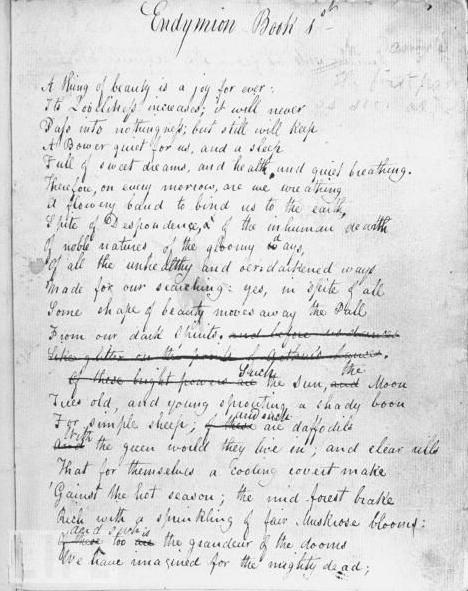
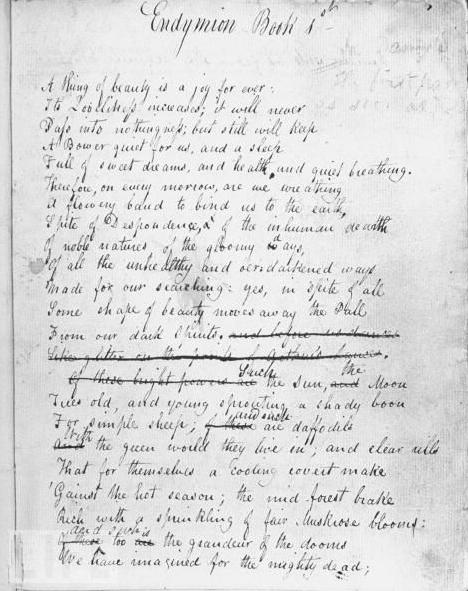
John Keats was 15 when both his parents passed away. He was taken out of school and enrolled to apprentice for a surgeon. Keats, however, had developed a love for poetry. So, he read as many great poems as possible during his off hours at the school library. Soon, he began writing poems in the style of these greats until he decided to quit medicine and write his own poetry.

To compete his self-apprenticeship, he decided he would write a 4000 line poem on the Greek legend Endymion. He committed to writing 50 lines a day. 75% of the way, he came to hate the poem, his flowery language, and overwriting. But, by the end of The Endymion, he had learnt to write and edit at great speed and he had hit upon a style that suited him and met his own high standards. Also, he had overcome writer’s block forever.

With these lessons, Keats went on to produce some of the finest poems in the English language in 1818 and 1819 until he took gravely ill. It was perhaps the most productive 2 years of writing in the history of western literature – all thanks to the Endymion leap..

EndymionJohn Keats’ original draft of The Endymion – source and thanks to: Wikipedia, Time.com

‘In Endymion, I leaped headlong into the sea and became better acquainted with the soundings, the quick-sands and the rocks than if I had stayed upon the green shore and took tea and comfortable advice.’ | John Keats

The low budget shark – The 200 words project

Here’s this week’s 200 word idea from Things a Little Bird Told Me by Biz Stone

When Steven Spielberg was shooting the movie “Jaws,” he wanted to create a realistic model of a shark so they could film it attacking people for all the scary scenes. However, this was going to be very expensive and beyond their budget. Faced with this constraint, Spielberg had a new low budget idea – shoot it from the point of view of the shark under water.

And, guess what? Way scarier!

Similarly, Herman Houser, whose company manufactures ARM chips that power a large proportion of the world’s cell phones, said the chips arose out of a computer chip making project where he gave his engineers no resources. They ended up creating a low cost low powered chip that didn’t really work for computers but was perfect for cell phones.

Twitter’s co-founders channeled constraints at a time when there were seemingly no constraints to publishing online. Twitter introduced a 140 character limit that clearly worked. And, lest we forget, Twitter was founded as a result of a two week hackathon.

Constraints
Source and thanks to: www.EBSketchin.com

‘The response to a general question like “how was your day” may be boring but a constrained question like “how was your lunch with Steve” will always be more interesting.’ | Biz Stone

Zoom out, Zoom in and Speedo Fastskin – The 200 words project

Here’s this week’s 200 word idea from Decisive by Chip Heath and Dan Heath..

Speedo hired Fiona Fairhurst in the 90’s with one objective – design a swimsuit to make swimmers faster.

Instead of zooming into the current version of swimsuits, she began “zooming out” and studying things that go really fast in the water. A breakthrough moment was when she touched the skin of a 9 foot shark at London’s Natural History museum . It was exceedingly rough/sharp when she ran her fingers in one direction and smooth on the other. This roughness reduced drag and increased thrust. So, she found a fabric that had a good similarity.

Then, taking inspiration from a torpedo, she designed a suit that covered the whole body. Olympic medal winner Jenny Thompson hated it until her coach pointed out she was close to her world record pace despite not diving in – by compressing all lumps and bumps, the suit gave swimmers a torpedo-like effect.

Speedo had trouble getting the suit approved as the FINA said it wasn’t “aesthetic.” They believed people liked the pool because of the skin on show. Eventually, 83% of the winners wore the “Fastskin” swimsuit at the Sydney Olympics. The advantage become so big that some fabrics were banned in 2010.

Zoom in Zoom out

Source and thanks to: www.EBSketchin.com

‘If I’m going to look at things fast, I look at everything that goes fast and mechanism that makes things go fast – Boats, torpedoes, animals etc.’ | Fiona Fairhurst

 Appeal to purpose – The 200 words project

Here’s this week’s 200 word idea from Give and Take by Adam Grant.

3 different messages/appeals were displayed in various hospital bathrooms to encourage people to use soap and hand sanitizers –
1. Hand hygiene saves you (appeal to self-interest)
2. Hand hygiene is good for the patient (appeal to purpose)
3. Gel in, wash out (catchy messaging)

The research team then weighed the amount of sanitizer used and found that the purpose message worked the best by far.

A similar study with university office workers, who worked on collecting alumni donations, showed that a 5 minute session every morning that shared stories about students who benefited from alumni donation scholarship doubled the number of weekly pledges they collected.

So, if we’re looking to appeal to people to change behavior, perhaps we could consider an appeal to purpose of the change.

Appeal to Purpose
Source and thanks to: www.EBSketchin.com

‘Great minds have purpose, others have wishes. Little minds are tamed and subdued by misfortunes; but great minds rise above them.’ | Washington Irving

Lovelace nurses and identity – The 200 words project

Here’s this week’s 200 word idea from Switch by Chip Heath and Dan Heath..

The Lovelace hospital in Albuquerque faced an 18-30% turnover of nurses. This meant a high staff replacement cost, low morale, and high risk to patients. Kathleen Davis, VP of Operations, decided the way forward was by “Appreciative inquiry” – to change the organization by figuring out what’s working. So, with consultant Susan Wood, they interviewed 100 about what was satisfying in their jobs.

Most nurses were feeling beaten down and overworked but their tone changed when asked what was working – they were all very loyal to nursing. They loved being ‘nurses’ – it was their identity.

So, Lovelace’s management introduced “Extraordinary nursing” awards, changed their onboarding programs to focus on building this identity, and conducted workshops to help nurses improve their nursing skills. Nurse satisfaction scores increased. The results followed – they improved retention by 13% and patient satisfaction with nursing went up.

Here’s to testing appreciative inquiry in our lives as well..

Appreciative inquiry
Source and thanks to: www.EBSketchin.com

‘To discover why nurses choose to stay at Lovelace – and to gather insight in such a way that the process in and of itself contributes positivity and minimizes negativity.’ | The purpose statement of the Lovelace inquiry statement